You may know the answer to a WAEC question and still lose marks because you spent too much time getting there.
This happens to many Nigerian students. They practise their subjects, understand important topics and even score well when using WAEC past questions, but their performance changes when a clock is running.
The problem is often not a lack of knowledge. It can be poor WAEC time management.
If you regularly run out of time during practice tests, spend several minutes on one difficult question or leave questions unanswered because the clock reaches zero, you need to train your speed alongside your knowledge.
The good news is that speed can be improved through deliberate practice.
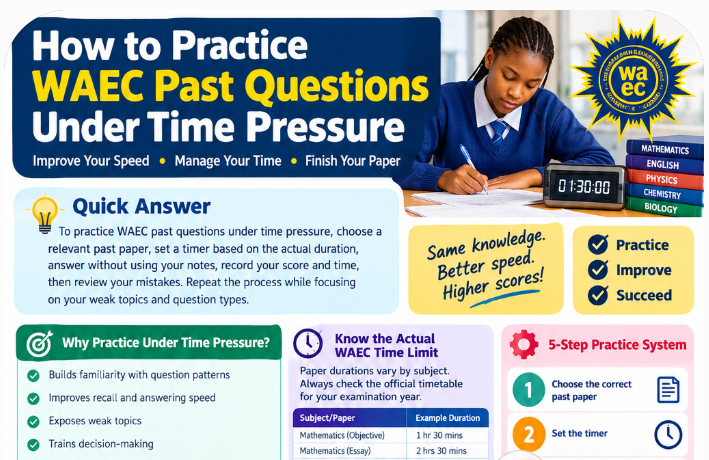
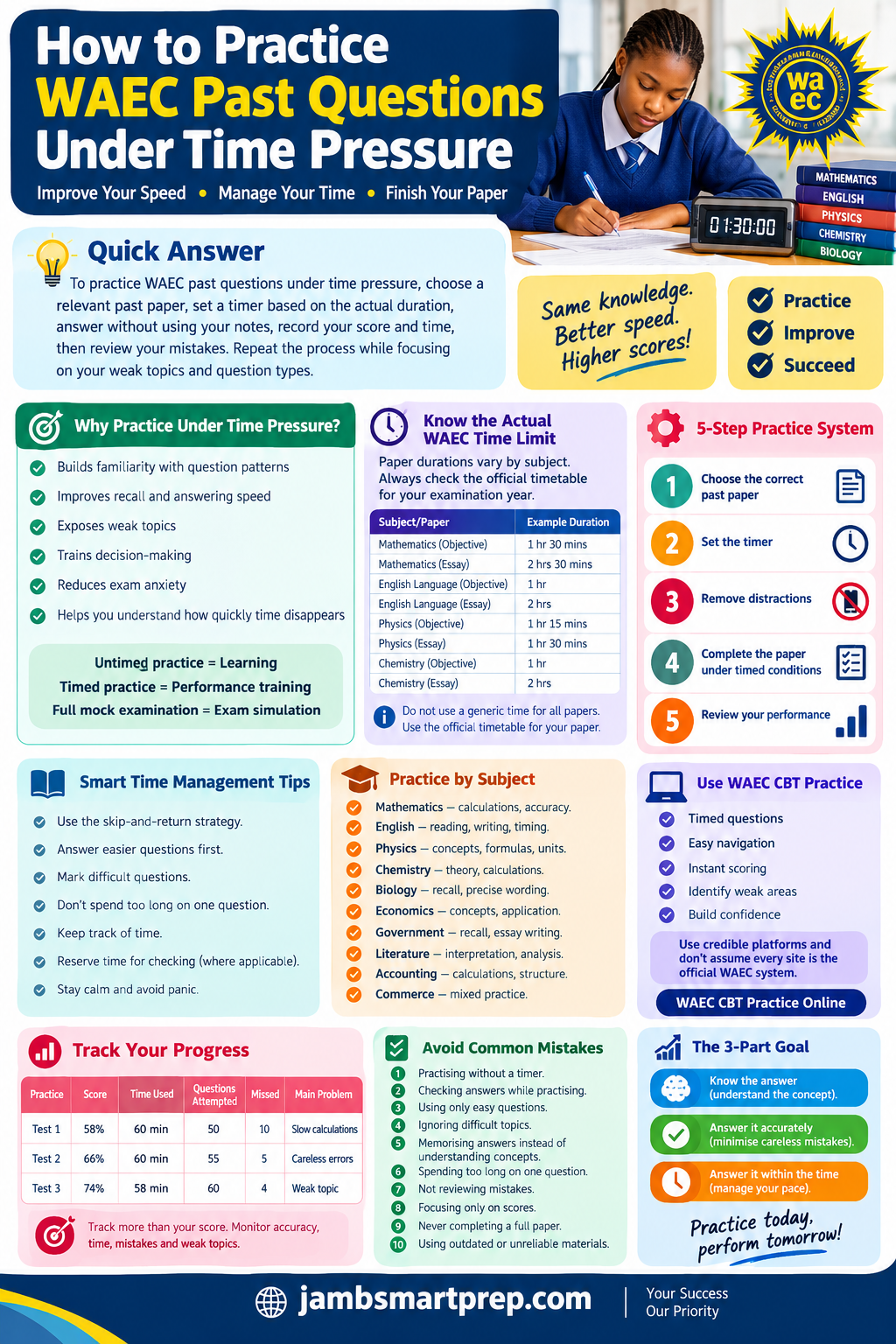
The best way to practice WAEC past questions under time pressure is to choose a relevant past paper, set a timer based on the actual duration of the paper, answer without using your notes, record your score and completion time, and analyse where you lost time. You then repeat the process while working on the specific topics and question types that slow you down.
This guide explains how to turn ordinary WAEC past questions and answers into realistic timed practice sessions, whether you are preparing for Mathematics, English Language, Physics, Chemistry, Biology, Economics, Government, Accounting or another WASSCE subject.
Why Should You Practice WAEC Past Questions Under Time Pressure?
Practising WAEC past questions is useful because it allows you to become familiar with the types of questions you may encounter and test whether you understand what you have studied.
However, answering questions without a time limit does not fully prepare you for examination conditions.
Imagine that you have 50 Mathematics questions to answer. If you give yourself three hours at home, you may eventually solve most of them.
That does not necessarily mean you are ready for the examination.
In the actual examination, you have a fixed amount of time. You must read, think, calculate, write or select your answers and make decisions while the clock continues moving.
This is why timed WAEC practice should become part of your preparation.
Untimed practice is for learning
When you are learning a new topic, it is reasonable to take your time.
You may need to:
- Read your notes.
- Study an example.
- Work through a difficult calculation.
- Check a formula.
- Understand why an answer is correct.
- Ask your teacher for an explanation.
There is nothing wrong with this.
At this stage, your priority is understanding.
Timed practice is for performance training
Once you understand the topic, introduce a timer.
Now you are asking a different question:
Can I demonstrate what I know accurately within the time available?
This is where WAEC exam speed becomes important.
Full mock examinations are for simulation
A full mock test takes timed practice a step further.
Instead of answering 20 questions from one topic, you attempt a complete paper under conditions that are as close as reasonably possible to the real examination.
The three stages therefore work together:
Untimed practice → learning
Timed practice → performance training
Full mock examination → exam simulation
Students who use all three approaches have a better way of identifying whether their problem is knowledge, speed, accuracy or decision-making.
Know the Actual WAEC Time Limit Before You Start Practising
One mistake students make when preparing for WAEC is assuming that every paper has the same duration.
It does not.
The time allowed depends on the subject and paper.
For example, the official 2026 WASSCE timetable for Nigeria gives General Mathematics Paper 1 an examination duration of 1 hour 30 minutes and Paper 2 a duration of 2 hours 30 minutes. English Language Paper 1 is 1 hour, while Paper 2 is 2 hours. Physics Paper 1 is 1 hour 15 minutes and Paper 2 is 1 hour 30 minutes. Chemistry Paper 1 is 1 hour and Paper 2 is 2 hours.
This matters because your practice timer should reflect the paper you are preparing for.
Examples of WAEC paper durations
| Subject/Paper | Example duration |
|---|---|
| General Mathematics Objective | 1 hour 30 minutes |
| General Mathematics Essay | 2 hours 30 minutes |
| English Language Objective | 1 hour |
| English Language Essay | 2 hours |
| Physics Objective | 1 hour 15 minutes |
| Physics Essay | 1 hour 30 minutes |
| Chemistry Objective | 1 hour |
| Chemistry Essay | 2 hours |
These examples are from the 2026 Nigeria timetable. Always check the official timetable for your own examination year and paper because examination arrangements can change.
Do not treat a practice timing strategy as an official WAEC rule. Your practice plan is something you use to train yourself. The official examination duration is determined by WAEC.
The Best Way to Practice WAEC Past Questions Under Time Pressure
A simple five-step system can transform the way you use past questions.
Step 1: Choose the correct past paper
Select questions relevant to your subject, syllabus and examination format.
Step 2: Set the timer
Use a realistic duration based on the paper you are practising.
Step 3: Remove distractions
Put your phone away and stop using your textbook, notes or search engines.
Step 4: Complete the paper under timed conditions
Answer the questions as though you were sitting for the actual examination.
Step 5: Review your performance
Do not look only at your score. Record how long you spent, which questions caused problems and where you lost time.
This fifth step is extremely important.
A student who repeatedly scores 55% but never analyses the reason for the mistakes may remain at 55%.
A student who discovers that most of the lost marks come from two weak topics can target those topics and improve much faster.
Choose WAEC Past Questions That Match Your Examination
Not all past-question practice sessions serve the same purpose.
You can use past questions in several ways.
Topic practice
You select questions from one topic.
For example, a Mathematics student might practise:
- Algebra
- Simultaneous equations
- Trigonometry
- Statistics
- Probability
- Geometry
Topic practice is particularly useful when you are still learning the syllabus.
Yearly past-paper practice
You select a complete paper from a particular examination year.
This gives you a broader mixture of questions.
Mixed practice
You combine questions from different topics.
This tests whether you can identify the correct method without being told which topic the question belongs to.
Full-paper practice
You attempt a complete paper under a fixed time limit.
This is the strongest form of exam simulation.
Which should you use?
Use all four, but at different stages.
If you are weak in a topic, start with topic practice.
When your understanding improves, move to mixed practice.
As the examination approaches, increase full-paper timed practice.
How to Use WAEC Past Questions for Exam Preparation
Past questions should not be treated as a collection of answers to memorise.
Their greatest value comes from showing you what you understand and what you do not understand.
Suppose you answer 40 Biology questions and get 30 correct.
Your first reaction may be:
“I scored 75%.”
That is useful, but it is not enough.
Ask additional questions:
- Which 10 questions did I miss?
- Did I misunderstand the questions?
- Did I forget facts?
- Did I confuse two concepts?
- Did I choose the wrong option because I rushed?
- Did I spend too much time on earlier questions?
- Did I leave some questions unanswered?
Your score tells you what happened.
Your review tells you why it happened.
That difference can significantly improve your WAEC exam preparation.
Step 2: Set a Realistic Timer
A timer is one of the simplest tools for improving WAEC exam speed.
But using a timer badly can also make practice unnecessarily stressful.
The objective is not to panic because the clock is running.
The objective is to learn how to work comfortably within a fixed period.
Why practising without a timer can be misleading
Suppose you answer 50 questions correctly at home.
You might conclude that you are fully prepared.
But what if those 50 questions took you three hours?
Your knowledge may be good, but your examination speed needs work.
This is why every serious student should eventually include timed sessions in their WAEC practice test routine.
How Much Time Should You Spend on Each WAEC Question?
There is no single answer that applies to every WAEC paper.
Questions have different levels of difficulty.
A simple question may take only a few seconds, while a calculation or essay question may require substantially more time.
However, you can use a simple calculation to understand your average pace:
Available time ÷ number of questions = approximate average time per question
For example, if a practice test contains 60 questions and you have 60 minutes:
60 minutes ÷ 60 questions = approximately 1 minute per question
This does not mean you must spend exactly one minute on every question.
You might answer an easy question in 20 seconds and use the additional time on a more demanding question.
The calculation simply gives you a sense of the pace you need to maintain.
Do Not Turn the Timer Into Your Enemy
Some students become more anxious when they start using a timer.
They repeatedly check the clock and become distracted.
That is not the purpose of timed practice.
During the first few sessions, concentrate on developing a sense of pace.
After several sessions, you should become more comfortable estimating how much time you have left.
A timer should eventually become a guide rather than a source of panic.
Start With a Gradual Time-Pressure System
If you currently take twice the examination time to complete a paper, immediately forcing yourself to finish within the official time may be discouraging.
Instead, build your speed gradually.
Level 1: Untimed practice
Focus on understanding.
Do not worry about speed.
Level 2: Light timing
Give yourself a generous but fixed amount of time.
For example, if you normally take 90 minutes to complete a practice set, try completing it in 80 minutes.
Level 3: Strict timing
Reduce the time gradually until you can complete the paper within the appropriate examination duration.
Level 4: Full examination simulation
Use the actual paper duration.
Do not pause.
Do not use your notes.
Do not search for answers.
Level 5: Performance optimisation
Analyse the questions that consumed the most time and practise similar questions separately.
This approach is more useful than simply repeating full papers without examining your performance.
Practise Without Your Notes
Timed practice should test what you can do independently.
If you keep checking your textbook during a timed session, your result will not accurately show your current examination readiness.
Avoid:
- checking textbooks
- searching Google
- asking friends
- checking answers after every question
- pausing the timer
- restarting difficult sections
- looking at worked examples
Instead, complete the session first.
Then review your work.
The rule is simple
During the timed session, answer from what you know.
After the session, study what you did not know.
This separation makes your practice results much more meaningful.
Use the Skip-and-Return Strategy
One of the biggest causes of poor WAEC time management is allowing a single difficult question to consume too much time.
Imagine you have 20 minutes left and you are still trying to solve one difficult Mathematics question.
Even if you eventually get it right, you may have sacrificed several easier questions.
That is not efficient examination strategy.
Use the skip-and-return method
When you encounter a difficult question:
- Read it carefully.
- Decide whether you understand what it requires.
- Begin solving it if you know the method.
- If you become stuck, mark it.
- Move to the next question.
- Return to it later.
This is particularly useful during objective examinations.
Use the Green, Yellow and Red System
A simple classification system can make this strategy easier.
Green questions
These are questions you understand immediately.
Answer them.
Yellow questions
You understand the question but may need some calculation or thought.
Return to these after clearing the easiest questions.
Red questions
You are unsure of the method or are spending too much time without making progress.
Move on temporarily.
The objective is not to ignore red questions permanently.
The objective is to prevent one red question from destroying your performance on the rest of the paper.
How to Know When to Move on From a Difficult WAEC Question
Students often ask:
“How long should I spend on one WAEC question?”
There is no universal number.
The correct amount of time depends on:
- the paper
- the question type
- the difficulty
- your current ability
- the number of questions remaining
- the amount of time left
The more important skill is recognising when your current approach is no longer productive.
If you have read the question several times, started calculations and still have no clear path forward, continuing indefinitely may not be the best decision.
Mark it and continue.
You may discover the solution when you return later with a clearer mind.
How to Answer WAEC Questions Faster
Speed does not mean rushing.
Fast answering comes from combining knowledge, familiarity and good decision-making.
1. Know the syllabus
The better you understand the topics, the less time you spend trying to remember basic concepts during the examination.
2. Practise common question types
Repeated exposure helps you recognise familiar structures.
3. Improve your reading
Read the actual question rather than trying to predict the answer before understanding what is being asked.
4. Avoid unnecessary rereading
Once you understand the question, move to the solution.
5. Learn when to move on
Do not let one difficult question control your entire paper.
6. Review your mistakes
Repeated mistakes slow you down because you have not fixed the underlying problem.
How to Improve WAEC Objective Test Speed
Objective questions can appear easy because each one may require only a short answer.
However, a large number of questions can make time management challenging.
To improve your speed:
Read carefully
Do not sacrifice accuracy for speed.
Words such as not, except, least, most, always and best can change what a question is asking.
Eliminate clearly wrong options
If you know that two options cannot be correct, remove them mentally before comparing the remaining choices.
Avoid overthinking simple questions
If you know the answer and have checked the question properly, move on.
Mark uncertain questions
Do not allow uncertainty about one question to stop you from answering the rest.
Review flagged questions later
Use your remaining time strategically.
How to Practise WAEC Essay Questions Under Time Pressure
Essay papers require a different approach.
You cannot manage them exactly like objective questions.
You must think, plan and write.
This makes time allocation especially important.
Read the question carefully
Before writing, make sure you understand exactly what the question requires.
Plan your answer
A short plan can prevent you from wasting time halfway through the response.
Allocate your time
Know approximately how much time you have available and how many questions you need to answer.
Avoid spending too much time on introductions
An introduction should serve its purpose.
It should not consume a large portion of the available writing time.
Leave time for checking
Where the paper allows it, reserve some time to review your work.
Look for:
- missing points
- calculation errors
- spelling mistakes
- incomplete answers
- unanswered sections
Practise writing against the clock
A student who only reads notes and answers objective questions may struggle with essay speed.
Include timed writing sessions in your preparation.
This is particularly important for subjects such as English Language, Government, Literature-in-English and other papers that require substantial written responses.
How to Practise Mathematics Under Time Pressure
Mathematics is one of the subjects where time management and accuracy must work together.
A student may understand the method but still lose valuable time because of slow calculations.
Practise common question types
Do not wait until the examination to discover that a particular type of question takes you too long.
Know your formulas
You should not spend unnecessary time trying to remember formulas that you have already been taught.
Practise calculations repeatedly
Repeated calculation practice can improve familiarity and confidence.
Do not get trapped by one problem
If your method is not working, move forward and return later.
Estimate where appropriate
Estimation can sometimes help you identify an obviously incorrect result.
Check units and signs
A small error in a calculation can turn an otherwise correct solution into an incorrect answer.
Speed should never come at the expense of accuracy.
Practising Physics and Chemistry Under Time Pressure
Physics and Chemistry require a mixture of conceptual understanding, calculations and careful reading.
During timed practice, record the questions that consistently take longer than expected.
For example, you may discover that you understand Physics theory but take too long with numerical calculations.
That tells you what to practise.
Similarly, a Chemistry student may discover that calculations are not the main problem. The difficulty may be interpreting questions involving chemical equations, organic chemistry or practical concepts.
Your practice should respond to the problem you actually have.
How to Simulate a Real WAEC Examination at Home
One of the best ways to prepare for a timed examination is to reproduce the conditions as closely as reasonably possible.
You do not need a special classroom.
You need discipline.
Before starting
- Choose a complete past paper.
- Confirm the appropriate duration.
- Get your writing materials ready.
- Put your phone away.
- Remove unnecessary books.
- Set the timer.
- Sit somewhere quiet.
During the test
- Start the timer.
- Read the instructions.
- Answer the questions.
- Keep track of your progress.
- Mark difficult questions.
- Do not check your notes.
- Do not pause the timer.
After the test
- Stop when the allocated time ends.
- Record your score.
- Record your completion time.
- Identify unanswered questions.
- Analyse your mistakes.
This is much more valuable than casually answering questions while watching television or chatting on your phone.
The 90-Minute WAEC Practice Simulation
If the paper you are preparing for has a 90-minute duration, create a 90-minute practice session.
The goal is not merely to finish.
You want to know:
- How many questions can you answer confidently?
- Where do you slow down?
- How many questions remain unanswered?
- How many mistakes are caused by rushing?
- How many mistakes are caused by weak knowledge?
After the test, write down the answers.
The 2-Hour WAEC Practice Simulation
The same principle applies to a two-hour paper.
Set the timer for two hours and treat the session as an examination.
Do not stop the clock because a question is difficult.
The difficulty is part of the training.
If you repeatedly practise working through difficult questions while maintaining control of your time, the real examination environment becomes less unfamiliar.
Full-Paper Simulation
As the examination approaches, complete full papers regularly.
The exact frequency depends on your schedule.
The important point is to avoid making every study session a full examination.
There should still be time for:
- learning
- revision
- topic practice
- correction
- weak-area practice
- timed practice
- full mock tests
A good preparation system combines these activities.
Use WAEC CBT Practice to Train Your Speed
For students preparing for computer-based practice, WAEC CBT practice online can add another dimension to preparation.
A digital practice platform can help students practise:
- timed questions
- question navigation
- selecting answers
- repeated practice
- instant scoring
- identifying weak areas
- working under a countdown timer
For students using online resources, it is important to distinguish between a private practice platform and the official WAEC examination system.
Do not assume that every website reproduces the official examination interface or procedures exactly.
WAEC’s own FAQ directs candidates to its e-learning platform for up-to-date practice questions.
This makes it sensible to use credible practice materials and compare them against the official syllabus and examination information.
Suggested practice routine
You can combine online practice with paper-based past questions.
For example:
Monday: Mathematics CBT practice
Tuesday: English Language timed practice
Wednesday: Chemistry topic practice
Thursday: Physics timed questions
Friday: Biology mixed practice
Saturday: Full mock test
Sunday: Review mistakes
The exact timetable should be adapted to your subjects and available study time.
Track More Than Your WAEC Practice Score
Your score is important.
But it is not the only measurement that matters.
A useful practice record should contain:
| Practice | Score | Time Used | Questions Attempted | Questions Missed | Main Problem |
| Test 1 | 58% | 60 min | 50 | 10 | Slow calculations |
| Test 2 | 66% | 60 min | 55 | 5 | Careless errors |
| Test 3 | 74% | 58 min | 60 | 4 | Weak topic |
The numbers above are examples.
Create your own record.
Track:
- score
- accuracy
- completion time
- unanswered questions
- careless mistakes
- weak topics
- questions that consumed too much time
This allows you to see progress more clearly.
Speed Alone Is Not the Goal
Students sometimes make the mistake of thinking:
“I need to answer faster.”
That is only partly correct.
The real target is accurate speed.
Think about the three possible situations:
Fast + inaccurate = poor performance
Slow + accurate = incomplete paper
Fast + accurate = target
You therefore want controlled speed.
If your score falls significantly every time you try to answer faster, you are moving too quickly.
Slow down slightly, identify the source of the errors and build speed again.
What to Do When You Keep Running Out of Time
If you repeatedly fail to finish WAEC practice papers, do not simply tell yourself to “study harder.”
First identify the cause.
Problem 1: Poor reading speed
You may spend too long understanding questions.
Solution: Practise reading questions carefully and identifying the key instruction.
Problem 2: Weak subject knowledge
You may spend too long trying to remember basic concepts.
Solution: Return to the relevant topic and study it before attempting another timed paper.
Problem 3: Spending too long on difficult questions
You may be trying to solve every question immediately.
Solution: Use the skip-and-return strategy.
Problem 4: Calculation problems
You may understand the method but calculate slowly.
Solution: Practise similar calculations repeatedly.
Problem 5: Anxiety
You may know the answer but become distracted by the clock.
Solution: Increase timed practice gradually rather than starting with full examination pressure.
Problem 6: Changing answers unnecessarily
You may repeatedly doubt correct answers.
Solution: Change an answer when you identify a clear reason for doing so, not simply because you become nervous.
Problem 7: You only practise individual topics
You may perform well when you know the topic beforehand but struggle with mixed questions.
Solution: Introduce mixed and full-paper practice.
A Seven-Day WAEC Speed Improvement Plan
A short intensive plan can help you identify your biggest time-management problem.
Day 1: Take a baseline test
Complete a timed paper.
Do not worry about getting a perfect score.
Your goal is to discover your current performance level.
Record:
- score
- time used
- unanswered questions
- difficult questions
Day 2: Analyse your mistakes
Do not immediately take another full paper.
Review the previous test.
Identify whether your biggest problem was:
- knowledge
- speed
- accuracy
- reading
- decision-making
Day 3: Practise weak topics
Focus on the areas responsible for most of your mistakes.
Use untimed practice initially if necessary.
Day 4: Timed objective practice
Use shorter timed sessions.
For example, practise a group of questions with a fixed deadline.
Day 5: Timed essay or calculation practice
If your subject requires written responses or calculations, practise those under time pressure.
Day 6: Full mock examination
Complete another full paper using the appropriate duration.
Day 7: Compare your results
Compare the second test with the first.
Look beyond the score.
Ask:
- Did I finish more questions?
- Did I make fewer careless mistakes?
- Did I spend less time on difficult questions?
- Did my accuracy improve?
- Did I feel more comfortable with the timer?
This gives you a more complete picture of your progress.
How Many WAEC Past Questions Should You Practise Every Day?
There is no magic number of questions that every student must answer daily.
Your ideal amount depends on:
- your available study time
- number of subjects
- current academic level
- examination date
- question difficulty
- whether you review your mistakes
A student with two hours available may have a different target from another student who has five hours.
More questions are not automatically better.
Quality of review matters as much as quantity
A student may answer 100 questions and ignore every mistake.
Another student may answer 40 questions, carefully analyse every wrong answer and practise the weak topics afterward.
The second student may get more educational value from the session.
Your goal should be:
Answer → mark → analyse → learn → practise again
Not simply:
Answer → score → move on
Create a WAEC Mistake Log
A mistake log can become one of your most useful preparation tools.
Use four columns:
| Question | What went wrong? | Correct approach | Action |
| Q12 | Forgot formula | Review formula | Practise 10 similar questions |
| Q18 | Misread question | Read keywords carefully | Do 5 timed questions |
| Q27 | Too slow | Use a faster method | Repeat calculation |
| Q35 | Topic weakness | Study topic | Return to syllabus |
The purpose is to turn mistakes into specific actions.
If you repeatedly forget a formula, revise the formula.
If you repeatedly misread questions, practise careful reading.
If you repeatedly take too long on a particular calculation, practise that calculation type.
If you do not understand a topic, return to the syllabus and study it.
How to Review WAEC Past Questions After Practice
Do not stop when the timer ends.
The review stage is where much of the learning takes place.
For every wrong answer, ask five questions.
1. Did I not know the topic?
If yes, you have a knowledge problem.
2. Did I misunderstand the question?
If yes, you have a reading problem.
3. Did I know the answer but make a careless mistake?
If yes, you have an accuracy problem.
4. Did I run out of time?
If yes, you have a time-management problem.
5. Did another question consume too much time?
If yes, you may have a decision-making problem.
These categories make correction more useful.
Instead of saying:
“I got Question 27 wrong.”
You can say:
“I got Question 27 wrong because I spent too long on Question 24 and rushed the final section.”
That is a problem you can actually solve.
How to Balance WAEC Speed, Accuracy and Understanding
Successful WAEC preparation requires three things.
Knowledge
Do I know what to do?
If you do not understand the topic, speed will not solve the problem.
Speed
Can I complete it within the available time?
If you understand everything but take too long, you may not finish the paper.
Accuracy
Can I produce the correct answer?
If you work quickly but make many careless mistakes, speed is working against you.
The order should therefore be:
Understand → practise → improve accuracy → develop speed
Do not sacrifice understanding simply to become faster.
WAEC Time Management Tips for the Actual Examination
Your practice should eventually prepare you for the real examination environment.
Read the instructions carefully
Do not begin answering until you understand what the paper requires.
Watch the clock
You do not need to stare at the clock every few seconds.
Check your progress periodically.
Start with questions you understand
This can help you build momentum and avoid wasting early time on a difficult question.
Do not become trapped by one question
If a question is consuming too much time, move forward where the paper format permits it and return later.
Keep track of unanswered questions
A question left unanswered is an opportunity you may still be able to recover.
Reserve time for checking where appropriate
If you finish early, use the remaining time intelligently.
Do not panic because another candidate appears faster
You cannot accurately judge another student’s performance by watching how quickly they write.
Focus on your own paper.
Follow examination rules
Time-management strategies should never involve malpractice.
WAEC states that examination malpractice includes offences such as bringing books or cribs into the examination hall, impersonation, swapping scripts and taking part in mass or organised cheating, among other violations.
Your preparation should therefore focus entirely on legitimate study, practice and examination techniques.
A Simple WAEC Time-Management Formula
A useful practice framework is:
Total available time → reading/planning → answering → review
The exact allocation depends on the paper.
For example, during a 60-minute objective practice session, you might use:
- the opening period to understand instructions and settle into the paper
- the main period to answer questions
- the final period to revisit flagged questions
These are practice strategies, not official WAEC timing rules.
The official duration for your paper should always be taken from the relevant WAEC timetable.
Best WAEC Subjects to Practise Under Time Pressure
Almost every WAEC subject can benefit from timed practice, but the type of practice should match the subject.
WAEC Mathematics
Focus on calculations, question selection and accuracy.
WAEC English Language
Practise reading, objective questions and timed writing.
WAEC Physics
Focus on concepts, calculations, formulas and units.
WAEC Chemistry
Combine theory, calculations and careful interpretation.
WAEC Biology
Practise rapid recall while paying attention to precise wording.
WAEC Economics
Practise objective questions, concepts and structured written responses.
WAEC Government
Practise both recall and structured essay responses.
WAEC Literature-in-English
Focus on knowledge of texts, interpretation and timed writing.
WAEC Accounting
Practise calculations and structured responses under realistic time limits.
WAEC Commerce
Use mixed practice to test both recall and application.
The important principle is to avoid using exactly the same practice method for every subject.
WAEC Past Questions vs WAEC Mock Tests
Past questions and mock tests are related but serve slightly different purposes.
| Feature | WAEC Past Questions | WAEC Mock Tests |
| Real previous questions | Yes | Not necessarily |
| Timed practice | Optional | Usually |
| Exam simulation | Depends on how used | Stronger |
| Topic diagnosis | Strong | Strong |
| Speed training | Yes | Yes |
| Familiarity with previous question patterns | Strong | Depends on test design |
You should not necessarily choose one over the other.
Use WAEC past questions to become familiar with previous examination questions and use mock tests to simulate broader examination conditions.
Is Practising WAEC Past Questions Enough to Pass?
Past questions are an important preparation resource, but they should not be your only resource.
You also need to:
- understand the syllabus
- study your class notes and textbooks
- learn concepts
- practise weak topics
- review mistakes
- take timed tests
- complete mock examinations
- improve examination technique
Do not simply memorise answers from old papers.
A familiar-looking question can be changed, reworded or presented in a different context.
The goal is to understand the underlying concept.
How to Stop Running Out of Time in WAEC Exams
Start by identifying where your time is going.
If you spend too long on calculations, practise calculations.
If you read slowly, work on reading questions more efficiently.
If you repeatedly get stuck on difficult questions, use the skip-and-return strategy.
If you panic whenever you see the timer, gradually increase your exposure to timed practice.
Most importantly, do not wait until the examination day to discover that you cannot finish within the allotted time.
Train for time pressure before the examination.
How Can I Improve My WAEC CBT Speed?
Practise regularly with timed questions.
Focus on:
- reading efficiently
- selecting answers confidently
- avoiding unnecessary hesitation
- moving past difficult questions
- reviewing flagged questions
- learning from incorrect answers
The more familiar you become with answering questions under a fixed time limit, the easier it becomes to judge your pace.
How Can I Simulate a WAEC Exam at Home?
Choose a complete paper and use the official duration for that paper.
Then:
- Find a quiet place.
- Put away your phone.
- Prepare your materials.
- Set the timer.
- Start at a fixed time.
- Complete the paper without notes.
- Stop when the time ends.
- Mark your answers.
- Record your performance.
- Review your mistakes.
Repeat this process regularly.
Should I Answer Easy WAEC Questions First?
In many timed practice situations, answering questions you understand first can help you secure marks and prevent difficult questions from consuming your available time.
However, the exact strategy should match the paper’s instructions and format.
The key principle is:
Do not sacrifice several answerable questions because you are stuck on one difficult question.
What Should I Do When I Do Not Know a WAEC Question?
Do not panic.
Read it carefully.
Try to determine whether you can eliminate any options or recall the relevant concept.
If you still cannot make meaningful progress and the paper format permits returning later, mark the question and continue.
Come back to it after answering questions you know.
How Do I Review My WAEC Past-Question Mistakes?
Do not simply copy the correct answer.
Determine why your answer was wrong.
Was it:
- lack of knowledge?
- poor reading?
- careless calculation?
- poor time management?
- confusion between concepts?
- failure to understand what the question required?
Then take action based on the cause.
Final WAEC Timed-Practice Checklist
Before ending each timed practice session, make sure you have done the following:
- Choose the correct subject.
- Use relevant WAEC past questions.
- Confirm the appropriate paper duration.
- Set a timer.
- Remove distractions.
- Do not use your notes during the test.
- Answer questions you understand.
- Mark difficult questions.
- Keep track of time.
- Complete as much of the paper as possible.
- Stop when the practice time ends.
- Mark your answers.
- Record your score.
- Record your completion time.
- Identify unanswered questions.
- Analyse your mistakes.
- Identify where you lost time.
- Practise your weak areas.
- Repeat the timed test.
How to Turn WAEC Past Questions Into a Daily Speed Practice Routine
If you want to make this method part of your daily preparation, keep it simple.
Start with a short timed session.
For example:
Practice 1: 20 questions in 20 minutes.
Review the result.
Then:
Practice 2: 40 questions in 40 minutes.
Review again.
Finally:
Practice 3: Complete the full paper using its appropriate examination duration.
The goal is not to rush through the questions.
The goal is to gradually move from:
“I need unlimited time to solve this.”
to:
“I understand the question, I know what to do and I can complete it within the available time.”
That is the type of improvement that matters in a real examination.
Conclusion
WAEC past questions are much more powerful when you use them as a training tool rather than simply as a collection of questions and answers.
Start with untimed practice when you are learning.
Introduce a timer when you are ready to test your performance.
Then progress to full examination simulations.
Most importantly, study your mistakes.
If you repeatedly run out of time, find out why. If you are slow with calculations, practise calculations. If you spend too long on difficult questions, improve your skip-and-return strategy. If you make careless mistakes when rushing, work on controlled speed.
Remember the three-part goal:
Know the answer.
Answer it accurately.
Answer it within the available time.
That is what effective WAEC time management is really about.
If you are ready to test your progress, choose one of your WAEC subjects, select a suitable past-question paper and start a timed practice session. Record your score and time, identify your weakest areas and practise them again.
For students preparing with online resources, WAEC’s own FAQ points candidates toward its e-learning platform for up-to-date practice questions.
The best time to discover that you are too slow is during practice, not inside the examination hall.
Related posts
- WAEC CBT Practice Online
- WAEC Past Questions and Answers
- WAEC Syllabus
- WAEC Mock Test
- WAEC Study Timetable
- WAEC Mathematics Practice
- WAEC English Language Practice
- WAEC Physics Practice
- WAEC Chemistry Practice
- WAEC Biology Practice
- How to Prepare for WAEC CBT
- How to Improve WAEC Mathematics
- How to Stop Making Careless Mistakes in WAEC
- How to Use WAEC Past Questions Effectively
