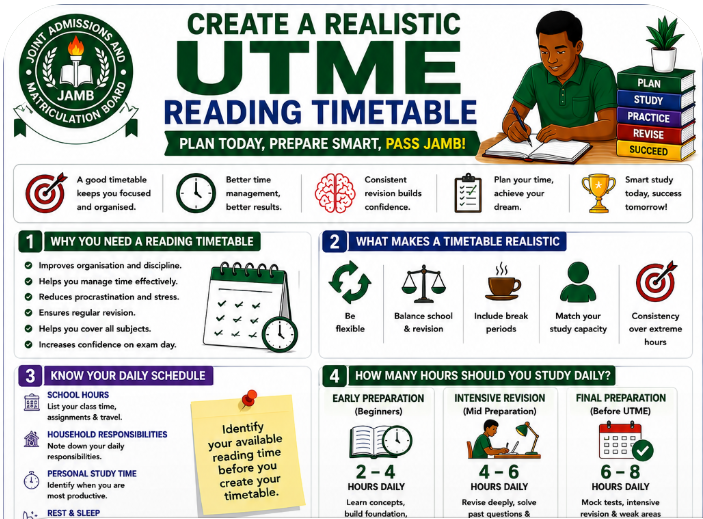
Every year, thousands of Nigerian students register for the Joint Admissions and Matriculation Board examination with hopes of gaining admission into universities, polytechnics, and colleges of education.
Yet many UTME candidates struggle with one major problem.
They do not have a proper reading timetable.
Some students read only when they feel motivated. Others create unrealistic schedules they cannot follow for more than three days. Many also spend hours reading the wrong topics without structure or revision plans.
The result is confusion, stress, poor concentration, and inconsistent preparation.
The truth is simple.
A realistic UTME reading timetable can completely change how you prepare for JAMB. It helps you stay organized, reduce procrastination, improve revision consistency, and manage your study time wisely.
Students who follow smart study schedules usually feel more confident during examinations because they prepare gradually instead of depending on last-minute reading.
If you have been searching for:
- create a realistic UTME reading timetable
- best timetable for JAMB candidates
- how to organize your JAMB reading time
- effective study timetable for UTME candidates
this guide will help you.
In this article, you will learn how to create an effective JAMB study timetable, balance school and revision, improve discipline, avoid burnout, and organize a smart daily study routine for UTME success.
Why Every UTME Candidate Needs a Reading Timetable
Many students underestimate the importance of having a reading timetable during JAMB preparation.
Without proper organization, preparation quickly becomes stressful and inconsistent.
Organized Preparation Improves Performance
A good JAMB reading timetable helps students:
- Plan subjects properly
- Avoid random reading
- Track progress easily
- Reduce panic before exams
Students who prepare with a timetable often study more consistently than those who depend on mood or motivation.
Better Time Management
Most UTME candidates combine:
- Secondary school classes
- Assignments
- Household responsibilities
- Religious activities
- Social commitments
Without proper planning, important study time disappears quickly.
Also read: How Many Hours Should UTME First-Time Candidates Study Daily?
A realistic timetable helps students use available time wisely.
Reduced Procrastination
One common reason students procrastinate is confusion.
When students already know:
- what to read,
- when to read,
- and how long to study,
they are more likely to remain disciplined.
Planned Reading vs Random Reading
There is a huge difference between:
Planned Reading
- Structured study sessions
- Subject balance
- Revision periods
- Clear daily goals
and:
Random Reading
- Reading only when convenient
- Ignoring weak subjects
- Lack of revision
- Poor consistency
Planned preparation almost always produces better results.
What Makes a Reading Timetable Realistic?
Many students create beautiful study schedules that completely fail after one week.
Why?
Because the timetable is unrealistic.
A Realistic Timetable Matches Your Lifestyle
Your timetable should consider:
- School hours
- Energy levels
- Home responsibilities
- Attention span
- Rest periods
A schedule that works for your friend may not work for you.
Flexibility Matters
A good timetable should allow adjustments when necessary.
For example:
- Unexpected school activities
- Family responsibilities
- Health challenges
Students should avoid rigid schedules that become frustrating quickly.
Consistency Is More Important Than Extreme Reading
Some students create schedules involving:
- 12-hour reading sessions
- Overnight study every day
- No breaks
Also read: How to Prepare for UTME as a First-Time Candidate
These plans usually fail because they are exhausting.
A realistic JAMB timetable focuses more on:
- consistency,
- discipline,
- and gradual improvement.
Know Your Daily Schedule Before Creating a Timetable
Before creating your UTME study timetable, first understand how your daily routine works.
School Hours
Students still attending secondary school should include:
- Class periods
- Homework time
- School travel time
in their planning.
Household Responsibilities
Many Nigerian students also assist with:
- Cooking
- Cleaning
- Family errands
- Shop work
Ignoring these responsibilities can make a timetable unrealistic.
Personal Study Time
Identify the periods when you are naturally most productive.
Some students focus better:
- early in the morning,
- while others concentrate better at night.
Rest and Sleep
Students should never sacrifice sleep completely for reading.
Poor sleep reduces:
- concentration,
- memory retention,
- and overall productivity.
Decide How Many Hours to Study Daily
One major question UTME candidates ask is:
“How many hours should I read for JAMB daily?”
There is no perfect answer for everybody.
However, most successful candidates follow balanced schedules.
Early Preparation Stage
Students preparing several months early can study:
2–4 Focused Hours Daily
At this stage, students should focus on:
- understanding concepts,
- reading gradually,
- and building consistency.
Intensive Revision Period
Closer to UTME, many students increase study time to:
4–6 Focused Hours Daily
This period usually includes:
- past question practice,
- CBT preparation,
- and intensive revision.
Focused Reading Matters More
A student who studies seriously for four hours daily may perform better than someone reading for ten distracted hours.
Quality matters more than extreme reading.
Divide Subjects Properly in Your Timetable
One major timetable mistake students make is neglecting some subjects completely.
Balance All Subjects Properly
Every JAMB subject requires attention.
Students should allocate time based on:
- subject difficulty,
- examination importance,
- and personal weakness.
Give More Time to Weak Subjects
If Mathematics is difficult for you, it should receive more attention than easier subjects.
The same applies to:
- English Language,
- Physics,
- Chemistry,
- Literature,
- or Government.
Avoid Subject Neglect
Some students focus only on favorite subjects while ignoring weaker ones.
That approach reduces overall performance.
Balanced preparation improves confidence.
Focus More on Difficult Subjects
Weak subjects should never be ignored during UTME preparation.
Why Weak Subjects Matter
Many students fail to reach competitive scores because one weak subject reduces their total performance.
For example:
A candidate scoring:
- 75 in English,
- 80 in Biology,
- 78 in Chemistry,
but only:
- 35 in Physics
may struggle to gain admission into competitive science courses.
Daily Practice Improves Weak Subjects
Students struggling with difficult subjects should:
- solve exercises daily,
- revise formulas regularly,
- and practice calculations often.
Mathematics and English Need Regular Attention
English Language is compulsory for all candidates.
Mathematics is also important for many science, commercial, and engineering courses.
Students should revise both consistently.
Include CBT Practice in Your Daily Timetable
UTME is a computer-based examination.
That means CBT familiarity is extremely important.
Why CBT Practice Matters
Many first-time candidates panic during the examination simply because they are unfamiliar with:
- navigation buttons,
- timers,
- and CBT systems.
Benefits of Daily CBT Practice
Regular CBT practice helps students:
- answer questions faster,
- improve confidence,
- manage time better,
- and reduce fear.
Timed Practice Sessions
Students should occasionally practice under real examination conditions using timers.
This improves speed and concentration significantly.
Use JambSmartPrep CBT App for Daily Practice
Technology has made JAMB preparation easier for Nigerian students.
One useful platform students can use is:
JambSmartPrep CBT App
Benefits of JambSmartPrep CBT App
The app helps students:
- practice mock examinations,
- improve answering speed,
- track performance,
- and identify weak subjects.
Students who practice CBT regularly often feel calmer during the actual UTME examination.
Best Time to Read for JAMB
Students often ask whether morning reading or night reading is better.
The answer depends partly on personal concentration patterns.
Morning Reading Benefits
Many students perform better during early morning study sessions.
Advantages of Morning Reading
Morning reading often provides:
- fresher concentration,
- fewer distractions,
- and better memory retention.
Many candidates prefer studying between:
- 4:30 AM and 7:00 AM.
Night Reading Benefits
Night reading also works well for many students.
Advantages of Night Reading
Night reading often provides:
- quieter environments,
- fewer interruptions,
- and longer study sessions.
However, students should avoid sacrificing sleep entirely.
Morning vs Night Reading Comparison
| Morning Reading | Night Reading |
|---|---|
| Fresher brain | Quieter environment |
| Better concentration | Longer study periods |
| Less distraction | Better focus for some students |
| Improved memory retention | Flexible study hours |
The best reading time is the period when you concentrate best consistently.
Include Revision Periods in Your Timetable
Many students read new topics constantly without revising older ones.
That mistake causes forgetfulness.
Why Revision Matters
Revision helps students:
- strengthen memory,
- improve understanding,
- and identify weak areas.
Weekly Revision Sessions
Students should dedicate specific days for:
- reviewing summary notes,
- solving past questions,
- and revisiting difficult topics.
Final-Week Revision Plans
During the final weeks before UTME, students should focus more on:
- revision,
- mock tests,
- and weak subject improvement.
Include Short Breaks to Avoid Burnout
Reading continuously without breaks reduces productivity.
Mental Fatigue Affects Learning
Excessive reading often causes:
- weak concentration,
- tiredness,
- and reduced memory retention.
Use the 50-Minute Study Technique
A simple method many students use is:
50 minutes reading
10 minutes break
This improves concentration and mental freshness.
Proper Sleep Improves Performance
Students should aim for:
- healthy sleep,
- proper meals,
- and balanced study routines.
Burnout reduces learning effectiveness.
Sample JAMB Timetable for Science Students
Example Science Timetable
| Time | Activity |
|---|---|
| 5:00 AM – 6:00 AM | Mathematics revision |
| Afternoon | School assignments |
| 4:00 PM – 5:30 PM | Physics practice |
| 6:00 PM – 7:00 PM | Break |
| 8:00 PM – 9:30 PM | Chemistry and CBT practice |
This timetable balances revision, CBT preparation, and rest.
Sample JAMB Timetable for Art Students
Example Art Timetable
| Time | Activity |
|---|---|
| 5:00 AM – 6:00 AM | English Language |
| Afternoon | Literature reading |
| 4:00 PM – 5:30 PM | Government revision |
| 6:00 PM – 7:00 PM | Break |
| 8:00 PM – 9:30 PM | Past questions and CBT practice |
Students should adjust schedules based on personal needs.
Common Mistakes Students Make While Creating Timetables
Several timetable mistakes reduce preparation effectiveness.
Unrealistic Study Hours
Reading plans involving excessive hours usually fail quickly.
Ignoring Break Periods
Students need rest to remain productive.
Neglecting Weak Subjects
Weak subjects should receive more attention, not less.
Lack of Revision
Without revision, students forget topics easily.
Poor Consistency
Many students follow their timetable for only a few days before stopping completely.
Consistency matters more than perfection.
How Top JAMB Candidates Organize Their Reading Time
Many high-scoring candidates follow similar preparation habits.
Consistent Revision
Top students revise regularly instead of depending on last-minute reading.
Balanced Schedules
Successful candidates usually:
- balance all subjects,
- practice CBT daily,
- and solve past questions consistently.
Discipline Matters
Most high-performing students remain disciplined even when they do not feel motivated.
Daily effort produces gradual improvement.
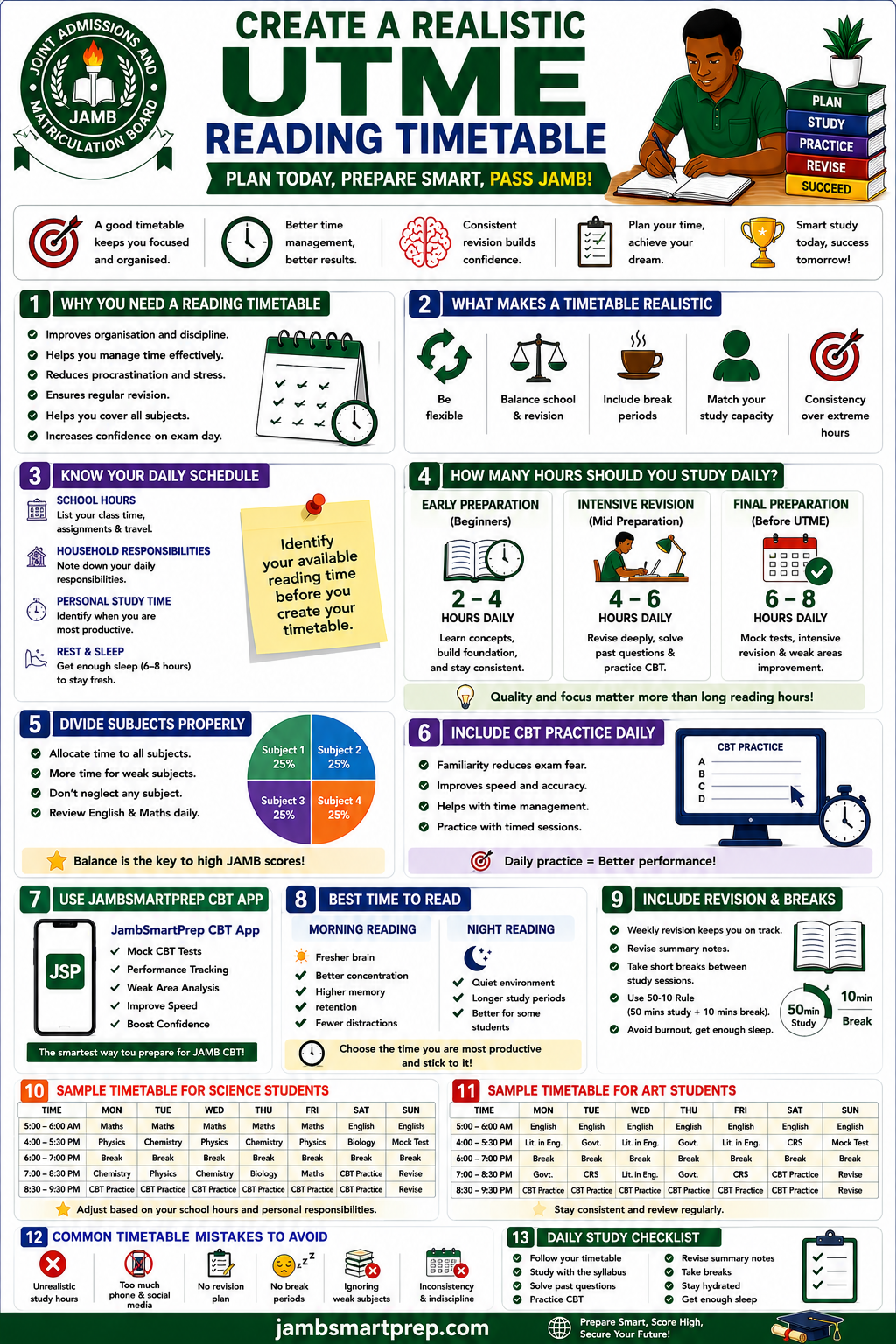
📘 Smart Daily Reading Timetable for UTME Success
Recommended Daily Study Hours
✅ Early preparation: 2–4 hours daily
✅ Intensive revision: 4–6 focused hours daily
✅ Final preparation stage: 6–8 hours with proper breaks
Smart Subject Allocation Guide
✅ More time for weak subjects
✅ Daily English Language revision
✅ Weekly Mathematics practice
✅ Weekend mock CBT sessions
Daily CBT Practice Schedule
✅ Practice timed CBT questions
✅ Learn navigation skills
✅ Improve answering speed
✅ Review incorrect answers afterward
Break Timetable Guide
📖 50 minutes reading
☕ 10 minutes break
Repeat throughout the study session.
Morning vs Night Reading
Morning Reading
- Better concentration
- Fresher memory
- Fewer distractions
Night Reading
- Quieter environment
- Longer reading periods
- Better for some students
Frequently Asked Questions About JAMB Reading Timetables
How do I create a realistic JAMB timetable?
Start by understanding your daily schedule, available study hours, weak subjects, and revision needs before organizing balanced study periods.
How many hours should I read daily for JAMB?
Most students study between 3 and 6 focused hours daily depending on their preparation stage.
What is the best time to study for UTME?
Morning and night reading both work well depending on personal concentration patterns.
Can I prepare for JAMB with 3 hours daily?
Yes. Consistent 3-hour daily study sessions can produce excellent results when used effectively.
How often should I revise for JAMB?
Students should revise weekly and revisit difficult topics regularly.
Should I read every day for UTME?
Yes. Daily reading improves memory retention and preparation consistency.
How do I balance school and JAMB preparation?
Create a flexible timetable that considers school hours, assignments, and revision sessions.
Is night reading good for JAMB preparation?
Yes, provided students still maintain healthy sleep schedules.
How do top students organize their timetable?
Most top students use balanced schedules, daily CBT practice, and regular revision periods.
What is the best CBT app for JAMB preparation?
Many students use the JambSmartPrep CBT App for mock examinations and revision practice.
What subjects should I focus on most during JAMB preparation?
Focus more on weak subjects while maintaining revision for stronger subjects.
How early should I start preparing for UTME?
Students should ideally begin preparation several months before the examination.
Can poor timetables affect JAMB performance?
Yes. Poor planning often leads to inconsistent preparation and weak revision.
How many breaks should students take while reading?
Students should take short breaks after focused reading sessions to improve concentration.
What are the common mistakes during JAMB preparation?
Common mistakes include lack of revision, poor CBT practice, unrealistic schedules, and procrastination.
Can I prepare for JAMB at home successfully?
Yes. Many Nigerian students prepare successfully at home using textbooks, CBT apps, and past questions.
Should students study in the morning or at night?
Students should study during periods when they naturally concentrate best.
How can I stay focused while reading?
Reduce social media distractions, follow a timetable, and study in quiet environments.
How important are past questions for JAMB preparation?
Past questions help students understand question patterns and improve speed.
How can I improve weak subjects quickly?
Practice regularly, revise consistently, and solve exercises daily.
Conclusion
Creating a realistic UTME reading timetable is one of the smartest steps any JAMB candidate can take.
A proper timetable improves organization, consistency, discipline, and confidence during preparation.
Instead of creating unrealistic study plans that quickly fail, students should focus on balanced schedules they can follow consistently over time.
Remember that steady preparation almost always produces better results than random marathon reading.
Use your timetable wisely, revise regularly, practice CBT consistently, and trust your preparation process.
Have you created your JAMB timetable already? Share this guide with another UTME candidate and bookmark this article for your daily revision routine.