Every year, thousands of Nigerian students preparing for the Joint Admissions and Matriculation Board examination ask the same question:
“How many hours should I read for JAMB daily?”
For first-time UTME candidates, this question can feel stressful. Some students believe they must read for 12 hours every day before they can score high. Others become discouraged because they can only study for a few hours after school.
The truth is that passing JAMB is not simply about reading for extremely long hours. Smart study habits, consistency, proper revision, and focused reading matter far more than exhaustion and overnight reading.
Many students who score above 300 in UTME do not necessarily read all day without rest. Instead, they follow structured study routines, solve past questions regularly, and maintain balanced reading schedules.
If you have been searching for:
- how many hours should UTME first-time candidates study daily
- how many hours should I read for JAMB
- best reading timetable for first-time UTME candidates
- how to prepare for JAMB effectively
this guide will help you.
Also read: How to Prepare for UTME as a First-Time Candidate
In this article, you will learn the ideal study hours for JAMB preparation, how top candidates organize their reading schedules, the best reading time for JAMB, and how to avoid burnout while preparing for UTME.
Table of Contents
ToggleIs There a Perfect Number of Hours for JAMB Preparation?
One important thing every student should understand is that there is no single “perfect” number of hours for all candidates.
Students learn differently.
Some students understand topics quickly within two focused hours. Others may need more time to master the same concept.
Quality Matters More Than Extreme Reading
A student who studies effectively for four focused hours daily may perform better than someone who reads for ten distracted hours.
What matters most is:
- Concentration
- Understanding
- Revision consistency
- Practice quality
Many students waste time because they:
- Read while chatting online
- Memorize without understanding
- Study without practice questions
- Read when mentally tired
That type of reading rarely produces good results.
Why Overreading Can Reduce Concentration
Reading excessively without breaks can lead to:
- Mental fatigue
- Poor memory retention
- Lack of concentration
- Stress and burnout
Students preparing for UTME should focus on balanced study habits rather than exhausting themselves.
Also read: How to Prepare for WAEC and NECO in One Month
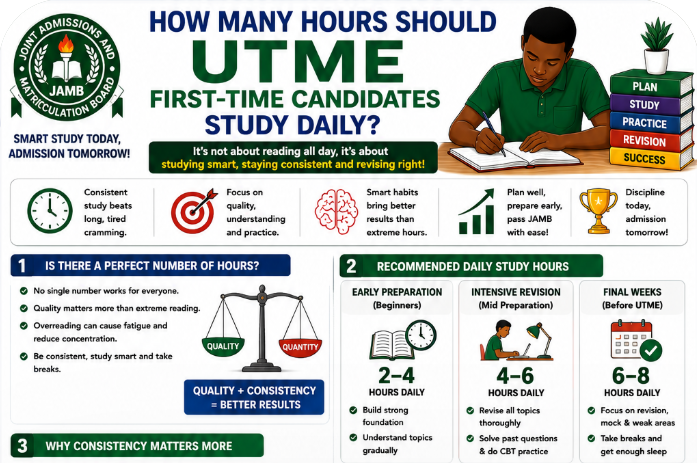
Recommended Daily Study Hours for First-Time UTME Candidates
The ideal study hours often depend on:
- How early preparation started
- School schedule
- Subject difficulty
- Personal concentration level
Below is a realistic guide many successful students follow.
Beginners Starting Early
Students beginning preparation several months before UTME can study:
2–4 Focused Hours Daily
This is usually enough when preparation starts early.
At this stage, students should focus on:
- Understanding concepts
- Building reading habits
- Learning with the syllabus
Intensive Revision Period
Closer to the examination period, students often increase study hours to:
4–6 Focused Hours Daily
This period usually includes:
- Intensive revision
- Past question practice
- CBT preparation
- Weak subject improvement
Final Weeks Before UTME
During the final weeks, many students study:
6–8 Hours Daily With Proper Breaks
However, this should not involve nonstop reading.
Students should include:
- Short breaks
- Light exercise
- Proper meals
- Sleep periods
The goal is effective preparation, not exhaustion.
Why Consistency Matters More Than Long Reading Hours
One major mistake UTME candidates make is depending on “marathon reading.”
Some students ignore their books for weeks and suddenly attempt to read all night shortly before the examination.
That approach rarely works well.
Benefits of Daily Revision
Students who read consistently usually:
- Remember topics better
- Improve gradually
- Feel more confident
- Experience less panic before exams
A Simple Example
Consider two students:
Student A
- Reads 3 focused hours daily for 5 months
Student B
- Reads 12 hours occasionally only when exams are close
In most cases, Student A performs better because learning improves through repetition and consistency.
Memory Retention Improves With Consistency
The brain remembers information better when students revise regularly instead of cramming overnight.
That is why daily revision habits are extremely important for JAMB preparation.
Best Time to Read for JAMB
Another common question students ask is:
“What is the best reading time for JAMB?”
The answer depends partly on personal concentration patterns.
However, certain study periods are usually more productive.
Morning Reading Benefits
Many students concentrate better during early morning reading.
Advantages of Morning Reading
Morning study sessions often provide:
- Fewer distractions
- Better mental alertness
- Improved concentration
- Fresher memory retention
Many top JAMB candidates prefer reading between:
- 4:30 AM and 7:00 AM
because the environment is usually quieter.
Night Reading Benefits
Night reading also works well for many students.
Advantages of Night Reading
Night study sessions often provide:
- Quiet environments
- Better focus
- Less interruption
- Longer uninterrupted reading periods
However, students should avoid extreme overnight reading that affects sleep quality.
Morning vs Night Reading Comparison
| Morning Reading | Night Reading |
|---|---|
| Fresher brain | Quieter environment |
| Better concentration | Fewer interruptions |
| Improved memory retention | Longer study periods |
| Less fatigue | Better for some students |
The best reading time for JAMB is the period when you concentrate best consistently.
How to Create an Effective JAMB Reading Timetable
A proper JAMB study timetable helps students stay disciplined and organized.
Without a timetable, many candidates read randomly and neglect important subjects.
Daily Study Targets
Students should divide subjects properly based on:
- Difficulty level
- Subject importance
- Weak areas
Weekly Revision Goals
Weekly targets help students:
- Measure progress
- Avoid procrastination
- Stay motivated
Include Break Periods
Effective reading schedules should include:
- Short breaks
- Meal periods
- Exercise time
- Sleep hours
Breaks improve concentration and reduce mental fatigue.
Sample JAMB Timetable for Science Students
| Time | Activity |
|---|---|
| 5:00 AM – 6:00 AM | Mathematics revision |
| Afternoon | School assignments |
| 4:00 PM – 5:30 PM | Physics practice |
| 6:00 PM – 7:00 PM | Break |
| 8:00 PM – 9:30 PM | CBT practice |
Sample Timetable for Art Students
| Time | Activity |
|---|---|
| 5:00 AM – 6:00 AM | English Language |
| Afternoon | Literature reading |
| 4:00 PM – 5:30 PM | Government revision |
| 6:00 PM – 7:00 PM | Break |
| 8:00 PM – 9:30 PM | Past question practice |
Focus on Smart Study Instead of Long Reading
Smart study techniques improve performance faster than endless reading.
Active Learning Techniques
Students preparing for UTME should use:
- Flashcards
- Summary notes
- Practice exercises
- Teaching others
These methods improve understanding better than passive reading.
Solve Practice Questions Frequently
Students who solve questions regularly usually:
- Learn faster
- Understand exam patterns
- Improve confidence
Use Timed Practice Sessions
Timed practice helps students prepare for CBT pressure and improve speed.
Avoid Reading Without Understanding
One common JAMB mistake is memorizing without comprehension.
Some students read repeatedly without truly understanding concepts.
Problems With Passive Reading
Passive reading often causes:
- Forgetfulness
- Poor understanding
- Weak problem-solving skills
Understanding Matters More Than Memorization
Students should focus on:
- Understanding formulas
- Applying concepts
- Solving practical questions
This approach improves long-term memory retention.
Include CBT Practice in Your Daily Study Routine
Since UTME is computer-based, CBT practice is extremely important.
Many first-time candidates panic simply because they are unfamiliar with CBT systems.
Benefits of CBT Practice
Regular CBT practice helps students:
- Improve speed
- Build confidence
- Learn time management
- Reduce examination fear
Practice Mock CBT Tests
Students should regularly:
- Answer timed CBT questions
- Practice navigation skills
- Learn how to use timers properly
Mock practice improves performance significantly.
Use JambSmartPrep CBT App for Daily Practice
Technology has made JAMB preparation easier for Nigerian students.
One helpful platform students can use is:
JambSmartPrep CBT App
Benefits of JambSmartPrep CBT App
The app helps students:
- Practice mock CBT exams
- Track performance
- Improve answering speed
- Identify weak subjects
Students who practice CBT regularly often feel calmer during the actual examination.
How to Avoid Burnout While Studying for UTME
Reading excessively without rest can reduce productivity.
Importance of Rest
Students preparing for JAMB should:
- Sleep properly
- Take breaks
- Eat healthy meals
- Avoid excessive stress
The 50-Minute Study Technique
A simple technique many students use is:
- 50 minutes reading
- 10 minutes break
This improves concentration and reduces mental fatigue.
Avoid Overnight Exhaustion
Students should avoid:
- Reading without sleep
- Excessive caffeine use
- Studying continuously without breaks
Healthy study habits improve performance better than exhaustion.
Common Study Mistakes UTME Candidates Make
Several mistakes reduce students’ chances of success yearly.
Common JAMB Study Mistakes
Reading Without a Timetable
Random reading causes poor organization.
Depending on Marathon Reading
Overnight reading rarely improves long-term understanding.
Ignoring Weak Subjects
Students often avoid subjects they fear most.
Excessive Social Media Use
Phone distractions waste valuable study time.
Lack of Revision
Without revision, students forget previously studied topics quickly.
Avoiding these mistakes improves preparation greatly.
How Top JAMB Candidates Usually Study
Many high-scoring candidates follow similar habits.
Daily Revision Habits
Top students revise consistently instead of cramming.
Balanced Study Schedules
Most successful candidates:
- Follow timetables
- Practice CBT regularly
- Solve past questions often
- Focus on weak areas
Discipline Matters
Successful students usually stay disciplined even when motivation drops.
That consistency produces long-term improvement.
Should Students Read Every Day for JAMB?
Yes.
Daily study habits improve memory retention and understanding.
Benefits of Daily Reading
Students who read daily usually:
- Retain information better
- Improve gradually
- Feel more confident
Include Light Revision Days
Daily reading does not always mean intense study sessions.
Some days can involve:
- Summary note revision
- Formula review
- Light CBT practice
Weekend Revision Strategy
Weekends are excellent for:
- Mock tests
- Past questions
- Weak subject improvement
Consistent daily study habits usually produce better results than irregular marathon reading.
📘 Best Daily Study Routine for First-Time UTME Candidates
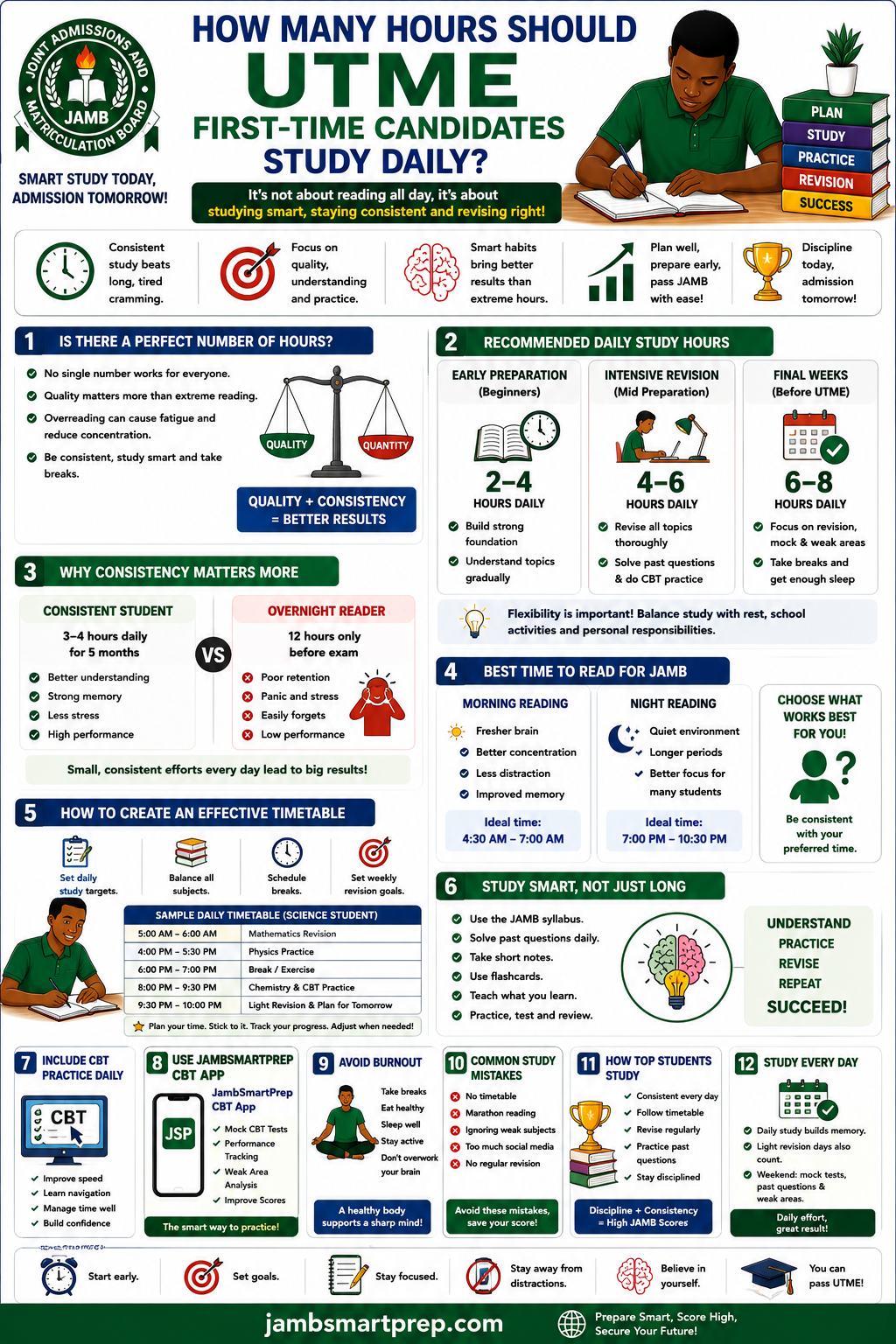
Recommended Daily Study Hours
✅ Early preparation stage: 2–4 hours daily
✅ Intensive revision period: 4–6 hours daily
✅ Final weeks before UTME: 6–8 hours with breaks
Smart Study Techniques
✅ Use the JAMB syllabus
✅ Solve past questions regularly
✅ Practice CBT daily
✅ Revise summary notes
✅ Focus on weak subjects
Morning vs Night Reading
Morning Reading
- Fresher brain
- Better concentration
- Fewer distractions
Night Reading
- Quieter environment
- Longer reading periods
- Better focus for some students
Break Schedule Guide
📖 50 minutes reading
☕ 10 minutes break
Repeat throughout your study session.
Frequently Asked Questions About JAMB Study Hours
How many hours should I read daily for JAMB?
Most students study between 3 and 6 focused hours daily depending on their preparation stage.
Is reading 2 hours daily enough for JAMB?
Yes, especially when preparation starts early and study sessions remain focused and consistent.
What is the best time to study for UTME?
Many students perform well during early morning or quiet night reading sessions.
Can I pass JAMB by studying 4 hours daily?
Yes. Many successful candidates pass JAMB through consistent 4-hour daily study routines.
How do top JAMB students study?
Most top students use structured timetables, solve past questions regularly, and practice CBT consistently.
Should I read every day for JAMB?
Yes. Daily revision improves memory retention and confidence.
Is night reading effective for JAMB preparation?
Yes, provided students still maintain proper sleep schedules.
How do I avoid burnout while studying?
Take breaks regularly, sleep properly, and avoid marathon reading without rest.
How can I stay focused while reading?
Reduce social media distractions, create a timetable, and study in quiet environments.
What is the best timetable for JAMB candidates?
The best timetable is one that balances all subjects realistically and consistently.
How early should first-time candidates start preparing for JAMB?
Students should ideally begin serious preparation several months before the examination.
Can long reading hours improve JAMB scores?
Only when study sessions remain focused and productive. Long distracted reading often reduces effectiveness.
What subjects should students focus on most?
Students should focus more on weak subjects while maintaining revision for stronger subjects.
How often should students solve past questions?
Past questions should be practiced regularly, preferably several times weekly.
What are the common mistakes during JAMB preparation?
Common mistakes include poor time management, lack of CBT practice, excessive social media use, and reading without a timetable.
Can I prepare for JAMB at home successfully?
Yes. Many students prepare successfully at home using textbooks, CBT apps, and past questions.
How many breaks should students take while reading?
Students should take short breaks after every focused reading session to improve concentration.
What is the best app for JAMB CBT practice?
Many students use the JambSmartPrep CBT App for mock examinations and revision practice.
How can I improve concentration while studying?
Study in quiet environments, reduce distractions, and maintain proper sleep habits.
Should students study in the morning or at night?
Students should study during the periods when they concentrate best consistently.
Conclusion
There is no perfect number of hours every UTME candidate must study daily.
What matters most is consistency, smart study habits, focused revision, and disciplined preparation.
Students who follow realistic timetables, solve past questions regularly, practice CBT consistently, and maintain balanced reading schedules usually perform better than those depending on marathon reading.
Remember that quality study matters far more than extreme study hours.
Start early, remain consistent, avoid burnout, and trust your preparation process.
How many hours do you currently study daily for JAMB? Share this guide with another UTME candidate and bookmark this article for your revision routine.
Share this:
- Print (Opens in new window) Print
- Email a link to a friend (Opens in new window) Email
- Share on Reddit (Opens in new window) Reddit
- Share on Tumblr (Opens in new window) Tumblr
- Share on Telegram (Opens in new window) Telegram
- Share on Threads (Opens in new window) Threads
- Share on WhatsApp (Opens in new window) WhatsApp
- Share on Mastodon (Opens in new window) Mastodon
- Share on Nextdoor (Opens in new window) Nextdoor
- Share on Bluesky (Opens in new window) Bluesky
- Share on Facebook (Opens in new window) Facebook
- Share on LinkedIn (Opens in new window) LinkedIn
- Share on Pinterest (Opens in new window) Pinterest