Every year, millions of Nigerian students sit for the West African Senior School Certificate Examination conducted by the West African Examinations Council. After the exams, many students rush online to check their results, only to become confused by grades like A1, B3, C6, D7, or F9.
Questions such as “What is A1 in WAEC?” or “Can I gain admission with C6?” are very common among candidates and parents.
Understanding the WAEC grading system is important because your grades can influence university admission, scholarship opportunities, and even job applications in Nigeria.
In this guide, you will learn everything about WAEC grading, including the meaning of each grade, how WAEC grades are calculated, admission requirements, and practical ways to improve your results.
Table of Contents
ToggleQuick Breakdown of WAEC Grades
| Grade | Meaning | Percentage Range |
|---|---|---|
| A1 | Excellent | 75–100% |
| B2 | Very Good | 70–74% |
| B3 | Good | 65–69% |
| C4 | Credit | 60–64% |
| C5 | Credit | 55–59% |
| C6 | Credit | 50–54% |
| D7 | Pass | 45–49% |
| E8 | Pass | 40–44% |
| F9 | Fail | 0–39% |
Key Things to Remember
- A1 is the highest WAEC grade
- C6 is usually the minimum accepted for university admission
- English Language and Mathematics are compulsory for most courses
- F9 means failure in a subject
- Better grades improve admission chances
What Is WAEC Grading?
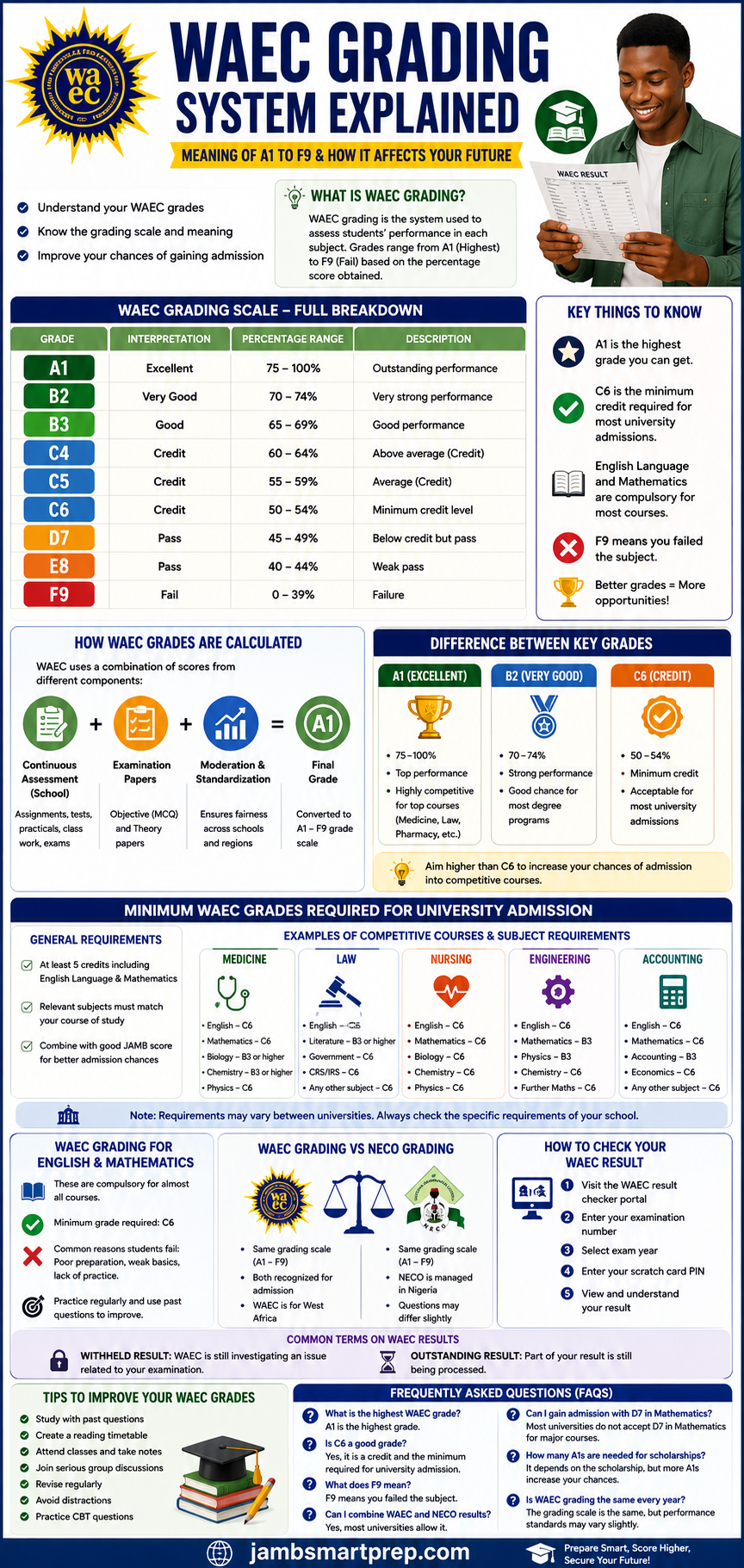
WAEC grading is the system used by the West African Examinations Council to assess students’ academic performance after examinations.
Instead of showing raw scores only, WAEC converts performance into grades ranging from A1 to F9.
This grading system helps schools, universities, employers, and scholarship boards evaluate candidates fairly.
Also read: 20 Tips to Ace WAEC and NECO Exams The Way You Want
In simple terms:
- Higher grades show stronger performance
- Lower grades show weaker performance
- Credits and distinctions improve admission opportunities
WAEC grading applies to all major secondary school subjects including:
- English Language
- Mathematics
- Biology
- Economics
- Government
- Physics
- Literature in English
- Chemistry
WAEC Grading System Explained
Many students search for “WAEC grading system explained” because they want to understand what their results truly mean.
Below is the standard WAEC grading scale commonly used in Nigeria.
Full Breakdown of WAEC Grades
| Grade | Interpretation | Percentage Range |
|---|---|---|
| A1 | Excellent | 75–100% |
| B2 | Very Good | 70–74% |
| B3 | Good | 65–69% |
| C4 | Credit | 60–64% |
| C5 | Credit | 55–59% |
| C6 | Credit | 50–54% |
| D7 | Pass | 45–49% |
| E8 | Pass | 40–44% |
| F9 | Fail | 0–39% |
What These Grades Mean
A1 — Excellent
This is the best WAEC grade possible. Students with multiple A1 grades are often considered highly competitive for courses like Medicine, Law, Pharmacy, and Engineering.
B2 and B3 — Very Good and Good
These are strong grades that still give students excellent admission opportunities.
C4 to C6 — Credit
C6 is usually the minimum acceptable grade for university admission in Nigeria.
Most universities require at least five credits including:
- English Language
- Mathematics
- Relevant subjects related to the course
D7 and E8 — Pass
These grades are considered weak for university admission.
Also read: Best NECO Study Tips to Reduce Stress (Smart Guide for Students)
Some colleges or vocational institutions may accept them under certain conditions.
F9 — Fail
F9 means the student failed the subject completely.
Students with F9 in English or Mathematics usually need to retake the examination.
How WAEC Grades Are Calculated
One common question students ask is, “How does WAEC grading system work?”
WAEC grades are calculated using a combination of different assessment methods.
Continuous Assessment
Your school-based assessments contribute to your final result.
These may include:
- Assignments
- Class tests
- Practical work
- Mock examinations
Objective and Theory Papers
Most WAEC subjects contain:
- Multiple-choice questions
- Essay or theory sections
- Practical examinations for science subjects
Both sections contribute to the final score.
Moderation and Standardization
WAEC also uses moderation processes to ensure fairness across different schools and regions.
This helps maintain consistent standards nationwide.
The exact marking scheme may vary slightly depending on the subject.
What Is the Difference Between A1, B2, and C6?
The difference between these grades can affect admission chances significantly.
A1 Grade
Students with mostly A1 grades are usually strong candidates for highly competitive courses such as:
- Medicine
- Dentistry
- Pharmacy
- Law
They may also qualify for scholarships.
B2 and B3 Grades
These grades are still very respectable and widely accepted for university admission.
Students with B grades often compete successfully for many professional courses.
C6 Grade
C6 is considered the minimum credit pass accepted by most universities.
However, students with many C6 grades may struggle to compete for highly competitive courses.
For example:
- A student with 7 A1 grades applying for Medicine has a stronger chance than a student with mostly C6 grades.
Minimum WAEC Grades Required for University Admission
Understanding WAEC grading for university admission is very important.
Most Nigerian universities require:
- At least five credits
- Credits in English Language and Mathematics
- Relevant subjects related to the chosen course
WAEC Requirements for Competitive Courses
Medicine
Usually requires strong grades in:
- English
- Mathematics
- Biology
- Chemistry
- Physics
Law
Important subjects include:
- English Language
- Literature in English
- Government
- CRS or IRS
Nursing
Most schools require credits in:
- English
- Mathematics
- Biology
- Chemistry
- Physics
Engineering
Important subjects include:
- Mathematics
- Physics
- Chemistry
- English
Even with good WAEC grades, students still need strong Joint Admissions and Matriculation Board scores for admission consideration.
WAEC Grading System for English Language and Mathematics
English Language and Mathematics are among the most important WAEC subjects.
Almost all universities, polytechnics, and colleges require credits in both subjects.
Why Students Fail These Subjects
Common reasons include:
- Poor preparation
- Weak reading habits
- Fear of Mathematics
- Poor grammar and comprehension skills
- Inadequate practice
Students who fail English or Mathematics may struggle to gain admission even if other subjects are good.
WAEC Grading System for Science Students
Science students often face tougher competition because many science-related courses are highly competitive.
Important science subjects include:
- Biology
- Chemistry
- Physics
- Further Mathematics
Students aiming for Medicine or Engineering should target at least B grades or higher in science subjects.
How Science Students Can Improve Grades
Helpful strategies include:
- Practicing calculations regularly
- Watching tutorial videos
- Solving past questions
- Attending practical classes seriously
WAEC Grading System for Art and Commercial Students
Art and commercial students also need strong grades for admission opportunities.
Common Art Subjects
- Literature in English
- Government
- CRS
- History
Common Commercial Subjects
- Accounting
- Commerce
- Economics
- Office Practice
Students applying for Mass Communication, Accounting, or Business Administration should aim for strong credit grades.
Common Misunderstandings About WAEC Grading
Many myths confuse students after WAEC results are released.
“D7 Is a Credit”
This is incorrect.
D7 is only a pass, not a credit.
Most universities do not accept D7 for core subjects.
“A1 Guarantees Admission”
Strong grades help, but admission also depends on:
- JAMB score
- Post-UTME performance
- Catchment policies
- Competition level
“WAEC Grading Is Exactly the Same Every Year”
While the grading structure remains similar, performance statistics and moderation may vary yearly.
How to Improve Your WAEC Grades
Students who want distinctions must prepare seriously.
Best Study Tips for Better WAEC Results
Use Past Questions
Past questions help students understand repeated patterns.
Create a Reading Timetable
A timetable improves consistency and organization.
Join Group Discussions
Studying with serious classmates can improve understanding.
Practice CBT Questions
Computer-based practice improves speed and confidence.
Revise Regularly
Frequent revision strengthens memory retention.
Students searching for “how to score A1 in WAEC” should focus on discipline and steady preparation.
WAEC Grading vs NECO Grading
Many students compare WAEC and National Examinations Council grading systems.
Both systems are very similar.
Similarities
- Both use A1 to F9 grading structures
- Both are accepted for admission in Nigeria
- Both assess secondary school performance
Differences
- NECO is managed within Nigeria
- WAEC covers multiple West African countries
- Some students believe NECO questions are slightly more direct
Most universities accept either WAEC or NECO results.
How to Check and Understand Your WAEC Result
Students can check their results online using the WAEC result checker portal.
Steps to Check WAEC Results
- Visit the WAEC result checker website
- Enter examination number
- Select exam year
- Enter scratch card PIN
- Submit details
Common Terms Students See
Withheld Result
This means WAEC is investigating issues related to the examination.
Outstanding Result
This usually means part of the result has not yet been processed.
Frequently Asked Questions About WAEC Grading
What is the highest WAEC grade?
A1 is the highest WAEC grade.
Is C6 a good grade in WAEC?
Yes. C6 is considered a credit and is usually accepted for university admission.
Can I gain admission with D7 in Mathematics?
Most universities do not accept D7 in Mathematics for major courses.
What does F9 mean in WAEC?
F9 means failure in a subject.
How many A1s are needed for scholarships?
Scholarship requirements vary, but students with multiple A1 grades are often more competitive.
Is WAEC grading the same every year?
The grading structure remains similar, although moderation may differ slightly yearly.
Which WAEC grades are accepted for university admission?
Most universities require at least C6 in core subjects.
What is the difference between WAEC and NECO grading?
Both systems are similar, although the examination bodies are different.
How do universities calculate WAEC points?
Some universities assign points based on grades for admission screening exercises.
Can I combine WAEC and NECO results?
Yes. Many universities allow candidates to combine WAEC and NECO results.
Conclusion
Understanding WAEC grading can reduce confusion and help students make smarter academic decisions.
Instead of panicking after seeing your result, focus on understanding what each grade means and how it affects your future opportunities.
Strong preparation, regular revision, and disciplined study habits can improve your WAEC performance significantly.
Whether you are aiming for A1 distinctions or simply trying to secure admission requirements, consistency remains the key.
What WAEC grade are you aiming for this year? Share this guide with another student preparing for WAEC and bookmark this page for future reference.
