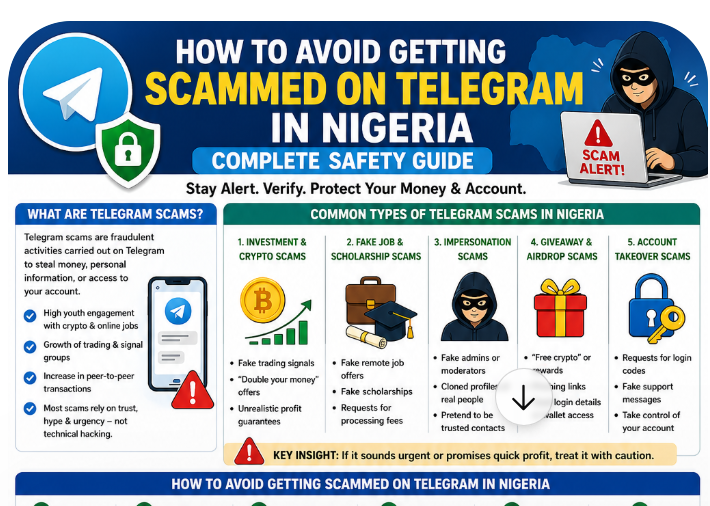
You join a Telegram group that promises daily crypto signals or scholarship updates. Within minutes, someone posts a “limited offer” with screenshots of huge profits. It looks convincing. People in the group seem to be confirming it. You feel tempted to act fast.
This is how many Telegram scams begin.
Across Nigeria, cases of Telegram scams are rising. The platform’s privacy features and fast messaging system make it easy for fraudsters to operate without being noticed. Students, job seekers, and even business owners are common targets.
So the real questions are simple:
- How do you avoid getting scammed on Telegram in Nigeria?
- How can you tell if a Telegram message or group is fake?
- What should you do if you are already targeted?
This guide answers those questions in clear terms. By the end, you will understand how Telegram scams work, how to spot them early, and how to protect yourself without stress.
What Are Telegram Scams?
Telegram scams in Nigeria refer to fraudulent activities carried out through the Telegram app to steal money, personal details, or account access.
Also read: How to Avoid Getting Scammed on Facebook in Nigeria (Complete Safety Guide)
These scams are not always technical. In fact, most of them rely on simple tricks.
Why Telegram Is Commonly Used for Scams
In Nigeria, Telegram has grown quickly because of:
- Increased interest in crypto trading and online income
- Popularity of anonymous groups and channels
- Ease of creating accounts without strict identity checks
This creates an environment where scammers can operate freely.
Key Insight
Most Telegram scams succeed because of human decisions, not system failure. People trust too quickly, act under pressure, or fail to verify information.
Common Types of Telegram Scams in Nigeria
Understanding common scam patterns is the first step in avoiding them.
A. Investment and Crypto Scams
This is one of the most common forms of online scams in Nigeria on Telegram.
- Fake trading signals
- Promises to double your money
- Screenshots of fake profits
A student preparing for exams might join a “crypto group” hoping to earn extra money, only to lose everything.
B. Fake Job and Scholarship Scams
These target students directly.
- “Work from home” offers
- Fake international scholarships
- Requests for “processing fees”
Some scammers even use names similar to real opportunities like PTDF or Chevening to gain trust.
C. Impersonation Scams
- Fake Telegram admins
- Cloned profiles of real users
- Messages like “message me privately for assistance”
Once you respond, the scam begins.
D. Giveaway and Airdrop Scams
- “You’ve won free crypto”
- Fake links asking you to log in
- Requests for wallet access
These scams are designed to steal your login credentials.
E. Account Takeover Scams
- Someone asks for your Telegram verification code
- Claims it was sent to you by mistake
- Uses it to take control of your account
Key Insight
If a message creates urgency or promises fast profit, you should pause immediately.
How to Avoid Getting Scammed on Telegram in Nigeria
This is the most important part of this guide.
Practical Telegram Fraud Prevention Steps
1. Verify Every User or Group
- Check how long the group has existed
- Look at previous messages
- Confirm admin identity
Do not rely on group popularity alone.
2. Avoid Sending Money to Unknown Contacts
- Never invest money based on Telegram messages
- Avoid “admin-only” deals
Even if others claim success, it may be staged.
3. Do Not Trust Unrealistic Offers
- High returns with low risk are not real
- “Limited slots” is a pressure tactic
4. Avoid Clicking Suspicious Links
- Check links carefully
- Avoid shortened or hidden URLs
5. Enable Telegram Security Features
- Turn on two-step verification
- Set privacy controls for your phone number
6. Avoid Urgent Financial Requests
If someone says:
- “Send now”
- “Last chance”
Take a step back. Scammers depend on urgency.
Key Takeaway
Learning how to stay safe on Telegram is mostly about slowing down and verifying information.
Also read: How to Avoid Getting Scammed on WhatsApp in Nigeria
How to Identify a Telegram Scam Message
Many users ask, “How do I know if a Telegram message is a scam?”
Here are clear warning signs:
- Poor grammar or inconsistent writing
- Messages that create pressure
- Requests for money or login codes
- Suspicious links
- New or anonymous accounts
Simple Rule
If something feels slightly off, do not ignore that feeling. Check before acting.
Can Telegram Scammers Hack Your Account?
A common concern is: Can Telegram scammers hack my account?
The Truth
Yes, but mostly through:
- Phishing links
- Fake login pages
- Social engineering
What They Cannot Do Easily
- They cannot hack your account just by sending a message
Important Note
Most account breaches happen because users share their verification codes or click unsafe links.
What to Do If You Are Targeted by a Telegram Scam
If you suspect a scam, act immediately.
Immediate Steps
- Stop replying
- Block the user
- Report the account or group
- Inform your contacts
If Money Is Involved
- Contact your bank immediately
- Request transaction review
- Report to authorities
Key Takeaway
The faster you act, the better your chances of limiting damage.
How to Report Telegram Scams in Nigeria
If you want online fraud Nigeria help, reporting is important.
Where to Report
- Your bank
- Law enforcement agencies
- Telegram support
Steps to Follow
- Gather evidence
- Screenshots
- Chat history
- Submit a complaint
- Follow up regularly
Key Insight
Reporting scams helps prevent others from becoming victims.
Real-Life Scam Scenarios (Nigeria)
Case 1: Crypto Scam
A university student joins a Telegram trading group. He sends money for investment. The admin disappears the next day.
Case 2: Smart Decision
Another student receives the same offer but decides to verify it. He checks online reviews and finds warnings. He avoids sending money.
Lesson
Simple verification can save your money.
Common Mistakes People Make on Telegram
- Acting too quickly
- Trusting group admins blindly
- Ignoring warning signs
- Sharing personal details
Insight
Scammers succeed when people rush decisions.
Telegram Security Tips for Nigerian Users
Here are practical Telegram security tips:
- Enable two-step verification
- Hide your phone number
- Use strong passwords
- Avoid random groups
- Review active sessions
These small steps can prevent major problems.
How to Protect Family and Friends
Many victims are not aware of these scams.
You can help by:
- Educating relatives
- Sharing safety tips
- Warning about trending scams
- Encouraging verification
Key Insight
Awareness spreads protection.
Quick Checklist: Stay Safe on Telegram
✔ Do This:
- Verify users and groups
- Avoid sending money blindly
- Enable security settings
- Report suspicious activity
❌ Avoid This:
- Trusting unknown contacts
- Clicking random links
- Sharing login details
FAQs: Telegram Scams in Nigeria
How can I avoid Telegram scams in Nigeria?
Verify users, avoid sharing sensitive information, and enable security features.
What are common Telegram scams in Nigeria?
Investment scams, fake jobs, impersonation scams, and giveaway scams.
How do I know if a Telegram message is a scam?
Look for urgency, suspicious links, and unusual requests.
What should I do if I get scammed on Telegram?
Stop communication, report the user, and contact your bank if money is involved.
Can Telegram scammers hack my account?
Yes, mainly through phishing and verification code scams.
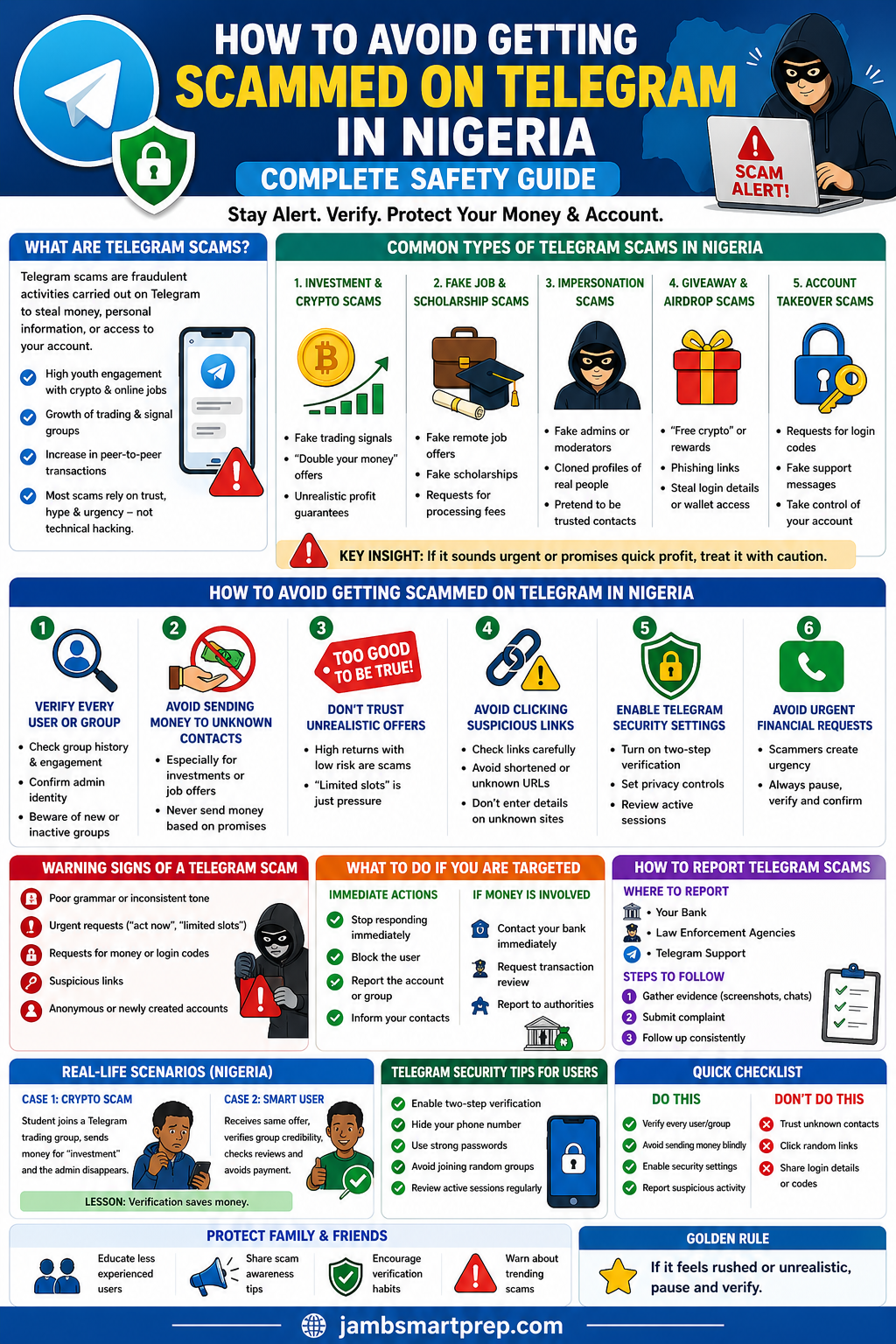
How to Avoid Getting Scammed on Telegram in Nigeria (Complete Safety Guide)
Common Scams:
- Investment scams
- Fake jobs
- Giveaway scams
Warning Signs:
- Urgent requests
- Anonymous users
- Suspicious links
Protection Tips:
- Verify identity
- Enable two-step verification
- Avoid sharing codes
Golden Rule:
If it feels rushed or unrealistic, pause and verify.
Conclusion
Learning how to avoid getting scammed on Telegram in Nigeria is no longer optional. It is necessary.
Many people lose money not because they are careless, but because scammers are becoming more convincing. The difference often comes down to one thing: verification.
Take a few minutes to check before you act. Enable your security settings. Be cautious with every offer that looks too easy.
If you found this guide useful, consider sharing it with friends or classmates. You may help someone avoid a costly mistake.
Before you go:
Have you ever seen a suspicious Telegram message? What did you do differently?