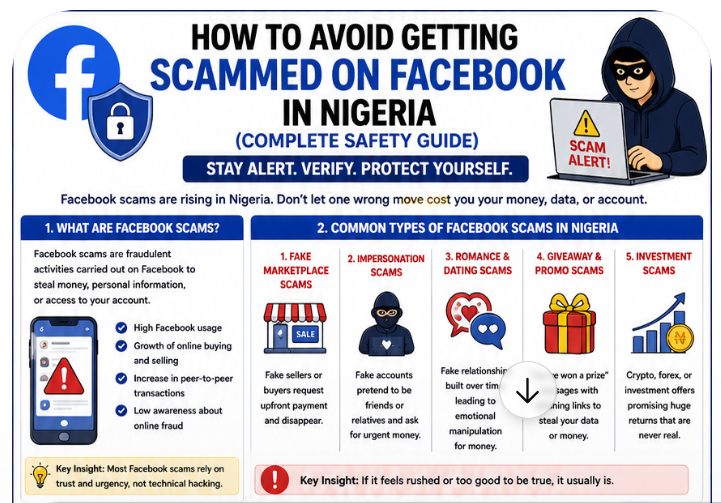
You receive a message on Facebook from someone claiming to be a friend, a buyer, or even a company offering a quick deal. The message sounds urgent. It feels real. You are tempted to respond immediately.
That is how many scams begin.
Across Nigeria, cases of Facebook scams are rising. Students, small business owners, and everyday users are losing money simply because they trusted too quickly or failed to verify simple details.
At this point, a few questions usually come to mind:
- How do I avoid getting scammed on Facebook in Nigeria?
- How can I identify fake profiles or suspicious messages?
- What should I do if I am already targeted?
This guide answers those questions in a clear and practical way. You will learn how Facebook scams work, how to spot warning signs early, and how to protect yourself before any damage is done.
What Are Facebook Scams?
Facebook scams are fraudulent activities carried out on social media to steal money, personal information, or access to accounts.
In Nigeria, the problem has grown for a few simple reasons:
- Millions of users are active daily on Facebook
- Online buying and selling have increased
- Bank transfers are quick and easy
Scammers take advantage of these habits. They do not rely on advanced hacking. Instead, they rely on trust, urgency, and emotional pressure.
Also read: How to Avoid Getting Scammed on WhatsApp in Nigeria
A typical scam works like this:
- You receive a message
- You feel pressure to act quickly
- You skip verification
- You send money or share details
That single moment of haste is often enough.
Common Types of Facebook Scams in Nigeria
Understanding how scams work is the first step in avoiding them. Below are the most common Facebook scams in Nigeria.
1. Fake Marketplace Scams
This is very common among students who buy phones, gadgets, or textbooks online.
- A seller advertises a product at a very low price
- You are asked to pay upfront
- After payment, the seller disappears
In some cases, fake buyers also exist. They may send fake payment alerts to trick sellers.
2. Impersonation Scams
Here, scammers create fake accounts using the name and photo of someone you know.
- You receive a message from a “friend”
- They claim to be in urgent need of money
- They ask you to send funds quickly
Many victims later discover that the real person knew nothing about the request.
3. Romance and Dating Scams
This type targets emotions rather than logic.
- A scammer builds a relationship over time
- Gains your trust
- Introduces a financial problem
- Requests money
This method is slow but very effective.
4. Giveaway and Promotion Scams
You may see messages like:
- “You’ve won a prize”
- “Click here to claim your reward”
These links often lead to fake pages that collect your personal data.
5. Investment Scams
These are becoming more common among young Nigerians.
- Crypto or forex offers
- Promises of quick profit
- Requests for initial deposits
The returns are fake. The loss is real.
Key Insight:
If a message feels rushed or too good to be true, it usually is.
How to Avoid Getting Scammed on Facebook in Nigeria
If you want to stay safe, you need a simple but consistent approach. These Facebook fraud prevention steps can save you from most scams.
1. Verify Every Profile
Before trusting anyone:
- Check how long the account has existed
- Look at previous posts and interactions
- Confirm mutual friends
Fake accounts often have limited history.
2. Avoid Sending Money to Strangers
This is one of the most common mistakes.
If you have not verified the person properly, do not send money. It is better to delay than to lose funds.
3. Be Careful with Facebook Marketplace
For students buying items like phones or books:
- Try to meet physically when possible
- Inspect the product before payment
- Use trusted payment methods
4. Do Not Click Suspicious Links
Many scams start with a link.
- Check the website address carefully
- Avoid shortened or unfamiliar links
5. Enable Facebook Security Features
Take advantage of built-in protection:
- Turn on two-factor authentication
- Enable login alerts
- Review active sessions regularly
6. Avoid Urgent Financial Requests
Scammers rely on pressure.
If someone asks for money urgently:
- Pause
- Call them directly
- Confirm the situation
Key Takeaway:
Verification and patience are your strongest defenses.
How to Identify a Fake Facebook Account
You may wonder, how do I know if a Facebook account is fake?
Watch for these signs:
- Very few friends or followers
- Recently created account
- Profile pictures that look like stock images
- Messages that feel scripted or unnatural
- Too many emotional or urgent requests
Also read: How to Track a Fraudster in Nigeria (Realistic Guide)
A fake account may look convincing at first, but small details usually reveal the truth.
Can Facebook Scammers Hack Your Account?
Yes, but not in the way many people think.
Most scams are not technical hacks. They are tricks.
Scammers may:
- Send phishing links
- Create fake login pages
- Ask for verification codes
If you enter your details on a fake page, you give them access.
Important Note:
Random messages alone cannot hack your account. Access is usually granted by the user unknowingly.
What to Do If You Are Targeted by a Facebook Scam
If you suspect a scam, act quickly.
Immediate Actions
- Stop responding
- Block the account
- Report the profile on Facebook
- Inform your friends
If Money Is Involved
- Contact your bank immediately
- Request transaction review
- Report the case to authorities
The faster you act, the better your chances of limiting damage.
How to Report Facebook Scams in Nigeria
Reporting is important, even if you did not lose money.
Where to Report
- Your bank
- Law enforcement agencies
- Facebook support
Steps to Follow
- Take screenshots of chats
- Save payment details
- Submit your complaint
- Follow up regularly
Reporting helps protect others from falling into the same trap.
Real-Life Scam Scenarios in Nigeria
Case 1: Marketplace Scam
A student sees a phone advertised at a cheap price. Payment is made upfront. The seller disappears.
Case 2: Smart Buyer
Another student sees a similar offer but chooses to verify:
- Calls the seller
- Requests a physical meeting
- Inspects the product
No money is lost.
Lesson:
Verification saves money.
Common Mistakes People Make on Facebook
Many scams succeed because of simple errors:
- Acting too quickly
- Trusting familiar names without checking
- Ignoring warning signs
- Sharing personal information
Awareness alone can prevent most of these mistakes.
Facebook Security Tips for Nigerian Users
To stay safe on Facebook, follow these steps:
- Enable two-factor authentication
- Use strong and unique passwords
- Avoid logging in on public devices
- Log out after using shared systems
- Review login activity regularly
How to Protect Family and Friends
Scammers often target people who are less informed.
You can help by:
- Educating older relatives
- Sharing scam awareness tips
- Encouraging verification habits
- Warning about trending scams
A simple conversation can prevent serious loss.
Quick Checklist: How to Avoid Getting Scammed on Facebook in Nigeria
✔ Verify every account
✔ Avoid sending money blindly
✔ Enable security settings
✔ Report suspicious activity
❌ Do not:
- Trust unknown users
- Click random links
- Share sensitive information
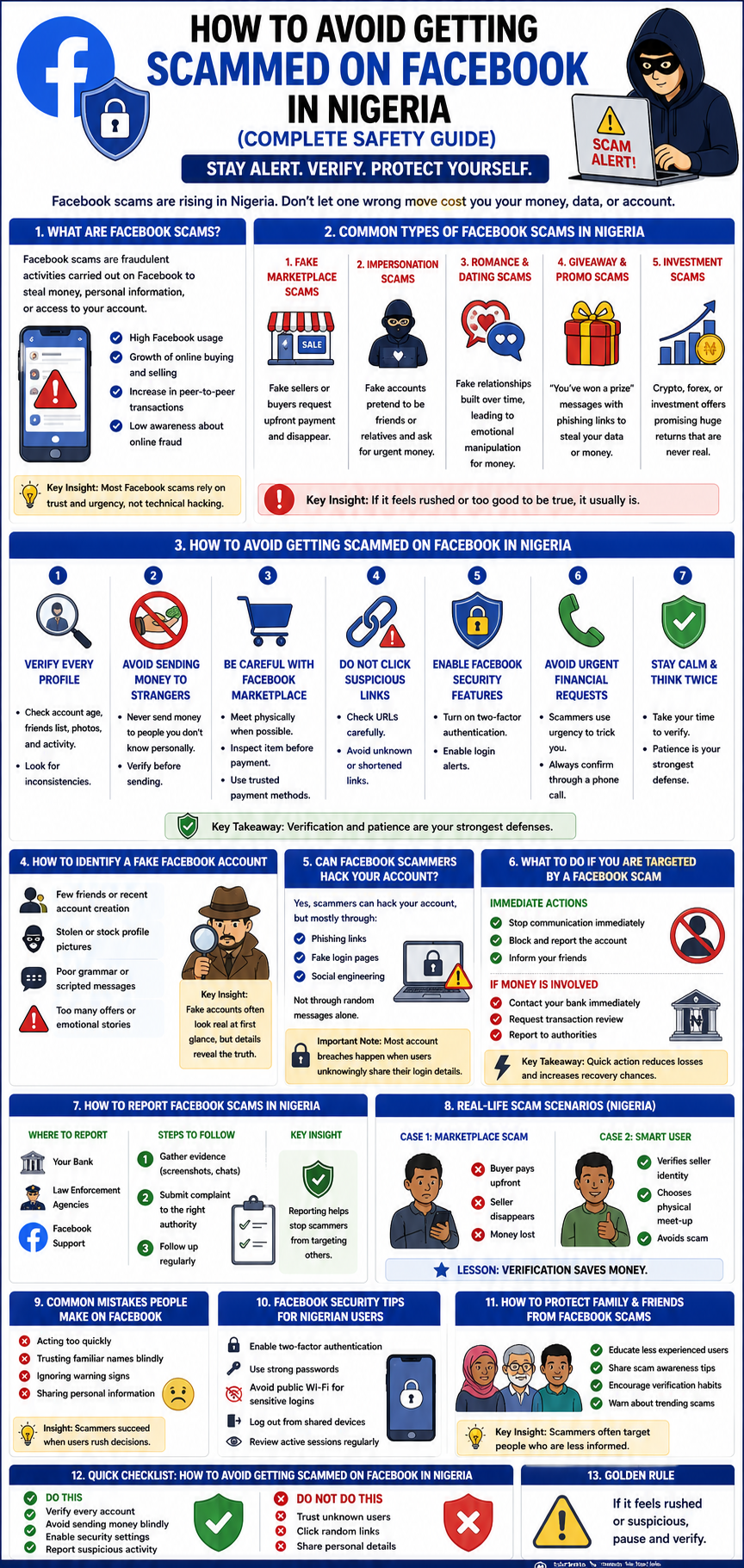
Facebook Scam Prevention Guide (Nigeria)
Common Scams:
- Marketplace scams
- Impersonation scams
- Investment scams
Warning Signs:
- Urgent requests
- Fake profiles
- Suspicious links
Protection Tips:
- Verify identity
- Enable two-factor authentication
- Avoid sharing personal details
Golden Rule:
If it feels rushed or suspicious, pause and verify.
FAQ
How can I avoid Facebook scams in Nigeria?
Verify profiles, avoid sending money to strangers, and use Facebook security features like two-factor authentication.
What are common Facebook scams in Nigeria?
Common scams include fake marketplace deals, impersonation scams, romance scams, and fake promotions.
How do I know if a Facebook account is fake?
Check account history, friends list, profile activity, and message behavior. Fake accounts often lack real engagement.
What should I do if I get scammed on Facebook?
Stop communication, report the account, contact your bank, and gather evidence for authorities.
Can Facebook scammers hack my account?
Yes, mainly through phishing links and fake login pages. Avoid sharing your login details anywhere.
Is it safe to buy items on Facebook Marketplace in Nigeria?
Yes, but only if you verify the seller and avoid upfront payments without inspection.
Can I recover money lost to Facebook scams?
Recovery is possible in some cases, especially if you act quickly and report to your bank immediately.
Conclusion
Knowing how to avoid getting scammed on Facebook in Nigeria is no longer optional. It is a necessary skill for anyone using social media today.
Most scams succeed because people act quickly without verifying. A few extra minutes of caution can save you from losing money or personal information.
Start with simple steps:
- Enable your Facebook security settings
- Verify every transaction or request
- Stay alert and avoid pressure
If this guide has helped you, consider sharing it with friends or family. Someone else may avoid a costly mistake because of it.
What about you? Have you ever encountered a Facebook scam, and how did you handle it?