Online shopping has made life easier for millions of Nigerians. Today, you can buy phones, clothes, gadgets, books, food items, beauty products, and even home appliances without leaving your house. Platforms like Instagram, Facebook, WhatsApp, TikTok, and independent online stores have created countless opportunities for buyers and sellers.
Unfortunately, not every online vendor is genuine.
Every year, many Nigerians lose money to fake online stores, fraudulent social media accounts, and dishonest vendors. Some customers pay for products that never arrive. Others receive items that look completely different from what was advertised.
This growing problem has made many people ask important questions:
- How do I know if an online vendor is genuine in Nigeria?
- What are the signs of a fake online seller?
- How can I avoid being scammed by online vendors?
- How can I safely buy from WhatsApp vendors?
- What should I check before paying an online seller?
The good news is that there are reliable ways to verify online vendors before sending your hard-earned money.
By the end of this guide, you will know exactly how to verify an online vendor in Nigeria, identify warning signs, avoid online scams, and shop safely from Nigerian online stores.
Why Online Shopping Scams Are Increasing in Nigeria
Before learning how to identify legitimate vendors, it is important to understand why online shopping scams continue to grow.
Growth of Social Commerce
Social commerce refers to buying and selling products directly through social media platforms.
In Nigeria, platforms such as Instagram, Facebook, WhatsApp, and TikTok have become major marketplaces. Thousands of small businesses operate exclusively through social media.
This growth has created opportunities for genuine entrepreneurs, but it has also attracted scammers looking to exploit unsuspecting buyers.
Increased Use of Instagram and WhatsApp Vendors
Many Nigerian consumers now prefer shopping through Instagram and WhatsApp because it is convenient.
Instead of visiting a physical store, customers simply:
- Browse products online
- Send a message
- Make payment
- Wait for delivery
While this process is convenient, it also makes it easier for fake vendors to operate anonymously.
Lack of Consumer Awareness
Many online shoppers do not know how to perform proper vendor verification.
Some people:
- Pay immediately without research
- Ignore warning signs
- Trust screenshots without verification
- Fall for unrealistic discounts
Scammers often target buyers who are eager to make quick purchases.
Why Fraudsters Target Online Buyers
Fraudsters understand human psychology.
They often use:
- Limited-time offers
- Massive discounts
- Emotional marketing
- Fake testimonials
- Pressure tactics
These strategies encourage buyers to make quick decisions without verifying the vendor.
Common Online Shopping Scam Statistics in Nigeria
Nigeria’s digital economy continues to expand rapidly, with millions of online transactions occurring every year.
As online shopping increases, reports of fraud and fake vendors have also risen. Consumer protection agencies and financial institutions regularly warn Nigerians to verify sellers before making payments.
The lesson is simple:
The more online shopping grows, the more important vendor verification becomes.
What Makes an Online Vendor Legit?
Many people assume a vendor is legitimate simply because they have a social media page. That assumption can be costly.
A genuine online vendor displays certain characteristics that distinguish them from scammers.
Characteristics of Genuine Online Businesses
Legitimate vendors typically have:
- Clear business information
- Consistent branding
- Genuine customer reviews
- Original product photos
- Professional communication
- Transparent pricing
- Reliable customer service
They are willing to answer questions and provide proof of their legitimacy.
How Legitimate Vendors Operate
A genuine business focuses on building long-term customer relationships.
They understand that trust is the foundation of sustainable growth.
Most legitimate vendors:
- Respond professionally
- Provide detailed product information
- Honor agreements
- Deliver products as promised
- Handle complaints responsibly
Why Trust and Transparency Matter
Trust reduces uncertainty.
When customers trust a vendor, they are more likely to:
- Make purchases
- Recommend the business
- Leave positive reviews
- Become repeat customers
Transparency helps build this trust.
A vendor who openly shares information about their business is usually more trustworthy than one who hides important details.
The Difference Between a Real Vendor and a Scam Vendor
| Legitimate Vendor | Scam Vendor |
|---|---|
| Provides business details | Hides identity |
| Uses original product images | Uses stolen images |
| Has customer reviews | Has little or no proof |
| Offers customer support | Disappears after payment |
| Has clear policies | Avoids answering questions |
| Builds long-term relationships | Focuses on quick payments |
Understanding these differences can help you avoid costly mistakes.
Check Whether the Vendor Has a Registered Business
One of the most effective ways to determine whether an online vendor is genuine is by checking if the business is registered.
Why CAC Registration Matters
In Nigeria, businesses are registered through the Corporate Affairs Commission.
Business registration demonstrates that a company has taken steps to operate legally.
Although registration alone does not guarantee honesty, it adds an important layer of credibility.
How to Verify CAC Registration
Before making a large purchase, ask the vendor for:
- Registered business name
- CAC registration number
- Business registration certificate
You can compare the information provided with publicly available records.
A genuine vendor usually has no problem sharing these details.
Understanding Business Names and Limited Companies
You may encounter:
- Business Name registrations
- Limited Liability Companies
- Partnerships
All of these can be legitimate forms of business registration.
The important thing is that the vendor can provide verifiable information.
When Lack of Registration Should Raise Concern
Not every small business is registered, especially new startups.
However, caution is necessary when:
- Large payments are involved
- The vendor refuses to provide information
- No other trust signals are available
The absence of registration should encourage further verification.
Practical Example: Verifying a Nigerian Business Before Payment
Imagine you want to buy a laptop worth ₦500,000 from an Instagram vendor. Also read: How to Avoid Fake Vendors on Instagram in Nigeria
Before sending payment:
- Ask for the registered business name.
- Request CAC details.
- Check customer reviews.
- Verify delivery history.
- Request recent transaction proof.
Spending ten minutes on verification could save hundreds of thousands of naira.
Examine the Vendor’s Social Media Presence
A vendor’s social media account often reveals valuable information about their credibility.
How Long Has the Account Existed?
Older accounts generally inspire more confidence than newly created ones.
Look for:
- Posting history
- Account age
- Consistent activity
An account created two days ago with expensive products deserves extra scrutiny.
Consistency of Posts
Legitimate businesses typically post regularly.
Signs of a genuine account include:
- Product updates
- Customer feedback
- Delivery posts
- Educational content
- Behind-the-scenes activities
Consistency shows that the business is actively operating. Also read: 20 Most Profitable Businesses in Nigeria with Low Capital – A Comprehensive Guide (2026 Edition)
Engagement Quality
High follower counts do not always indicate trustworthiness.
Pay attention to:
- Likes
- Comments
- Shares
- Customer questions
Authentic engagement often reflects a genuine audience.
Genuine Comments vs Fake Comments
Fake vendors sometimes purchase fake followers and comments.
Watch for repetitive comments such as:
- Nice product
- Great page
- Awesome
If comments seem unnatural or repetitive, investigate further.
Red Flags in Social Media Profiles
Warning signs include:
- Recently created accounts
- No customer interactions
- Comments disabled
- No tagged customers
- No delivery evidence
- Inconsistent branding
How Fake Vendors Manipulate Followers
Many scammers buy thousands of fake followers to appear trustworthy.
Remember:
A page with 100,000 followers can still be fraudulent.
Always focus on engagement quality rather than follower numbers alone. Also read: How to Build Trust with Customers as a Nigerian Vendor 2026
Review Customer Testimonials and Feedback Carefully
One of the strongest trust signals for online vendor verification in Nigeria is customer feedback.
However, not all testimonials are genuine.
Learning how to evaluate reviews properly can help you avoid online scams.
Why Reviews Matter
Reviews provide evidence that real people have successfully purchased from the vendor.
Positive feedback can reveal:
- Product quality
- Delivery reliability
- Customer service standards
- Overall customer satisfaction
A vendor with hundreds of satisfied customers generally poses less risk than one with no reviews at all.
Where to Find Genuine Reviews
Look for reviews on:
- Google Business Profiles
- Facebook pages
- Instagram highlights
- Independent review platforms
- Website testimonials
Do not rely on a single source.
Cross-check multiple platforms whenever possible.
How to Spot Fake Testimonials
Signs of suspicious reviews include:
- Generic wording
- Identical writing styles
- No customer names
- No profile pictures
- Excessive praise without details
Real reviews often contain specific experiences and product details.
Checking Google Reviews
Google reviews are often more difficult to manipulate than social media screenshots.
Look for:
- Number of reviews
- Review dates
- Detailed customer experiences
- Vendor responses
Facebook Recommendations
Facebook recommendations can provide valuable insights. Also read: How to Avoid Getting Scammed on Facebook in Nigeria (Complete Safety Guide)
Pay attention to:
- Customer complaints
- Response quality
- Resolution of issues
Independent Review Platforms
Independent review websites can offer unbiased opinions about a business.
Search the vendor’s name online and see what previous customers are saying.
Asking Previous Customers
One of the safest verification methods is contacting past customers directly.
Politely ask:
- Did you receive your order?
- Was the product as described?
- Would you buy again?
Real customers often provide honest answers.
Verify Product Photos and Videos
One of the easiest ways to identify a fake online vendor is by carefully examining their product photos and videos.
Many fraudulent sellers steal images from foreign websites, online marketplaces, or legitimate businesses to deceive customers.
Why Original Product Photos Matter
Original photos show that the vendor actually possesses the products they claim to sell.
When a vendor uses genuine photos:
- You can see the actual item available for sale.
- Product quality becomes easier to assess.
- Customers gain confidence in the seller.
Trusted online sellers in Nigeria usually upload their own photos and videos regularly.
Reverse Image Search Techniques
A powerful way to verify a vendor is through reverse image searches.
Simply:
- Save the product image.
- Upload it to Google Images.
- Review the results.
If the same image appears on dozens of unrelated websites, the vendor may not own the product.
This method is especially useful when buying:
- Phones
- Laptops
- Fashion items
- Jewelry
- Electronics
How to Detect Stolen Images
Watch for:
- Professional studio images with no business branding
- Photos copied directly from foreign websites
- Images that look different from the vendor’s usual posts
- Watermarks belonging to another company
These can indicate that the seller is not showing actual inventory.
Requesting Live Product Videos
A legitimate vendor should be willing to provide a current video of the product.
Ask them to:
- Record today’s date alongside the item
- Show multiple angles
- Demonstrate product functionality
Scammers often avoid such requests because they do not have the product.
Asking for Real-Time Proof
For expensive purchases, request:
- Live videos
- Packaging videos
- Warehouse photos
- Recent delivery updates
A genuine business typically has no reason to refuse.
Case Study: Vendor Using Stock Images vs Actual Inventory
Imagine two Instagram vendors selling the same smartphone.
Vendor A:
- Uses photos copied from a foreign website.
- Refuses to send additional images.
- Has no delivery videos.
Vendor B:
- Shows original photos.
- Sends real-time videos.
- Posts customer deliveries regularly.
Which vendor appears more trustworthy?
Most buyers would confidently choose Vendor B.
Check for Clear Contact Information
One of the strongest trust signals for online businesses in Nigeria is transparency.
Legitimate businesses are usually easy to contact.
Business Phone Numbers
A genuine vendor should provide:
- A reachable phone number
- WhatsApp contact information
- Customer support lines where applicable
Try calling or messaging before making payment.
Email Addresses
Professional businesses often use dedicated email addresses.
Examples:
While Gmail addresses are common among small businesses, a business domain email often signals greater professionalism.
Physical Addresses
Many legitimate businesses operate from:
- Shops
- Offices
- Warehouses
- Distribution centers
Ask for a location when possible.
If a vendor refuses to provide any location information, proceed carefully.
Website Contact Pages
A professional website should include:
- Phone numbers
- Email addresses
- Business addresses
- Contact forms
Missing contact details can be a warning sign.
Google Maps Verification
Search the business location on Google Maps.
Check:
- Customer reviews
- Photos
- Business listings
A verified location increases confidence.
Why Anonymous Vendors Are Risky
When a seller hides:
- Their name
- Their business location
- Their contact information
You may have little recourse if something goes wrong.
Transparency usually indicates accountability.
Evaluate Communication Style and Professionalism
The way a vendor communicates often reveals whether they are trustworthy.
Response Time
Professional vendors value customer inquiries.
While they may not respond instantly, they should reply within a reasonable timeframe.
Long delays before purchase can indicate future service problems.
Clarity of Information
Legitimate vendors provide clear answers regarding:
- Pricing
- Delivery
- Product specifications
- Refund policies
Vague responses should raise concerns.
Professional Customer Service
Observe how the vendor treats customers.
Good signs include:
- Respectful language
- Patience
- Detailed explanations
- Willingness to answer questions
Product Knowledge
A genuine seller understands their products.
They should be able to explain:
- Features
- Benefits
- Specifications
- Usage instructions
Scammers often provide generic answers.
How Scammers Often Communicate
Common scammer behaviors include:
- Rushing customers into payment
- Avoiding detailed questions
- Becoming defensive when asked for proof
- Using emotional pressure
Never allow anyone to pressure you into making a quick decision.
Look for a Professional Website
Although many businesses operate entirely through social media, a website can add another layer of credibility.
Why Websites Increase Trust
Websites help businesses appear more established.
They also provide:
- Business information
- Product details
- Customer support channels
- Company policies
Signs of a Genuine Website
Look for:
- Professional design
- Functional pages
- Contact information
- Consistent branding
- Product descriptions
Secure HTTPS Certificates
Check whether the website begins with:
https://
The padlock icon indicates that the connection is secure.
While HTTPS alone does not guarantee legitimacy, reputable websites generally use it.
About Us Pages
A trustworthy business usually explains:
- Who they are
- What they do
- Their mission
- Their history
Scam websites often have little or no company information.
Return Policies
A legitimate online store should clearly explain:
- Returns
- Exchanges
- Refund eligibility
This demonstrates accountability.
Terms and Conditions
Professional businesses provide clear terms governing transactions.
Privacy Policies
Privacy policies explain how customer data is handled.
Their presence often reflects greater professionalism.
Verify Payment Methods Before Sending Money
One of the most important online shopping safety tips in Nigeria is verifying payment methods.
Many scams succeed because buyers send money without checking who is receiving it.
Warning Signs of Unsafe Payment Requests
Be cautious if a vendor:
- Demands immediate payment
- Refuses secure payment options
- Requests unusual payment methods
- Pressures you to act quickly
These are common scam tactics.
Personal Accounts vs Business Accounts
While some small businesses use personal accounts, business accounts generally inspire greater confidence. Also read: 20 Cheapest Businesses to Start from Home in Nigeria – A Comprehensive Guide (2026)
Business accounts often display:
- Registered business names
- Improved professionalism
- Better accountability
Secure Payment Gateways
Trustworthy websites commonly use secure payment processors.
Examples include:
- Card payments
- Bank transfers through verified gateways
- Reputable online payment systems
Secure gateways help protect customer information.
Payment-on-Delivery Options
For certain products and locations, payment-on-delivery can reduce risk.
However, availability may vary depending on the vendor and logistics arrangements.
Escrow Services and Buyer Protection
Escrow systems hold payment until products are delivered.
Although not widely used by all Nigerian vendors, they provide extra protection for high-value purchases. Also read: How to Avoid Fake Vendors on Twitter (X) in Nigeria (Complete Safety Guide)
Protecting Your Financial Information
Never share:
- ATM PINs
- Banking passwords
- One-time passwords (OTPs)
- Debit card security codes unnecessarily
Legitimate vendors will never ask for these details.
Common Red Flags That Suggest an Online Vendor May Be Fake
Knowing the warning signs can save you from becoming a victim. Also read: How to Avoid Getting Scammed on TikTok in Nigeria (Complete Safety Guide)
Prices That Are Too Good to Be True
A brand-new iPhone selling for half the market price should raise immediate suspicion.
If a deal looks unbelievable, verify carefully.
Pressure to Pay Immediately
Scammers frequently use urgency to prevent proper verification.
Examples include:
- “Last item available”
- “Offer expires in 10 minutes”
- “Pay now before someone else buys it”
No Customer Reviews
A complete absence of reviews is concerning, especially for businesses claiming to have served many customers.
Recently Created Social Media Accounts
Brand-new accounts selling expensive products deserve extra scrutiny.
Poor Grammar and Inconsistent Information
Frequent inconsistencies in:
- Product descriptions
- Pricing
- Contact information
can indicate fraud.
Refusal to Provide Verification
A genuine vendor should welcome reasonable verification requests.
Refusal to provide proof is a major warning sign.
No Physical Address
Businesses that completely hide their location may be difficult to trace if problems occur.
No Refund Policy
A vendor unwilling to discuss refunds may not intend to resolve customer issues.
Multiple Customer Complaints
Search online for:
- Scam reports
- Negative reviews
- Customer complaints
Repeated complaints often reveal patterns of misconduct.
Quick Red Flag Checklist
Avoid making payment if a vendor:
- Uses stolen images
- Refuses verification
- Has no reviews
- Hides contact information
- Uses pressure tactics
- Has inconsistent business details
- Offers unrealistic discounts
These signs do not always prove fraud individually, but several together should trigger serious caution.
How to Verify an Instagram Vendor in Nigeria
Instagram has become one of the biggest online marketplaces in Nigeria. Thousands of businesses sell products ranging from smartphones and fashion items to beauty products and home appliances.
Unfortunately, fake vendors also use Instagram to target unsuspecting buyers.
If you are wondering how to verify an Instagram vendor in Nigeria, follow these practical steps before making payment. Also read: How to Avoid Getting Scammed on Telegram in Nigeria (Complete Safety Guide)
Analyze Follower Quality
Many people assume that a vendor with thousands of followers is trustworthy.
This is not always true.
Some fake vendors buy followers to appear credible.
Instead of focusing only on follower count, check:
- Engagement rates
- Genuine comments
- Customer interactions
- Tagged posts
A page with 5,000 active followers is often more trustworthy than one with 100,000 fake followers.
Check Tagged Posts
Tagged posts can reveal real customer experiences.
Look for:
- Customers posting received products
- Delivery confirmations
- User-generated content
- Product reviews
If nobody has tagged the vendor despite years of operation, investigate further.
Review Story Highlights
Professional vendors often organize story highlights such as:
- Customer Reviews
- Deliveries
- Product Videos
- Frequently Asked Questions
- Business Information
These highlights provide valuable evidence of genuine business activities.
Examine Customer Interactions
Pay attention to how the vendor responds to comments.
Good signs include:
- Prompt responses
- Professional language
- Helpful answers
A vendor who ignores customer inquiries may not prioritize customer service.
Ask for Recent Delivery Evidence
Request proof of recent deliveries.
Examples include:
- Dispatch videos
- Courier receipts
- Delivery confirmations
- Customer acknowledgments
Most genuine vendors are happy to provide this information.
Verify Business Information
Before making payment:
- Ask for CAC registration details
- Verify phone numbers
- Check other social media accounts
- Confirm website information
Consistency across platforms often indicates legitimacy.
How to Verify a WhatsApp Vendor Before Payment
WhatsApp has become one of the most popular business platforms in Nigeria. Also read: How to Avoid Getting Scammed on WhatsApp in Nigeria
Many legitimate businesses operate successfully through WhatsApp Business.
However, scammers also use the platform extensively.
Use WhatsApp Business Verification Features
A professional vendor should ideally use WhatsApp Business. Also read: How to Avoid Fake Vendors on Instagram in Nigeria
Look for:
- Business profile information
- Business description
- Catalogs
- Business hours
- Contact details
These features add credibility.
Review Catalog Information
A complete catalog often indicates that the vendor takes their business seriously.
Check for:
- Product descriptions
- Pricing
- Product images
- Business branding
Request Recent Customer References
Ask for contact details of previous customers willing to provide feedback.
You can politely inquire about:
- Product quality
- Delivery experience
- Customer service
Ask for Video Proof
Request a live video showing:
- The product
- Packaging process
- Available inventory
This is one of the most effective ways to avoid fake vendors on WhatsApp.
Verify Social Media Presence
Cross-check whether the WhatsApp vendor also has:
- TikTok
- Website
Businesses with multiple online touchpoints generally appear more credible.
Cross-Check Business Information
Ensure that:
- Phone numbers match
- Business names are consistent
- Contact details are accurate
Inconsistencies should prompt further investigation.
How Nigerian Consumers Can Shop Safely Online
Safe online shopping in Nigeria requires caution and patience.
Many scams succeed because buyers rush the process.
The following online shopping safety tips can significantly reduce your risk.
Research Before Payment
Never make payment immediately after seeing a product advertisement.
Spend time researching:
- Vendor reputation
- Customer reviews
- Business history
- Delivery records
Even ten minutes of research can prevent major losses.
Start With Small Purchases
If you are dealing with a vendor for the first time:
- Test with a small order
- Evaluate the experience
- Confirm reliability
This strategy minimizes potential losses.
Save Conversations and Receipts
Always keep records of:
- Chat messages
- Payment receipts
- Product descriptions
- Delivery promises
These records may become important if disputes arise.
Use Protected Payment Channels
Whenever possible:
- Use secure payment gateways
- Avoid suspicious payment requests
- Verify account names before transferring money
Double-check payment details before sending funds.
Avoid Emotional Buying Decisions
Scammers often exploit emotions.
Common tactics include:
- Flash sales
- Massive discounts
- Limited-time offers
- Scarcity marketing
Remain calm and verify before paying.
Report Suspicious Vendors
If you encounter suspicious behavior:
- Warn others
- Report fake accounts
- Leave honest reviews
- Notify relevant authorities where necessary
Your report could prevent someone else from becoming a victim.
What to Do If You Are Scammed by an Online Vendor
Despite taking precautions, scams can still occur.
If you become a victim, act quickly.
Gather Evidence Immediately
Collect all available evidence, including:
- Screenshots
- Payment receipts
- Chat histories
- Product advertisements
- Vendor contact details
The more evidence you have, the stronger your case.
Contact Your Bank
Immediately notify your bank.
In some situations, rapid reporting may help initiate investigations or transaction reviews.
Although recovery is not guaranteed, acting quickly improves your chances.
Report to Relevant Authorities
Depending on the circumstances, you may report fraudulent activities to:
- Consumer protection agencies
- Law enforcement authorities
- Cybercrime reporting channels
Provide all supporting evidence.
File Complaints Through Consumer Protection Channels
Consumer protection organizations often assist in dispute resolution and public awareness efforts.
Submitting a formal complaint may help build a record against repeat offenders. Also read: JAMB Support Contact – JAMB Help Centre | JAMB Complaint Solution
Warn Other Potential Victims
Share factual experiences through:
- Reviews
- Social media warnings
- Consumer forums
Avoid exaggeration and focus on verifiable facts.
Learn From the Experience
Although losing money is painful, each experience provides lessons that can improve future online shopping decisions.
Use the incident to strengthen your verification process.
Real Examples of Online Vendor Scams and Lessons Learned
Understanding common scam patterns can help you recognize them before becoming a victim.
Fake Electronics Vendors
A common scam involves expensive gadgets. Also read: How to Avoid Getting Scammed on Facebook in Nigeria (Complete Safety Guide)
A buyer sees:
- Brand-new phones
- Laptops
- Gaming consoles
at prices far below market value.
After payment:
- The vendor disappears
- Communication stops
- No product is delivered
Lesson: Always verify inventory and compare prices with market rates.
Fashion Store Scams
Fashion scams are common on Instagram and WhatsApp.
A customer orders:
- Shoes
- Clothing
- Handbags
using attractive photos copied from foreign websites.
The result may be:
- No delivery
- Wrong product
- Poor-quality substitute
Lesson: Request original photos and customer reviews before payment.
Fake Delivery Services
Some fraudsters pretend to be logistics companies. Also read: How to Track a Fraudster in Nigeria (Realistic Guide)
They demand:
- Additional fees
- Clearance charges
- Insurance payments
after customers have already paid for products.
Lesson: Confirm delivery arrangements directly with the original vendor.
Lessons Every Buyer Should Learn
Regardless of the scam type, several patterns appear repeatedly:
- Victims skipped verification.
- Unrealistic discounts influenced decisions.
- Pressure tactics encouraged rushed payments.
- Lack of reviews was ignored.
- Business details were not verified.
The safest approach is always:
Research → Verify → Confirm → Purchase Safely
This simple process can help you avoid most online shopping scams in Nigeria.
Online Vendor Verification Checklist
Before sending money to any online seller, go through this simple checklist. If a vendor cannot satisfy most of these requirements, proceed with caution.
Essential Vendor Verification Table
| Verification Item | Check |
|---|---|
| CAC Registration | ✓ |
| Website Available | ✓ |
| Customer Reviews | ✓ |
| Original Product Photos | ✓ |
| Active Social Media Presence | ✓ |
| Clear Contact Information | ✓ |
| Secure Payment Methods | ✓ |
| Refund Policy Available | ✓ |
| Physical Address Provided | ✓ |
| Professional Communication | ✓ |
Quick Verification Rule
Before paying any online vendor, ask yourself these questions:
- Have I verified the business?
- Have I checked customer reviews?
- Have I confirmed the product is real?
- Have I spoken with the vendor?
- Have I checked for scam complaints online?
If the answer to any of these questions is “No,” spend more time researching before making payment.
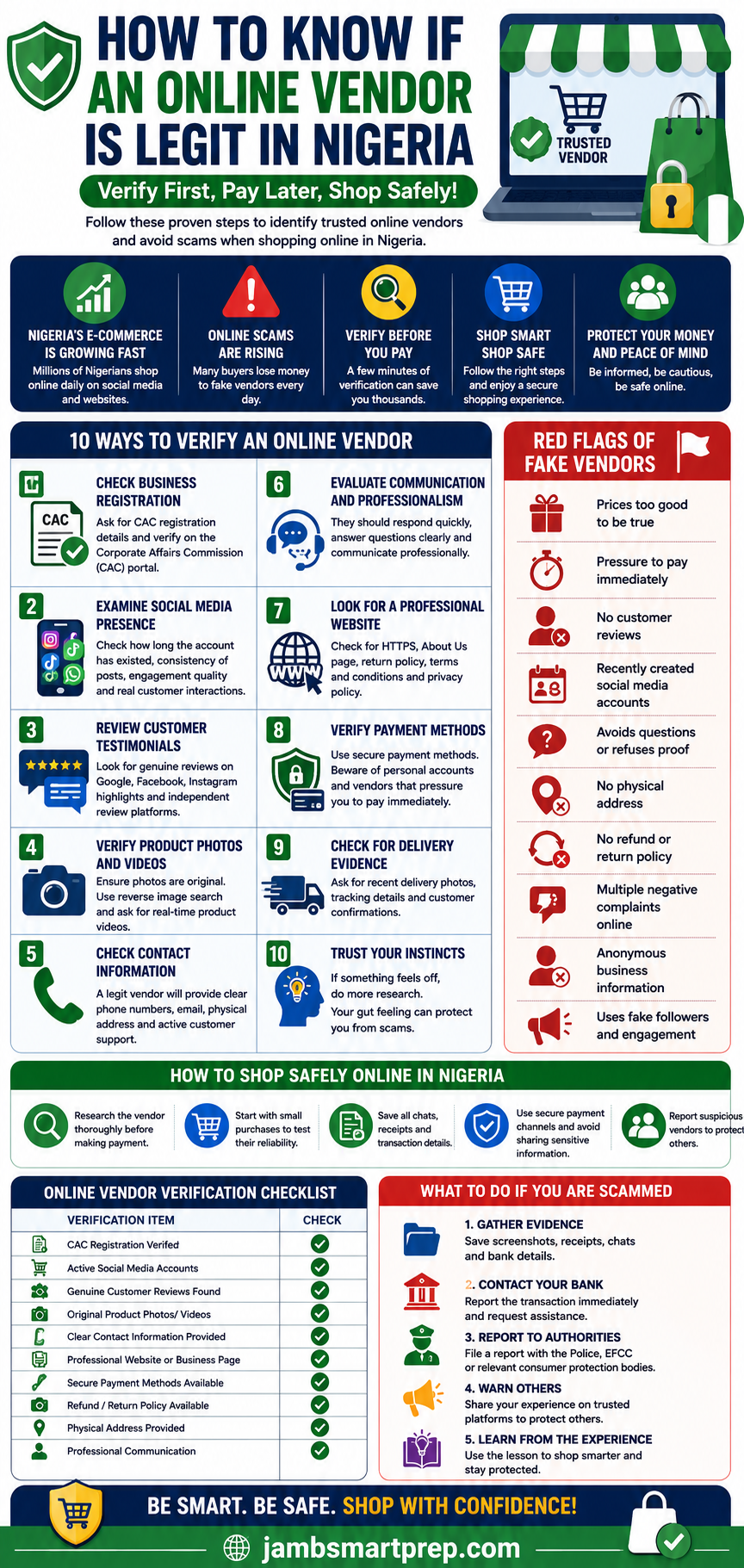
10 Signs an Online Vendor Is Legit in Nigeria
This section can be converted into an infographic for visual SEO and improved reader engagement.
10 Signs an Online Vendor Is Legit in Nigeria
✅ CAC Registration Available
✅ Original Product Photos
✅ Verified Customer Reviews
✅ Professional Website
✅ Secure Payment Options
✅ Active Social Media Accounts
✅ Clear Contact Information
✅ Transparent Pricing
✅ Refund and Return Policy
✅ Positive Customer Feedback
Visual Flow
Research → Verify → Confirm → Purchase Safely
Why This Matters
Many online shopping scams can be avoided simply by following this four-step process.
Successful online buyers do not rush.
They verify first and pay later.
Frequently Asked Questions
How do I know if an online vendor is genuine in Nigeria?
Check for business registration, customer reviews, original product photos, clear contact information, and evidence of successful deliveries. Genuine vendors are usually willing to provide verification when asked.
Can I trust an Instagram vendor without a website?
Yes, some legitimate businesses operate entirely through Instagram. However, you should verify their reviews, delivery history, business information, and customer interactions before making payment.
How can I verify a WhatsApp vendor?
Check whether they use WhatsApp Business, request product videos, ask for customer references, verify social media accounts, and confirm business details before sending money.
What are the biggest online shopping scam warning signs?
Some major red flags include:
- Unrealistic discounts
- No customer reviews
- Recently created accounts
- Pressure to pay immediately
- Refusal to provide proof
- No physical address
- Poor communication
Is CAC registration proof that a vendor is genuine?
Not necessarily.
CAC registration increases credibility, but it should be combined with other checks such as reviews, delivery records, customer feedback, and business transparency.
How can I avoid fake vendors on social media?
You can avoid fake vendors by:
- Checking reviews
- Requesting product videos
- Researching the business
- Verifying contact details
- Avoiding rushed payments
Should I trust vendors with no reviews?
Be cautious.
A lack of reviews does not automatically mean the vendor is fraudulent, but it increases risk. Consider starting with a small purchase before making larger transactions.
What should I do before sending payment?
Before paying:
- Verify business details.
- Check customer reviews.
- Confirm product authenticity.
- Review refund policies.
- Verify payment information.
Taking these steps can significantly reduce your chances of being scammed.
Conclusion
Online shopping has transformed the way Nigerians buy products and services. From smartphones and fashion items to educational materials and household goods, consumers now enjoy access to thousands of online vendors.
However, convenience should never replace caution.
The rise of fake vendors on Instagram, WhatsApp, Facebook, TikTok, and independent websites means buyers must become smarter and more vigilant.
The good news is that most online scams follow predictable patterns.
When you understand how to verify an online vendor in Nigeria, you can identify warning signs early and avoid costly mistakes.
Key Takeaways
- Always verify before making payment.
- Genuine vendors welcome reasonable verification.
- Reviews, registration, and transparency matter.
- Original photos are stronger than stock images.
- Trust should be earned, not assumed.
- One verification step can save thousands of naira.
Remember:
Research → Verify → Confirm → Purchase Safely
Following this simple process can dramatically reduce your risk when shopping online. Also read: Safe Ways to Pay Online in Nigeria (Complete Guide to Secure Payments)
Things You Can Do Before Purchasing Online
Before your next online purchase, use the verification checklist provided in this guide.
Have you ever encountered a fake online vendor in Nigeria? What lessons did you learn from the experience?
Share your experience in the comments to help other readers stay safe.
You may also find these related guides helpful:
Related Articles
- How to Build Trust with Customers as a Nigerian Vendor
- How to Avoid Fake Vendors on WhatsApp in Nigeria
- Safe Online Shopping Tips for Nigerians
- How to Start an Online Business in Nigeria
- WhatsApp Business Marketing Strategies for Nigerian Entrepreneurs
- 10 Signs an Online Vendor Is Legit in Nigeria
- Online Shopping Safety Checklist
- Red Flags of Fake Online Vendors
- How to Verify a Vendor Before Payment
- Online Scam Prevention Guide for Nigerians
Important Links
- How to Build Trust with Customers as a Nigerian Vendor
- How to Avoid Fake Vendors on Instagram
- WhatsApp Shopping Safety Guide
- How to Verify CAC Registration Online
- Best Payment Methods for Safe Online Shopping
- Common Online Scam Tactics in Nigeria
- Consumer Rights for Online Shoppers in Nigeria
- How to Report Online Fraud in Nigeria
Additional FAQ Questions
- How do I know if an online vendor is genuine in Nigeria?
- How can I verify a WhatsApp vendor before payment?
- Can I trust Instagram vendors without websites?
- What are the warning signs of fake online sellers?
- Is CAC registration enough to prove legitimacy?
- What should I check before buying from an online store?
By implementing the tips in this guide, Nigerian consumers can shop with greater confidence, reduce the risk of fraud, and make safer online purchasing decisions. This approach not only protects your money but also helps support genuine businesses that are working hard to build trust and deliver value.