
Preparing for JAMB can feel overwhelming. The syllabus is wide, the competition is high, and there is always that pressure to perform well in a single exam that determines your admission.
Many students make the same mistake every year. They try to read everything at once without knowing what really matters. After weeks of study, they still feel unprepared.
If you are in that situation, you are not alone.
The truth is simple. You do not need to master every single line of the JAMB syllabus to score high. What you need is focus.
By the end of this guide, you will clearly understand the JAMB areas of concentration 2026 for Biology, Chemistry, Physics, and Mathematics, and how to use them to improve your chances of scoring above 250.
What Are JAMB Areas of Concentration?
JAMB areas of concentration are the most important topics in each subject. These are the topics that questions are frequently drawn from every year.
Instead of reading the entire syllabus blindly, smart students focus more on these high-yield areas.
Why Smart Students Focus on Areas of Concentration
- Limited time: Most candidates prepare within a few months
- Repeated questions: JAMB often repeats similar questions in different formats
- Better retention: It is easier to remember focused topics
- Higher confidence: You walk into the exam knowing what to expect
Reading everything is good, but reading the right things is better.
How JAMB Sets Questions (Important Insight Students Ignore)
The Joint Admissions and Matriculation Board sets questions directly from the official JAMB syllabus 2026.
However, there is a pattern.
- Many questions are recycled from past exams
- Some are slightly modified versions of previous questions
- A large percentage comes from core topics
Key Insight
Education experts in Nigeria often note that over 60 percent of JAMB questions are similar to past questions in structure or concept.
Also, performance statistics show that a large number of candidates score below 200 each year. This is not always due to difficulty, but poor preparation strategy.
Students who focus on JAMB areas of concentration 2026 tend to perform better because they study with direction.
JAMB Biology Areas of Concentration 2026
When it comes to JAMB Biology topics, certain areas appear consistently.
Core Topics You Must Not Skip
- Cell structure and organization
- Ecology and environmental biology
- Genetics and inheritance
- Evolution
- Human physiology (digestive, respiratory, reproductive systems)
- Plant structure and functions
Frequently Repeated JAMB Biology Questions
- Classification of living organisms
- Food chains and ecosystems
- Mendelian genetics
These topics form the foundation of many Biology questions.
How to Study Biology for JAMB Effectively
- Use diagrams for better understanding
- Practice past questions regularly
- Focus on definitions and biological processes
Example:
A student preparing for Medicine in Lagos improved her Biology score from 52 to 78 simply by focusing on genetics and human physiology.
JAMB Chemistry Areas of Concentration 2026
Understanding JAMB Chemistry topics requires both theory and calculation.
High-Scoring Chemistry Topics
- Atomic structure
- Chemical bonding
- Periodic table
- Stoichiometry
- Acids, bases, and salts
- Organic chemistry
Topics That Carry More Marks
- Chemical equations
- Gas laws
- Electrolysis
Best Way to Read Chemistry for JAMB
- Memorize key formulas
- Solve calculations daily
- Understand reactions instead of cramming
Tip: Many questions in Chemistry are calculation-based. Practice is essential.
JAMB Physics Areas of Concentration 2026
Physics can be challenging, but focusing on the right topics makes it manageable.
Important Physics Topics to Focus On
- Mechanics (motion, force, energy)
- Heat and thermodynamics
- Waves and sound
- Electricity and magnetism
- Optics
Commonly Repeated Questions in Physics
- Ohm’s law
- Newton’s laws of motion
- Work, energy, and power
Practical Physics Study Tips
- Practice calculations consistently
- Understand formulas and their applications
- Relate concepts to real-life situations
JAMB Mathematics Areas of Concentration 2026
Many students fear Mathematics, but it becomes easier with the right focus.
Key Topics You Must Master
- Algebra
- Trigonometry
- Geometry
- Statistics and probability
- Basic calculus
High-Yield Areas in Mathematics
- Quadratic equations
- Logarithms
- Coordinate geometry
How to Read JAMB Mathematics and Pass
- Practice daily without skipping
- Use CBT apps to improve speed
- Focus on accuracy under time pressure
How to Use Areas of Concentration to Score Above 250
Knowing the topics is not enough. You must apply them correctly.
Step-by-Step Study Strategy
- Get the official JAMB syllabus 2026
- Highlight key topics for each subject
- Create a simple study timetable
- Practice CBT past questions daily
- Revise every weekend
Consistency is more important than long study hours.
Sample Weekly Study Plan (For Science Students)
Monday: Biology + Chemistry
Tuesday: Physics + Mathematics
Wednesday: Biology revision + CBT practice
Thursday: Chemistry + Physics
Friday: Mathematics + revision
Saturday: Full CBT mock test
Sunday: Light revision and rest
This structure helps balance all subjects effectively.
Best Resources to Prepare for JAMB 2026
To succeed, you need the right tools.
Recommended Resources
- JAMB past questions and answers
- CBT practice apps (widely used by Nigerian students)
- Standard textbooks such as:
- New School Biology
- Essential Chemistry
- Senior Secondary Physics
- Modern Mathematics
Many top-performing students combine textbooks with CBT apps for better results.
Common Mistakes Students Make While Preparing for JAMB
Avoid these if you want to succeed:
- Reading without practicing questions
- Ignoring weak subjects
- Studying without a timetable
- Relying on exam malpractice (“expo”)
Students who depend on shortcuts often struggle in the long run.
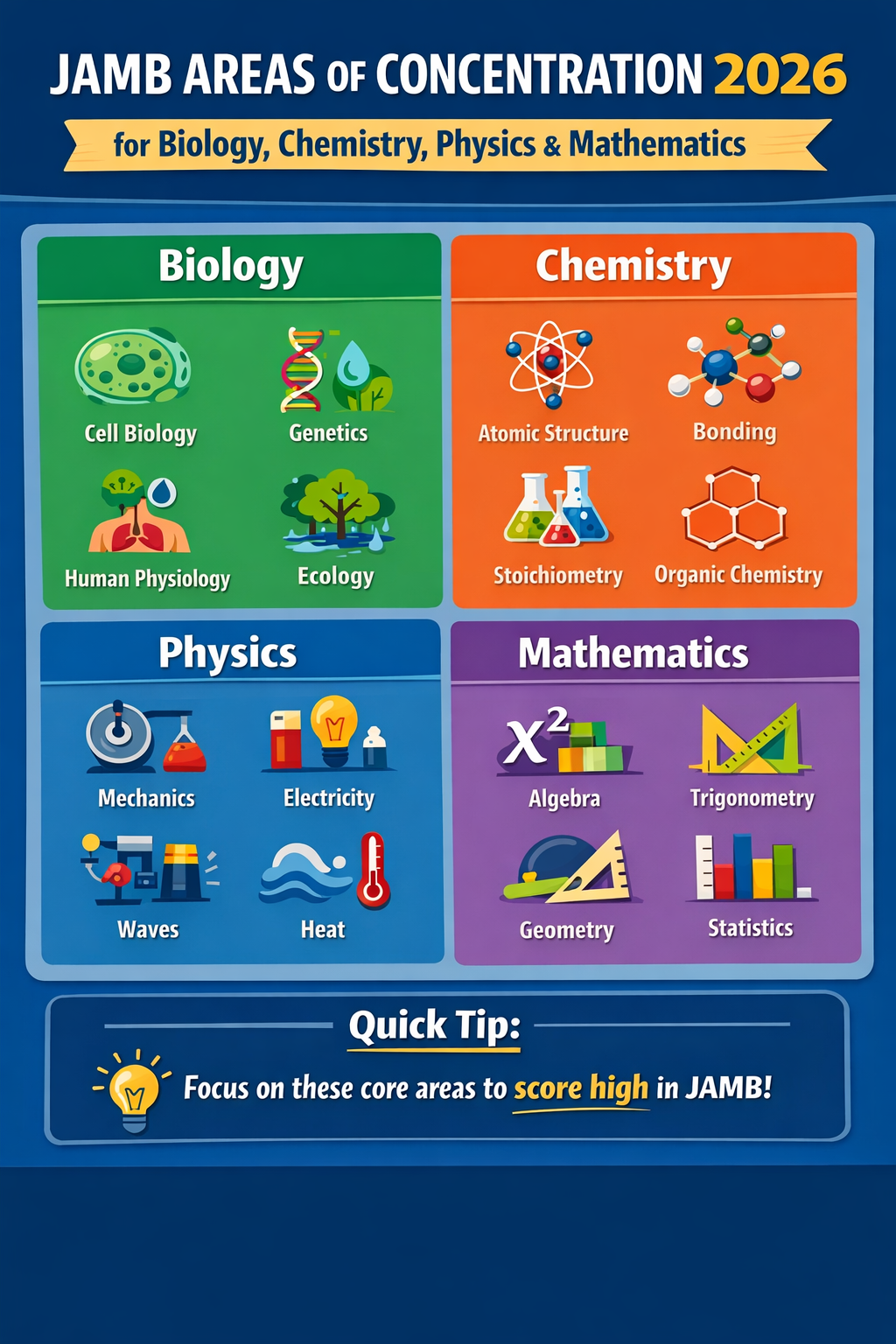
JAMB Areas of Concentration 2026
Biology:
Cell Biology | Genetics | Ecology | Human Physiology
Chemistry:
Atomic Structure | Bonding | Stoichiometry | Organic Chemistry
Physics:
Mechanics | Electricity | Waves | Heat
Mathematics:
Algebra | Trigonometry | Geometry | Statistics
Quick Tip: Focus on these core areas first before expanding to other topics.
Frequently Asked Questions (FAQs)
What are the most important topics in JAMB Biology 2026?
Cell structure, genetics, ecology, and human physiology are among the most important.
Areas of concentration for JAMB Chemistry and Physics?
Chemistry focuses on atomic structure, bonding, and calculations, while Physics focuses on mechanics, electricity, and energy.
How to read JAMB Mathematics and pass?
Practice daily, focus on algebra and trigonometry, and use CBT tools to improve speed.
Best way to study JAMB science subjects?
Combine textbooks with past questions, focus on key topics, and revise consistently.
Can I pass JAMB by focusing only on areas of concentration?
Yes, but it is best to use them as a guide while still covering the full syllabus gradually.
How many hours should I study daily for JAMB?
2–5 hours of focused study daily is enough if done consistently.
What is the best way to prepare for JAMB CBT exams?
Practice with CBT apps, simulate exam conditions, and manage your time effectively.
Final Thoughts
Success in JAMB is not about reading everything. It is about reading with purpose.
When you focus on the JAMB areas of concentration 2026, you reduce stress, save time, and improve your chances of scoring high.
Start small. Pick one subject today and focus on the key topics. Practice past questions and track your progress.
Call to Action:
Start with one subject today. Focus on the key topics, practice past questions, and track your progress. If you have already started preparing, share your biggest challenge or study method.
Let’s hear from you:
Which course are you planning to study in university? Share it in the comments and let’s guide you further.