
Biology is one of the most chosen subjects in JAMB, yet many students struggle to score high.
If you have ever felt overwhelmed by the number of topics or found it hard to remember what you studied, you are not alone. Many candidates face the same challenge every year.
For students aiming for courses like Medicine, Nursing, Pharmacy, or Microbiology, a strong Biology score is not optional. It is essential.
The truth is simple. You do not need to read everything blindly. What you need is focus.
In this guide, you will find the most important topics to read for JAMB Biology 2026, along with practical tips to help you prepare effectively and improve your chances of success.
Overview of JAMB Biology Exam Structure
The Biology paper is set by the Joint Admissions and Matriculation Board and follows a clear structure.
Key details:
- Total questions: About 40
- Format: Computer-Based Test (CBT)
- Question type: Objective (multiple choice)
What JAMB tests:
- Theory and definitions
- Diagrams and labeling
- Application of concepts
Understanding the JAMB Biology syllabus 2026 helps you prepare in a more organized way.
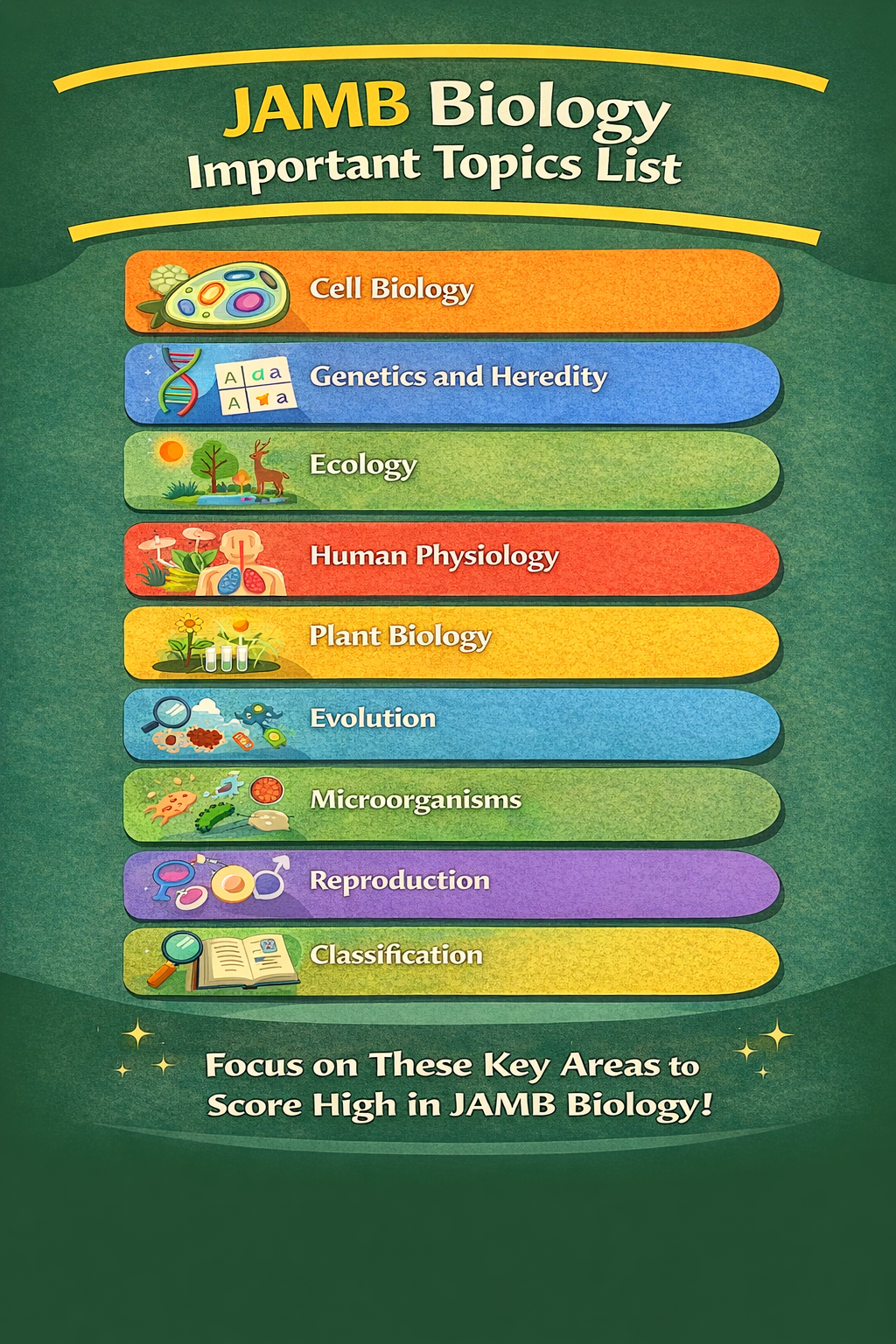
JAMB Biology Important Topics List 2026 (Areas of Concentration)
1. Cell Biology (Very Important)
This is one of the most important JAMB Biology topics.
Focus on:
- Cell structure and functions
- Differences between plant and animal cells
- Mitosis and meiosis
Why it matters:
Cell Biology forms the foundation of many other topics. Once you understand it, other areas become easier.
2. Genetics and Heredity
Genetics is another high-scoring area if studied well.
Key areas:
- Mendelian genetics
- Dominant and recessive traits
- DNA and chromosomes
Common questions:
- Punnett squares
- Inheritance patterns
Students who practice these questions often gain easy marks.
3. Ecology
Ecology deals with how organisms interact with their environment.
Topics to read:
- Ecosystems
- Food chains and food webs
- Environmental conservation
Study tip:
Focus on relationships between organisms rather than memorizing definitions.
4. Human Physiology
This section is very important and appears frequently.
Key systems:
- Digestive system
- Respiratory system
- Circulatory system
- Nervous system
Why it matters:
Most questions here are straightforward if you understand how the systems work.
5. Plant Biology
Plant topics are common in JAMB Biology.
Focus areas:
- Photosynthesis
- Transpiration
- Plant nutrition
- Plant reproduction
Diagrams are often used, so practice drawing and labeling.
6. Evolution
Evolution helps explain how organisms change over time.
Topics include:
- Theories of evolution
- Natural selection
- Adaptation
This area is usually theory-based and easy to understand.
7. Microorganisms
Microorganisms are small but important in Biology.
Study:
- Bacteria, viruses, fungi
- Diseases and prevention
- Useful microorganisms
Questions here often relate to everyday life.
8. Reproduction in Organisms
Reproduction is another important topic.
Key areas:
- Sexual and asexual reproduction
- Human reproductive system
- Fertilization and development
9. Classification of Living Things
This topic focuses on grouping organisms.
Topics include:
- Kingdom classification
- Characteristics of organisms
- Basic taxonomy
Understanding classification helps you answer many objective questions easily.
Recommended Approach to Studying JAMB Biology
1. Use JAMB Past Questions PDF
This is one of the most effective study tools.
Why it works:
- Questions are often repeated
- You understand the exam pattern
- You improve speed
2. Study With Diagrams
Biology is a visual subject.
What to do:
- Practice drawing diagrams
- Label correctly
- Revise regularly
3. Use Mnemonics and Memory Techniques
Some topics are easier to remember with simple tricks.
Examples:
- Use acronyms
- Create short memory phrases
This helps improve retention.
4. Practice With CBT Apps
Following the right JAMB CBT study tips can make a big difference.
Benefits:
- Simulates real exam conditions
- Improves time management
- Builds confidence
Common Mistakes Students Make in JAMB Biology
Avoid these mistakes:
- Cramming without understanding
- Ignoring diagrams
- Skipping important topics
- Not practicing past questions
These errors often lead to poor performance.
Smart Study Plan for JAMB Biology 2026
A simple plan can help you stay consistent.
Sample Weekly Plan:
- Monday: Cell biology
- Tuesday: Genetics
- Wednesday: Human physiology
- Thursday: Ecology
- Friday: Plant biology
- Weekend: Revision and mock tests
Stick to your plan and adjust when needed.
Real-Life Example: How a Student Scored High in JAMB Biology
Amina, a student from Kano, struggled with Biology at first.
She read textbooks but did not practice questions.
What she changed:
- Practiced past questions daily
- Used diagrams to study
- Revised regularly
Result:
Her score improved significantly, and she gained admission into a health-related course.
Her story shows that consistent practice works.
JAMB Biology Important Topics (Quick Summary)
- Cell biology
- Genetics and heredity
- Ecology
- Human physiology
- Plant biology
- Evolution
- Microorganisms
- Reproduction
- Classification
Frequently Asked Questions (FAQs)
What are the most important topics in JAMB Biology 2026?
The key topics include:
- Cell biology
- Genetics
- Human physiology
- Ecology
How can I pass JAMB Biology easily?
Focus on understanding concepts, practice past questions, and revise regularly.
Is JAMB Biology difficult?
It depends on preparation. With proper study and practice, it becomes easier.
Are JAMB Biology questions repeated?
Yes, many questions are repeated or slightly modified.
What is the best way to study Biology for JAMB?
Combine:
- Reading
- Diagrams
- Practice
- Revision
How many hours should I study Biology daily?
At least 1–2 hours daily is enough if you are consistent.
Do I need diagrams for JAMB Biology?
Yes, diagrams are important and often appear in questions.
Conclusion: Focus on Key Topics and Study Smart
You do not need to read everything to succeed in JAMB Biology.
Focus on the important topics, understand the concepts, and practice regularly.
With consistency and the right approach, you can improve your score and achieve your admission goals.
Call to Action (CTA)
Start your preparation today:
- Study the topics listed in this guide
- Download JAMB past questions
- Practice CBT regularly
Which topic in Biology do you find most difficult? Share in the comments.
Which course are you planning to study in university? Let us know in the comments.
If this guide helped you, share it with other students preparing for JAMB. It might help them succeed too.