
Chemistry is one subject that many JAMB candidates approach with caution. Not because it is impossible, but because it requires both understanding and practice.
If you have ever struggled with chemical equations or found calculations confusing, you are not alone. Many students preparing for JAMB face the same challenge every year.
For those aiming for competitive courses such as Medicine, Pharmacy, Engineering, or Laboratory Science, Chemistry is a core subject. A weak score here can affect your overall chances of admission.
The good news is simple. You do not need to read everything in your textbook. You only need to focus on the right topics.
In this guide, you will find the most important JAMB Chemistry key topics for 2026, along with practical strategies to help you prepare effectively and improve your score.
Overview of JAMB Chemistry Exam Structure
The Chemistry paper is set by the Joint Admissions and Matriculation Board and follows a clear format.
Key details:
- Total questions: About 40
- Format: Computer-Based Test (CBT)
- Question type: Objective (multiple choice)
What to expect:
- Theory-based questions
- Calculations and numerical problems
- Chemical equations and reactions
Understanding the JAMB Chemistry syllabus 2026 helps you avoid reading irrelevant topics and focus on what truly matters.
JAMB Chemistry Key Topics 2026 (Areas of Concentration)
1. Atomic Structure (Very Important)
Atomic structure is the foundation of Chemistry.
Focus on:
- Structure of the atom
- Electron configuration
- Atomic number and mass number
Why it matters:
Many other topics depend on this. If you understand atomic structure, topics like bonding and periodic trends become easier.
2. Chemical Bonding
This topic explains how atoms combine.
Key areas:
- Ionic bonding
- Covalent bonding
- Metallic bonding
Study focus:
- How bonds are formed
- Properties of compounds
Students who understand bonding often find other Chemistry topics less difficult.
3. Stoichiometry (Calculations)
This is one of the most important areas in JAMB Chemistry.
Topics include:
- Mole concept
- Balancing chemical equations
- Mass-volume relationships
Common questions:
- Gas calculations
- Quantity relationships
Practice is very important here. The more you solve, the better you become.
4. States of Matter
This topic deals with the physical forms of substances.
Focus on:
- Solids, liquids, and gases
- Gas laws
- Kinetic theory
Understanding how particles behave helps you answer conceptual questions easily.
5. Thermochemistry
Thermochemistry explains heat changes in reactions.
Key concepts:
- Endothermic reactions
- Exothermic reactions
- Energy changes
Questions from this area are usually direct if you understand the basics.
6. Chemical Equilibrium
Equilibrium focuses on reversible reactions.
Important areas:
- Dynamic equilibrium
- Le Chatelier’s principle
This topic often appears in JAMB and is relatively easy to score with proper understanding.
7. Acids, Bases, and Salts
This is one of the easiest sections if studied well.
Study:
- Properties of acids and bases
- pH scale
- Neutralization
Many questions here are straightforward and predictable.
8. Organic Chemistry
Organic Chemistry may seem complex, but JAMB focuses on basic concepts.
Key areas:
- Hydrocarbons
- Functional groups
- Naming compounds
Tip:
Focus on structures and simple reactions rather than advanced details.
9. Electrolysis and Redox Reactions
This topic combines theory and application.
Focus on:
- Oxidation and reduction
- Electrochemical cells
- Electrolysis processes
10. Periodic Table
The periodic table helps you understand element behavior.
Key areas:
- Periodic trends
- Group properties
Understanding trends reduces the need for memorization.
Recommended Approach to Studying JAMB Chemistry
1. Use JAMB Past Questions PDF
This is one of the most reliable ways to prepare.
Benefits:
- Helps you identify repeated questions
- Shows exam patterns
- Builds confidence
2. Master Key Formulas
Chemistry involves calculations, so formulas are important.
What to do:
- Create a formula notebook
- Revise regularly
- Practice applying formulas
3. Practice Calculations Daily
Do not avoid calculations.
Instead:
- Solve problems every day
- Start with simple questions
- Move to more complex ones
Consistency makes a big difference.
4. Use CBT Practice Platforms
Following the right JAMB CBT study tips can improve your performance.
Advantages:
- Simulates real exam conditions
- Improves speed
- Reduces exam anxiety
Common Mistakes Students Make in JAMB Chemistry
Many students lose marks because of avoidable mistakes.
Avoid these:
- Skipping calculation questions
- Memorizing formulas without understanding
- Ignoring important topics
- Poor time management during exams
Smart Study Plan for JAMB Chemistry 2026
A structured plan helps you stay consistent.
Sample Weekly Plan:
- Monday: Atomic structure
- Tuesday: Chemical bonding
- Wednesday: Stoichiometry
- Thursday: Organic chemistry
- Friday: Acids and bases
- Weekend: Revision and mock tests
You can adjust this plan based on your strengths and weaknesses.
Real-Life Example: How a Student Improved in Chemistry
Chinedu, a student from Enugu, used to struggle with Chemistry.
He avoided calculations and focused only on theory.
What changed:
- He started practicing calculations daily
- Used JAMB past questions regularly
- Reviewed topics every weekend
Result:
His score improved significantly, and he secured admission into an Engineering course.
This shows that improvement is possible with the right approach.
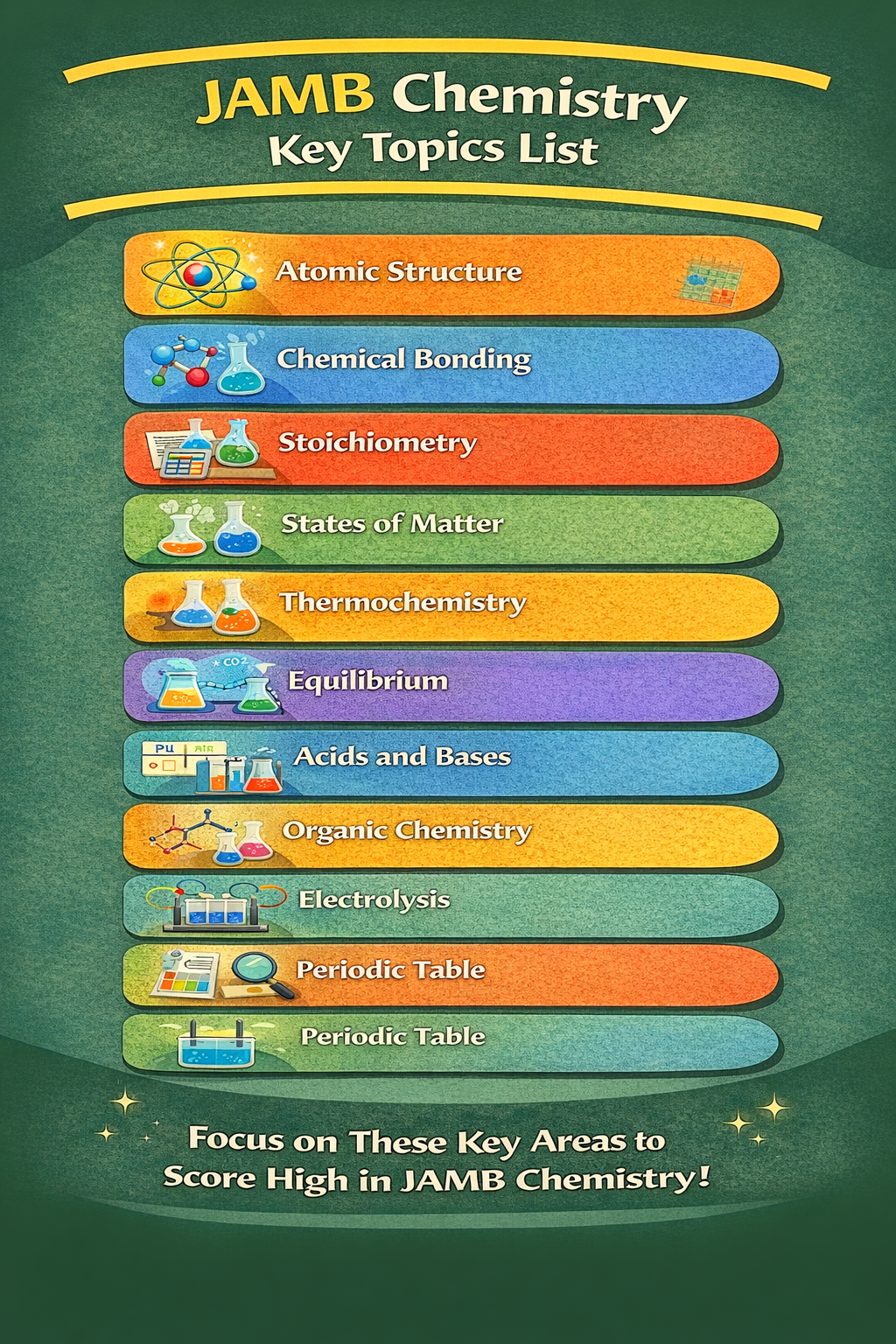
JAMB Chemistry Key Topics (Quick Summary)
- Atomic structure
- Chemical bonding
- Stoichiometry
- States of matter
- Thermochemistry
- Equilibrium
- Acids and bases
- Organic chemistry
- Electrolysis
- Periodic table
Frequently Asked Questions (FAQs)
What are the most important topics in JAMB Chemistry 2026?
The most important topics include:
- Atomic structure
- Stoichiometry
- Chemical bonding
- Organic chemistry
- Acids and bases
How can I pass JAMB Chemistry easily?
Focus on understanding concepts, practice calculations, and revise consistently.
Is JAMB Chemistry calculation-based?
Yes. It includes both theory and calculations, but calculations carry significant marks.
Are JAMB Chemistry questions repeated?
Yes. Many questions are repeated or slightly modified from past exams.
What is the best way to study Chemistry for JAMB?
Combine:
- Theory reading
- Formula practice
- Past questions
- CBT simulations
How many hours should I study Chemistry daily?
2–3 hours daily is enough if you stay consistent and focused.
Can I pass JAMB Chemistry without a strong background?
Yes. With consistent practice and proper guidance, you can improve significantly.
Conclusion: Focus on Key Topics and Practice Consistently
Chemistry becomes easier when you focus on the right topics and practice regularly.
You do not need to read everything. Focus on the key areas outlined in this guide, understand the concepts, and solve as many questions as possible.
With discipline and consistency, you can improve your performance and score high in JAMB Chemistry.
Call to Action (CTA)
Start your preparation today:
- Study the key topics listed in this guide
- Download JAMB past questions
- Practice CBT regularly
Which Chemistry topic do you find most difficult? Share in the comments.
Which course are you planning to study in university? Let us know in the comments.
If you found this guide helpful, share it with other students preparing for JAMB.