
Preparing for JAMB can feel overwhelming, especially when you are not sure what to focus on. Many students keep asking the same question: Should I read the JAMB syllabus 2026 or focus on past questions?
Some spend months reading textbooks without practicing questions. Others jump straight into past questions without understanding the topics. Both approaches often lead to average results.
The real problem is not lack of effort. It is lack of direction.
If you are serious about passing UTME and scoring above 250, you need a smarter approach.
By the end of this guide, you will clearly understand the difference between JAMB 2026 syllabus vs past questions, when to use each one, and how to combine both effectively to improve your score.
Understanding the JAMB Syllabus 2026
The JAMB syllabus is the official guide that outlines everything you are expected to study for the UTME.
It is prepared by the Joint Admissions and Matriculation Board and serves as the foundation for all exam questions.
Simply put, if a topic is not in the syllabus, it will not appear in the exam.
What the JAMB Syllabus Contains
The JAMB syllabus 2026 is more than just a list of topics. It includes:
- Detailed topics for each subject
- Recommended textbooks
- Learning objectives for each topic
- Key areas of focus
For example, in Biology, the syllabus may list topics like genetics, ecology, and human physiology, along with what you are expected to understand in each area.
Benefits of Using the JAMB Syllabus
Many students ignore the syllabus, but it is one of the most important tools you have.
Here is why:
- Gives clear direction
You know exactly what to study and what to skip - Saves time
You avoid reading irrelevant materials - Ensures full coverage
You do not miss important topics
If you want to understand how to pass JAMB 2026, the syllabus is your starting point.
What Are JAMB Past Questions?
JAMB past questions are collections of real exam questions from previous years.
They are often available as PDFs or CBT practice apps used by Nigerian students.
These questions reflect the actual format, style, and difficulty level of the UTME.
Why Past Questions Are Powerful
Past questions are not just for practice. They reveal patterns.
Here is what makes them effective:
- Many questions are repeated or slightly modified
- You become familiar with exam structure
- You improve speed and accuracy
Students who consistently practice JAMB past questions tend to perform better in the exam.
Statistics and Real Insight
From student experiences and coaching centers across Nigeria, it is often observed that:
- A significant number of JAMB questions are repeated directly or indirectly each year
- Students who combine syllabus reading with past questions practice are more likely to score above 250
This explains why past questions remain one of the best study tools.
JAMB 2026 Syllabus vs Past Questions: Key Differences
Understanding the difference between both helps you use them correctly.
Comparison Table
| Aspect | JAMB Syllabus | Past Questions |
|---|---|---|
| Purpose | Guide topics | Show exam pattern |
| Coverage | Broad | Specific |
| Usage | Learning | Practice |
| Advantage | Full understanding | Exam familiarity |
The syllabus teaches you what to read. Past questions show you how questions come.
Which One Should You Focus On?
The honest answer is simple.
You need both.
Relying on only one will limit your performance.
When to Focus More on Syllabus
- At the beginning of your preparation
- When learning new topics
- When building understanding
At this stage, your goal is to understand concepts clearly.
When to Focus More on Past Questions
- Closer to the exam
- During revision
- When testing your knowledge
Here, your goal is to apply what you have learned.
How to Combine JAMB Syllabus and Past Questions Effectively
If you are looking for the best way to study for JAMB, this is it.
Step-by-Step Study Method
- Start with the syllabus
Pick a topic and understand it - Study the topic using textbooks or notes
Focus on key concepts - Practice past questions immediately
Apply what you just learned - Identify repeated questions
Take note of patterns - Revise weak areas
Go back and improve
This method helps you learn faster and remember longer.
Topics That Repeat Most in JAMB Exams
Some topics appear more frequently than others. These are known as JAMB areas of concentration.
Examples by Subject
Biology
- Genetics
- Ecology
- Human physiology
Chemistry
- Atomic structure
- Chemical bonding
- Acids and bases
Physics
- Mechanics
- Electricity
- Heat
Mathematics
- Algebra
- Trigonometry
- Statistics
Focusing on these topics increases your chances of scoring high.
Real-Life Case Study (Nigerian Student)
Let us compare two students preparing for UTME.
Student A
- Read only the syllabus
- Focused on textbooks
- Practiced few questions
Result: Scored around 210
Student B
- Studied the syllabus
- Practiced past questions daily
- Used CBT apps
Result: Scored above 270
The difference is clear. Combining both methods produces better results.
Common Mistakes Students Make
Many students fail not because they are not intelligent, but because they make avoidable mistakes.
- Reading without practicing questions
- Memorizing answers without understanding
- Ignoring the syllabus completely
- Starting past questions too late
Avoiding these mistakes can improve your score significantly.
Best Resources for JAMB 2026 Preparation
To prepare effectively, you need the right tools.
Recommended Study Materials
- JAMB past questions PDF
- CBT practice apps used in Nigeria
- Standard textbooks recommended in the syllabus
Popular CBT apps help simulate real exam conditions and improve speed.
Sample Study Plan Combining Both Methods
A structured plan helps you stay consistent.
Weekly Breakdown
Monday – Wednesday
- Study syllabus topics
- Read and understand concepts
Thursday – Friday
- Practice past questions
- Focus on accuracy
Saturday
- Take a full CBT mock test
Sunday
- Revise weak areas
- Review mistakes
Following this plan can improve both understanding and performance.
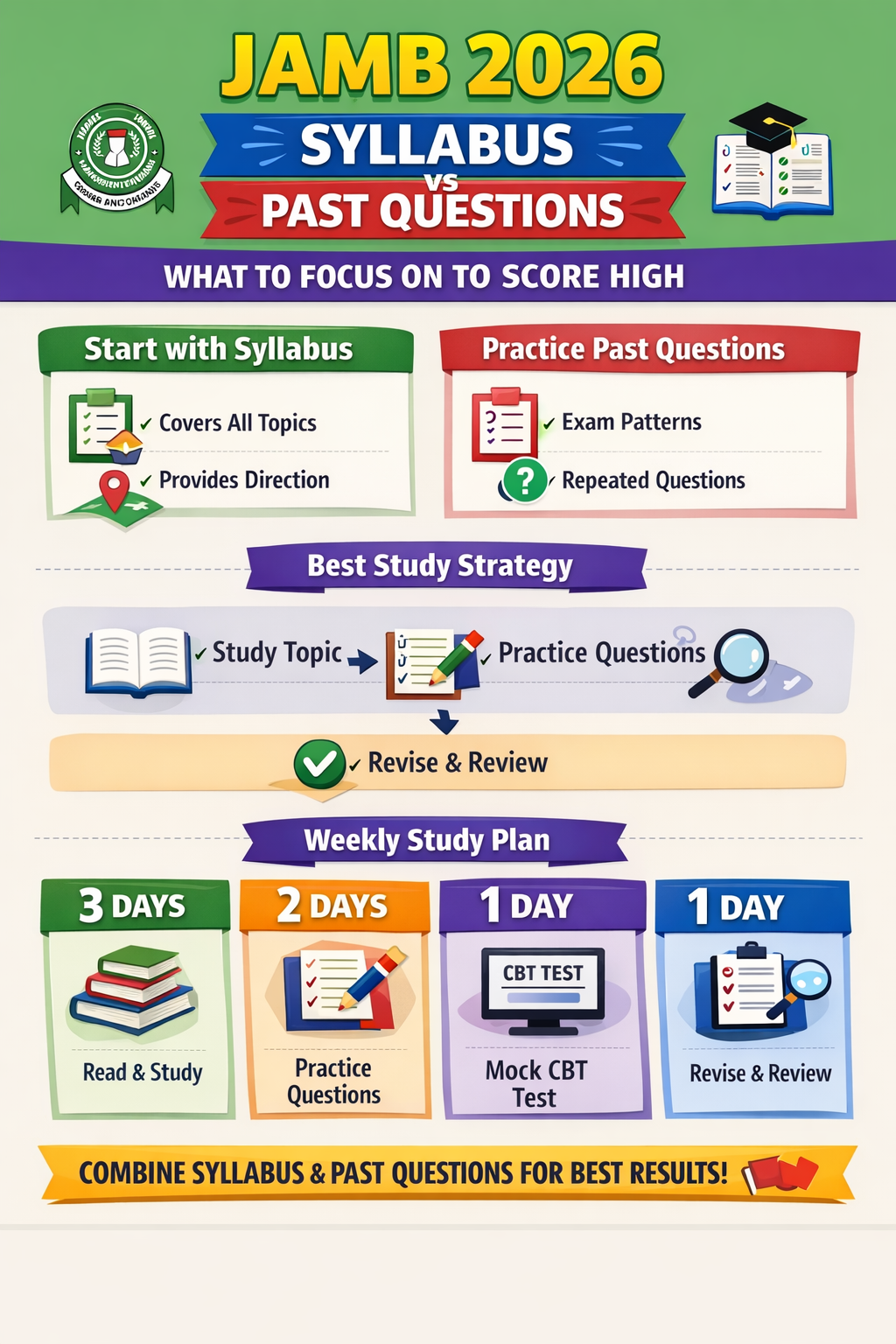
JAMB 2026 Syllabus vs Past Questions: What to Focus On to Score High
You can include a visual infographic in your blog with the following structure:
Title:
JAMB 2026 Study Strategy Guide
Section 1: Start with Syllabus
- Covers all topics
- Provides direction
Section 2: Practice Past Questions
- Shows exam pattern
- Reveals repeated questions
Section 3: Best Strategy
- Study topic → Practice questions → Revise
Section 4: Weekly Plan
- 3 days reading
- 2 days practice
- 1 mock test
- 1 revision
Frequently Asked Questions (FAQs)
Should I read JAMB syllabus or past questions?
You should use both. The syllabus helps you understand what to study, while past questions help you practice how questions are set.
Is JAMB syllabus enough to pass UTME?
No. The syllabus alone is not enough. You need past questions to understand exam patterns and improve speed.
How to use JAMB past questions effectively?
- Practice after studying each topic
- Focus on understanding answers
- Repeat questions multiple times
What topics repeat most in JAMB exams?
Common topics include:
- Biology: Genetics and ecology
- Chemistry: Atomic structure
- Physics: Mechanics
- Mathematics: Algebra
Can I pass JAMB without past questions?
It is possible but difficult. Most high-scoring students rely heavily on past questions.
How many hours should I study daily for JAMB?
A consistent 3 to 5 hours daily is effective if you focus on quality study and practice.
What is the best way to study JAMB science subjects?
- Understand concepts first
- Practice calculations
- Use diagrams and examples
- Solve past questions regularly
Conclusion
When it comes to JAMB 2026 syllabus vs past questions, the best approach is not choosing one over the other.
It is combining both in a smart and consistent way.
The syllabus gives you direction. Past questions give you experience.
Together, they give you results.
If you want to score high in UTME, start applying this method today. Pick one topic, study it, practice questions, and track your progress.
Don’t choose between syllabus and past questions. Use both. Start with one topic today, practice questions immediately, and track your progress.
Which course are you planning to study in university? Let us know in the comments.