
Preparing for WAEC can feel overwhelming, even for students who put in long hours of study. Many candidates read textbooks daily but still walk into the exam hall unsure of themselves.
The real issue is often simple. They are not following the WAEC syllabus.
You may have asked yourself at some point, “Am I even reading the right topics for WAEC?” That question alone shows why many students struggle.
The WAEC syllabus is not just a document. It is your guide, your checklist, and your study map.
By the end of this guide, you will understand how to use the WAEC syllabus effectively, focus on the right topics, and prepare in a way that actually improves your results.
What Is the WAEC Syllabus?
The WAEC syllabus 2026 is the official document that outlines everything you are expected to study for your exams. It is prepared by the exam body to guide both teachers and students.
Instead of guessing what might come out, the syllabus tells you exactly what to expect.
Key Features of the WAEC Syllabus
- Organized into subjects and detailed topics
- Includes learning objectives for each topic
- Recommends textbooks for deeper understanding
- Covers both theory and practical components
For example, in Biology, the syllabus clearly lists areas like genetics, ecology, and physiology. In Mathematics, it highlights algebra, trigonometry, and statistics.
Why the WAEC Syllabus Is Important for Exam Success
Using the syllabus is one of the most practical WAEC exam preparation tips any student can follow.
It helps you study with direction instead of relying on guesswork.
Benefits of Using the WAEC Syllabus
- Better time management: You focus only on relevant topics
- Clear study direction: You know exactly what to read
- Higher chances of good grades: You avoid missing key areas
Many top-performing students in WAEC share one common habit. They study with the syllabus from day one.
Common Mistakes Students Make Without the WAEC Syllabus
Ignoring the syllabus often leads to wasted effort. You may be reading hard but not reading smart.
Here are common mistakes:
- Studying randomly without a plan
- Ignoring important topics that WAEC repeats
- Using outdated textbooks or materials
- Relying only on past questions without understanding
A student preparing for JAMB and WAEC at the same time once shared that he spent weeks on topics that never appeared in the exam. The problem was not effort. It was direction.
Step-by-Step Guide on How to Use WAEC Syllabus Effectively
If you have ever wondered how to use WAEC syllabus, this section will guide you step by step.
Step 1 – Get the Official WAEC Syllabus
Start by downloading the WAEC syllabus PDF from a trusted source.
Make sure:
- It is the latest version
- It matches your exam year
- It covers all your subjects
Step 2 – Break Topics Into Sections
Do not try to study everything at once.
Instead:
- Divide each subject into smaller topics
- Focus on one topic at a time
- Mark completed sections
This makes studying less stressful and more organized.
Step 3 – Set Study Goals
Create simple and realistic targets.
- Daily goals: “Finish one topic in Chemistry”
- Weekly goals: “Cover three Mathematics topics”
Clear goals keep you accountable.
Step 4 – Use Recommended Textbooks
The syllabus often suggests textbooks for each subject.
Stick to these recommendations to avoid:
- Reading irrelevant materials
- Confusing explanations
- Wasting time
Step 5 – Combine With Past Questions
After studying a topic:
- Practice WAEC past questions immediately
- Identify repeated patterns
- Review your mistakes
This step connects theory with real exam practice.
WAEC Areas of Concentration You Should Focus On
Some topics appear frequently in WAEC exams. These are often called WAEC areas of concentration 2026.
High-Yield Topics Across Subjects
Biology
- Genetics
- Ecology
- Human physiology
Chemistry
- Chemical bonding
- Stoichiometry
- Acids and bases
Physics
- Electricity
- Motion
- Energy
Mathematics
- Algebra
- Trigonometry
- Graphs
Focusing on these areas increases your chances of answering familiar questions during the exam.
How to Combine WAEC Syllabus With Past Questions
Many students ask, “WAEC syllabus vs past questions which is better?” The truth is simple. You need both.
Smart Study Method
- Study a topic using the syllabus
- Practice past questions on that topic
- Review your mistakes carefully
- Revise regularly
Why This Method Works
- Reinforces understanding
- Improves exam confidence
- Helps you recognize repeated question patterns
Students who combine both methods tend to perform better than those who rely on only one.
Best Study Plan Using WAEC Syllabus
A good WAEC study guide 2026 should include both learning and practice.
Weekly Study Plan
- Monday: Study new topics
- Tuesday: Practice past questions
- Wednesday: Revise weak areas
- Thursday: Mixed practice
- Friday: Timed test
- Saturday: Mock exam
- Sunday: Revision
This structure keeps your preparation balanced and consistent.
Real-Life Example (Student Case Study)
Let us look at two students.
Student A
- Ignored the syllabus
- Studied randomly
- Relied on guesswork
Result: Average performance
Student B
- Used the WAEC syllabus
- Focused on key topics
- Practiced past questions regularly
Result: Excellent performance
The difference is clear. Smart preparation always beats hard but unfocused effort.
Best Tips on How to Pass WAEC 2026 Using the Syllabus
If your goal is to succeed, these tips will help:
- Start early with the syllabus
- Focus on important topics first
- Practice past questions daily
- Revise consistently
- Track your progress weekly
Many Nigerian students who scored A1 in multiple subjects followed this exact pattern.
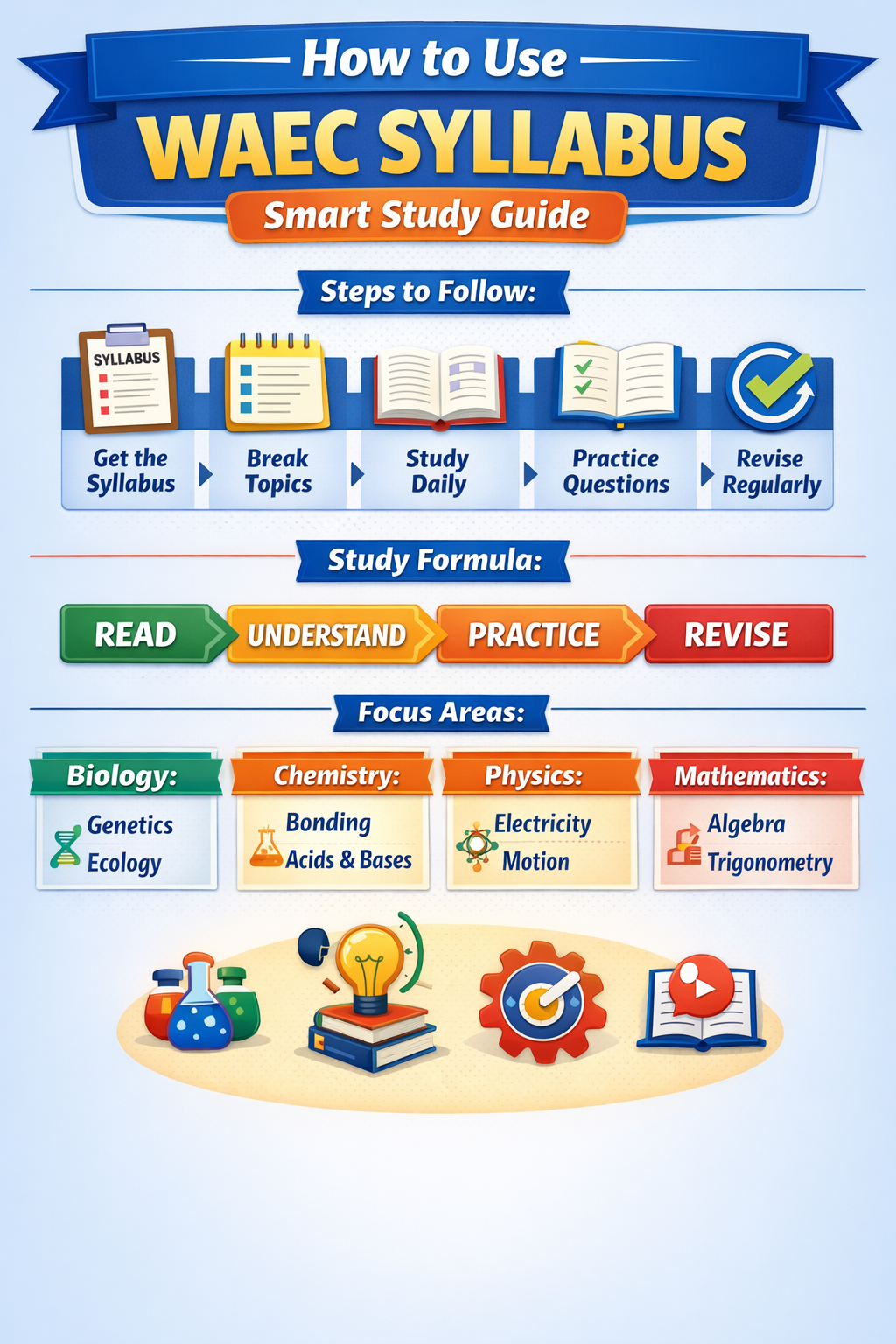
How to Use WAEC Syllabus – Smart Study Guide at a Glance
Steps to Follow:
- Step 1: Get the syllabus
- Step 2: Break topics
- Step 3: Study daily
- Step 4: Practice questions
- Step 5: Revise regularly
Study Formula:
Read → Understand → Practice → Revise
Focus Areas:
- Biology → Genetics
- Chemistry → Bonding
- Physics → Electricity
- Mathematics → Algebra
Frequently Asked Questions (FAQs)
How do I use WAEC syllabus effectively?
Break topics into smaller sections, study them one by one, and practice past questions after each topic.
Can WAEC syllabus help me pass exams?
Yes. It guides your study and ensures you cover all required topics.
What is the best way to study with WAEC syllabus?
Combine it with past questions, revise regularly, and focus on high-yield topics.
Should I use syllabus or past questions?
Use both. The syllabus builds understanding, while past questions improve exam performance.
Where can I download WAEC syllabus PDF?
You can download it from official WAEC platforms or trusted education websites.
How to read WAEC syllabus step by step?
Start with one subject, list all topics, study them in order, and tick each one after completion.
Can I pass WAEC without the syllabus?
It is possible, but risky. The syllabus gives you direction and improves your chances.
How many months should I use the syllabus to prepare?
At least 3 to 6 months of consistent study is recommended for strong results.
Does WAEC repeat questions?
Yes. Many topics repeat, although questions may be reworded.
What is the best way to study for WAEC 2026?
Use the syllabus, practice past questions, revise often, and follow a timetable.
Pro Tips for Smarter WAEC Preparation
- Study with a structured timetable
- Focus more on weak subjects
- Avoid distractions during study time
- Practice under exam conditions
- Stay consistent, even on low-motivation days
Consistency often matters more than intensity.
Conclusion
The WAEC syllabus is your roadmap. Without it, you are preparing blindly.
Students who succeed in WAEC do not just study hard. They study with direction.
Start today. Pick one subject, open the syllabus, and begin with the first topic. Study it well, practice past questions, and track your progress.
Which subject do you find most difficult right now? Share in the comments.
And one more thing.
Which course are you planning to study in university? Let us know below.