The West African Senior School Certificate Examination (WASSCE) is one of the most important exams for secondary school students in Nigeria. Among all the subjects, English Language carries a lot of weight because it is compulsory and also a requirement for admission into Nigerian universities, polytechnics, and colleges of education.
Many students struggle with English in WAEC, not because the exam is too hard, but because they don’t practice enough with past questions. Over the years, WAEC has been known to repeat questions or set them in slightly modified formats. That is why past questions are one of the best tools you can use to prepare.
In this guide, you will not only get free downloadable WAEC English past questions and answers PDF for 2026, but also learn how the exam is structured, common question patterns, and practical tips to boost your chances of success.
Why Past Questions Are Important
Past questions are more than just old exam papers. They give you an insight into WAEC’s testing style and help you focus on what matters. Here are some reasons why every student should practice with them:
-
Identify repeated questions: WAEC often repeats questions in English, especially in comprehension, summary, and objective sections.
-
Understand exam trends: By practicing, you can spot common themes like essay topics (e.g., “Write a letter to your principal” or “An essay on the importance of education”).
-
Improve time management: Practicing under exam conditions helps you know how to allocate time to objectives, essay, and comprehension sections.
-
Boost confidence: Seeing familiar questions on exam day reduces tension.
-
Track progress: You can measure your performance by timing yourself and checking answers against the marking scheme.
According to WAEC statistics, over 1.6 million candidates registered for WASSCE in 2023, and English Language was one of the most failed subjects. With proper practice using past questions, you can place yourself among the successful candidates.
Also read: How to Pass WAEC Without Expo 2026 – Proven Tips for Nigerian Students
WAEC English Exam Structure
The WAEC English exam has three main papers. Each paper tests a different skill and has its own marking scheme.
1. Paper 1: Objectives (50 questions)
-
Multiple-choice questions covering grammar, vocabulary, sentence structure, lexis and structure, and oral English.
-
This section usually takes 1 hour.
2. Paper 2: Essay/Composition
-
You will be asked to write essays, letters, debates, stories, or articles.
-
Usually, 5–7 essay topics are given, and you are required to choose one.
-
Duration: 2 hours.
-
Common essay types include:
-
Informal letters (to friends and relatives)
-
Formal letters (to principals, local government chairmen, or newspaper editors)
-
Argumentative essays (e.g., “Technology is better than agriculture”)
-
Narrative essays (e.g., “The day I will never forget”)
-
Descriptive essays (e.g., “Describe your best teacher”)
-
3. Paper 3: Test of Orals
-
This tests your listening and pronunciation skills.
-
Includes stress patterns, rhymes, intonation, and vowel/consonant sounds.
Knowing this structure helps you divide your preparation time wisely.
Commonly Repeated Questions in WAEC English
Over the years, students have observed that some topics and question formats are almost always repeated. Here are examples:
-
Comprehension passages: Usually based on social issues like corruption, education, or health.
-
Summary writing: Often taken from passages on environment, science, or morality.
-
Letter writing: Very frequent. For instance:
-
“Write a letter to your father telling him how you are coping with school life.”
-
“Write a letter to the Commissioner of Education on ways to improve your school.”
-
-
Speech or debate writing: e.g., “Write a debate on the topic: Social media is more harmful than useful.”
-
Past essay topics that have reappeared include:
-
“The day I will never forget.”
-
“My ambition in life.”
-
“The importance of education in society.”
-
Free Downloadable Past Question PDF
To make your preparation easier, we have provided a free WAEC English past questions and answers PDF (2026 edition). This file contains:
-
WAEC English past questions from 2010 to 2025
-
Detailed answers and solutions
-
Practice essay topics and marking schemes
Download WAEC English Past Questions and Answers PDF (Free 2026 Edition)
Make sure to use the PDF alongside your textbooks and class notes.
Section A — Objective / Multiple Choice (40 questions)
(Choose the correct answer; answer given after each question)
-
A sentence must always begin with a —
A. adjective B. verb C. noun D. capital letter
Answer: D -
Which is the past tense of “teach”?
A. teached B. taught C. teach D. teacheded
Answer: B -
Choose the correct plural: “criterion” —
A. criterions B. criteria C. criteriae D. criterium
Answer: B -
Which of the following is an antonym of “scarce”?
A. rare B. abundant C. negligible D. sparse
Answer: B -
“If I ____ him, I would tell him the truth.” Correct form:
A. see B. saw C. had seen D. will see
Answer: B -
Choose the correct word: “She ____ the letter before leaving.”
A. had written B. wrote C. will write D. writing
Answer: A -
Which sentence is punctuated correctly?
A. Its raining, heavily today.
B. It’s raining heavily today.
C. Its’ raining heavily today.
D. It is, raining heavily today.
Answer: B -
The correct form: “He apologized ____ being late.”
A. to B. for C. at D. with
Answer: B -
Choose the pair that shows cause and effect:
A. rain : umbrella B. cat : bark C. teacher : chalk D. fish : wings
Answer: A -
Which is the correct comparative of “good”?
A. more good B. better C. best D. gooder
Answer: B -
Identify the adjective in: “She wore a bright red dress.”
Answer: bright, red -
Which conjunction shows contrast?
A. and B. but C. so D. because
Answer: B -
Select the correct preposition: “He is proficient ____ French.”
A. on B. in C. at D. with
Answer: B -
Which word is a synonym of “assist”?
A. hinder B. help C. oppose D. ignore
Answer: B -
What part of speech is “quickly”?
A. noun B. verb C. adverb D. adjective
Answer: C -
Which is punctuated correctly for direct speech?
A. He said, “I am leaving”.
B. He said “I am leaving.”
C. He said, “I am leaving.”
D. He said, “I am leaving”.
Answer: C -
Choose correct tag question: “They are coming, ____?”
A. aren’t they B. is it C. don’t they D. didn’t they
Answer: A -
Pick the correct conditional: “If you had told me, I ____ help.”
A. would have B. will C. would D. had
Answer: A -
Which is correct: “Neither he nor she ____ ready.”
A. are B. am C. is D. were
Answer: C -
Choose the plural of “analysis”:
A. analysises B. analyses C. analyss D. analysis
Answer: B -
Which sentence uses active voice?
A. The ball was thrown by John.
B. John threw the ball.
C. The ball being thrown by John.
D. The ball thrown by John.
Answer: B -
Identify the underline error: “Each of the students have a book.”
A. Each B. of C. the students D. have
Answer: D (should be “has”) -
Which is correct relative pronoun: “The man ____ car was stolen called the police.”
A. who B. which C. whose D. whom
Answer: C -
Choose the word with stress on the first syllable:
A. control B. record (noun) C. engage D. category
Answer: D -
Pick the word that best completes: “She sings ____ than her sister.”
A. more beautifully B. beautiful C. more beautiful D. most beautifully
Answer: A -
Which is correct: “It’s been a long time ____ we met.”
A. when B. that C. which D. where
Answer: B -
Which is not a sentence fragment?
A. Because it rained. B. The man who arrived. C. He left early. D. While eating.
Answer: C -
Which punctuation ends an exclamatory sentence?
A. . B. , C. ! D. ;
Answer: C -
Which word is derived from Latin “video” meaning “I see”?
A. visual B. audible C. tactile D. gustatory
Answer: A -
Choose correct plural: “crisis” →
A. crisises B. crises C. crissi D. crisis
Answer: B -
Which is a compound noun?
A. blackboard B. run C. quickly D. tall
Answer: A -
“No sooner had he arrived ____ the meeting started.”
A. when B. than C. then D. before
Answer: B -
Which of these words is countable?
A. information B. advice C. rice D. book
Answer: D -
Select correct comparative: “far” →
A. farther B. more far C. farer D. most far
Answer: A -
Choose the correct form: “I wish I ____ more time.”
A. had B. have C. will have D. would have
Answer: A -
Which is correct idiom meaning ‘to reveal a secret’?
A. spill the beans B. break the ice C. hit the sack D. bite the bullet
Answer: A -
Which sentence is correct?
A. Between you and I, this is secret.
B. Between you and me, this is secret.
C. Between you and myself, this is secret.
D. Between us and me, this is secret.
Answer: B -
Identify the error: “She is one of those students who is hardworking.”
A. She B. is C. who D. is (should be “are”)
Answer: D -
Which word completes: “He spoke ____ confidence.”
A. with B. at C. in D. on
Answer: C -
Choose the correct synonym of “diligent”:
A. lazy B. hardworking C. careless D. erratic
Answer: B
Section B — Comprehension & Short-Answer (20 items)
(Short passages are summarized into question form; answers concise)
Passage A (summary/answers provided as model practice)
-
After reading a passage about rural healthcare improvements, question: “What was the main obstacle to clinic attendance in the village?”
Answer: Shortage of trained staff and poor road access. -
“How did the community overcome the problem?”
Answer: They established a rota of volunteer nurses and organized a community fund to repair the road. -
“Give two effects of improved clinic access on children’s health.”
Answer: Lower malaria cases; increased vaccination rates. -
From a passage about climate change: “Name one human activity contributing to the problem.”
Answer: Deforestation. -
“Suggest one local solution mentioned.”
Answer: Tree-planting and sustainable farming practices. -
Passage about a young entrepreneur: “How did she fund her start-up?”
Answer: Small loans from a cooperative and savings from part-time work. -
“What personal qualities helped her succeed?”
Answer: Persistence, good planning, and networking skills. -
Passage on corruption: “What was the author’s tone toward officials?”
Answer: Critical and disappointed. -
“What did the author propose as remedy?”
Answer: Stronger transparency laws and community watchdogs. -
Passage on education: “Why did rural enrollment increase?”
Answer: Government bursaries and community awareness campaigns.
Passage B (short passage practice)
-
“If the narrator describes the market as ‘bustling’, what does it suggest?”
Answer: Busy, lively, many people trading. -
“What does the word ‘resilient’ mean in the context of a family surviving flood?”
Answer: Able to recover quickly, adaptable. -
“Why is word choice important in comprehension answers?”
Answer: It shows accurate understanding and earns marks for precision. -
“In a poetic passage, what is imagery?”
Answer: Language that creates sensory pictures (sight, sound, touch). -
“When asked for the author’s main point, what should you include?”
Answer: A concise statement that captures the central idea. -
“How to identify bias in a passage?”
Answer: Look for one-sided arguments, omitted facts, emotive language. -
“What to do when unsure about a comprehension question?”
Answer: Re-read the relevant lines and look for direct clues/keywords. -
“Why paraphrase rather than copy?”
Answer: Paraphrasing shows understanding and avoids losing marks for irrelevant copying. -
“Give one tip for answering inference questions.”
Answer: Use contextual clues rather than rely on outside knowledge. -
“What is the value of quoting the passage sparingly?”
Answer: It supports answers but too much quoting wastes time.
Section C — Summary / Sentence Transformation / Grammar (20 items)
-
Summary practice: Reduce the sentence to one short sentence: “Despite repeated warnings about heavy rains, many residents returned to build near the river and suffered flood damage.”
Answer (model): Ignoring warnings, residents built by the river and were later flooded. -
Convert to passive: “The committee approved the new policy.”
Answer: The new policy was approved by the committee. -
Combine with a relative clause: “I saw a man. He had lost his wallet.”
Answer: I saw a man who had lost his wallet. -
Change to reported speech: “She said, ‘I will help you tomorrow.’”
Answer: She said that she would help me the next day. -
Correct the error: “He don’t like rice.”
Answer: He doesn’t like rice. -
Use “unless” in a sentence meaning “if not”: “You will fail the exam if you don’t study.”
Answer: You will fail the exam unless you study. -
Form noun from verb: “investigate” →
Answer: investigation -
Fill in preposition: “We arrived ____ the airport early.”
Answer: at -
Make comparative: “This problem is (serious).”
Answer: This problem is more serious. -
Rewrite to express purpose: “He saved money. He wanted to buy a laptop.”
Answer: He saved money to buy a laptop. -
Combine: “She is kind. She is strong.” (use “not only… but also”)
Answer: She is not only kind but also strong. -
Use correct tense: “By 2024 he (complete) his project.”
Answer: By 2024 he had completed his project. -
Change into question tag: “She can swim, ____?”
Answer: can’t she? -
Rewrite using “despite”: “Although she was ill, she attended the lecture.”
Answer: Despite being ill, she attended the lecture. -
Form adjective from noun “courage” →
Answer: courageous -
Use phrasal verb: “We postponed the meeting.” (use “put off”)
Answer: We put off the meeting. -
Correct sentence: “Each students must submit their work.”
Answer: Each student must submit his or her work. (or “All students must submit their work.”) -
Use conditional II: “If I were you, I ____ accept.”
Answer: would accept -
Change into negative: “Everyone agreed.”
Answer: Not everyone agreed. -
Replace direct object with pronoun: “She gave the book to John.” →
Answer: She gave it to him.
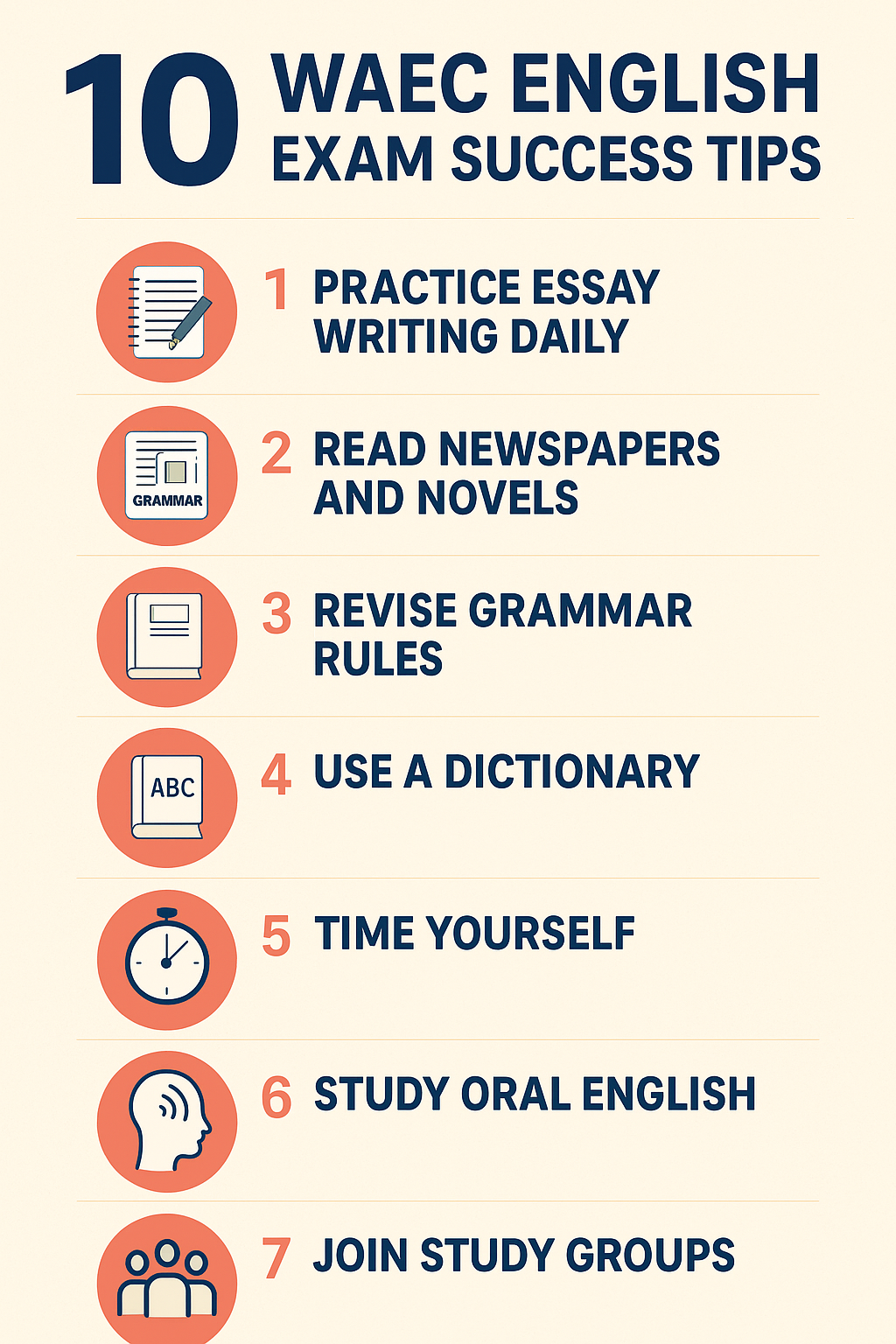
10 Tips to Prepare for English Exam
Here are proven study tips to help you succeed in WAEC English:
-
Practice essay writing daily – Pick a past essay topic and write under timed conditions.
-
Read newspapers and novels – This improves vocabulary and grammar naturally.
-
Revise grammar rules – Topics like concord, tenses, and prepositions are always tested.
-
Use a dictionary – Learn at least 5 new words daily.
-
Time yourself – Spend no more than 45 minutes on essay writing in practice.
-
Study oral English – Practice stress patterns and vowel sounds using past questions.
-
Join study groups – Discussing with others helps you remember more.
-
Avoid cramming – Focus on understanding rules, not just memorizing.
-
Practice with WAEC marking schemes – This shows how examiners want answers presented.
-
Stay updated – WAEC sometimes changes its pattern slightly, so follow official updates.
Conclusion
WAEC English may look challenging, but with the right preparation and consistent practice using past questions, you can excel. Remember, WAEC examiners often recycle old questions, so your past questions PDF is a goldmine.
If you want to pass WAEC English in 2026 with confidence:
-
Download the free PDF
-
Practice daily with a timetable
-
Follow the study tips shared in this article
Good luck with your WAEC exams. Success is possible with the right preparation.
WAEC English Past Questions FAQs (2026 Edition)
1. Where can I download WAEC English past questions PDF for free?
You can download it from the link provided in this article or from trusted educational platforms in Nigeria.
2. Are WAEC past questions repeated?
Yes. WAEC often repeats questions in comprehension, summary, and essay writing sections.
3. How many questions are in WAEC English objectives?
There are usually 50 multiple-choice questions.
4. How do I answer WAEC comprehension questions?
Read the passage carefully, underline keywords, and answer directly in simple sentences.
5. What type of essays are common in WAEC English?
Letter writing, narrative essays, argumentative essays, descriptive essays, and debates.
6. How long does the WAEC English exam last?
About 3 hours in total, covering objective, essay, and oral papers.
7. Can I pass WAEC English without past questions?
It’s possible, but past questions make preparation much easier and more focused.
8. How can I improve my WAEC English vocabulary?
Read widely, use a dictionary, and practice with word lists.
9. What is WAEC Test of Orals?
It is Paper 3, which tests pronunciation, rhymes, stress, and intonation.
10. What is the pass mark for WAEC English?
While WAEC does not publish pass marks, scoring 50% and above in each section greatly increases your chance of getting a credit.
11. How many essay topics are given in WAEC English?
Usually 5–7, but you are required to choose just one.
12. How do I prepare for WAEC summary questions?
Practice reducing long passages into short, clear sentences without losing meaning.
13. Can I use my JAMB English notes for WAEC preparation?
Yes. JAMB and WAEC English cover similar topics.
14. How often does WAEC repeat letter-writing topics?
Almost every year, at least one letter-writing topic is repeated or slightly modified.
15. What materials should I use with past questions?
WAEC-recommended textbooks, grammar books, and oral English guides.
16. Can I use mobile apps to practice WAEC English past questions?
Yes. Many apps allow timed practice for objectives and comprehension.
17. How many passages are in WAEC comprehension?
Usually two, each with 5–6 questions.
18. Is WAEC English harder than NECO English?
Both follow similar formats, but WAEC is considered slightly more competitive.
19. What common mistakes do students make in WAEC English?
Poor grammar, ignoring instructions, writing off-topic essays, and bad handwriting.
20. Can I bring a dictionary to the WAEC English exam?
No. Dictionaries and textbooks are not allowed.
21. Does WAEC accept bullet points in essays?
No. Essays must be written in full sentences and paragraphs.
22. How can I avoid failing WAEC English?
Practice with past questions, write clearly, follow instructions, and revise grammar.
23. What is the best time to start preparing for WAEC English?
At least 6 months before the exam.
24. Are oral English questions also repeated?
Yes, stress and vowel pattern questions are often recycled.
25. Can I pass WAEC English by studying only past questions?
Past questions are very helpful, but you should also study textbooks for grammar and essay improvement.
26. Do examiners check handwriting in WAEC English?
Yes. Illegible handwriting can cost you marks.
27. Are WAEC English objective answers available online?
Yes, but always cross-check with the marking scheme to avoid errors.
28. How many marks is essay writing worth in WAEC English?
It carries significant marks (usually 50% of Paper 2).
29. Is WAEC English compulsory for all candidates?
Yes. Without a credit pass in English, you cannot gain admission to Nigerian universities.
30. What grade do I need in English to enter UNILAG, UI, or UNN?
At least a credit (C6 and above) in WAEC English.
1 thought on “WAEC English Past Questions and Answers PDF (Download Free 2026)”