Every year, millions of Nigerian students walk out of the UTME examination hall feeling relieved. The tension of preparation is over, the exam has been written, and the next step seems unclear.
For many candidates, the big question begins immediately: what happens after JAMB exam?
Some students assume that once they finish UTME, the next message they will receive is an admission offer. In reality, the journey toward university admission in Nigeria involves several important stages after the exam.
Understanding what to do after writing JAMB can make a major difference. Candidates who know the correct steps are more likely to secure admission, while those who ignore the process often miss deadlines or important requirements.
This guide explains the post-UTME steps, the JAMB admission process, and how to gain admission after JAMB. By the end, you will clearly understand the steps to gain admission into Nigerian universities after JAMB and how to avoid the common mistakes many candidates make.
Understanding the JAMB Admission Process
Role of the Joint Admissions and Matriculation Board
The Joint Admissions and Matriculation Board, commonly called JAMB, is the official body responsible for coordinating admissions into tertiary institutions in Nigeria.
Its responsibilities include:
-
Conducting the Unified Tertiary Matriculation Examination (UTME)
-
Regulating admission processes for universities, polytechnics, and colleges of education
-
Managing admissions through the Central Admission Processing System (CAPS)
The introduction of the CAPS platform has made the JAMB admission process more transparent. It allows students to track their admission status and decide whether to accept or reject an offer.
Key Stages After Writing JAMB
After completing UTME, candidates must go through several important stages before admission can be confirmed.
These include:
-
Checking your JAMB result
-
Comparing your score with university cut-off marks
-
Applying for Post-UTME screening
-
Uploading O-Level results
-
Monitoring admission through CAPS
-
Accepting admission
-
Printing the JAMB admission letter
Understanding these stages helps students know what to do after JAMB result is out and how to stay ahead of deadlines.
Step 1: Check Your JAMB Result
The first step after UTME is checking your result.
Candidates can do this in two ways:
1. Through the JAMB Portal
Students can log in to the official JAMB website and view their results.
2. Through SMS
JAMB also provides an SMS service that allows candidates to check results using the phone number used during registration.
A typical UTME result shows:
-
Total score
-
Scores for each subject
-
Candidate details and registration number
Your score determines the next phase of your admission journey.
For instance, students aiming for competitive courses such as Medicine, Law, or Engineering must usually score much higher than the national average.
According to recent figures released by JAMB, over 1.9 million candidates register for UTME annually, but only a small percentage score above 250.
Step 2: Compare Your Score With University Cut-Off Marks
Once you know your score, the next step is comparing it with the cut-off mark of your chosen institution.
Universities in Nigeria use two types of cut-off marks:
-
JAMB general cut-off mark
-
Departmental cut-off mark
Below is a typical score range for competitive courses.
| Course Category | Common JAMB Score Range |
|---|---|
| Medicine | 270 – 320 |
| Law | 250 – 300 |
| Engineering | 220 – 280 |
| Social Sciences | 200 – 250 |
Students whose scores fall below these ranges should not panic.
There are still options such as:
-
choosing a less competitive course
-
applying to another institution
-
considering polytechnics or colleges of education
Many successful graduates today began with strategic course choices.
Step 3: Prepare for Post-UTME Screening
One of the most important post UTME steps is preparing for the university screening process.
Most universities conduct Post-UTME screening a few weeks after JAMB releases results.
Screening methods vary across institutions.
Common formats include:
-
Written Post-UTME examinations
-
Online aptitude tests
-
Document verification exercises
Some universities rely heavily on Post-UTME scores when deciding admission.
How to Prepare for Post-UTME Screening
Students who prepare early often perform better during screening.
Here are practical steps:
Study Post-UTME Past Questions
Past questions help candidates understand the pattern of university exams.
Many institutions repeat question formats each year.
Review UTME Topics
The Post-UTME exam usually covers similar subjects as UTME.
Focus on:
-
English language
-
Course-related subjects
-
Frequently tested topics
Monitor University Admission Portals
Admission updates are usually published on school websites.
Students should check portals regularly to avoid missing deadlines.
Learning how to prepare for Post-UTME screening early can significantly improve admission chances.
Step 4: Upload Your O-Level Results
Another crucial step after UTME is uploading your O-Level results.
Accepted results usually include:
-
West African Examinations Council (WAEC)
-
National Examinations Council (NECO)
Candidates must upload their results to the JAMB portal through an accredited CBT center.
Why This Step Matters
Admission cannot be processed without O-Level results.
Universities verify candidates’ academic qualifications through the JAMB database before approving admission.
Many students lose admission simply because they forget to upload their results early.
Step 5: Monitor the JAMB CAPS Portal
One of the most important platforms in the admission process is JAMB CAPS.
CAPS stands for Central Admission Processing System.
This system allows students to track admission progress in real time.
JAMB CAPS Admission Process Explained
Through CAPS, candidates can:
-
Check admission status
-
Accept or reject admission offers
-
Monitor admission updates from institutions
Students should check the portal frequently, especially during the admission season.
Understanding the JAMB CAPS admission process explained here helps students stay informed throughout the admission period.
Step 6: Accept Your Admission Offer
Once an institution offers admission, candidates must respond through the CAPS portal.
The steps include:
-
Log in to the JAMB portal
-
Open the CAPS admission section
-
Accept or reject the admission offer
Failure to accept admission within the required time may result in losing the opportunity.
This is why students must check the portal regularly.
Step 7: Print Your JAMB Admission Letter
After accepting admission, the next step is printing the official JAMB admission letter.
This document is required for several purposes:
-
university clearance
-
student registration
-
documentation during school resumption
Students must keep both digital and printed copies of the admission letter.
Alternative Options if You Do Not Meet the Cut-Off Mark
Not every student meets the cut-off mark for their first-choice university.
However, this does not mean the end of admission opportunities.
Possible alternatives include:
Change of Course
Students may switch to another department with a lower cut-off mark.
Change of Institution
JAMB allows candidates to change institutions through the portal.
This option is helpful when another school offers a better admission opportunity.
Apply to Polytechnics or Colleges of Education
Many polytechnics provide excellent programs in engineering, technology, and business.
Some graduates from polytechnics later gain direct entry admission into universities.
Understanding these options is an important part of how to gain admission after JAMB.
Common Mistakes Students Make After Writing JAMB
Many candidates lose admission because they make avoidable mistakes.
Below are some common ones.
Ignoring School Admission Updates
Some students fail to monitor university portals.
As a result, they miss important Post-UTME registration deadlines.
Solution:
Check school websites regularly.
Not Uploading O-Level Results
Without uploaded results, universities cannot verify qualifications.
Solution:
Upload your WAEC or NECO results immediately.
Waiting Too Long to Accept Admission
CAPS admission offers sometimes expire.
Solution:
Check the portal frequently and respond quickly.
Real Example: A Student Who Followed the Right Admission Steps
Consider the experience of a student from Lagos.
He scored 246 in UTME during his first attempt.
Instead of waiting passively, he followed the correct admission steps:
-
monitored the university admission portal frequently
-
prepared seriously for Post-UTME screening
-
uploaded his WAEC result immediately
-
checked CAPS regularly
Within a few months, he secured admission into a federal university to study Economics.
This example shows that understanding what to do after writing JAMB can significantly improve admission chances.
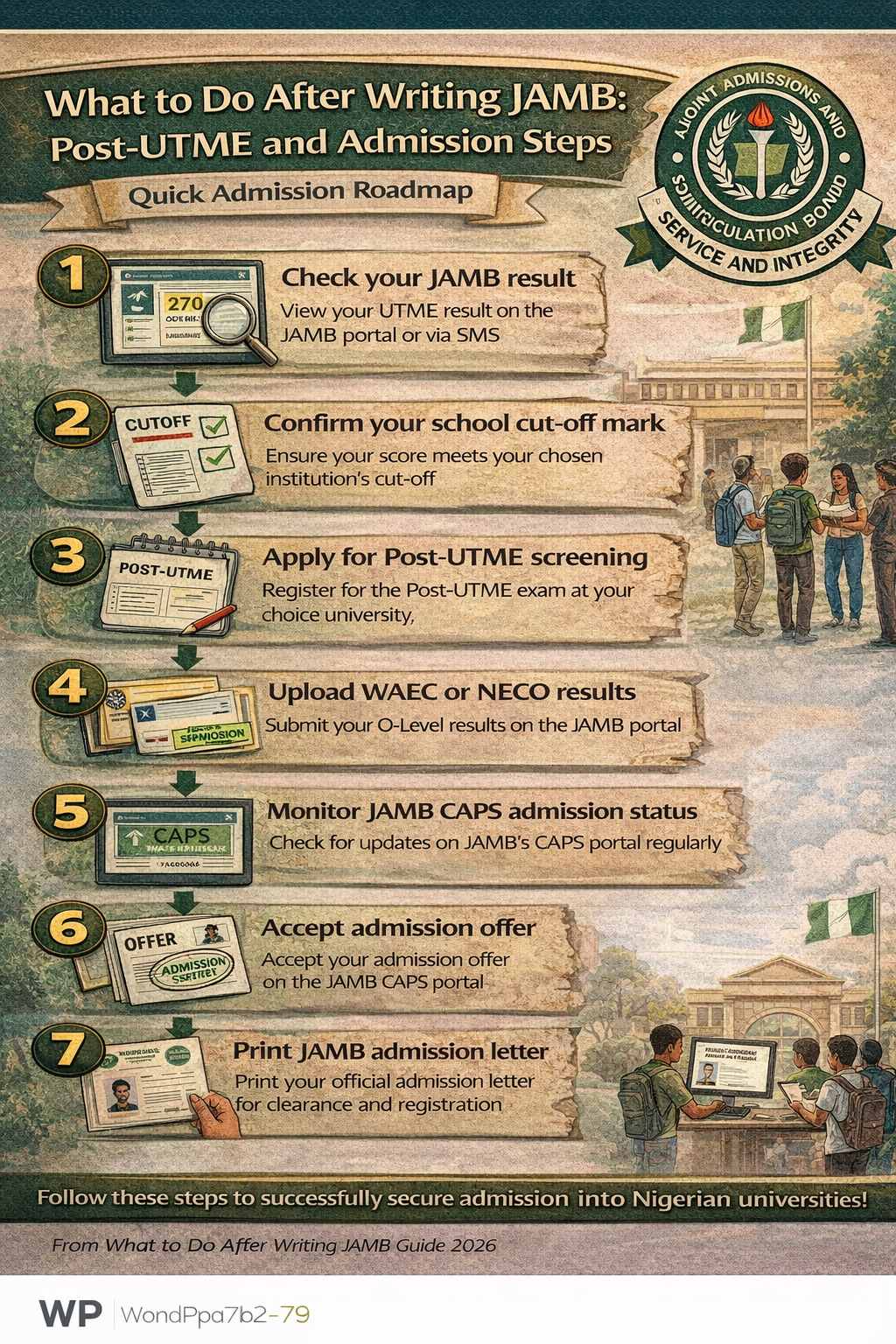
What to Do After Writing JAMB: Post-UTME and Admission Steps
Quick Admission Roadmap
-
Check your JAMB result
-
Confirm your school cut-off mark
-
Apply for Post-UTME screening
-
Upload WAEC or NECO results
-
Monitor JAMB CAPS admission status
-
Accept admission offer
-
Print JAMB admission letter
Additional Tips to Increase Admission Chances
Students who follow these extra strategies often gain admission faster.
Helpful tips include:
-
Apply early for Post-UTME screening
-
Prepare thoroughly for aptitude tests
-
Join serious study groups
-
Monitor admission news regularly
-
Focus on meeting departmental requirements
These habits improve your chances of success in the competitive Nigerian admission system.
Frequently Asked Questions (FAQs)
What should I do immediately after writing JAMB?
The first step is checking your UTME result and comparing your score with the cut-off mark of your chosen institution. Then begin preparing for Post-UTME screening.
What happens after JAMB results are released?
After results are released, candidates must apply for Post-UTME screening, upload their O-Level results, and monitor admission through CAPS.
What is the JAMB CAPS portal?
The CAPS portal is a platform used by JAMB to manage admission processes. It allows candidates to accept or reject admission offers and track admission progress.
Can I gain admission without Post-UTME?
Some universities conduct only document screening instead of written exams. However, many institutions still require Post-UTME or other screening processes.
How long does the JAMB admission process take?
The admission cycle typically runs between August and January, depending on the institution and admission schedule.
Can I change my course after writing JAMB?
Yes. JAMB allows candidates to change their course or institution through the official portal.
How often should I check the JAMB CAPS portal?
Students should check the CAPS portal at least once every few days during the admission season.
Conclusion: Follow the Right Steps After JAMB
Writing UTME is only the first stage of the admission journey.
Students who clearly understand the post-UTME steps and the JAMB admission process have a much better chance of securing admission.
By following the guidance in this article, you can:
-
prepare properly for Post-UTME screening
-
monitor your admission progress through CAPS
-
avoid common mistakes that cause admission delays
Stay informed, prepare early, and keep checking admission updates.
Your dream of studying at a Nigerian university becomes far more achievable when you understand what to do after writing JAMB and follow the correct steps toward admission.