You receive a WhatsApp message from someone claiming to be your friend or a business contact. The message sounds urgent. They need help, and they need it now. Or perhaps it is an offer that looks too good to ignore.
Moments like this are where many problems begin.
Across Nigeria, WhatsApp scams have become more common. With millions of people using smartphones and mobile banking daily, scammers now rely less on complex hacking and more on simple human mistakes. A quick decision, a moment of trust, or a failure to verify can lead to financial loss.
You may be asking:
- How can I avoid getting scammed on WhatsApp in Nigeria?
- How do I identify fake messages?
- What should I do if I am targeted?
Also read: How to Avoid WhatsApp Scams in Nigeria (Complete Safety Guide for Users)
This guide answers those questions in clear terms. You will learn how WhatsApp scams work, how to recognize them, and how to protect yourself and others.
What Are WhatsApp Scams?
WhatsApp scams are fraudulent activities carried out through messages, calls, or links on WhatsApp. Their goal is simple: to steal money, personal information, or access to your account.
In Nigeria, the rise of digital banking and instant transfers has made WhatsApp an attractive platform for fraud. According to reports from financial institutions and security agencies, thousands of scam complaints are linked to mobile messaging platforms each year.
Most of these scams do not rely on technical skills. Instead, they depend on:
- Urgency
- Trust
- Emotional pressure
This is why even careful people can fall victim.
Key Insight:
Most WhatsApp scams succeed because of human error, not advanced hacking.
Common Types of WhatsApp Scams in Nigeria
Understanding the types of scams you may encounter is the first step in avoiding them.
A. Impersonation Scams
This is one of the most common forms of WhatsApp scams in Nigeria.
- A scammer pretends to be your friend, sibling, or colleague
- They may use a familiar name and profile picture
- They send a message asking for urgent financial help
Many victims act quickly because they believe they are helping someone they know.
B. Investment and “Double Your Money” Scams
You may receive messages promising:
- Quick returns on crypto or forex investments
- “Double your money in 24 hours” schemes
These offers often include fake testimonials and screenshots to appear real.
C. Job and Scholarship Scams
This is especially relevant for students.
- Fake job offers or scholarship messages
- Requests for “processing” or “registration” fees
- Links to fake websites
A student looking for opportunities may easily trust such messages.
D. WhatsApp Account Hacking Scams
Here, the scammer tries to gain access to your account.
- They request a verification code sent to your phone
- Once you share it, they take control of your account
- They then message your contacts to scam them
E. Fake Promotions and Giveaways
- Messages claiming you have won a prize
- Links asking you to claim rewards
- Requests for personal details
These are usually phishing attempts.
Also read: How to Track a Fraudster in Nigeria (Realistic Guide)
Key Insight:
If a message creates pressure or urgency, it deserves careful attention.
How to Avoid Getting Scammed on WhatsApp in Nigeria
If you want to stay safe, you need simple habits that you can apply every day.
1. Verify Before You Trust
Never rely on a message alone.
- Call the person directly
- Use another platform to confirm
- Ask questions only the real person would know
2. Never Share Verification Codes
Your WhatsApp verification code is private.
- Do not send it to anyone
- Do not enter it on unknown websites
This single step can prevent account hijacking.
3. Avoid Suspicious Links
Before clicking any link:
- Check the web address carefully
- Look for unusual spelling or strange domains
- Avoid links from unknown contacts
4. Enable Two-Step Verification
This adds a second layer of security.
- Set a PIN for your WhatsApp account
- Even if someone gets your code, they cannot access your account easily
5. Be Careful with Unknown Numbers
Not every message deserves a reply.
- Ignore unfamiliar contacts asking for money
- Do not engage immediately
6. Avoid Urgent Financial Requests
Scammers depend on pressure.
- Take your time
- Confirm before sending money
Key Takeaway:
Caution and verification are your strongest defenses.
How to Identify a WhatsApp Scam Message
Sometimes, the signs are clear if you look closely.
Watch for:
- Poor grammar or strange wording
- Messages that sound unlike the person you know
- Urgent instructions such as “send now” or “act fast”
- Requests for money or personal information
- Links that look unusual
Key Insight:
If something feels wrong, pause. A few minutes of verification can save you from loss.
Can WhatsApp Scammers Hack Your Account?
Yes, but not in the way many people think.
Scammers usually rely on:
- Social engineering
- Trick messages
- Verification code requests
They do not gain access simply by sending messages.
Important Note:
Access is often given unknowingly when users share sensitive information.
What to Do If You Are Targeted by a WhatsApp Scam
If you suspect a scam, act quickly.
Immediate Steps:
- Stop responding
- Block the number
- Report the account on WhatsApp
- Inform your contacts
If Money Is Involved:
- Contact your bank immediately
- Request transaction review
- Report to relevant authorities
Key Takeaway:
Quick action reduces damage and may improve recovery chances.
How to Report WhatsApp Scams in Nigeria
Reporting is important, not just for you but for others.
Where to Report:
- Your bank
- Law enforcement agencies
- WhatsApp support
Steps to Follow:
- Save all evidence (messages, screenshots)
- Submit a formal complaint
- Follow up regularly
Key Insight:
Proper reporting helps track scam patterns and prevent future cases.
Real-Life Scam Scenarios in Nigeria
Case 1: Impersonation Scam
A student receives a message from a “friend” asking for urgent help. Without confirming, the student sends money. Later, they discover the account was hacked.
Case 2: Smart User
Another student receives a similar message but decides to call the friend first. The friend denies sending the message. The scam is avoided.
Lesson:
Verification makes the difference.
Common Mistakes People Make
Many scams succeed because of avoidable errors:
- Acting too quickly
- Trusting familiar names without checking
- Ignoring warning signs
- Sharing personal or financial details
Insight:
Awareness reduces risk.
WhatsApp Security Tips for Nigerian Users
To stay safe, adopt simple habits:
- Enable two-step verification
- Lock your WhatsApp with a PIN or fingerprint
- Update the app regularly
- Avoid using public Wi-Fi for sensitive chats
- Check linked devices frequently
These small actions can prevent major problems.
How to Protect Family and Friends
Scammers often target less informed users.
You can help by:
- Educating older relatives
- Sharing safety tips
- Warning about common scams
- Encouraging verification before action
Key Insight:
Awareness spreads protection.
Quick Checklist: How to Avoid Getting Scammed on WhatsApp in Nigeria
✔ Verify every urgent request
✔ Never share verification codes
✔ Avoid suspicious links
✔ Enable security features
✔ Report suspicious activity
❌ Do not:
- Send money without confirmation
- Trust unknown numbers
- Click random links
FAQs
How can I avoid WhatsApp scams in Nigeria?
Verify all messages, avoid sharing sensitive information, and enable security features like two-step verification.
What are common WhatsApp scams in Nigeria?
Impersonation scams, fake investments, job scams, account hacking attempts, and giveaway scams.
How do I know if a WhatsApp message is a scam?
Look for urgency, unusual language, requests for money, or suspicious links.
What should I do if I get scammed on WhatsApp?
Stop communication, report the account, contact your bank, and inform authorities immediately.
Can WhatsApp scammers hack my account?
Yes, mainly through tricks that make you share verification codes or personal information.
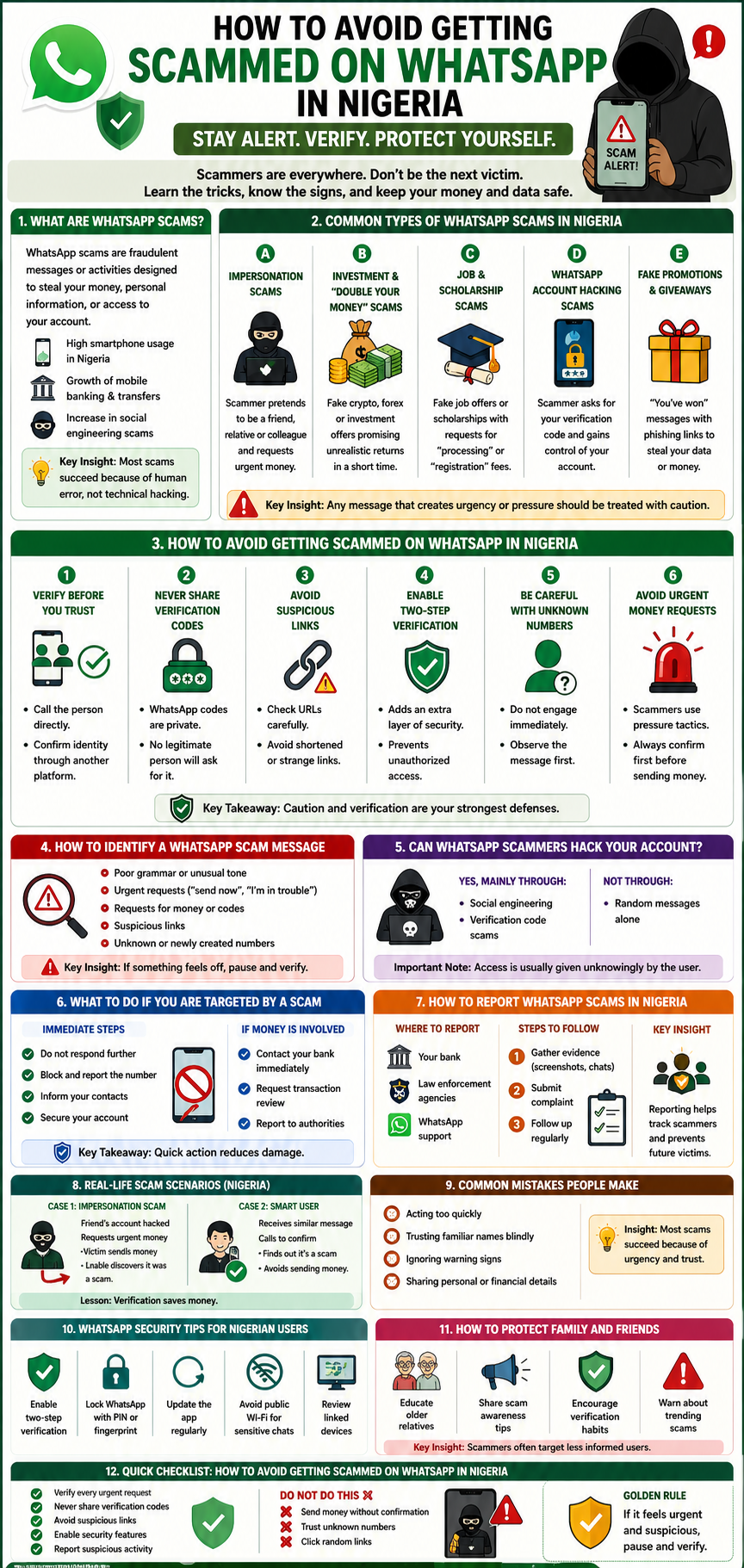
WhatsApp Scam Prevention Guide (Nigeria)
Common Scams:
- Impersonation
- Fake investments
- Giveaway scams
Warning Signs:
- Urgent requests
- Unknown numbers
- Suspicious links
Protection Tips:
- Verify identity
- Enable two-step verification
- Avoid sharing codes
Golden Rule:
If it feels urgent and suspicious, pause and verify.
Conclusion
Knowing how to avoid getting scammed on
in Nigeria is no longer optional. It is part of everyday digital safety.
Most scams do not succeed because people are careless. They succeed because people are rushed. A few seconds of pressure can lead to decisions that are hard to reverse.
Take control of your safety:
- Enable your WhatsApp security settings today
- Make verification a habit
- Share this guide with friends and family
A simple check can save your money, your data, and your peace of mind.
Have you ever received a suspicious WhatsApp message? What did you do in that moment?