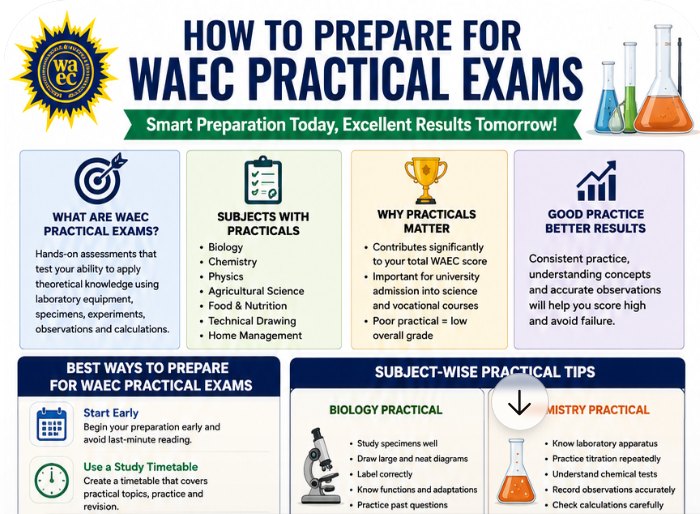
WAEC practical exams can feel intimidating for many Nigerian students. The moment practical dates are announced, fear usually starts creeping in. Some students worry about laboratory equipment, while others panic because they do not fully understand how practical exams are conducted.
For subjects like Biology, Chemistry, Physics, Agricultural Science, Food and Nutrition, and Technical Drawing, practical papers can significantly affect your final WAEC result. A weak practical score can reduce your overall grade even if your theory papers were good.
The truth is that many students do not fail WAEC practicals because they are not intelligent. Most failures happen because of poor preparation, fear, lack of exposure to laboratory work, or misunderstanding instructions during the exam.
The good news is that WAEC practical exams are very passable when you prepare correctly.
This detailed guide explains how to prepare for WAEC practical exams step by step. You will learn practical exam strategies, specimen preparation methods, laboratory tips, common mistakes to avoid, and how to build confidence before exam day.
Whether you are preparing for WAEC Biology practical, Chemistry practical, Physics practical, Agricultural Science practical, or any other practical subject, this guide will help you improve your preparation and increase your chances of scoring high marks.
What Are WAEC Practical Exams?
Meaning of WAEC Practical Exams
WAEC practical exams are hands-on assessments designed to test students’ ability to apply theoretical knowledge in real-life practical situations.
Unlike theory papers where students mainly write explanations, practical exams require candidates to:
- Observe
- Measure
- Experiment
- Draw
- Calculate
- Analyze specimens
- Use laboratory equipment
Practical exams help WAEC assess whether students truly understand the subjects they studied in school.
Also read: How Many Marks Does Physics Practical Carry in WAEC? (Complete Guide for Students)
Subjects That Usually Have WAEC Practicals
Several science and vocational subjects involve practical examinations.
Common WAEC practical subjects include:
- Biology
- Chemistry
- Physics
- Agricultural Science
- Food and Nutrition
- Home Management
- Technical Drawing
- Animal Husbandry
Each subject has different practical requirements and marking methods.
Why WAEC Practical Exams Matter
Many students underestimate practical papers. Also read: How Many Marks Does Chemistry Practical Carry in NECO? (Complete Guide for Students)
WAEC practical exams contribute significantly to your overall subject grade. Poor performance in practicals can affect your final result and university admission chances.
For science students hoping to study:
- Medicine
- Nursing
- Pharmacy
- Engineering
- Laboratory Science
- Agriculture
strong practical performance is especially important.
Universities often pay attention to science subject grades during admission screening.
Common Challenges Students Face During WAEC Practicals
Fear of Laboratory Equipment
Many students become nervous around laboratory tools and chemicals.
Common fears include:
- Fear of chemicals
- Fear of titration
- Fear of laboratory mistakes
- Fear of calculations
- Fear of damaging equipment
This fear usually comes from inadequate practice. Also read: How Many Marks Does Biology Practical Carry in NECO? (Complete Guide for Students)
Lack of Practice Before Exams
Some schools do not organize enough practical sessions before WAEC.
As a result, many students:
- Memorize instead of practicing
- See laboratory equipment only during exams
- Lack confidence during experiments
Practical subjects require repeated exposure.
Time Management Problems
Some candidates spend too much time on one question and rush the remaining sections.
Common problems include:
- Slow graph plotting
- Delayed calculations
- Spending excessive time observing specimens
Good time management is very important during WAEC practicals.
Misreading Instructions
A small mistake in reading instructions can affect several answers.
Examples include:
- Wrong measurements
- Incorrect specimen labeling
- Using the wrong formula
- Recording observations incorrectly
Students who rush instructions usually lose unnecessary marks.
How WAEC Practical Exams Are Usually Conducted
Practical Specimens and Materials
Before practical exams, WAEC usually releases specimen lists for schools.
These specimens may include:
- Chemicals
- Leaves
- Bones
- Seeds
- Farm tools
- Electrical instruments
- Laboratory apparatus
Schools prepare these materials before exam day.
Observation and Experiment Stages
Most WAEC practical exams involve:
- Measuring substances
- Mixing chemicals
- Recording color changes
- Identifying specimens
- Taking instrument readings
- Conducting simple experiments
Accuracy matters greatly. Also read: How to Pass WAEC – 10 Exceptional Tips for Passing WAEC in 2026
Answer Sheet and Calculations
Students may be required to:
- Draw tables
- Plot graphs
- Perform calculations
- Interpret results
- Label diagrams
Neatness is important.
Practical Exam Timing Structure
WAEC practical exams usually last between:
- 1 hour 30 minutes
- 2 hours 30 minutes
depending on the subject.
Candidates must work carefully while managing time properly. Also read: How Many Hours Should I Study Per Day for WAEC?
Best Ways to Prepare for WAEC Practical Exams
Start Early Preparation
One major mistake students make is waiting until the last few weeks before exams.
Practical preparation should begin early.
Benefits of early preparation include:
- Better understanding
- Reduced fear
- More practice opportunities
- Better confidence
Create a Practical Study Timetable
A study timetable helps you prepare consistently.
Your timetable should include:
- Specimen practice
- Laboratory sessions
- Graph practice
- Calculation drills
- Past question review
Consistency matters more than overnight cramming. Also read: How to Pass JAMB 2026 Without Stress or Cramming
Study WAEC Practical Past Questions
WAEC practical questions often follow repeated patterns.
Studying past questions helps students understand:
- Common experiment formats
- Repeated specimen types
- Frequently tested calculations
- Observation patterns
Many successful WAEC candidates rely heavily on past practical questions.
Understand the WAEC Practical Syllabus
The WAEC syllabus helps students identify important practical topics.
Focus more on:
- Frequently repeated experiments
- Important laboratory techniques
- Common specimen categories
The syllabus acts like a roadmap. Also read: What to Do Before NECO Exam Day to Pass Successfully
Practice With Real Laboratory Equipment
Practical subjects improve through hands-on experience.
Students should practice using:
- Burettes
- Pipettes
- Microscopes
- Measuring cylinders
- Voltmeters
- Ammeter
- Farm tools
Watching practical demonstrations also helps.
Master Specimen Identification
Specimen identification is especially important for:
- Biology practical
- Agricultural Science practical
Students should study:
- Leaves
- Seeds
- Bones
- Insects
- Farm tools
- Animal feed
- Crop diseases
Understanding characteristics and functions is important. Also read: What Are the Best Ways to Prepare for NECO Without Relying on Expo?
Learn Accurate Observation Techniques
WAEC practical exams often reward correct observations.
Students should learn how to identify:
- Color changes
- Gas evolution
- Texture differences
- Smell changes
- Precipitate formation
Accurate observation improves scores significantly.
Improve Graph and Table Skills
Graphs are common in Physics and Chemistry practicals.
Students should practice:
- Labeling axes
- Plotting accurately
- Drawing smooth curves
- Interpreting graphs
Neat tables and graphs attract marks.
How to Prepare for WAEC Biology Practical Exams
Learn Specimen Identification Properly
Biology practicals usually involve specimens like:
- Leaves
- Fruits
- Insects
- Bones
- Seeds
- Flowers
Students should study:
- Names
- Functions
- Characteristics
- Adaptations
Also read: How to Pass JAMB 2027
Practice Drawing and Labeling
Biology diagrams must be:
- Large
- Neat
- Properly labeled
Avoid sketchy drawings.
WAEC examiners reward clarity and accuracy.
Understand Functions and Characteristics
Students should know:
- Uses of specimens
- Structural adaptations
- Biological functions
These areas appear frequently in practical questions.
Common WAEC Biology Practical Mistakes
Common errors include:
- Poor labeling
- Wrong spellings
- Tiny diagrams
- Incomplete observations
- Incorrect specimen identification
Careful presentation improves marks.
How to Prepare for WAEC Chemistry Practical Exams
Understand Common Laboratory Apparatus
Students must understand apparatus such as:
- Burette
- Pipette
- Conical flask
- Test tube
- Beaker
- Measuring cylinder
Knowing apparatus functions is important.
Master Titration Procedures
Titration is one of the most important WAEC Chemistry practical topics.
Students should practice:
- Measuring accurately
- Reading burette values
- Detecting color changes
- Recording results neatly
Repeated practice builds confidence.
Learn Chemical Tests and Reactions
Important areas include:
- Gas tests
- Salt analysis
- Precipitate reactions
- Acid-base reactions
Observation accuracy matters greatly.
How to Avoid Calculation Mistakes
Many students lose marks through careless errors.
Avoid:
- Wrong units
- Decimal mistakes
- Incorrect formula substitution
Always double-check calculations.
How to Prepare for WAEC Physics Practical Exams
Learn Measurement Techniques
Physics practicals involve measurements heavily.
Students should practice:
- Reading scales correctly
- Using vernier calipers
- Measuring length accurately
- Recording values carefully
Practice Graph Plotting
Physics practicals often require graph drawing. Also read: WAEC Grading System Explained: How WAEC Grades Your Papers
Important graph skills include:
- Correct axes
- Proper scaling
- Accurate plotting
- Straight line drawing
Graphs carry valuable marks.
Understand Formula Application
Students should understand:
- Unit conversions
- Formula substitution
- Rearranging formulas
Physics calculations become easier with regular practice.
Common WAEC Physics Practical Errors
Frequent mistakes include:
- Wrong readings
- Poor graph plotting
- Formula confusion
- Unit errors
Practicing repeatedly helps reduce mistakes. Also read: How to Create a WAEC Reading Timetable That Works (2026 Guide for Serious Candidates)
WAEC Agricultural Science Practical Preparation Tips
Learn Farm Tool Identification
Students should identify tools such as:
- Hoe
- Cutlass
- Sprayer
- Wheelbarrow
- Rake
Understanding functions is important.
Understand Crop and Animal Specimens
Students should study:
- Crop diseases
- Animal feed
- Farm products
- Seed types
Observation-based questions are common.
Practice Observation and Description
Agricultural Science practicals often require detailed descriptions.
Focus on:
- Texture
- Uses
- Characteristics
- Appearance
Best Resources for WAEC Practical Preparation
WAEC Past Questions and Answers
Past questions help students understand exam patterns.
Benefits include:
- Familiarity with question style
- Improved confidence
- Better timing
School Laboratory Sessions
Students should attend every practical session organized by their school.
Hands-on experience matters greatly. Also read: How to Create a JAMB Reading Timetable That Works (2026 Guide for Serious Candidates)
YouTube Practical Tutorials
Video tutorials help students visualize experiments clearly.
Many Nigerian students improve understanding through visual demonstrations.
Study Groups and Peer Learning
Group study allows students to:
- Share explanations
- Practice experiments together
- Correct one another
Collaborative learning improves retention.
Best CBT Apps for WAEC Preparation
One highly recommended platform is:
- JambSmartPrep CBT App
The app helps students practice objective questions and improve exam readiness. Also read: JAMB Reading Timetable for 1 Month 2026 (Complete Study Plan for UTME Success)
Common Mistakes Students Make During WAEC Practical Exams
Rushing Experiments
Working too fast increases mistakes.
Failing to Read Instructions Carefully
Misreading instructions can affect multiple answers.
Poor Labeling
Unclear labels reduce marks.
Wrong Calculations
Careless calculation mistakes are common.
Dirty or Scattered Answer Sheets
Neatness matters during practical exams.
Panic and Exam Anxiety
Fear affects concentration.
Confidence improves performance.
WAEC Practical Exam Day Tips
Arrive Early
Early arrival helps students settle down mentally. Also read: How to Score Above 300 in JAMB UTME: Study Strategy from Top Scorers (2026 Guide)
Bring Required Materials
Essential materials may include:
- Pencil
- Eraser
- Ruler
- Calculator
- Lab coat
- Pen
Stay Calm During Experiments
Avoid panic if mistakes happen.
Stay focused.
Double-Check Calculations
Always review calculations before submission.
Label Everything Correctly
Incorrect labeling causes avoidable mark loss.
How WAEC Practical Exams Are Marked
Observation Scores
Correct observations attract marks.
Accuracy Scores
Measurements and calculations are assessed carefully.
Drawing and Labeling Marks
Neat diagrams receive better scores.
Calculation Marks
Correct formulas and units matter.
Neatness and Presentation
Organized work improves examiner readability.
How to Overcome Fear of WAEC Practicals
Practice Repeatedly
Confidence grows through repetition.
Watch Demonstration Videos
Visual learning reduces fear.
Build Confidence Through Mock Practicals
Practice exams improve familiarity.
Avoid Exam Malpractice Dependence
Students who rely on malpractice often panic when situations change.
Real preparation is safer and more reliable.
WAEC Practical Exam Success Checklist
4 Weeks Before Exam
- Study practical syllabus
- Gather past questions
- Attend laboratory sessions
3 Weeks Before Exam
- Practice specimen identification
- Revise calculations
- Learn graph plotting
2 Weeks Before Exam
- Practice titration
- Watch practical tutorials
- Solve past practical questions
1 Week Before Exam
- Revise observations
- Prepare exam materials
- Practice time management
Night Before Exam
- Sleep early
- Revise lightly
- Avoid panic reading
Exam Day
- Arrive early
- Stay calm
- Read instructions carefully
- Label diagrams properly
Frequently Asked Questions About WAEC Practical Exams
How can I pass WAEC practical exams easily?
Start preparing early, practice with past questions, and attend laboratory sessions consistently.
What subjects have WAEC practical exams?
Subjects include Biology, Chemistry, Physics, Agricultural Science, Food and Nutrition, Technical Drawing, and Home Management.
How do I study WAEC practical specimens?
Study specimen names, functions, characteristics, and diagrams repeatedly.
Are WAEC practical questions repeated?
WAEC practical questions often follow similar patterns yearly.
Can I pass WAEC practicals without laboratory experience?
Yes, but laboratory exposure improves confidence and understanding greatly.
What should I carry to WAEC practical exams?
You may need:
- Calculator
- Pencil
- Pen
- Ruler
- Lab coat
- Eraser
depending on the subject.
How are WAEC practical exams scored?
Marks are awarded for:
- Observation
- Accuracy
- Calculations
- Diagrams
- Labeling
- Presentation
How do I prepare for WAEC practical exams at home?
Use past questions, YouTube tutorials, specimen images, and regular revision schedules.
What are the best tips for passing WAEC practical exams?
Practice repeatedly, understand instructions, and improve observation skills.
How can I pass WAEC chemistry practical without fear?
Practice titration frequently and understand laboratory apparatus properly.
How to study WAEC biology practical specimens?
Use specimen charts, textbooks, diagrams, and repeated identification practice.
How to avoid mistakes during WAEC practical exams?
Read instructions carefully, stay calm, and double-check calculations.
Important Links
Link naturally to related articles such as:
- How to Pass WAEC Easily
- Best WAEC Study Tips
- WAEC Past Questions Guide
- How to Avoid JAMB Exam Mistakes
- Best Time to Read for WAEC
- How to Pass WAEC Without Expo
Conclusion
WAEC practical exams may seem difficult at first, but proper preparation changes everything.
Students who perform well in practical subjects usually prepare consistently, practice repeatedly, and understand laboratory procedures before exam day. Practical success is not about luck or “expo.” It comes from familiarity, confidence, and careful preparation.
Focus on:
- Practicing experiments
- Understanding specimens
- Solving past questions
- Improving observation skills
- Managing exam time properly
Most importantly, avoid panic.
Even students who initially struggle with practical subjects often improve greatly after repeated practice.
If you are preparing for WAEC practical exams, start now instead of waiting until the last minute.
You can also improve your preparation further by practicing regularly with the JambSmartPrep CBT App and reviewing WAEC practical past questions consistently.
What practical subject worries you most right now? Biology, Chemistry, Physics, or Agricultural Science? Start practicing today and build your confidence gradually.
1 thought on “How to Prepare for WAEC Practical Exams”