
Many WAEC candidates spend long hours reading Chemistry textbooks, solving equations, and memorizing reactions. Yet, when it comes to the practical exam, there is often uncertainty.
Questions like these are common:
- How many marks does Chemistry practical carry in WAEC?
- Does it really affect my final grade?
- Can practical help me move from a C to an A?
The real issue is simple. Most students do not fully understand the WAEC Chemistry marking system, especially the role of the practical paper.
If you are preparing for WAEC, this guide will give you a clear answer. You will learn how many marks Chemistry practical carries, how WAEC grades it, and practical steps to help you score higher.
Overview of WAEC Chemistry Exam Structure
To understand WAEC Chemistry practical marks, you first need to know how the full exam is structured.
The WAEC Chemistry exam is divided into three main papers:
Paper 1: Objective (Multiple Choice)
- Usually contains about 40 questions
- Tests basic knowledge and speed
- Covers all major topics
Paper 2: Theory (Essay)
- Requires detailed explanations
- Includes calculations and chemical equations
- Tests deep understanding
Paper 3: Practical
- Focuses on laboratory work
- Includes titration, observation, and analysis
Key Insight
Your final WAEC Chemistry result is not based on one paper alone. All three papers are combined to determine your grade.
Many students focus heavily on theory and neglect practical. This often leads to avoidable loss of marks.
How Many Marks Does Chemistry Practical Carry in WAEC?
Now to the main question.
Also read: How Many Marks Does Physics Practical Carry in WAEC? (Complete Guide for Students)
Direct Answer
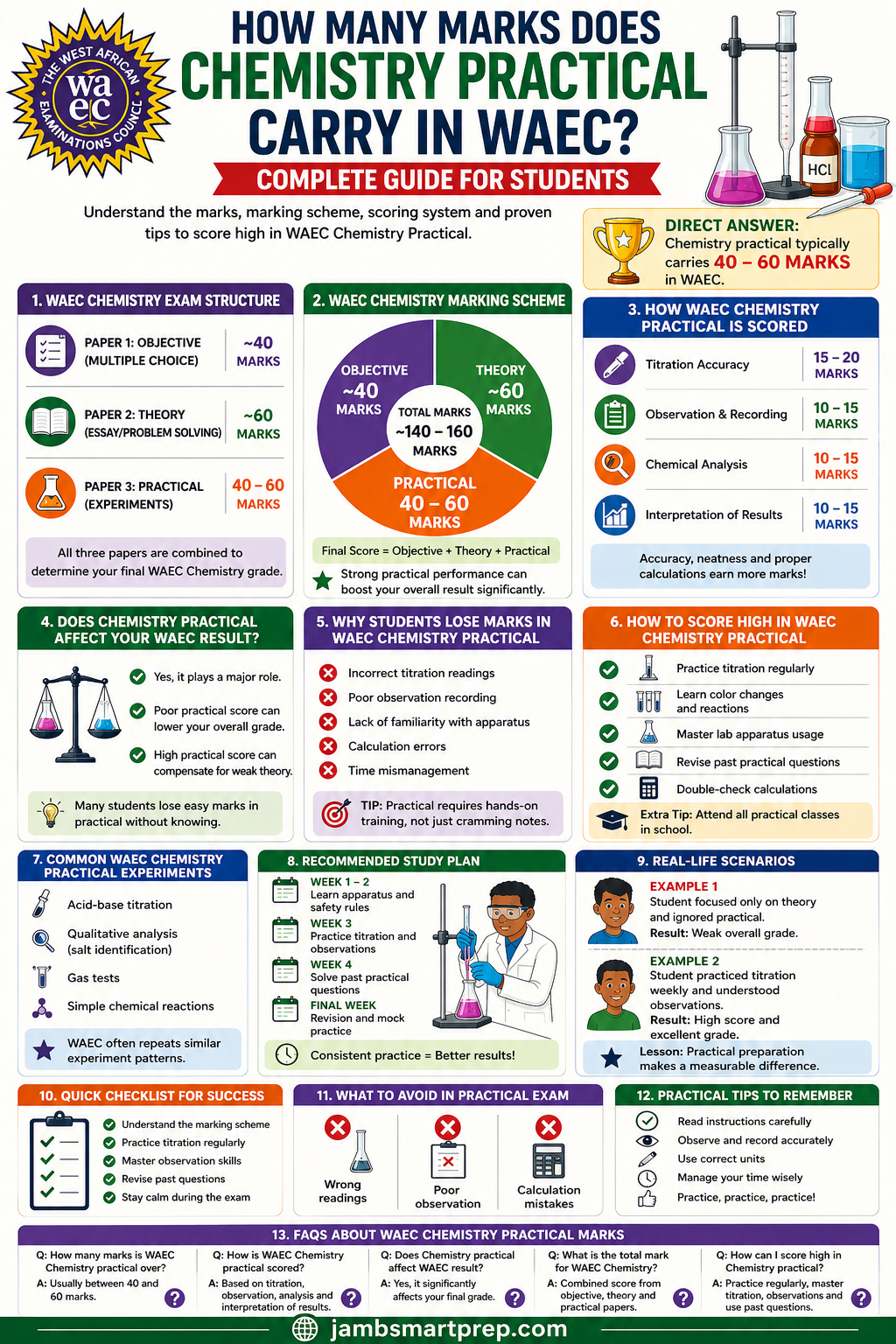
Chemistry practical typically carries between 40 and 60 marks in WAEC.
What This Means for You
- It forms a significant portion of your total score
- It can influence your final grade strongly
- A good practical score can push you into a higher grade band
For example:
- A student scoring average marks in theory but high in practical can still get a B or even A
- Another student who ignores practical may struggle to pass despite doing well in theory
Important Note
WAEC may adjust the exact mark distribution slightly each year, but the importance of practical remains consistent.
WAEC Chemistry Marking Scheme Explained
To fully understand WAEC Chemistry practical marks, let’s look at the overall marking structure.
Typical Mark Distribution
- Objective: ~40 marks
- Theory: ~60 marks
- Practical: ~40–60 marks
How WAEC Grades Chemistry
Your final score is calculated as:
Total Score = Objective + Theory + Practical
What This Means
- Each section contributes to your final grade
- Weak performance in one area can be balanced by strength in another
- Practical can serve as a score booster
How WAEC Chemistry Practical Is Scored
Many students ask: how is WAEC Chemistry practical scored?
Also read: How Many Marks Does Biology Practical Carry in WAEC? (Complete Guide for Students)
WAEC examiners assess your performance in several key areas.
1. Titration Accuracy
- Correct readings
- Proper use of burette and pipette
- Consistency in results
2. Observation and Recording
- Correct colour changes
- Accurate recording of results
- Clear presentation
3. Chemical Analysis
- Identification of substances
- Understanding reactions
4. Interpretation of Results
- Drawing conclusions
- Explaining observations
Example Mark Allocation
- Titration: 15–20 marks
- Observation: 10–15 marks
- Analysis/Inference: 10–15 marks
Key Insight
Even small mistakes in measurement or recording can cost marks. Precision matters in practical.
Does Chemistry Practical Affect Your WAEC Result?
Yes, it does.
Here’s Why
- It carries a large number of marks
- It directly contributes to your total score
- It can change your grade outcome
Real Impact
- Low practical score → Lower overall grade
- High practical score → Strong final result
Many students who fail Chemistry often lose marks in practical, not just theory.
Why Students Lose Marks in WAEC Chemistry Practical
Understanding common mistakes can help you avoid them.
Common Errors
- Incorrect titration readings
- Poor observation recording
- Lack of familiarity with lab equipment
- Calculation mistakes
- Poor time management
Example
A student may perform the experiment correctly but lose marks due to poor recording or wrong units.
Key Tip
Chemistry practical is not about cramming notes. It requires practice and familiarity.
How to Score High in WAEC Chemistry Practical
If you want to improve your WAEC Chemistry practical score, focus on these proven strategies.
1. Practice Titration Regularly
- Learn how to read burettes correctly
- Practice until your readings are consistent
2. Understand Colour Changes
- Know common indicators and reactions
- Be able to describe changes clearly
3. Master Lab Equipment
- Know how to use pipettes, burettes, and measuring cylinders
- Avoid handling errors
4. Revise Past Questions
- WAEC often repeats patterns
- Practice builds confidence
5. Double-Check Calculations
- Always confirm your answers
- Watch your units carefully
Extra Tip
Attend all practical classes in school. Students who skip practical sessions often struggle during the exam.
Common WAEC Chemistry Practical Experiments
WAEC tends to focus on familiar experiments.
Frequently Tested Areas
- Acid-base titration
- Qualitative analysis (salt identification)
- Gas tests
- Simple chemical reactions
Insight
If you study past questions, you will notice repeated experiment formats. This gives you an advantage.
Also read: WAEC 2026 Syllabus vs Past Questions: What to Focus On to Score High
Real-Life Scenario (Case Study)
Example 1: Theory-Focused Student
A student studied only theory and ignored practical.
- Result: Scored poorly overall
- Reason: Lost many marks in practical
Example 2: Balanced Preparation
Another student practiced titration weekly.
- Result: Scored an A in Chemistry
- Reason: Strong practical performance boosted total score
Lesson
Practical preparation is not optional. It plays a direct role in your success.
Recommended Study Plan for Chemistry Practical
Here is a simple plan you can follow.
Week 1–2
- Learn laboratory apparatus
- Understand safety rules
Week 3
- Practice titration
- Focus on observations
Week 4
- Solve past practical questions
Final Week
- Revise
- Practice under exam conditions
Quick Checklist for WAEC Chemistry Practical Success
Before your exam, make sure you can:
- Understand the WAEC Chemistry marking scheme
- Perform titration confidently
- Record observations correctly
- Solve past practical questions
- Stay calm and focused
WAEC Chemistry Practical Marks Guide
Chemistry Exam Structure
- Objective
- Theory
- Practical
Practical Marks
- 40–60 marks
What You’re Graded On
- Titration
- Observation
- Analysis
Tips to Score High
- Practice titration
- Learn reactions
- Revise past questions
Avoid
- Wrong readings ❌
- Poor observation ❌
- Calculation mistakes ❌
FAQs
How many marks is WAEC Chemistry practical over?
Chemistry practical is usually graded over 40–60 marks, depending on the exam structure for that year.
How is WAEC Chemistry practical scored?
It is scored based on titration accuracy, observation, recording, analysis, and interpretation of results.
Does Chemistry practical affect WAEC result?
Yes, it significantly affects your final grade because it contributes a large portion of the total score.
What is the total mark for WAEC Chemistry?
The total mark is a combination of objective, theory, and practical scores.
How can I score high in WAEC Chemistry practical?
Practice regularly, understand experiments, improve accuracy, and revise past questions.
Is Chemistry practical harder than theory?
Not necessarily. Many students find it easier because it is practical-based, but it requires preparation.
Can I pass WAEC Chemistry without doing well in practical?
It is possible, but difficult. A low practical score can reduce your overall grade significantly.
Where can I practice Chemistry practical in Nigeria?
You can practice in school laboratories, tutorial centres, or during organized practical sessions before WAEC.
Conclusion
Chemistry practical carries a significant portion of WAEC marks. It is not something you can ignore.
Your final grade depends on how well you perform across all sections, and practical plays a major role in that outcome.
If you want to succeed in WAEC Chemistry:
- Start practicing early
- Focus on titration and observation
- Use past questions consistently
A strong practical performance can be the difference between an average result and an excellent one.
Take the next step:
Bookmark this guide, share it with your classmates, and begin your practical preparation today.
Engagement Prompt:
Which part of Chemistry practical do you find most challenging? Titration, observation, or calculations? Share your experience.
