
Many WAEC candidates spend months reading Biology, yet still feel unsure about one important part of the exam, the practical. It is common to hear questions like:
- Is Biology practical really important in WAEC?
- How many marks does it carry?
- Can it affect my final grade?
These concerns are valid. A large number of students focus heavily on theory and objective questions, only to lose marks in the practical section.
The real issue is simple. Many students do not fully understand how the WAEC Biology marking system works.
This guide explains clearly how many marks Biology practical carries in WAEC, how WAEC grades it, and how you can prepare to score high without unnecessary stress.
Overview of WAEC Biology Exam Structure
To understand the value of the practical paper, you need to see how the entire WAEC Biology exam is arranged.
The WAEC Biology exam is divided into three papers:
Paper 1: Objective
- Multiple-choice questions
- Tests basic knowledge across topics
- Usually fast-paced and time-sensitive
Paper 2: Theory
- Essay-type questions
- Requires explanation, diagrams, and reasoning
Paper 3: Practical
- Hands-on or specimen-based questions
- Tests observation and application
Key Insight:
WAEC combines your scores from all three papers to determine your final Biology grade. No single paper stands alone.
Read also: How to Use the WAEC Syllabus to Prepare Smarter For Your Exams 2026
How Many Marks Does Biology Practical Carry in WAEC?
This is the question most students want a direct answer to.
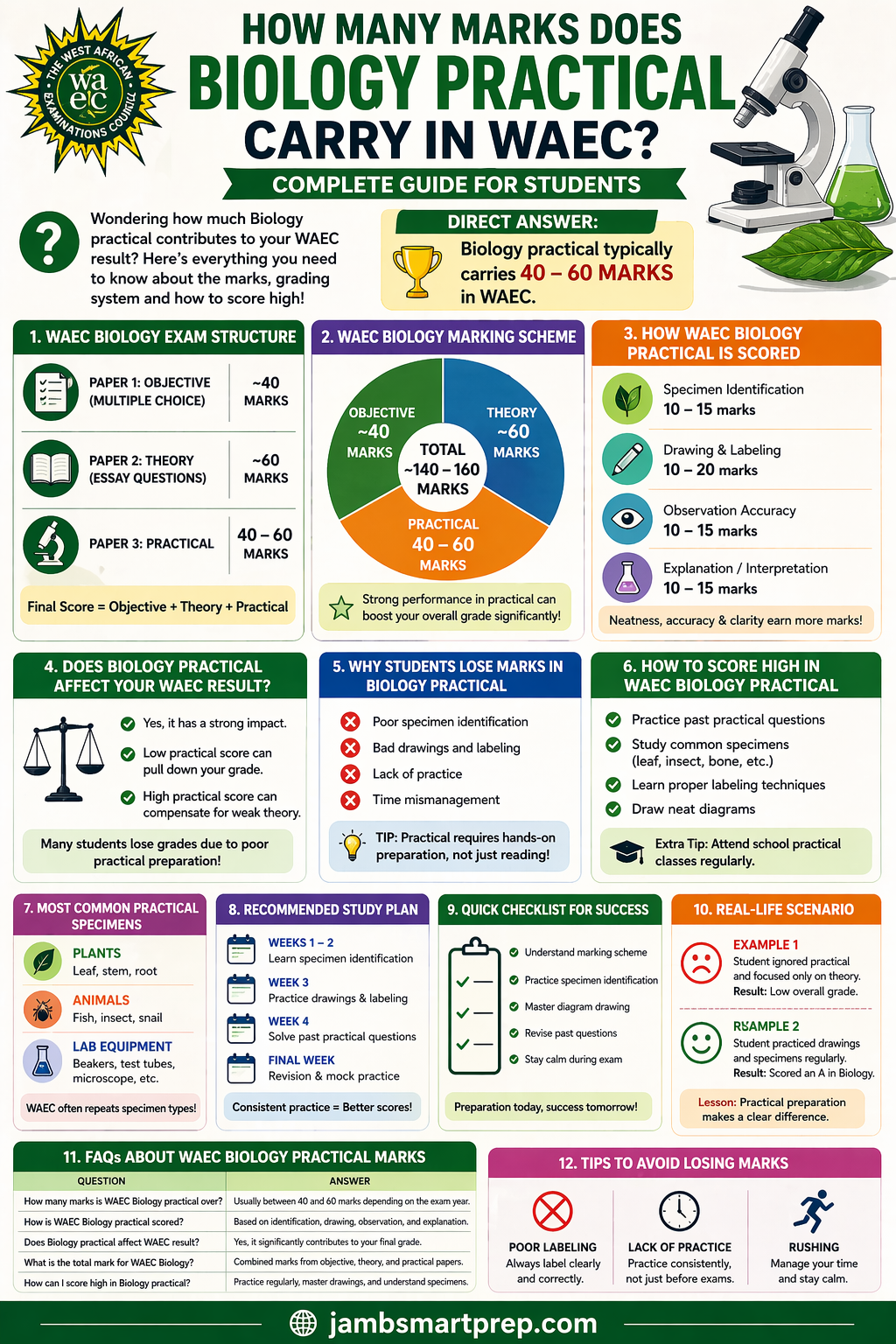
Biology practical typically carries between 40 and 60 marks, depending on the specific exam year and structure used by WAEC.
What This Means for You
- The practical paper contributes a large portion of your total score
- It can push your grade from a C to a B or from a B to an A
- Ignoring it can cost you valuable marks
Although WAEC may adjust exact figures slightly, the practical paper remains a major part of the assessment every year.
WAEC Biology Marking Scheme Explained
Understanding the WAEC Biology marking scheme helps you plan your preparation better.
Here is a general breakdown:
- Objective (Paper 1): About 40 marks
- Theory (Paper 2): About 60 marks
- Practical (Paper 3): About 40 to 60 marks
How the Final Score Is Calculated
Your total score is the combination of all three sections:
Final Score = Objective + Theory + Practical
Why This Matters
A strong performance in practical can improve your overall result significantly. Even if your theory is not perfect, a high practical score can balance it.
How WAEC Biology Practical Is Scored
Many students assume practical is random. It is not. WAEC follows a clear structure when awarding marks.
Areas You Are Graded On
- Specimen Identification
- Naming and recognizing biological samples
- Drawing and Labeling
- Clear, neat diagrams
- Correct labeling of parts
- Observation Accuracy
- Correct description of what you see
- Explanation and Interpretation
- Ability to explain results logically
Example of Marks Distribution
- Identification: 10–15 marks
- Drawing: 10–20 marks
- Explanation: 10–15 marks
Key Point:
Neatness and accuracy matter as much as knowledge.
Does Biology Practical Affect Your WAEC Result?
Yes, it does.
The practical paper has a strong influence on your final grade.
How It Affects Your Result
- A low practical score can pull down your overall grade
- A high practical score can improve a weak theory performance
Important Insight
Many students who miss top grades often lose marks in practical, not theory.
Why Many Students Lose Marks in WAEC Biology Practical
It is not always about difficulty. Most mistakes come from poor preparation.
Common Mistakes
- Inability to identify specimens
- Poor or rough drawings
- Incorrect labeling
- Lack of practical exposure
- Poor time management during the exam
Simple Truth
Practical is not something you can cram overnight. It requires steady practice.
How to Score High in WAEC Biology Practical
If you approach it correctly, practical can become one of your strongest areas.
Proven Strategies
- Practice Past Questions
- WAEC often repeats specimen types
- Study Common Specimens
- Leaf
- Fish
- Snail
- Insects
- Bones
- Master Drawing Skills
- Draw neatly
- Use clear lines
- Label correctly
- Understand Basic Concepts
- Do not just memorize
- Know why things work
- Attend Practical Classes
- School labs give real experience
Extra Tip
Practice drawing diagrams daily. It improves speed and confidence.
Most Common WAEC Biology Practical Specimens
WAEC does not usually surprise students with completely new specimens.
Frequently Used Specimens
- Plants: Leaf, stem, root
- Animals: Fish, snail, insect
- Laboratory Items: Beakers, test tubes, microscope
Insight
Once you master these common specimens, you are already ahead of many candidates.
Real-Life Scenario (Case Study Section)
Example 1
A student focused only on theory and ignored practical.
During the exam, he struggled with specimen identification and drawing.
Result:
Low overall grade in Biology.
Example 2
Another student practiced practical questions weekly.
She learned specimen features and improved her drawings.
Result:
Scored an A in Biology.
Lesson
Consistent practice makes a clear difference.
Recommended Study Plan for Biology Practical
A simple plan can make preparation easier.
Week-by-Week Plan
- Week 1–2: Learn specimen identification
- Week 3: Practice diagrams and labeling
- Week 4: Solve past practical questions
- Final Week: Revision and timed practice
Quick Checklist for WAEC Biology Practical Success
Before your exam, make sure you can tick these:
- Understand the marking scheme
- Identify common specimens
- Draw neat and labeled diagrams
- Practice past questions regularly
- Stay calm during the exam
FAQs About WAEC Biology Practical Marks
How many marks is WAEC Biology practical over?
It is usually between 40 and 60 marks depending on the exam structure.
How is WAEC Biology practical scored?
It is graded based on identification, drawing, observation, and explanation.
Does Biology practical affect WAEC result?
Yes, it plays a major role in determining your final grade.
What is the total mark for WAEC Biology?
It is the combined score from objective, theory, and practical papers.
How can I score high in WAEC Biology practical?
Practice regularly, focus on specimens, and improve your drawing skills.
Is WAEC Biology practical hard?
It is not difficult if you practice regularly and understand common specimens.
Can I pass WAEC Biology without practical?
No. Practical is a compulsory part of the exam and affects your final score.
How important is drawing in Biology practical?
Very important. A large portion of marks comes from diagrams and labeling.
Do WAEC repeat practical questions?
Yes. Similar specimen types and question patterns often appear each year.
When should I start preparing for Biology practical?
Start early, at least one month before the exam, to build confidence.
WAEC Biology Practical Marks Guide
Biology Exam Structure:
- Objective
- Theory
- Practical
Practical Marks:
- 40–60 marks
What You’re Graded On:
- Identification
- Drawing
- Observation
Tips to Score High:
- Practice past questions
- Learn specimens
- Draw neatly
Avoid:
- Poor labeling ❌
- Lack of practice ❌
- Rushing ❌
Conclusion
Biology practical carries significant marks in WAEC, and it can strongly influence your final grade.
Success in WAEC Biology is not only about reading textbooks. Your ability to identify specimens, draw clearly, and explain observations matters just as much.
If you take practical seriously and practice consistently, you can improve your score without stress.
What You Should Do Next
- Start practicing practical questions early
- Focus on diagrams and specimen identification
- Use past questions regularly
If you found this guide helpful, consider sharing it with other students preparing for WAEC.
Now, a quick question:
What part of Biology practical do you find most difficult?
