Few experiences are more frustrating than realizing that you have sent your hard-earned money to a scammer.
Whether it was a fake online vendor, a fraudulent investment platform, a phishing attack, a romance scam, or a social media fraudster, the emotional and financial impact can be devastating.
Every year, thousands of Nigerians lose millions of naira through online scams. Many victims assume their money is gone forever because they do not know what steps to take or which authorities can help.
The good news is that recovery is sometimes possible.
If you act quickly, preserve evidence, and report the incident properly, you may improve your chances of recovering some or all of your money.
This comprehensive guide explains exactly how to get money back after being scammed online in Nigeria, how to report online fraud, which agencies can help, and how to protect yourself from becoming a victim again. Based on the uploaded content outline.
Can You Really Get Money Back After Being Scammed Online?
The Reality of Scam Recovery
One of the most common questions victims ask is:
“Can I get my money back after being scammed online in Nigeria?”
The answer depends on several factors.
Some victims successfully recover their funds through bank investigations, law enforcement intervention, marketplace disputes, or court actions.
Others may recover only part of their losses.
Unfortunately, there are also situations where recovery becomes impossible, especially when reporting is delayed.
Factors That Affect Recovery Success
Recovery often depends on:
- How quickly you reported the fraud
- The payment method used
- Availability of evidence
- Whether the scammer’s account can be traced
- Cooperation from banks and payment providers
- The amount involved
Why Immediate Action Matters
The first few hours after discovering a scam are often critical.
Fraudsters frequently transfer stolen funds through multiple accounts to make tracking difficult.
The faster you act, the better your chances.
Payment Methods and Recovery Chances
Different payment methods offer different recovery possibilities.
| Payment Method | Recovery Possibility |
|---|---|
| Bank Transfer | Moderate |
| Debit Card | Moderate to High |
| Credit Card | High |
| Mobile Wallet | Moderate |
| Cryptocurrency | Low to Moderate |
| Cash Deposit | Low |
Common Recovery Myths
Many victims believe:
- Banks always refund scam victims
- EFCC automatically recovers all lost funds
- Crypto transactions can always be reversed
- Social media platforms refund scam victims
These assumptions are often incorrect.
Situations Where Recovery Is Most Likely
Recovery chances improve when:
- The fraud is reported immediately
- Funds are still in the recipient account
- The receiving account is frozen quickly
- Adequate evidence exists
- The scammer can be identified
What to Do Immediately After Being Scammed Online
Stop Further Payments
Never send additional money.
Scammers often claim:
- A refund fee is required
- Processing charges must be paid
- Verification payments are needed
These are usually attempts to steal more money.
Preserve All Evidence
Evidence is your strongest weapon.
Do not delete:
- Chats
- Emails
- SMS messages
- Voice notes
- Receipts
Save Screenshots and Conversations
Capture screenshots showing:
- Usernames
- Phone numbers
- Payment requests
- Product advertisements
- Promises made
Record Transaction Details
Keep records of:
- Transaction reference numbers
- Amount sent
- Date and time
- Recipient account details
Save Bank Alerts and Receipts
These documents help investigators verify your claims.
Document Scammer Information
Collect:
- Phone numbers
- Email addresses
- Social media profiles
- Bank account numbers
- Wallet addresses
Create a Timeline of Events
Write down:
- When contact began
- What was promised
- When payment occurred
- When you discovered the fraud
How to Recover Money Sent Through Bank Transfer
Contact Your Bank Immediately
Call your bank’s customer care immediately.
Visit a branch if necessary.
Explain clearly that you are a victim of fraud.
Request Transaction Investigation
Ask the bank to:
- Investigate the transaction
- Place restrictions if possible
- Contact the receiving bank
Submit Fraud Reports
Most banks require:
- Written complaint
- Proof of payment
- Fraud declaration forms
Follow Bank Recovery Procedures
Each bank has its own fraud investigation process.
Cooperate fully.
Escalating Complaints
If unsatisfied:
- Escalate internally
- Contact the Central Bank of Nigeria
- File a complaint with consumer protection agencies
Expected Recovery Timelines
Recovery may take:
- A few days
- Several weeks
- Multiple months
Realistic Expectations
Banks cannot guarantee recovery.
Their ability depends on whether funds remain traceable.
Can Nigerian Banks Reverse Fraudulent Transactions?
Circumstances That Allow Reversal
Banks may attempt reversal when:
- Fraud is reported quickly
- Funds remain in the beneficiary account
- Regulatory procedures permit action
Limitations of Bank Recovery
Banks cannot simply remove money from another person’s account without following legal procedures.
Importance of Fast Reporting
Delays reduce recovery chances significantly.
Evidence Banks Usually Require
- Bank alerts
- Transaction receipts
- Screenshots
- Fraud reports
Common Mistakes Victims Make
- Waiting several days before reporting
- Deleting conversations
- Providing incomplete information
How to Recover Money from Fake Online Vendors
Identifying Fake Vendor Scams
Warning signs include:
- Extremely low prices
- Urgent payment demands
- No physical address
- No customer reviews
- Recently created accounts
Contacting the Seller
Sometimes disputes arise from delivery delays rather than fraud.
Attempt communication first.
Reporting Marketplace Accounts
Report fraudulent accounts on:
- Facebook Marketplace
- TikTok
- X (Twitter)
Filing Complaints
Submit complaints to:
- FCCPC
- Bank
- Police Cybercrime Unit
Reporting Payment Accounts
Provide account details used by the scammer.
Also read: Telegram Crypto Scam Warning Signs in Nigeria 2026
Legal Options Available
You may pursue:
- Civil action
- Small claims court
- Consumer protection complaints
Case Study Example
A Lagos resident ordered a smartphone from an Instagram vendor and paid ₦180,000.
After reporting immediately and providing evidence, the bank investigation helped identify the receiving account, leading to recovery of part of the funds.
What to Do If You Were Scammed Through Social Media
Facebook Marketplace Scams
Common scams include:
- Fake products
- Advance payment fraud
- Non-existent rentals
Instagram Vendor Fraud
Watch for:
- Fake followers
- Stolen product photos
- Disabled comments
WhatsApp Vendor Scams
Scammers often:
- Use business profiles
- Demand urgent transfers
- Disappear after payment
Telegram Investment Scams
These schemes frequently promise:
- Guaranteed profits
- Daily returns
- Crypto doubling
Reporting Fraudulent Accounts
Use platform reporting tools immediately.
Also read: Consumer Rights and Online Fraud Protection in Nigeria 2026
Protecting Your Personal Information
Change:
- Passwords
- Banking PINs
- Authentication settings
Recovering Money Lost to Online Investment Scams
Ponzi Schemes
Ponzi operators use funds from new investors to pay earlier participants.
Eventually, they collapse.
Fake Forex Platforms
Common warning signs:
- Unrealistic profits
- No regulation
- Hidden ownership
Fake Crypto Investment Groups
Many operate through Telegram and WhatsApp.
Telegram Investment Fraud
Victims are usually promised daily profits with little risk.
Fake AI Trading Platforms
Recently, fraudsters have used artificial intelligence buzzwords to attract investors.
Recovery Challenges
Investment scams often involve complex money transfers.
Also read: How to Identify Fake Telegram Investment Groups in Nigeria 2026
Reporting Investment Fraud
Report to:
- EFCC
- Police Cybercrime Unit
- Bank
- Relevant regulators
Can You Recover Cryptocurrency Lost to Scammers?
Why Crypto Recovery Is Difficult
Cryptocurrency transactions are generally irreversible.
Blockchain Transaction Challenges
Once confirmed, transactions cannot usually be cancelled.
Tracking Wallet Addresses
Blockchain records remain public.
Also read: Telegram Scam Tricks in Nigeria 2026: How to Spot, Avoid, and Report Telegram Scams
Investigators can trace wallet movements.
Reporting to Exchanges
If funds moved to a known exchange, reporting quickly may help.
Reporting Wallet Addresses
Share wallet information with investigators.
Recovery Companies and Red Flags
Be cautious.
Many so-called recovery companies are scams themselves.
Realistic Expectations
Recovery is possible in limited cases but remains difficult.
How to Report Online Fraud in Nigeria
Reporting to Your Bank
This should be your first action.
Reporting to FCCPC
The Federal Competition and Consumer Protection Commission handles consumer complaints involving businesses and vendors.
Reporting to EFCC
The Economic and Financial Crimes Commission investigates financial crimes and cyber fraud.
Reporting to the Nigeria Police Cybercrime Unit
The cybercrime unit handles:
- Online fraud
- Identity theft
- Digital scams
Reporting Social Media Scams
Use platform reporting channels.
Reporting Fake Vendors
Provide:
- Account details
- Screenshots
- Receipts
Reporting Identity Theft
Act immediately if personal information has been compromised.
Government Agencies That Can Help Scam Victims
Federal Competition and Consumer Protection Commission (FCCPC)
Protects consumer rights.
Economic and Financial Crimes Commission (EFCC)
Investigates major financial crimes.
Central Bank of Nigeria (CBN)
Provides regulatory oversight for banks.
Nigeria Police Cybercrime Unit
Handles cybercrime investigations.
Nigerian Communications Commission (NCC)
Assists with telecom-related complaints.
National Information Technology Development Agency (NITDA)
Promotes cybersecurity awareness and digital governance.
Legal Remedies Available to Scam Victims in Nigeria
Civil Claims
Victims may sue for financial losses.
Consumer Protection Complaints
Useful against registered businesses.
Small Claims Court Options
Small claims courts offer a simpler route for certain disputes.
Criminal Investigations
Authorities can prosecute fraudsters.
Legal Documentation Required
Prepare:
- Receipts
- Screenshots
- Reports
- Witness statements
When to Seek Legal Advice
Consider legal assistance for significant losses.
Common Mistakes That Reduce Recovery Chances
Delaying Reports
Time is critical.
Deleting Evidence
Evidence preservation is essential.
Continuing Communication with Scammers
Avoid negotiations.
Sending Additional Money
Never pay “release fees.”
Ignoring Bank Instructions
Follow official procedures carefully.
Falling for Recovery Scams
Many victims lose money twice.
Beware of Scam Recovery Scams
What Are Recovery Scams?
Fraudsters promise to recover lost money for a fee.
Fake Recovery Agents
They often claim special connections with banks or authorities.
Fake Crypto Recovery Services
These scams target desperate victims.
Red Flags of Recovery Fraud
- Guaranteed recovery
- Upfront fees
- No verifiable identity
- Pressure tactics
How to Verify Legitimate Assistance
Work only with:
- Banks
- Law enforcement agencies
- Licensed legal professionals
Real-Life Scam Recovery Stories in Nigeria
Fake Vendor Case
A victim reported immediately and recovered part of the funds after bank intervention.
Banking Fraud Example
Quick reporting allowed a receiving account to be restricted before withdrawal.
Social Media Scam Case
A fraudulent Instagram account was reported and removed after multiple complaints.
Investment Scam Example
Victims worked collectively with authorities to pursue organizers of a collapsed investment platform.
Lessons Victims Learned
- Report quickly
- Save evidence
- Verify vendors
- Avoid emotional decisions
Scam Recovery Checklist
| Recovery Step | Status |
|---|---|
| Stop Further Payments | ✓ |
| Save Evidence | ✓ |
| Contact Bank Immediately | ✓ |
| Report to Authorities | ✓ |
| Change Passwords | ✓ |
| Monitor Accounts | ✓ |
| Report Scammer Accounts | ✓ |
| Preserve Transaction Records | ✓ |
| Avoid Recovery Scams | ✓ |
| Learn Prevention Strategies | ✓ |
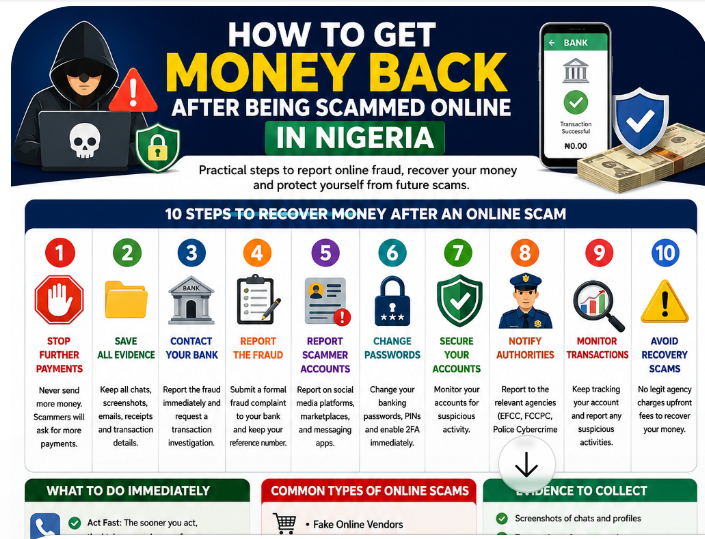
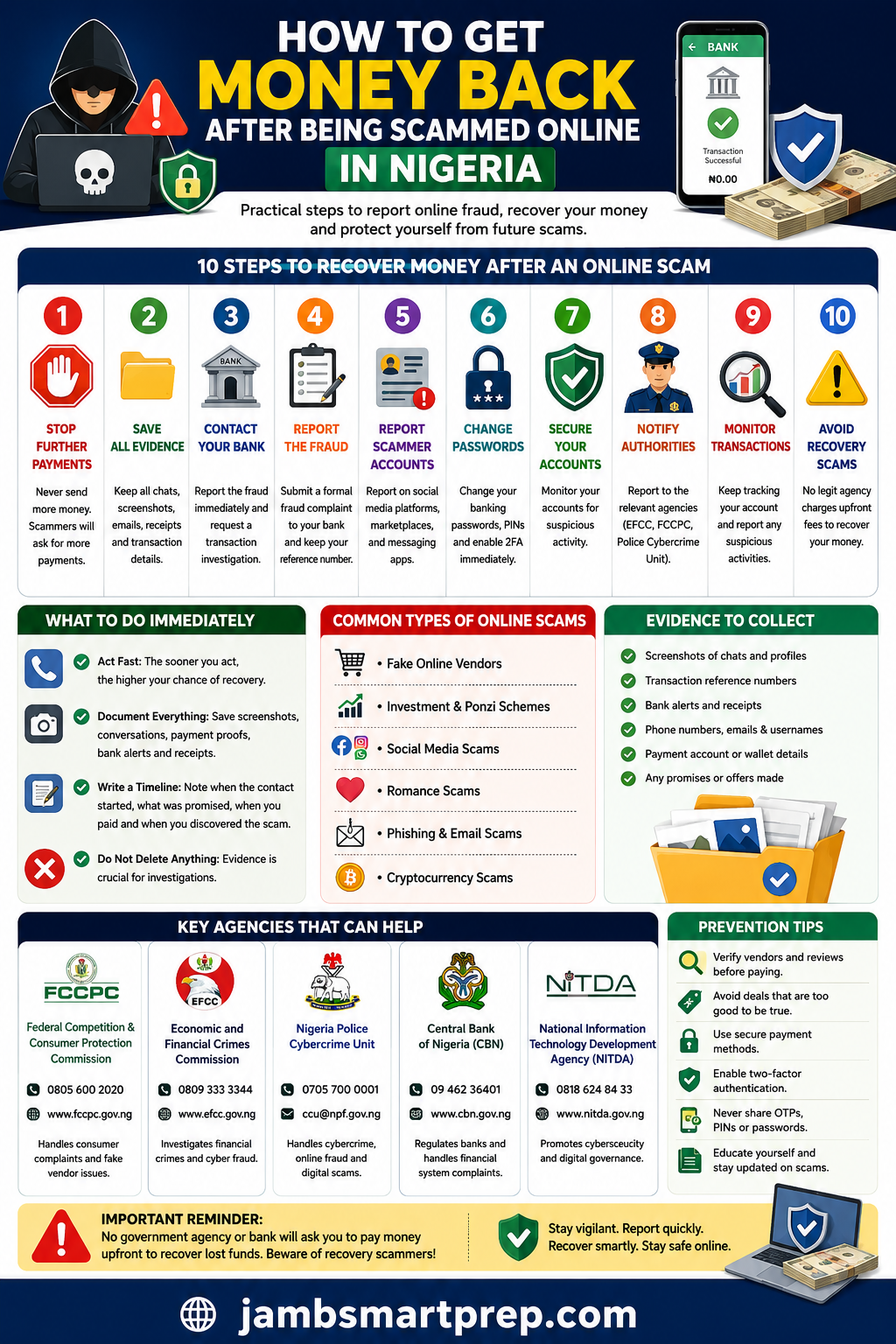
10 Steps to Recover Money After an Online Scam in Nigeria
Visual Flow
Scam Incident → Immediate Action → Report → Recovery Process → Future Protection
Infographic Elements
- Stop Further Payments
- Save Evidence
- Contact Bank
- Report Fraud
- Report Scammer
- Change Passwords
- Secure Accounts
- Notify Authorities
- Monitor Transactions
- Avoid Recovery Scams
Frequently Asked Questions
Can I get my money back after being scammed online in Nigeria?
Yes, recovery is possible in some cases, especially when fraud is reported immediately and evidence is available.
Can banks reverse scam transactions?
Banks may attempt recovery under certain circumstances, but reversals are not guaranteed.
How quickly should I report online fraud?
Immediately. The sooner you report, the higher the chances of successful intervention.
Can EFCC recover money from scammers?
The EFCC can investigate financial crimes and may help facilitate recovery when funds are traced.
What evidence should I keep?
Keep screenshots, receipts, account details, messages, emails, transaction references, and bank alerts.
Can cryptocurrency be recovered after a scam?
Recovery is difficult but sometimes possible when funds pass through identifiable exchanges.
How do I report a fake online vendor?
Report the vendor to your bank, the platform used, the FCCPC, and relevant law enforcement agencies.
What should I do if the scammer contacts me again?
Do not engage further. Preserve the communication as evidence and report it.
Conclusion
Being scammed online can feel overwhelming, but acting quickly can make a significant difference.
The most important steps are to stop further payments, preserve evidence, contact your bank immediately, and report the fraud to the appropriate authorities. Whether you are trying to recover money from a fake vendor in Nigeria, report online fraud, or seek help from agencies such as the FCCPC, EFCC, or the Police Cybercrime Unit, speed and documentation remain your strongest tools.
Key Takeaways
- Recovery is possible in some situations.
- Speed of reporting greatly affects outcomes.
- Evidence is critical.
- Multiple agencies can assist victims.
- Prevention remains the best protection.
Have you ever recovered money after being scammed online or helped someone through the recovery process? Share your experience in the comments. Your story may help another Nigerian avoid losing money or take the right action after becoming a victim.