A promise of doubling your money in a few weeks may sound tempting, but it is often the beginning of a costly scam.
Every year, thousands of Nigerians lose millions of naira to fake investment platforms, Ponzi schemes, fraudulent cryptocurrency projects, and online trading scams. Many victims invest their savings believing they have discovered a life-changing opportunity, only to realize later that they have been deceived.
The rise of social media, Telegram groups, WhatsApp investment communities, and digital finance platforms has made investing more accessible than ever. Unfortunately, it has also created opportunities for fraudsters to target unsuspecting investors.
The most worrying aspect is that investment fraud does not only affect inexperienced investors. Professionals, business owners, civil servants, students, and retirees have all fallen victim to online investment scams in Nigeria.
This comprehensive guide explores the most common online investment scams in Nigeria, how scammers operate, warning signs to watch for, and practical steps you can take to protect yourself and your money.
By the end of this guide, you will know how to identify fake investment platforms, avoid financial fraud, and respond appropriately if you become a victim.
What Are Online Investment Scams?
Definition of Investment Fraud
Investment fraud occurs when individuals or organizations deceive people into investing money in fake, misleading, or non-existent opportunities.
The scammer’s goal is simple:
- Collect funds from victims
- Create false expectations
- Disappear with the money
Many online scam investments are designed to look legitimate.
How Investment Scams Work
Most investment scams follow a similar pattern:
- Attractive opportunity is advertised.
- High returns are promised.
- Investors deposit money.
- Small profits may be paid initially.
- Larger investments are encouraged.
- Withdrawals become difficult.
- The platform disappears.
Why Nigerians Are Frequently Targeted
Several factors contribute to the growth of investment fraud Nigeria cases:
- High unemployment rates
- Desire for financial independence
- Increasing internet access
- Social media influence
- Limited financial literacy
Fraudsters understand these factors and use them to attract victims.
The Rise of Digital Investment Platforms
Technology has transformed investing.
Today, people can invest through:
- Mobile apps
- Websites
- Telegram groups
- WhatsApp communities
- Cryptocurrency exchanges
While many platforms are legitimate, scammers often imitate genuine investment services.
Impact on Victims
Investment scams affect victims financially and emotionally.
Common consequences include:
- Loss of savings
- Debt accumulation
- Emotional stress
- Family conflicts
- Loss of trust
Some victims lose funds intended for school fees, business expansion, or retirement.
Why Intelligent Investors Fall for Scams
One common misconception is that only inexperienced people become victims.
The reality is different.
Scammers rely on:
- Greed
- Urgency
- Trust
- Social proof
- Fear of missing out (FOMO)
These psychological triggers affect people regardless of education level.
Why Online Investment Scams Are Growing in Nigeria
Increased Internet Usage
Nigeria has experienced significant growth in internet adoption.
More internet users create more opportunities for fraudsters to find victims.
Economic Pressures and Quick-Profit Mindset
Many Nigerians seek additional income streams.
Fraudsters exploit this desire by promoting unrealistic investment returns.
Promises such as:
- “Double your money in 30 days”
- “Earn 10% daily”
- “Become financially free in one month”
often attract victims.
Social Media Marketing
Social media has become one of the most powerful tools for investment scammers.
Platforms commonly used include:
Scammers create convincing advertisements and fake success stories.
Cryptocurrency Popularity
The growth of digital currencies has created new opportunities for fraud.
Many cryptocurrency scams Nigeria victims were first introduced through social media groups.
Telegram and WhatsApp Investment Groups
Investment-related groups frequently promise:
- Crypto signals
- Forex trading opportunities
- AI-powered investments
- High-yield returns
Unfortunately, many of these groups are fraudulent.
Lack of Financial Literacy
Many investors do not fully understand:
- Risk management
- Investment regulations
- Financial markets
- Portfolio diversification
This knowledge gap creates opportunities for scammers.
The Most Common Online Investment Scams in Nigeria
Ponzi Schemes
Ponzi schemes Nigeria remains one of the most common forms of investment fraud.
Investors are promised unusually high returns.
Earlier investors are paid using money from new participants.
Eventually, the scheme collapses.
Pyramid Schemes
Pyramid schemes focus heavily on recruitment.
Participants earn more by bringing in new members than by selling actual products or services.
These schemes are unsustainable.
Fake Cryptocurrency Investments
Scammers promote:
- Fake coins
- Fake exchanges
- Fake crypto wallets
- Fake mining opportunities
Victims often discover the fraud only after trying to withdraw funds.
Fake Forex Trading Platforms
Fake forex brokers Nigeria commonly advertise:
- Guaranteed profits
- Risk-free trading
- Professional account management
Many of these platforms are unlicensed.
Binary Options Scams
Binary options fraud typically promises quick profits based on market predictions.
Many fraudulent platforms manipulate outcomes to ensure investor losses.
Fake AI Trading Platforms
Artificial intelligence has become a popular marketing buzzword.
Fraudsters claim their systems can:
- Predict markets perfectly
- Generate automatic profits
- Eliminate investment risks
These claims are usually false.
Telegram Investment Scams
Telegram investment scams often operate through:
- Private groups
- Crypto channels
- Trading communities
Members are encouraged to invest in suspicious opportunities.
WhatsApp Investment Fraud
WhatsApp groups frequently feature:
- Fake screenshots
- Fake withdrawal proofs
- Fake testimonials
These tactics create false trust.
Social Media Investment Scams
Fraudsters use influencers, sponsored ads, and fake success stories to attract victims.
Fake Real Estate Investment Schemes
Some scammers claim to offer profitable property investments that do not actually exist.
Crowdfunding Investment Scams
Fake crowdfunding projects promise returns from businesses or startups that are fictional.
Fake Agricultural Investment Programs
Agriculture investment scams promise profits from:
- Poultry farming
- Fish farming
- Crop production
Many projects have no actual operations.
Fake Cooperative Investment Schemes
Some fraudsters disguise scams as cooperative societies.
Advance Fee Investment Fraud
Victims are asked to pay fees before receiving access to supposed investment opportunities.
These opportunities never materialize.
How Ponzi Schemes Operate in Nigeria
Understanding the Ponzi Model
A Ponzi scheme uses money from new investors to pay earlier investors.
There is usually little or no legitimate business activity.
How Early Investors Get Paid
Early participants often receive payments.
This creates trust and encourages larger investments.
Why Ponzi Schemes Eventually Collapse
The model depends on continuous recruitment.
Once new investors stop joining, the scheme fails.
Famous Ponzi Scheme Examples in Nigeria
Nigeria has witnessed several major Ponzi scheme collapses over the years.
These incidents caused billions of naira in losses and affected thousands of people.
Warning Signs of a Ponzi Scheme
Watch for:
- Guaranteed profits
- No risk claims
- Referral bonuses
- Pressure to recruit others
- Lack of transparency
Lessons Learned From Past Collapses
Key lessons include:
- High returns usually mean high risks.
- Verification is essential.
- Popularity does not equal legitimacy.
- Social proof can be misleading.
Cryptocurrency Investment Scams Explained
Fake Crypto Exchanges
Scammers create fake exchanges that mimic legitimate trading platforms.
Victims deposit funds but cannot withdraw them.
Pump-and-Dump Schemes
Fraudsters artificially inflate cryptocurrency prices before selling their holdings and abandoning the project.
Fake Token Launches
New cryptocurrency projects are promoted aggressively.
Investors buy tokens that ultimately become worthless.
Rug Pull Scams
Developers suddenly abandon a project after collecting investor funds.
Telegram Crypto Investment Fraud
Telegram remains one of the most common channels for cryptocurrency scams Nigeria.
Scammers use private groups and fake experts to attract investors.
Romance and Crypto Scams
Some scammers combine romance fraud with cryptocurrency investments.
Victims are encouraged to invest in fake trading platforms by people they believe are romantic partners.
Crypto Recovery Challenges
Cryptocurrency recovery is difficult because blockchain transactions are generally irreversible.
However, reporting quickly may improve investigation opportunities.
Fake Forex and Trading Platform Scams
Unlicensed Brokers
Always verify whether a broker is properly regulated.
Many fake forex brokers Nigeria operate without licenses.
Guaranteed Profit Claims
No legitimate trading platform can guarantee profits.
Any platform making such promises should be treated with suspicion.
Manipulated Trading Results
Fraudulent platforms often display fake profits to encourage larger investments.
Withdrawal Restrictions
A major warning sign occurs when investors cannot access their funds.
Fake Trading Signals
Scammers often sell expensive trading signals that have little or no value.
Red Flags of Forex Scams
Common warning signs include:
- Unrealistic profits
- Aggressive marketing
- Lack of regulation
- Poor transparency
- Withdrawal difficulties
Telegram and WhatsApp Investment Scams
Telegram and WhatsApp have become major tools for online investment scams in Nigeria.
Fraudsters use these platforms because they provide easy access to large audiences and allow scammers to build trust through group interactions.
Telegram Investment Groups
Many Telegram investment groups claim to offer:
- Daily trading signals
- Cryptocurrency opportunities
- Forex investment strategies
- AI-powered trading systems
Some groups appear highly professional.
They may have:
- Thousands of members
- Regular updates
- Testimonials
- Screenshots of profits
However, many of these groups are carefully designed scams.
Victims are encouraged to deposit funds into fake platforms controlled by the scammers.
Fake Trading Mentors
One increasingly common scam involves fake investment mentors.
These individuals claim to be:
- Forex experts
- Crypto millionaires
- Financial coaches
- Investment advisors
They frequently post images of luxury cars, expensive watches, and foreign vacations to attract followers.
After gaining trust, they begin selling courses or encouraging investments in fraudulent schemes.
Fake Crypto Experts
Cryptocurrency scams Nigeria continue to evolve.
Fraudsters often claim they possess:
- Insider information
- Secret trading algorithms
- Exclusive investment opportunities
Victims are pressured into investing quickly before supposedly profitable opportunities disappear.
WhatsApp Investment Broadcasts
WhatsApp groups frequently serve as recruitment channels for online scam investments.
Scammers send messages promising:
- Guaranteed profits
- Daily returns
- Risk-free investments
- Fast wealth creation
These broadcasts often contain fabricated success stories.
Social Proof Manipulation
One reason many victims trust investment scams is social proof.
Scammers create the illusion that many people are earning money.
They achieve this through:
- Fake group conversations
- Multiple fake accounts
- Fabricated reviews
- Edited screenshots
Fake Testimonials
Testimonials are among the most powerful marketing tools used by scammers.
Examples include:
“I invested ₦50,000 and received ₦500,000.”
“This platform changed my life.”
Most of these testimonials are fabricated.
How Victims Are Recruited
Recruitment often follows a predictable process:
- Victim sees advertisement.
- Victim joins Telegram or WhatsApp group.
- Trust is gradually established.
- Success stories are shared.
- Investment opportunity is introduced.
- Victim deposits funds.
- Withdrawal issues begin.
Fake AI Investment Platforms
What Are AI Trading Scams?
Artificial intelligence is currently one of the most popular technology trends.
Unfortunately, scammers have begun exploiting public interest in AI to promote fraudulent investment opportunities.
AI investment scams claim to use advanced algorithms capable of:
- Predicting market movements
- Generating guaranteed profits
- Eliminating investment risks
These claims are rarely legitimate.
How Scammers Use Artificial Intelligence Buzzwords
Many fraudulent platforms use terms such as:
- Machine learning
- Deep learning
- Automated trading
- Neural networks
- Predictive analytics
The goal is to make the investment sound sophisticated and trustworthy.
Automated Trading Fraud
Some platforms claim that robots trade on behalf of investors.
Victims are told:
- No experience is needed
- The system works automatically
- Returns are guaranteed
In reality, many of these systems do not trade at all.
Fake Investment Dashboards
One common tactic involves creating realistic-looking dashboards.
The dashboard may show:
- Growing account balances
- Daily profits
- Successful trades
- Investment growth charts
These figures are often entirely fictional.
Why AI Scams Are Increasing
Several factors contribute to the growth of AI investment scams:
- Public fascination with AI
- Limited understanding of the technology
- Desire for passive income
- Aggressive social media marketing
How to Verify AI Investment Claims
Before investing in any AI-related platform:
- Request proof of regulation
- Verify company registration
- Research management teams
- Examine independent reviews
- Ask detailed questions about the technology
If explanations are vague, proceed cautiously.
Red Flags That Reveal an Investment Scam
Recognizing warning signs can prevent financial losses.
Guaranteed Returns
This is perhaps the biggest warning sign.
No legitimate investment can guarantee profits.
Every investment involves risk.
No Investment Risk
Be skeptical of statements such as:
- “100% safe investment”
- “No risk involved”
- “Guaranteed daily profits”
Legitimate financial institutions never make such promises.
Pressure to Invest Quickly
Scammers frequently create urgency.
Examples include:
- “Limited slots available”
- “Offer ends today”
- “Invest now or miss out”
Pressure tactics are designed to prevent careful research.
Lack of Regulatory Approval
Always verify whether an investment company is properly regulated.
A legitimate business should be able to provide licensing information.
Poor Transparency
Be cautious when companies refuse to disclose:
- Ownership details
- Office locations
- Management teams
- Financial information
Referral-Based Earnings
Many fraudulent schemes focus more on recruitment than investment performance.
If earnings depend heavily on recruiting others, the scheme may be unsustainable.
Withdrawal Problems
One of the clearest signs of investment fraud Nigeria is difficulty withdrawing funds.
Common excuses include:
- Technical issues
- Maintenance upgrades
- Verification delays
- Additional fees
Hidden Company Information
Legitimate investment firms usually provide:
- Contact details
- Physical addresses
- Regulatory information
Scammers often hide these details.
Unrealistic Profit Projections
Be skeptical of promises such as:
- 20% weekly returns
- 50% monthly profits
- Doubling investments quickly
These figures are generally unsustainable.
Excessive Marketing Hype
Many scams rely on marketing rather than genuine investment performance.
Warning signs include:
- Luxury lifestyle promotions
- Celebrity endorsements without proof
- Constant recruitment campaigns
How to Verify an Investment Platform Before Investing
Check Regulatory Status
Always determine whether the platform operates legally.
Verify registration with appropriate regulatory bodies where applicable.
Verify Company Registration
Check whether the business is officially registered.
Registration alone does not guarantee legitimacy, but lack of registration is a serious warning sign.
Research Online Reviews
Search for:
- User experiences
- Complaints
- Scam reports
- Independent reviews
Pay attention to recurring concerns.
Investigate Company Leadership
Legitimate businesses usually disclose their leadership teams.
Research the backgrounds of founders and executives.
Examine Withdrawal Policies
Read withdrawal terms carefully.
Look for:
- Hidden charges
- Restrictions
- Unusual conditions
Test Customer Support
Contact customer support before investing.
Evaluate:
- Response time
- Professionalism
- Quality of answers
Poor support may indicate larger problems.
Start With Small Amounts
Never commit large sums immediately.
Testing the platform with a small amount may reveal problems before significant losses occur.
Real-Life Investment Scam Scenarios in Nigeria
The Fake Forex Mentor
A young graduate joins a Telegram trading group.
The group administrator presents himself as a successful forex trader.
After sharing screenshots of profits, he persuades members to invest.
Initially, small returns are paid.
Later, larger investments disappear.
The Telegram Crypto Group
An investor joins a cryptocurrency channel promising exclusive trading opportunities.
Members are encouraged to buy tokens before a supposed price increase.
After substantial investments are collected, the administrators disappear.
The AI Trading Platform
A website claims to use artificial intelligence to generate daily profits.
The dashboard shows consistent gains.
Investors become confident and increase deposits.
When withdrawal requests begin, the platform suddenly becomes inaccessible.
The Social Media Investment Influencer
A social media influencer promotes an investment platform to thousands of followers.
Many followers invest without conducting independent research.
Months later, the platform collapses.
Lessons From Real Victims
Common lessons include:
- Verify before investing.
- Avoid emotional decisions.
- Ignore guaranteed profit claims.
- Research independently.
- Never rely solely on social proof.
What To Do If You Invested in a Scam
Stop Sending Money
Do not make additional deposits.
Many scammers request more funds under various excuses.
Preserve Evidence
Save:
- Screenshots
- Emails
- Chat messages
- Payment receipts
- Transaction references
Save Transaction Records
Maintain copies of all financial records.
These may become important during investigations.
Contact Your Bank
If bank transfers were used, report the fraud immediately.
Report the Fraud
File complaints with relevant authorities as quickly as possible.
Protect Personal Information
Change passwords and secure financial accounts.
Avoid Recovery Scams
Be cautious of anyone promising guaranteed recovery of lost funds for an upfront fee.
Many recovery services are scams themselves.
Can You Recover Money Lost to Investment Scams?
One of the first questions victims ask is:
“Can I recover money lost to an investment scam?”
The answer depends on several factors.
In some situations, recovery is possible. In others, recovering funds becomes extremely difficult, especially when victims delay reporting the fraud.
Recovery Possibilities
Some victims have successfully recovered part of their funds through:
- Bank investigations
- Regulatory interventions
- Court actions
- Law enforcement investigations
However, no recovery process can guarantee success.
Factors Affecting Recovery
Several factors influence recovery chances:
- Speed of reporting
- Payment method used
- Availability of evidence
- Traceability of funds
- Cooperation from financial institutions
- Whether the scammer can be identified
Generally, the faster you report the fraud, the better your chances.
Bank Transfer Recovery
If you transferred funds through a Nigerian bank account, immediately notify your bank.
Banks may be able to:
- Investigate transactions
- Contact receiving institutions
- Flag suspicious accounts
- Support law enforcement efforts
Quick action is critical because scammers often move funds rapidly between accounts.
Cryptocurrency Recovery Challenges
Cryptocurrency scams Nigeria are particularly difficult to resolve.
Unlike traditional banking transactions, most cryptocurrency transfers cannot simply be reversed.
Challenges include:
- Anonymous wallet addresses
- Cross-border transactions
- Decentralized platforms
- Rapid movement of funds
Despite these challenges, reporting remains important because blockchain transactions can sometimes be traced.
Importance of Quick Reporting
Time is one of the most important factors in scam recovery.
Many victims wait weeks or months before reporting fraud.
Unfortunately, this delay often gives scammers enough time to:
- Withdraw funds
- Close accounts
- Delete platforms
- Create new identities
Realistic Expectations
Victims should maintain realistic expectations.
Recovery may involve:
- Full recovery
- Partial recovery
- No recovery
The outcome depends on the circumstances of each case.
How to Report Investment Fraud in Nigeria
Reporting investment fraud serves two important purposes:
- It may improve recovery opportunities.
- It helps prevent additional victims.
Reporting to EFCC
The Economic and Financial Crimes Commission investigates financial crimes, cybercrime, and investment fraud.
When reporting, provide:
- Transaction records
- Screenshots
- Chat conversations
- Wallet addresses
- Bank account details
- Website information
The more evidence you provide, the stronger your case becomes.
Reporting to FCCPC
The Federal Competition and Consumer Protection Commission handles consumer complaints involving deceptive practices and fraudulent business activities.
Victims can submit complaints regarding fake investment services and misleading promotions.
Reporting to the Police Cybercrime Unit
The cybercrime division of the Nigeria Police Force investigates online fraud and digital financial crimes.
Evidence should be preserved before making a report.
Reporting to Your Bank
Contact your bank immediately after discovering fraudulent activity.
Provide:
- Transaction reference numbers
- Beneficiary account details
- Payment receipts
- Evidence of fraud
Your bank may initiate internal investigations.
Reporting Cryptocurrency Fraud
If cryptocurrency was involved:
- Save wallet addresses
- Preserve transaction hashes
- Record exchange information
- Document all communications
These details may assist investigators.
Filing Consumer Complaints
Victims can also pursue formal complaints through consumer protection channels where appropriate.
This is particularly useful when fraudulent platforms presented themselves as legitimate businesses.
Government Agencies That Can Help Victims
Many Nigerians do not know which agencies are responsible for handling investment fraud complaints.
Understanding their roles can help victims take the right steps.
Economic and Financial Crimes Commission (EFCC)
The EFCC remains one of Nigeria’s leading agencies for investigating:
- Financial fraud
- Online investment scams
- Cryptocurrency fraud
- Ponzi schemes
- Money laundering
The commission can work with banks and international agencies during investigations.
Federal Competition and Consumer Protection Commission (FCCPC)
The FCCPC focuses on protecting consumers from unfair business practices.
It can assist with complaints involving deceptive investment services.
Central Bank of Nigeria (CBN)
The Central Bank of Nigeria regulates financial institutions operating within Nigeria.
Although the CBN does not directly investigate every scam case, it oversees banking regulations and consumer complaint processes.
Nigeria Police Cybercrime Unit
This specialized unit investigates:
- Internet fraud
- Identity theft
- Online scams
- Digital financial crimes
Victims should provide complete evidence when filing reports.
Nigerian Communications Commission (NCC)
The Nigerian Communications Commission may become relevant when scams involve telecommunications services, SIM registrations, or communication channels.
National Information Technology Development Agency (NITDA)
The National Information Technology Development Agency promotes cybersecurity awareness and digital safety education.
Its resources can help investors recognize emerging scam trends.
Common Mistakes Investors Make
Many victims unknowingly make mistakes that increase losses or reduce recovery chances.
Learning from these mistakes can help protect both current and future investors.
Chasing Unrealistic Returns
One of the most common causes of investment fraud is the desire for unusually high profits.
Promises such as:
- 10% daily returns
- 50% monthly profits
- Guaranteed wealth
should immediately trigger caution.
Ignoring Due Diligence
Many victims invest without conducting proper research.
Before investing, always verify:
- Company registration
- Regulatory status
- Ownership details
- Independent reviews
Investing Based on Social Media Hype
Social media popularity does not prove legitimacy.
Many scams appear successful because fraudsters manipulate public perception.
Trusting Friends Blindly
A friend recommending an investment does not automatically make it safe.
Many victims were introduced to scams by:
- Family members
- Friends
- Colleagues
- Religious associates
Always perform independent verification.
Failing to Verify Licenses
Legitimate financial service providers usually operate under regulatory frameworks.
Failure to verify licensing increases risk.
Reinvesting Fake Profits
Many scams pay small returns initially.
Victims interpret this as proof of legitimacy and invest larger amounts.
This tactic is common in Ponzi schemes Nigeria.
Falling for Recovery Scams
After losing money, some victims encounter another scam.
Recovery scammers promise:
- Guaranteed fund recovery
- Insider connections
- Special access to authorities
In exchange for upfront payments.
These promises are usually fraudulent.
How to Protect Yourself From Online Investment Scams
Protecting yourself begins with education and disciplined decision-making.
Verify Before Investing
Never invest based solely on advertisements or recommendations.
Always conduct independent research.
Understand the Investment
If you cannot clearly explain how the investment generates profits, avoid it.
Legitimate investments should be understandable.
Diversify Investments
Avoid putting all your money into one opportunity.
Diversification reduces risk exposure.
Avoid Emotional Decisions
Fraudsters often use:
- Excitement
- Fear
- Urgency
- Greed
to influence decisions.
Take time to evaluate opportunities carefully.
Learn Basic Financial Literacy
Understanding investment fundamentals helps reduce vulnerability to fraud.
Important topics include:
- Risk management
- Diversification
- Regulation
- Market behavior
Stay Updated on Scam Trends
Scammers continuously adapt their tactics.
Regularly educating yourself about emerging fraud schemes can help you stay protected.
Use Regulated Platforms
Whenever possible, invest through regulated institutions with established reputations.
These platforms generally offer greater transparency and accountability.
Online Investment Scam Prevention Checklist
Before investing, review the following checklist:
| Prevention Step | Status |
|---|---|
| Verify Registration | ✓ |
| Check Regulatory Approval | ✓ |
| Research Reviews | ✓ |
| Verify Management Team | ✓ |
| Avoid Guaranteed Returns | ✓ |
| Understand Investment Risks | ✓ |
| Test Withdrawals | ✓ |
| Avoid Pressure Tactics | ✓ |
| Protect Personal Information | ✓ |
| Stay Educated | ✓ |
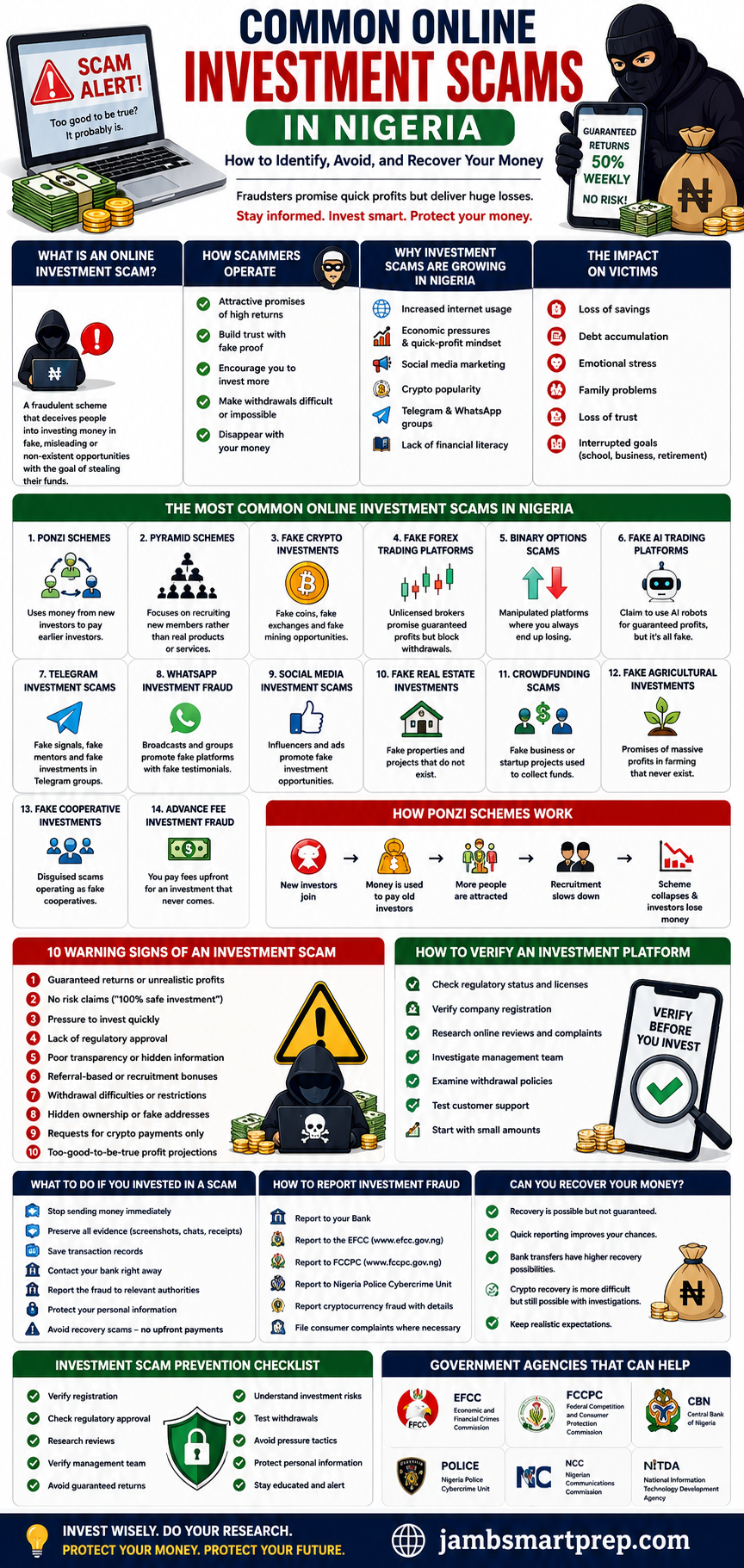
10 Warning Signs of an Online Investment Scam in Nigeria
Visual Elements
- Guaranteed Returns
- No Risk Claims
- Pressure to Invest Fast
- Referral Rewards
- Fake Testimonials
- Unlicensed Platform
- Withdrawal Issues
- Hidden Ownership
- Crypto Payment Requests
- Too-Good-To-Be-True Profits
Visual Flow
Advertisement → Investor Interest → Deposit → Fake Profits → Withdrawal Problems → Scam Discovery
Frequently Asked Questions
What Are the Most Common Online Investment Scams in Nigeria?
The most common online investment scams Nigeria currently include:
- Ponzi schemes
- Pyramid schemes
- Fake cryptocurrency investments
- Fake forex trading platforms
- Telegram investment scams
- WhatsApp investment fraud
- Fake AI trading platforms
- Social media investment scams
- Fake agricultural investment programs
- Fake real estate investment opportunities
These scams often promise unusually high returns with little or no risk.
How Do Ponzi Schemes Work?
A Ponzi scheme uses money from new investors to pay earlier investors.
Initially, investors may receive profits, creating the illusion of a successful business.
As more people join, the scheme grows rapidly.
Eventually, recruitment slows down, new money stops coming in, and the scheme collapses.
At that point, most participants lose their money.
How Can I Identify a Fake Investment Platform?
Several warning signs can reveal fake investment platforms Nigeria:
- Guaranteed profits
- Lack of regulatory approval
- Pressure to invest quickly
- Poor transparency
- Anonymous ownership
- Referral-based earnings
- Withdrawal restrictions
- Unrealistic returns
Always conduct independent research before investing.
Can I Recover Money Lost to Investment Fraud?
Recovery may be possible depending on:
- How quickly the fraud is reported
- The payment method used
- Availability of evidence
- Traceability of funds
- Cooperation from financial institutions
While some victims recover part of their losses, others may not recover any funds.
This is why prevention remains the most effective protection.
How Do I Report Investment Scams in Nigeria?
Victims can report investment fraud to:
- Their bank
- The EFCC
- The FCCPC
- The Nigeria Police Cybercrime Unit
- Relevant regulatory bodies
When reporting, preserve:
- Screenshots
- Chat records
- Payment receipts
- Transaction references
- Wallet addresses
- Website information
Detailed evidence improves investigation outcomes.
Can EFCC Recover Money From Scammers?
The Economic and Financial Crimes Commission investigates financial crimes and investment fraud.
Although the EFCC cannot guarantee recovery of funds, it can:
- Investigate scam operations
- Trace financial transactions
- Work with financial institutions
- Prosecute offenders
- Support asset recovery efforts
Victims should report cases as quickly as possible.
Are Telegram Investment Groups Safe?
Not all Telegram investment groups are scams.
However, Telegram investment scams have increased significantly because fraudsters exploit the platform’s privacy features.
Before trusting any investment opportunity shared on Telegram:
- Verify the company
- Research independently
- Confirm regulatory status
- Avoid guaranteed-return schemes
Never rely solely on group testimonials.
What Should I Do After Losing Money to a Scam?
If you have already invested in a fraudulent scheme:
Step 1: Stop Sending Money
Do not make additional payments.
Step 2: Save Evidence
Preserve:
- Screenshots
- Receipts
- Emails
- Chat messages
- Transaction records
Step 3: Contact Your Bank
Report the transaction immediately.
Step 4: Report the Fraud
File complaints with relevant authorities.
Step 5: Protect Your Information
Update passwords and secure financial accounts.
Step 6: Avoid Recovery Scams
Be cautious of anyone demanding upfront fees to recover your money.
How Can I Verify an Investment Opportunity?
Before investing:
Verify Registration
Check whether the company is legally registered.
Confirm Regulatory Approval
Determine whether relevant authorities regulate the platform.
Research Online Reviews
Search for complaints and user experiences.
Investigate Management Teams
Verify the identities and backgrounds of company leaders.
Test Customer Support
Assess responsiveness and professionalism.
Start Small
Avoid investing large amounts initially.
What Are the Biggest Warning Signs of Investment Fraud?
The most common red flags include:
- Guaranteed returns
- No risk claims
- High-pressure sales tactics
- Hidden ownership
- Fake testimonials
- Referral-focused compensation
- Unlicensed operations
- Withdrawal difficulties
- Excessive marketing hype
If multiple warning signs appear together, extreme caution is warranted.
Quick Comparison Table: Legitimate Investment vs Investment Scam
| Feature | Legitimate Investment | Investment Scam |
|---|---|---|
| Risk Disclosure | Clearly explained | Claims no risk |
| Returns | Reasonable and variable | Guaranteed and unrealistic |
| Regulation | Properly licensed | Often unregulated |
| Ownership | Transparent | Hidden or unclear |
| Withdrawals | Accessible | Frequently restricted |
| Marketing | Balanced | Aggressive and emotional |
| Transparency | High | Low |
| Customer Support | Professional | Poor or unavailable |
Final Scam Prevention Strategy
Before investing a single naira, ask yourself these questions:
Investment Verification Questions
- Is this company properly registered?
- Can I verify the management team?
- Are returns realistic?
- Does the platform disclose risks?
Financial Safety Questions
- Can I afford to lose this money?
- Am I investing based on facts or emotions?
- Have I independently researched the opportunity?
Scam Detection Questions
- Am I being pressured to invest quickly?
- Does the company focus heavily on recruitment?
- Are profits guaranteed?
If any answer raises concerns, investigate further before proceeding.
Key Takeaways
The rise of online investment scams in Nigeria highlights the importance of financial education and careful decision-making.
Remember these critical lessons:
- Online investment scams are increasing in Nigeria.
- Ponzi schemes remain one of the biggest threats.
- Cryptocurrency scams are growing rapidly.
- Guaranteed returns are major warning signs.
- Telegram and WhatsApp are frequently used by fraudsters.
- Verification is your strongest defense.
- Reporting fraud quickly improves recovery chances.
- Financial literacy reduces vulnerability to scams.
Most importantly:
If an investment opportunity sounds too good to be true, it probably is.
Conclusion
Investment opportunities can help Nigerians build wealth, create financial security, and achieve long-term goals.
Unfortunately, scammers understand this desire and continue developing increasingly sophisticated methods to deceive investors.
By learning how investment fraud works, recognizing warning signs, verifying platforms properly, and avoiding emotional decisions, you can significantly reduce your risk of becoming a victim.
Whether the opportunity involves cryptocurrency, forex trading, artificial intelligence, agriculture, real estate, or online crowdfunding, always remember that legitimate investments involve risk and transparency.
No genuine investment can guarantee extraordinary profits without risk.
Protect your money by verifying before investing, asking difficult questions, and conducting independent research.
A few hours of due diligence can prevent years of financial regret.
Now Over To You
Have you ever encountered a suspicious investment platform, fake forex broker, cryptocurrency scam, or Telegram investment group?
Share your experience in the comments section. Your story may help another Nigerian recognize investment fraud and avoid losing hard-earned money.
Important Links
- How to Get Money Back After Being Scammed Online in Nigeria
- Telegram Scam Tricks in Nigeria
- Telegram Crypto Scam Warning Signs in Nigeria
- How to Identify Fake Telegram Investment Groups in Nigeria
- Romance Scams on Telegram Explained in Nigeria
- Consumer Rights and Online Fraud Protection in Nigeria
- How to Avoid Fake Vendors on WhatsApp in Nigeria
- 10 Warning Signs of an Online Investment Scam
- How Ponzi Schemes Work in Nigeria
- Investment Scam Recovery Process
- How to Report Investment Fraud in Nigeria
- Online Investment Scam Prevention Checklist
- Common Cryptocurrency Scams Explained