Thousands of Nigerians have lost billions of naira to investment platforms that promised quick wealth but eventually disappeared overnight.
From the rise of MMM Nigeria to newer online investment platforms, Ponzi schemes continue to trap unsuspecting people with promises of huge returns, little risk, and instant financial freedom.
Many victims are not careless people. They are workers trying to supplement their income, business owners looking for investment opportunities, students searching for financial support, and retirees hoping to grow their savings.
The reality is that Ponzi schemes are carefully designed to appear legitimate. They often look like genuine investment platforms, complete with professional websites, testimonials, referral systems, and customer support channels.
Understanding how Ponzi schemes work in Nigeria is one of the most effective ways to avoid becoming a victim.
In this comprehensive guide, you will learn:
- What a Ponzi scheme is
- How Ponzi schemes operate
- Why Nigerians continue to fall for them
- Famous Ponzi scheme examples in Nigeria
- Warning signs to watch for
- How to protect your money from investment fraud
This article is based on the uploaded pillar-content outline.
What Is a Ponzi Scheme?
Definition of a Ponzi Scheme
A Ponzi scheme is a fraudulent investment operation where returns paid to earlier investors come from money contributed by new investors rather than from legitimate business profits.
In simple terms, there is usually no real investment generating income.
The entire system survives by constantly attracting new participants.
As long as fresh money keeps entering the scheme, it appears successful.
Once recruitment slows down, the scheme collapses.
Origin of the Term “Ponzi Scheme”
The term “Ponzi scheme” comes from Charles Ponzi, an Italian businessman who became famous in the early 1920s for operating one of the largest investment frauds in history.
Ponzi promised investors enormous returns within a short period.
Thousands of people invested.
Eventually, authorities discovered that the profits were being paid using money from new investors.
Who Was Charles Ponzi?
Charles Ponzi gained international attention in 1920 after promising investors a 50% return within 45 days.
His operation attracted millions of dollars.
However, investigations later revealed there was no legitimate business generating those profits.
The scheme eventually collapsed, leaving many investors with significant losses.
How Ponzi Schemes Differ From Legitimate Investments
Legitimate investments generate profits through real economic activities such as:
- Business operations
- Stock market investments
- Real estate development
- Agriculture
- Manufacturing
- Financial services
Ponzi schemes, on the other hand, depend on continuous recruitment.
Without new investors, the system fails.
Why Ponzi Schemes Are Illegal
Ponzi schemes are illegal because they involve fraud and deception.
Operators knowingly mislead investors about:
- Investment risks
- Sources of profits
- Business activities
- Sustainability of returns
These actions violate financial regulations and consumer protection laws.
Why People Confuse Them With Real Investments
Many Ponzi schemes appear legitimate because they:
- Have professional websites
- Offer customer support
- Display profit dashboards
- Provide initial payouts
- Use financial terminology
These features make it difficult for inexperienced investors to recognize the fraud.
How Ponzi Schemes Work in Nigeria
The Basic Ponzi Model
The core structure of a Ponzi scheme is simple.
Money from new investors is used to pay older investors.
No genuine profit-generating activity exists.
The operator creates the illusion of a successful investment business.
How New Investors Fund Old Investors
Consider this example:
- Investor A contributes ₦100,000.
- Investor B contributes ₦100,000.
- Investor C contributes ₦100,000.
Instead of investing the funds, the operator uses money from Investors B and C to pay Investor A.
Investor A receives profits and becomes convinced the platform works.
He then encourages others to join.
Why Early Participants Receive Payments
One reason Ponzi schemes spread rapidly is that some early participants actually receive profits.
These payments serve as marketing tools.
When people see friends receiving money, trust increases.
Recruitment becomes easier.
The Recruitment Cycle
Most Ponzi schemes Nigeria depend heavily on recruitment.
Participants are encouraged to:
- Invite friends
- Recruit family members
- Share referral links
- Promote the platform on social media
Each new investor provides fresh capital.
Growth Through Referrals
Referral bonuses are one of the strongest indicators of a Ponzi scheme.
Participants may receive:
- Cash rewards
- Commission percentages
- Additional investment bonuses
This encourages aggressive promotion.
The Illusion of Profitability
The platform appears successful because:
- Investors receive payments
- Testimonials circulate online
- Social media buzz increases
- Success stories spread rapidly
However, the business model remains unsustainable.
The Eventual Collapse
Every Ponzi scheme eventually reaches a point where:
- New registrations decline
- Withdrawals increase
- Cash flow becomes insufficient
At this stage, payments stop.
The scheme collapses.
Step-by-Step Breakdown of a Typical Ponzi Scheme
Understanding the life cycle of a Ponzi scheme can help investors identify danger early.
Stage 1 – Launching the Opportunity
The operators introduce a new investment platform.
Marketing focuses on:
- Wealth creation
- Financial freedom
- Passive income
- Fast returns
Stage 2 – Promising Unrealistic Returns
Common promises include:
- 30% monthly returns
- 50% profit in 45 days
- Daily income opportunities
- Guaranteed investment growth
These promises attract attention quickly.
Stage 3 – Attracting Early Investors
Early adopters join because:
- Returns appear attractive
- Risk seems low
- Friends recommend the platform
Stage 4 – Paying Early Participants
The first investors receive profits.
This builds credibility.
Many participants begin promoting the scheme aggressively.
Stage 5 – Viral Expansion
The platform gains popularity through:
- WhatsApp groups
- Telegram channels
- Facebook posts
- TikTok videos
- Word-of-mouth referrals
Growth accelerates rapidly.
Stage 6 – Withdrawal Delays
Eventually, warning signs emerge.
Investors begin experiencing:
- Delayed payments
- System maintenance notices
- Withdrawal restrictions
- Technical issues
Stage 7 – Platform Collapse
As recruitment slows, the scheme becomes unsustainable.
Payments stop completely.
Panic spreads among investors.
Stage 8 – Disappearance of Operators
In many cases:
- Websites disappear
- Social media accounts vanish
- Customer support stops responding
Victims are left with losses.
Why Ponzi Schemes Are So Popular in Nigeria
Economic Hardship
Economic challenges often make people more vulnerable to promises of quick wealth.
High Unemployment Rates
Many unemployed individuals seek alternative income sources.
Scammers exploit this desire.
Desire for Financial Freedom
Most victims genuinely want to improve their financial situations.
Fraudsters understand this motivation.
Social Media Influence
Social media platforms make it easy to spread investment promotions.
Fear of Missing Out (FOMO)
When people see others claiming to earn money, they fear being left behind.
Peer Pressure
Recommendations from friends and family often carry significant influence.
Financial Illiteracy
Limited understanding of investment principles makes it easier for fraudsters to succeed.
Common Characteristics of Ponzi Schemes
Guaranteed Returns
Legitimate investments cannot guarantee profits.
Ponzi schemes frequently make such promises.
Little or No Risk Claims
Every investment involves risk.
Claims of risk-free investing are major warning signs.
Referral Bonuses
Heavy emphasis on recruitment often indicates fraud.
Aggressive Marketing
Ponzi schemes rely heavily on advertising and hype.
Lack of Transparency
Information about company ownership is often unclear.
Hidden Ownership
Many operators conceal their identities.
Unregistered Operations
Regulatory approval is often absent.
Unrealistic Profit Projections
Returns are typically far above market standards.
Pressure to Reinvest
Participants are encouraged to reinvest profits rather than withdraw them.
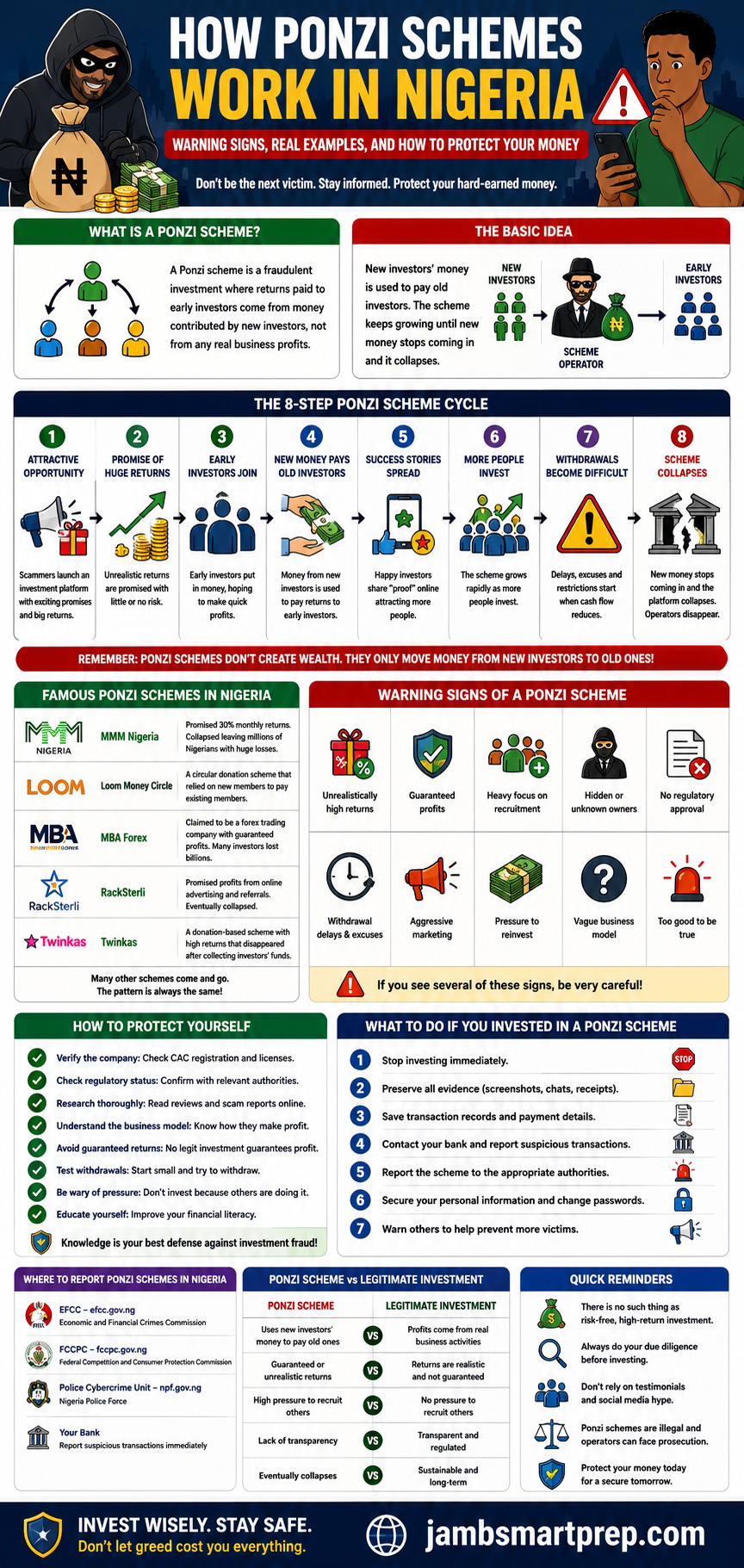
How Ponzi Schemes Work in Nigeria: The 8-Step Scam Cycle
- Attractive Investment Opportunity
- Promise of Huge Returns
- Early Investors Join
- New Investors Fund Old Investors
- Success Stories Spread
- More People Invest
- Withdrawals Become Difficult
- Platform Collapses
Launch → Recruitment → Early Payments → Rapid Growth → More Deposits → Withdrawal Problems → Panic → Collapse
Famous Ponzi Scheme Examples in Nigeria
Nigeria has experienced several high-profile Ponzi scheme collapses over the years.
While each scheme had a different name and marketing strategy, they all shared one thing in common:
They relied on new investors’ money to pay earlier investors.
MMM Nigeria
MMM Nigeria remains the most famous Ponzi scheme in Nigerian history.
Launched in Nigeria in 2015, MMM promised participants returns of up to 30% per month.
The scheme rapidly gained popularity.
At its peak, millions of Nigerians reportedly participated.
People invested:
- Salaries
- School fees
- Business capital
- Retirement savings
Initially, many participants received payments.
This created confidence and encouraged more recruitment.
However, in late 2016, withdrawals were frozen.
The platform eventually collapsed, leaving many Nigerians with substantial losses.
Loom Money Circle
Loom became popular through social media platforms.
Participants were encouraged to contribute money and recruit others.
The scheme used a circular structure where new members supposedly funded earlier participants.
Like many similar programs, it eventually became unsustainable.
MBA Forex
MBA Forex attracted investors by claiming to provide professional forex trading services.
Many Nigerians believed they were investing in legitimate trading activities.
When withdrawal issues emerged, thousands of investors reportedly struggled to access their funds.
The case generated significant public attention.
RackSterli
RackSterli marketed itself as a digital advertising and reward platform.
Participants earned returns through investments and referrals.
Eventually, regulatory concerns and payment challenges emerged.
Chinmark Group Controversy
The Chinmark case generated widespread discussions about investment regulation and investor protection.
Many investors raised concerns regarding delayed payments and access to funds.
Ultimate Cycler
Ultimate Cycler promised significant returns through member participation and recruitment.
Like many pyramid-style programs, sustainability became a major challenge.
Twinkas
Twinkas operated similarly to other donation-based schemes.
Members were encouraged to contribute funds with the expectation of receiving larger returns later.
Get Help Worldwide
This platform attracted participants with promises of financial assistance and high returns.
Its structure closely resembled other community-based Ponzi operations.
Other Notable Cases
Nigeria has witnessed numerous smaller Ponzi schemes over the years, including:
- Donation platforms
- Crypto investment clubs
- Telegram investment groups
- Referral-based investment programs
- AI trading schemes
Although their names change, the underlying structure often remains the same.
Lessons Learned From Past Collapses
The collapse of major Ponzi schemes teaches several important lessons:
- High returns usually involve high risks.
- Guaranteed profits are unrealistic.
- Popularity does not prove legitimacy.
- Social media hype can be misleading.
- Verification is essential before investing.
How Ponzi Schemes Recruit Victims
Recruitment is the lifeblood of every Ponzi scheme.
Without new investors, the system cannot survive.
Social Media Advertising
Social media has become one of the most effective recruitment tools.
Fraudsters use:
- Facebook ads
- Instagram promotions
- TikTok videos
- X (Twitter) posts
to reach potential victims.
WhatsApp Groups
Many investment scams Nigeria spread through WhatsApp.
Administrators create groups filled with:
- Success stories
- Profit screenshots
- Testimonials
- Referral opportunities
The goal is to create trust and urgency.
Telegram Communities
Telegram investment groups are increasingly popular.
Scammers use Telegram because:
- Groups can accommodate large numbers of members.
- Privacy features make tracking difficult.
- Automated bots can be used for marketing.
Influencer Marketing
Some operators collaborate with influencers or individuals who appear influential.
These endorsements can make fraudulent schemes seem credible.
Fake Testimonials
Testimonials are among the most powerful recruitment tools.
Examples include:
“I invested ₦100,000 and received ₦300,000.”
“This platform changed my life.”
Many such testimonials are fabricated or exaggerated.
Referral Incentives
Referral commissions encourage participants to recruit others.
Typical rewards include:
- Cash bonuses
- Additional returns
- Commission percentages
The stronger the recruitment focus, the higher the risk of fraud.
Religious and Community Networks
Some scammers exploit trust within:
- Churches
- Mosques
- Community associations
- Professional groups
People are often more willing to invest when recommendations come from familiar faces.
Family and Friend Referrals
Many victims join because someone they know personally recommends the opportunity.
Unfortunately, friends and family members are often victims themselves.
Ponzi Schemes vs Pyramid Schemes
Many people use the terms interchangeably.
However, there are important differences.
Similarities Between Both Scams
Both schemes:
- Depend on recruitment
- Promise high returns
- Eventually collapse
- Cause financial losses
Key Differences
A Ponzi scheme typically has a central operator who controls all funds.
A pyramid scheme focuses more directly on recruitment, where participants earn by bringing in new members.
Which Is More Dangerous?
Both can be financially devastating.
However, Ponzi schemes often appear more legitimate because they are disguised as investment opportunities.
How to Identify Each Type
Signs of a Ponzi scheme:
- Investment-focused marketing
- Guaranteed returns
- Centralized management
Signs of a pyramid scheme:
- Recruitment-focused earnings
- Membership fees
- Multi-level structures
Examples of Both Models
Many modern scams combine elements of both models.
This makes detection more difficult.
Psychological Tricks Used by Ponzi Scheme Operators
Successful fraudsters understand human psychology.
They often rely more on emotions than on financial expertise.
Fear of Missing Out (FOMO)
People naturally dislike feeling left behind.
Scammers exploit this by creating urgency.
Examples include:
- “Limited investment slots available.”
- “Join before registration closes.”
- “Don’t miss this opportunity.”
Social Proof
When people see others claiming success, they assume the opportunity is legitimate.
Scammers create social proof through:
- Testimonials
- Profit screenshots
- Success stories
- Group discussions
Authority Bias
People tend to trust individuals who appear knowledgeable or successful.
Fraudsters often present themselves as:
- Financial experts
- Investment coaches
- Business executives
- Cryptocurrency professionals
Scarcity Tactics
Limited-time offers encourage rushed decisions.
Investors may skip proper research because they fear missing out.
Greed and Fast Wealth Promises
One of the strongest psychological triggers is the desire for quick financial gains.
Promises such as:
- Double your money quickly
- Earn passive income effortlessly
- Achieve financial freedom rapidly
often attract victims.
Emotional Manipulation
Some scammers use emotional stories to build trust.
Examples include:
- Family hardships
- Personal struggles
- Community development projects
Community Trust Exploitation
Fraudsters frequently target existing communities because trust already exists.
People may invest because:
- Friends have joined
- Family members recommend it
- Religious leaders appear supportive
Warning Signs That Reveal a Ponzi Scheme
Before investing, look for these major red flags:
Unrealistically High Returns
Legitimate investments rarely produce extraordinary profits consistently.
Guaranteed Profits
No genuine investment can guarantee returns.
No Clear Business Model
If you cannot understand how profits are generated, proceed cautiously.
Lack of Regulatory Approval
Verify whether the company operates legally.
Difficulty With Withdrawals
Delayed or restricted withdrawals are major warning signs.
Excessive Recruitment Focus
Heavy emphasis on referrals often indicates trouble.
Vague Investment Strategy
Fraudsters often avoid detailed explanations.
Hidden Company Information
Lack of transparency should raise concerns.
Pressure to Act Quickly
Urgency is a common scam tactic.
Too-Good-To-Be-True Opportunities
If something sounds too good to be true, it usually is.
Real-Life Ponzi Scam Scenarios
Many Ponzi schemes follow predictable patterns. Understanding how these scams play out in real life can help you recognize danger before it is too late.
The Telegram Investment Group
A university student joins a Telegram investment group after seeing screenshots of people claiming to earn daily profits.
The group administrator presents himself as a cryptocurrency expert and shares motivational messages about financial freedom.
Initially, members who invest small amounts receive returns.
Encouraged by these payments, they invest larger sums.
Within months:
- Withdrawals become delayed.
- Administrators stop responding.
- The Telegram group disappears.
Thousands of naira are lost.
The Fake Forex Expert
A young entrepreneur discovers a social media account belonging to someone who claims to be a professional forex trader.
The trader displays:
- Luxury cars
- Foreign trips
- Expensive gadgets
- Trading screenshots
Investors are promised monthly returns of 40% to 60%.
Some receive initial payments.
Later, the platform experiences “technical difficulties.”
Eventually, withdrawals stop entirely.
The WhatsApp Referral Program
A WhatsApp group advertises an opportunity where participants can earn by helping others.
Members are encouraged to:
- Invest money
- Recruit friends
- Build teams
The platform grows rapidly through referrals.
When recruitment slows down, the scheme collapses.
Many participants lose their contributions.
The Social Media Investment Influencer
An influencer promotes a supposedly revolutionary investment platform.
Thousands of followers trust the recommendation.
The platform gains popularity quickly.
Months later, investors begin reporting withdrawal problems.
The platform eventually shuts down, leaving investors stranded.
Lessons Learned From Victims
Most victims report similar experiences:
- They ignored warning signs.
- Friends encouraged participation.
- Early payouts created trust.
- They invested more after seeing initial profits.
- They failed to verify the platform properly.
The most important lesson is simple:
Always verify before investing.
How to Verify an Investment Opportunity Before Investing
One of the best ways to avoid investment scams Nigeria is to conduct proper due diligence.
Before investing even a small amount, take the following steps.
Check Company Registration
Verify whether the company is legally registered.
A legitimate business should have verifiable registration details.
However, registration alone does not guarantee legitimacy.
It is only the first step.
Verify Regulatory Compliance
Determine whether the company operates under relevant financial regulations.
Legitimate investment firms typically comply with regulatory requirements.
If a platform refuses to provide licensing information, proceed cautiously.
Research Independent Reviews
Search online for:
- User experiences
- Complaints
- Scam reports
- Regulatory warnings
Pay attention to recurring concerns.
A pattern of complaints often signals trouble.
Investigate Management Team
Research the people behind the company.
Ask questions such as:
- Who owns the platform?
- What is their professional background?
- Are their identities verifiable?
Hidden ownership is a major warning sign.
Understand the Business Model
Ask yourself:
How does this company actually generate profits?
If the explanation is vague or overly complicated, be cautious.
A legitimate investment should have a clear and understandable business model.
Examine Withdrawal Policies
Read all terms and conditions carefully.
Look for:
- Withdrawal restrictions
- Hidden fees
- Processing delays
- Unusual conditions
Many scams reveal themselves through withdrawal policies.
Ask Difficult Questions
Do not be afraid to ask detailed questions.
Examples include:
- What risks are involved?
- How are profits generated?
- Who regulates the company?
- How are funds managed?
Legitimate businesses generally provide clear answers.
Start With Extreme Caution
Even after conducting research, avoid investing large amounts immediately.
If you decide to proceed:
- Start small.
- Test withdrawals.
- Monitor performance carefully.
This approach reduces potential losses.
What To Do If You Invested in a Ponzi Scheme
Discovering that you have invested in a fraudulent scheme can be emotionally difficult.
However, taking immediate action can improve your chances of limiting losses.
Stop Investing Immediately
Do not send additional funds.
Many Ponzi operators attempt to keep victims engaged by promising future payouts.
Avoid the temptation to “recover” your losses through further investments.
Preserve Evidence
Save all available evidence, including:
- Screenshots
- Emails
- Chat messages
- Investment agreements
- Promotional materials
Evidence may become crucial during investigations.
Save Transaction Records
Maintain copies of:
- Bank receipts
- Transfer records
- Cryptocurrency transactions
- Payment confirmations
These records can help authorities trace funds.
Contact Your Bank
If bank transfers were used, notify your bank immediately.
Provide:
- Transaction references
- Beneficiary account information
- Supporting evidence
Early reporting improves recovery opportunities.
Report the Platform
Do not assume someone else has already reported the fraud.
Every report strengthens investigations.
Secure Personal Information
If you shared sensitive information, immediately:
- Change passwords
- Enable two-factor authentication
- Monitor financial accounts
- Update security settings
Warn Other Potential Victims
Sharing information can help prevent additional losses.
Alert:
- Friends
- Family members
- Colleagues
- Community groups
Can You Recover Money Lost in a Ponzi Scheme?
One of the most common questions victims ask is:
“Can I recover money lost in a Ponzi scheme?”
The answer depends on several factors.
Recovery Possibilities
Recovery may be possible when:
- Funds remain traceable
- Authorities intervene quickly
- Assets are recovered
- Sufficient evidence exists
Some victims recover part of their losses.
Others may recover nothing.
Factors That Affect Recovery
Several factors influence recovery chances:
- Speed of reporting
- Payment method used
- Availability of evidence
- Cooperation from financial institutions
- Ability to identify operators
Bank Transfer Recovery
Bank transfers may offer better recovery prospects than some other payment methods.
Quick reporting allows banks to investigate suspicious transactions more effectively.
Asset Recovery Investigations
In some cases, law enforcement agencies may seize assets connected to fraudulent operations.
Recovered assets may eventually be used to compensate victims.
However, this process can take significant time.
Challenges of Recovery
Recovery is often difficult because:
- Funds may be spent quickly.
- Operators may disappear.
- Money may move across multiple accounts.
- Cryptocurrency transactions may be hard to reverse.
Realistic Expectations
Victims should remain realistic.
Recovery is not guaranteed.
The primary goal should always be prevention.
Avoiding a scam is far easier than recovering money afterward.
How to Report Ponzi Schemes in Nigeria
Reporting fraud helps authorities investigate operators and protect other investors.
Reporting to EFCC
The Economic and Financial Crimes Commission investigates:
- Investment fraud
- Online scams
- Financial crimes
- Ponzi schemes
Provide as much evidence as possible.
Reporting to FCCPC
The Federal Competition and Consumer Protection Commission handles consumer complaints involving deceptive business practices.
Reporting to Police Cybercrime Unit
The cybercrime division of the Nigeria Police Force investigates digital fraud and online financial crimes.
Reporting to Your Bank
Notify your bank immediately if financial transactions are involved.
Banks may assist with investigations.
Filing Consumer Complaints
Formal complaints can help document fraudulent activities and support enforcement efforts.
Preserving Evidence for Investigations
Before reporting, ensure you preserve:
- Screenshots
- Payment records
- Website details
- Chat conversations
- Promotional materials
Government Agencies Fighting Investment Fraud
Nigeria has several agencies responsible for investigating financial scams and protecting consumers from fraudulent investment schemes.
Knowing where to seek help can improve your chances of getting assistance if you become a victim.
Economic and Financial Crimes Commission (EFCC)
The Economic and Financial Crimes Commission is one of the primary agencies responsible for combating financial crimes in Nigeria.
The EFCC investigates:
- Ponzi schemes
- Cryptocurrency fraud
- Investment scams
- Online financial fraud
- Money laundering
Many high-profile Ponzi scheme cases in Nigeria have been investigated by the EFCC.
Federal Competition and Consumer Protection Commission (FCCPC)
The Federal Competition and Consumer Protection Commission protects consumers from deceptive and unfair business practices.
The FCCPC can assist victims who have been misled by fraudulent investment platforms and deceptive marketing campaigns.
Central Bank of Nigeria (CBN)
The Central Bank of Nigeria regulates banks and financial institutions operating within Nigeria.
While the CBN does not directly manage every investment scam complaint, it helps oversee financial systems and consumer protection processes.
Nigeria Police Cybercrime Unit
The cybercrime division of the Nigeria Police Force investigates:
- Online fraud
- Identity theft
- Digital financial crimes
- Internet scams
Victims should preserve evidence before making reports.
Nigerian Communications Commission (NCC)
The Nigerian Communications Commission helps regulate telecommunications services and may assist in cases involving fraudulent communications.
National Information Technology Development Agency (NITDA)
The National Information Technology Development Agency promotes cybersecurity awareness and digital literacy.
Investors can benefit from NITDA’s educational resources on online safety.
Common Mistakes Investors Make
Many victims unknowingly make decisions that increase their risk of falling for Ponzi schemes.
Understanding these mistakes can help prevent future losses.
Chasing Fast Profits
The desire to become wealthy quickly is one of the biggest reasons people fall victim to investment fraud.
Promises of:
- 30% monthly returns
- Guaranteed daily profits
- Instant wealth
often attract investors despite obvious warning signs.
Ignoring Red Flags
Many victims notice suspicious behavior but choose to ignore it.
Examples include:
- Withdrawal delays
- Lack of transparency
- Anonymous ownership
- Unrealistic promises
Ignoring these warning signs can be costly.
Following Crowd Mentality
People often assume an investment is safe simply because many others are participating.
However, popularity does not guarantee legitimacy.
MMM Nigeria attracted millions of participants before collapsing.
Trusting Testimonials Blindly
Many online testimonials are fabricated.
Scammers frequently use:
- Edited screenshots
- Fake success stories
- Paid endorsements
- Multiple fake accounts
to create false credibility.
Investing Without Research
One of the most common mistakes is investing before conducting independent verification.
Before investing, always research:
- Company registration
- Ownership
- Reviews
- Regulatory status
Reinvesting Initial Profits
Many Ponzi schemes pay early investors.
This encourages participants to reinvest larger amounts.
Unfortunately, these initial payments are often designed to create trust.
Delaying Reports
Victims frequently wait too long before reporting fraud.
Quick reporting can improve investigation and recovery opportunities.
How to Protect Yourself From Ponzi Schemes
Protecting yourself begins with knowledge and discipline.
Learn Financial Literacy
Basic financial education helps investors recognize unrealistic opportunities.
Important topics include:
- Investment risk
- Diversification
- Compound growth
- Portfolio management
Verify Before Investing
Never rely solely on advertisements or recommendations.
Always conduct independent research.
Understand Investment Risks
Every legitimate investment involves some level of risk.
No investment can guarantee profits.
Avoid Guaranteed Returns
Whenever you hear phrases such as:
- “Guaranteed profit”
- “Risk-free investment”
- “Certain returns”
consider them major warning signs.
Diversify Investments
Avoid putting all your funds into a single investment opportunity.
Diversification reduces risk exposure.
Stay Updated on Scam Trends
Fraudsters constantly develop new strategies.
Keeping up with scam trends can help you identify threats early.
Seek Independent Advice
Before investing significant amounts, consider consulting:
- Financial advisors
- Accountants
- Investment professionals
Independent opinions can help reveal risks you may have overlooked.
Ponzi Scheme Prevention Checklist
Before investing in any opportunity, use this checklist:
| Prevention Step | Status |
|---|---|
| Verify Registration | ✓ |
| Check Regulatory Status | ✓ |
| Research Reviews | ✓ |
| Understand Business Model | ✓ |
| Avoid Guaranteed Returns | ✓ |
| Verify Management Team | ✓ |
| Test Withdrawals | ✓ |
| Avoid Pressure Tactics | ✓ |
| Protect Personal Information | ✓ |
| Stay Educated | ✓ |
How Ponzi Schemes Work in Nigeria: The 8-Step Scam Cycle
- Attractive Investment Opportunity
- Promise of Huge Returns
- Early Investors Join
- New Investors Fund Old Investors
- Success Stories Spread
- More People Invest
- Withdrawals Become Difficult
- Platform Collapses
Launch → Recruitment → Early Payments → Rapid Growth → More Deposits → Withdrawal Problems → Panic → Collapse
Frequently Asked Questions
What Is a Ponzi Scheme?
A Ponzi scheme is an investment fraud where returns paid to existing investors come from money contributed by new investors rather than legitimate profits.
How Do Ponzi Schemes Work in Nigeria?
Ponzi schemes operate by attracting new investors, using their funds to pay earlier participants, and creating the illusion of profitability.
The system eventually collapses when recruitment slows down.
Why Do Ponzi Schemes Collapse?
Ponzi schemes are unsustainable.
They depend on a constant flow of new investors.
Once new deposits decline, operators cannot meet withdrawal demands.
What Are the Warning Signs of a Ponzi Scheme?
Major warning signs include:
- Guaranteed returns
- No investment risk
- Referral bonuses
- Hidden ownership
- Unlicensed operations
- Withdrawal difficulties
Is a Ponzi Scheme Legal in Nigeria?
No.
Ponzi schemes are illegal because they involve fraud and deception.
Operators may face investigations and prosecution.
Can I Recover Money Lost in a Ponzi Scheme?
Recovery is sometimes possible but depends on factors such as:
- Speed of reporting
- Availability of evidence
- Traceability of funds
- Cooperation from authorities
How Do Scammers Recruit Victims?
Common recruitment methods include:
- Social media advertising
- WhatsApp groups
- Telegram communities
- Referral programs
- Fake testimonials
- Influencer endorsements
How Can I Identify Fake Investment Platforms?
Always verify:
- Registration status
- Regulatory approval
- Company ownership
- Reviews
- Business model
If information is unclear, proceed cautiously.
What Should I Do If I Invested in a Ponzi Scheme?
You should:
- Stop investing immediately.
- Preserve evidence.
- Contact your bank.
- Report the scheme.
- Secure personal information.
- Warn potential victims.
How Do I Report Ponzi Schemes in Nigeria?
Victims can report cases to:
- EFCC
- FCCPC
- Nigeria Police Cybercrime Unit
- Their bank
- Relevant consumer protection agencies
Key Takeaways
Before you leave, remember these important lessons:
- Ponzi schemes rely on new investors to pay old investors.
- They are unsustainable and eventually collapse.
- Guaranteed returns are major warning signs.
- Social proof is often manipulated.
- Financial literacy is your strongest defense.
- Verification should always come before investment.
- Quick reporting improves recovery opportunities.
Most importantly:
If an investment opportunity sounds too good to be true, it usually is.
Conclusion
Ponzi schemes have caused enormous financial losses in Nigeria for decades.
From MMM Nigeria to newer online investment fraud schemes, the pattern remains the same. Fraudsters promise extraordinary returns, attract investors through trust and social proof, and eventually disappear when the system can no longer sustain itself.
Understanding how Ponzi schemes work in Nigeria is essential for protecting your finances.
Always verify investment opportunities, conduct independent research, avoid emotional decisions, and remember that genuine wealth is usually built gradually through legitimate investments rather than promises of instant riches.
The best protection against financial scams is knowledge.
Now Over To You
Have you ever encountered a suspicious investment platform or Ponzi scheme in Nigeria?
Share your experience in the comments section. Your story could help another person avoid losing money to investment fraud.
Important Links
- Common Online Investment Scams in Nigeria
- How to Get Money Back After Being Scammed Online in Nigeria
- Telegram Investment Scams Explained
- Telegram Crypto Scam Warning Signs
- How to Identify Fake Investment Platforms
- Consumer Rights and Online Fraud Protection in Nigeria
- Romance Scams on Telegram Explained in Nigeria