Online shopping, digital banking, mobile payments, social media marketplaces, and cryptocurrency transactions have changed the way Nigerians buy goods and services.
Today, a student in Port Harcourt can order a laptop from Lagos, pay online, and receive delivery within days. A business owner in Abuja can purchase inventory through an online marketplace without ever meeting the seller physically.
While these innovations have made life easier, they have also created new risks.
Online fraud, fake vendors, phishing scams, identity theft, fake investment schemes, and cybercrime continue to affect thousands of Nigerians every year.
Many victims lose money not because they are careless, but because they are unaware of their legal rights as consumers and do not know how to respond when fraud occurs.
Consumer rights in Nigeria exist to protect individuals from unfair business practices, deceptive transactions, unsafe products, and fraudulent activities.
Unfortunately, many Nigerians are unfamiliar with these protections.
This guide explains everything you need to know about consumer rights and online fraud protection in Nigeria.
By the end of this article, you will understand:
- Your rights as a consumer in Nigeria
- Consumer protection laws in Nigeria
- Legal remedies available to fraud victims
- How to stay safe during online transactions
- How to identify common online scams
- Steps to take if you become a victim of fraud
Whether you shop online regularly, use mobile banking, invest digitally, or buy products through social media platforms, this guide can help you protect your money and personal information.
Understanding Consumer Rights in Nigeria
What Are Consumer Rights?
Consumer rights are legal protections designed to safeguard buyers of goods and services.
These rights ensure that consumers:
- Receive accurate information
- Purchase safe products
- Are treated fairly by businesses
- Have access to remedies when things go wrong
Consumer rights exist because businesses generally have more information and resources than customers.
Without proper protection, consumers can easily become victims of fraud, deception, or exploitation.
Why Consumer Rights Matter
Consumer rights create a safer marketplace.
They help:
- Protect buyers from fraud
- Encourage business transparency
- Improve product quality
- Promote fair competition
- Build trust in the economy
When consumers understand their rights, they are more likely to make informed decisions.
This reduces opportunities for scammers and dishonest businesses.
The Importance of Consumer Protection
Consumer protection goes beyond preventing fraud.
It also ensures that:
- Products meet safety standards
- Services match advertised claims
- Businesses respect customer rights
- Complaints are properly addressed
Strong consumer protection systems benefit both buyers and legitimate businesses.
Consumer Rights in the Digital Age
Technology has transformed commerce.
Today, Nigerians regularly use:
- Online stores
- Mobile banking apps
- Digital wallets
- Cryptocurrency exchanges
- Social media marketplaces
While these platforms offer convenience, they also expose consumers to new risks.
Digital consumer protection has therefore become more important than ever.
Online consumer protection Nigeria is no longer limited to physical products. It now covers digital transactions, online services, electronic payments, and data privacy.
Rights Every Nigerian Consumer Should Know
Every Nigerian consumer should understand the following basic rights:
- Right to safety
- Right to information
- Right to choose
- Right to be heard
- Right to seek redress
- Right to consumer education
- Right to privacy
These rights form the foundation of consumer protection in Nigeria.
Common Consumer Challenges in Nigeria
Many Nigerians face challenges such as:
Fake Online Vendors
Some sellers collect payments and disappear without delivering products.
Counterfeit Products
Customers sometimes receive fake or substandard items.
Misleading Advertising
Businesses may exaggerate product quality or make false promises.
Online Fraud
Scammers use fake websites, social media accounts, and phishing schemes to steal money.
Data Privacy Violations
Personal information may be collected or shared without consent.
Understanding your rights helps you respond effectively to these challenges.
Consumer Protection Laws in Nigeria
Nigeria has several laws and regulatory frameworks designed to protect consumers.
Understanding these laws can help victims of fraud seek appropriate remedies.
Federal Competition and Consumer Protection Act (FCCPA)
The Federal Competition and Consumer Protection Act is one of the most important consumer protection laws in Nigeria.
The Act promotes:
- Fair business practices
- Consumer welfare
- Market transparency
- Product safety
The FCCPA provides legal protection against unfair treatment by businesses and service providers.
Role of the Federal Competition and Consumer Protection Commission (FCCPC)
The FCCPC is responsible for enforcing consumer protection laws.
Its responsibilities include:
- Investigating complaints
- Resolving consumer disputes
- Monitoring business practices
- Protecting consumer interests
The commission serves as a key agency for consumer rights enforcement in Nigeria.
Cybercrimes (Prohibition, Prevention, etc.) Act
As internet scams in Nigeria continue to evolve, cybercrime legislation has become increasingly important.
The Cybercrimes Act addresses:
- Online fraud
- Identity theft
- Computer-related offences
- Electronic fraud
- Cyberstalking
- Financial crimes
This law provides legal tools for investigating and prosecuting cybercriminals.
Central Bank of Nigeria Consumer Protection Framework
The Central Bank of Nigeria (CBN) has established guidelines to protect users of financial services.
The framework covers:
- Banking complaints
- Electronic payment disputes
- Financial transparency
- Customer rights
Consumers can seek assistance when financial institutions fail to provide fair treatment.
Nigerian Data Protection Laws
Data protection regulations help protect personal information.
These laws govern:
- Collection of personal data
- Storage of information
- Data sharing practices
- Consumer privacy rights
Organizations that mishandle personal data may face penalties.
Electronic Transaction Regulations
Electronic transaction regulations provide legal recognition for digital transactions.
These regulations support:
- Online payments
- Electronic contracts
- Digital business operations
They help establish accountability in digital commerce.
Legal Rights Available to Victims of Online Fraud
Victims of online fraud may have several legal options available.
Depending on the circumstances, they may:
- File complaints with regulatory agencies
- Report crimes to law enforcement
- Seek compensation
- Pursue civil remedies
The appropriate action often depends on the nature of the fraud.
Fundamental Consumer Rights Every Nigerian Has
Understanding your basic rights is essential for protecting yourself in both physical and digital marketplaces.
Also read: How to Know if an Online Vendor Is Legit in Nigeria
Right to Safety
Consumers have the right to protection from products and services that may endanger their health or safety.
Examples include:
- Defective electronics
- Unsafe medications
- Hazardous products
- Dangerous services
Businesses have a responsibility to provide safe products.
Right to Information
Consumers are entitled to accurate information about products and services.
This includes:
- Pricing
- Features
- Risks
- Terms and conditions
Misleading information violates this right.
Right to Choose
Consumers should have access to a variety of products and services at competitive prices.
Businesses should not engage in practices that unfairly restrict consumer choice.
Right to Be Heard
Consumers have the right to express concerns and submit complaints.
Companies should provide reasonable channels for customer feedback and dispute resolution.
Right to Seek Redress
When consumers suffer losses because of defective products or unfair practices, they have the right to seek remedies.
Possible remedies include:
- Refunds
- Replacements
- Repairs
- Compensation
Also read: How to Identify Fake Telegram Investment Groups in Nigeria 2026
This right is particularly important in cases involving online shopping fraud Nigeria.
Right to Consumer Education
Consumers have the right to receive information that helps them make informed decisions.
Consumer education helps people:
- Avoid scams
- Understand contracts
- Compare products
- Protect personal information
Knowledge remains one of the strongest forms of consumer protection.
Right to Privacy and Data Protection
In today’s digital economy, privacy is increasingly important.
Consumers have the right to expect that their personal information will be:
- Protected
- Securely stored
- Used responsibly
- Not shared without authorization
This right plays a major role in online fraud protection Nigeria.
Why Nigerian Students Should Understand Consumer Rights
Many students regularly engage in online transactions.
Examples include:
- Paying school fees online
- Buying textbooks
- Purchasing gadgets
- Applying for scholarships
- Registering for examinations
- Using mobile banking
Students are frequently targeted by scammers because they often seek affordable products and opportunities online.
Also read: How to Avoid Getting Scammed on TikTok in Nigeria (Complete Safety Guide)
Understanding consumer rights can help students:
- Avoid fake vendors
- Identify scholarship scams
- Protect banking details
- Report fraudulent activities
Consumer awareness is an important life skill that extends beyond academics.
Key Takeaways So Far
Consumer rights and online fraud protection in Nigeria are closely connected.
As digital transactions become more common, understanding these rights becomes increasingly important.
Also read: Opay vs PalmPay – Which Is Safer for Transactions?
Key lessons from so far include:
- Consumer rights protect buyers from unfair practices.
- Nigeria has several consumer protection laws and regulatory agencies.
- The FCCPA and FCCPC play major roles in protecting consumers.
- Cybercrime laws help address online fraud and digital offences.
- Every Nigerian consumer has rights to safety, information, privacy, redress, and education.
- Students and online shoppers should understand these rights to reduce fraud risks.
Why Online Fraud Is Increasing in Nigeria
The internet has made life easier for millions of Nigerians.
Today, people can:
- Shop online
- Transfer money instantly
- Pay bills digitally
- Invest remotely
- Work from home
- Access global services
Unfortunately, these conveniences have also created opportunities for cybercriminals.
Online fraud in Nigeria has grown significantly over the past decade, affecting individuals, businesses, students, and even government institutions.
Understanding why fraud is increasing can help consumers stay alert.
Growth of E-Commerce
Online shopping has expanded rapidly in Nigeria.
Consumers now buy products through:
- E-commerce websites
- Instagram stores
- Facebook Marketplace
- WhatsApp vendors
- Independent online shops
While many sellers are genuine, scammers often exploit the trust of online buyers.
Fake stores can appear professional and convincing.
Increased Use of Mobile Banking
Mobile banking has become a major part of daily life.
Millions of Nigerians now use:
- Mobile banking apps
- USSD services
- Internet banking
- Digital wallets
Fraudsters target these platforms through phishing attacks, fake alerts, and identity theft.
Expansion of Social Media Marketplaces
Social media has evolved beyond communication.
Today, platforms such as:
- TikTok
serve as marketplaces where products and services are bought and sold.
Unfortunately, social media also provides fertile ground for scammers.
Cryptocurrency Adoption
Nigeria remains one of Africa’s leading cryptocurrency markets.
While cryptocurrency creates legitimate opportunities, it has also led to:
- Fake investment platforms
- Crypto giveaway scams
- Fake trading groups
- Wallet-draining attacks
Many victims are inexperienced investors who fail to verify opportunities properly.
Low Cybersecurity Awareness
Many consumers still lack basic cybersecurity knowledge.
Common mistakes include:
- Clicking suspicious links
- Sharing OTPs
- Reusing passwords
- Ignoring privacy settings
Scammers exploit these weaknesses.
Economic Factors
Economic challenges often push people to seek:
- Quick income
- Investment opportunities
- Side hustles
- Financial assistance
Fraudsters use these desires to attract victims with unrealistic promises.
Cybercrime Trends in Nigeria
Cybercriminals continuously adapt their tactics.
Modern fraud schemes now include:
- AI-generated scams
- Deepfake impersonations
- Sophisticated phishing campaigns
- Social engineering attacks
As technology evolves, fraud methods become more convincing.
Most Common Types of Online Fraud in Nigeria
To improve online fraud protection Nigeria, consumers must understand the most common threats they face.
Fake Online Stores
Fake online stores are among the most common online shopping fraud Nigeria cases.
How They Operate
Scammers create websites or social media pages that appear legitimate.
They advertise products at attractive prices and encourage customers to make payments.
After payment:
- The product never arrives.
- Communication stops.
- The seller disappears.
Warning Signs
Watch for:
- Extremely low prices
- No customer reviews
- No physical address
- Recently created social media pages
- Requests for full payment upfront
Example Scenario
A university student sees a laptop advertised at half the normal market price.
The seller demands full payment before delivery.
After payment, the seller blocks the buyer.
The laptop never arrives.
Social Media Marketplace Scams
Social media has become a major source of fraud.
Facebook Marketplace Fraud
Scammers may:
- Advertise products they do not own
- Use stolen images
- Demand advance payments
Victims pay for goods that do not exist.
Instagram Vendor Scams
Fake Instagram stores often:
- Display attractive products
- Use fake reviews
- Offer unrealistic discounts
After receiving payment, they disappear.
WhatsApp Vendor Fraud
Some fraudsters operate entirely through WhatsApp.
They:
- Share product catalogs
- Collect payments
- Refuse delivery
Because there is often little accountability, recovery becomes difficult.
Phishing Scams
Phishing remains one of the most dangerous forms of internet scams in Nigeria.
Fake Banking Messages
Victims receive messages claiming:
- Their account has been compromised
- A transaction failed
- Verification is required
The messages often contain malicious links.
Fake Login Pages
Scammers create websites that mimic:
- Banks
- Payment platforms
- Social media accounts
Victims unknowingly enter credentials that are immediately stolen.
OTP Theft
Fraudsters may request One-Time Passwords (OTPs) while pretending to be customer support agents.
Sharing OTPs can give criminals access to financial accounts.
Online Investment Scams
Investment fraud continues to affect thousands of Nigerians.
Ponzi Schemes
Ponzi schemes promise high returns and use money from new investors to pay earlier participants.
Eventually, the scheme collapses.
Crypto Fraud
Examples include:
- Fake token launches
- Fake mining operations
- Fake crypto exchanges
- Rug pull projects
Telegram Investment Groups
Many Telegram groups advertise:
- Guaranteed profits
- Forex trading opportunities
- Crypto investments
In reality, many are designed solely to steal money.
Romance Scams
Romance scams combine emotional manipulation with financial fraud.
Emotional Manipulation
Scammers spend weeks or months building trust.
They may claim to be:
- Foreign professionals
- Military personnel
- Business executives
Financial Requests
Once trust is established, requests begin.
Common excuses include:
- Medical emergencies
- Travel expenses
- Business problems
Victims often send money believing they are helping someone they care about.
Loan Scams
Loan scams target people seeking financial assistance.
Fake Loan Offers
Scammers promise:
- Instant approval
- No collateral
- Low interest rates
Advance Fee Fraud
Before the loan is released, victims are asked to pay:
- Processing fees
- Insurance charges
- Documentation fees
The promised loan never materializes.
Identity Theft
Identity theft occurs when criminals steal personal information.
Personal Data Theft
Scammers collect:
- BVN details
- NIN information
- Bank account numbers
- Identification documents
Account Takeovers
Stolen information may be used to access:
- Bank accounts
- Social media profiles
- Email accounts
Identity theft can create long-term financial and legal problems.
Online Shopping Fraud in Nigeria
Online shopping fraud continues to affect many consumers.
Understanding these scams is essential for online consumer protection Nigeria.
Fake E-Commerce Websites
Scammers create websites that resemble legitimate online stores.
These sites often include:
- Professional designs
- Product catalogs
- Fake customer reviews
Their primary goal is to collect payments.
Counterfeit Products
Some sellers deliver products that differ significantly from advertised descriptions.
Examples include:
- Fake electronics
- Counterfeit fashion items
- Substandard accessories
Consumers may receive items of much lower quality than expected.
Non-Delivery Scams
In non-delivery scams:
- Payment is made.
- Delivery is promised.
- Excuses begin.
- Communication stops.
The product never arrives.
Fake Payment Confirmations
Scammers sometimes send fake transaction alerts to sellers.
Unsuspecting sellers release goods before verifying payment.
Refund Refusal Tactics
Some fraudulent businesses intentionally avoid refund requests.
They may:
- Ignore messages
- Delay responses
- Invent excuses
Consumers should understand their right to seek redress.
How to Verify Online Sellers
Before making purchases:
Check Reviews
Look for independent customer feedback.
Verify Contact Information
Confirm:
- Phone numbers
- Addresses
- Email contacts
Examine Social Media Presence
Long-standing accounts are generally more trustworthy than newly created pages.
Request Additional Verification
Ask for:
- Business registration details
- Product videos
- Live demonstrations
Verification reduces risk significantly.
How Online Scammers Target Nigerian Consumers
Understanding scam tactics is a key part of consumer fraud prevention tips.
Social Engineering
Social engineering involves manipulating people into revealing information or taking actions against their interests.
Scammers often appear trustworthy before making requests.
Fear-Based Manipulation
Examples include:
- Your account has been suspended.
- Your bank account is at risk.
- Immediate verification is required.
Fear encourages rushed decisions.
Urgency Tactics
Scammers create artificial deadlines.
Common phrases include:
- Offer ends today.
- Last chance.
- Limited slots available.
Urgency reduces critical thinking.
Fake Testimonials
Testimonials can be fabricated easily.
Never rely solely on positive reviews provided by the seller.
Authority Impersonation
Fraudsters often pretend to be:
- Bank staff
- Government officials
- Customer support agents
People naturally trust authority figures.
Emotional Exploitation
Romance scammers frequently use:
- Sympathy
- Friendship
- Affection
Emotional connections can override rational judgment.
Scarcity Marketing
Scarcity tactics include:
- Only two items left
- Exclusive access
- Limited opportunity
The goal is to encourage impulsive decisions.
Key Takeaways so Far
Online fraud is increasing in Nigeria because of:
- Growing e-commerce activity
- Mobile banking adoption
- Social media marketplaces
- Cryptocurrency growth
- Low cybersecurity awareness
Common online fraud schemes include:
- Fake online stores
- Social media marketplace scams
- Phishing attacks
- Investment scams
- Romance fraud
- Loan scams
- Identity theft
Scammers typically rely on:
- Social engineering
- Fear
- Urgency
- Emotional manipulation
- Fake authority
- Scarcity tactics
Warning Signs of Online Fraud
One of the best ways to protect yourself from online fraud is to recognize the warning signs before you send money, share personal information, or click suspicious links.
Fraudsters often use similar tactics across different scams. Once you understand these patterns, it becomes easier to avoid becoming a victim.
Unrealistic Discounts
If a deal appears too good to be true, it probably is.
Examples include:
- A brand-new iPhone selling for 70% below market price
- Designer products offered at extremely low prices
- Expensive electronics being sold for a fraction of their normal cost
Scammers use attractive prices to lure buyers into making quick decisions.
Always compare prices across multiple platforms before purchasing.
Requests for Immediate Payment
Fraudsters frequently pressure victims into making immediate payments.
Common phrases include:
- Pay now to secure the item.
- Limited stock available.
- First payment gets priority delivery.
- Offer expires today.
Legitimate businesses generally allow customers time to make informed decisions.
Poor Communication
Many fraudulent vendors display poor communication habits.
Examples include:
- Vague responses
- Contradictory information
- Frequent spelling mistakes
- Inability to answer basic questions
Professional businesses usually communicate clearly and consistently.
No Verifiable Contact Information
A trustworthy business should provide:
- Phone numbers
- Email addresses
- Physical addresses
- Customer support channels
Be cautious when a seller operates only through private messages.
Suspicious Payment Methods
Scammers often request payments through methods that are difficult to trace or reverse.
Examples include:
- Direct transfers to personal accounts
- Cryptocurrency payments
- Gift cards
- Unverified payment channels
Always verify where your money is going.
Fake Reviews
Fake reviews have become increasingly common.
Warning signs include:
- Identical wording across reviews
- Extremely positive reviews with no criticism
- Reviews posted within a short time frame
- Generic comments lacking detail
Look for reviews from independent platforms.
Pressure to Act Quickly
Urgency is a classic scam tactic.
Fraudsters often create artificial deadlines to prevent careful thinking.
Whenever you feel pressured, pause and investigate further.
Unsecured Websites
Before entering payment details, check whether the website:
- Uses HTTPS
- Displays a security certificate
- Has a professional design
- Provides company information
A poorly designed website with no security measures should raise concerns.
How Nigerians Can Protect Themselves Online
Preventing fraud is far easier than recovering lost money.
These practical strategies can significantly improve online fraud protection Nigeria.
Verify Sellers Before Paying
Before making any payment:
- Research the seller
- Check reviews
- Verify contact details
- Request additional proof of legitimacy
A few minutes of verification can prevent costly mistakes.
Research Companies Thoroughly
Look beyond social media profiles.
Check:
- Business registration
- Company websites
- Independent reviews
- Customer complaints
Reliable businesses leave a traceable digital footprint.
Use Secure Payment Methods
Whenever possible, use payment methods that offer consumer protections.
Examples include:
- Secure payment gateways
- Reputable financial platforms
- Escrow services
Avoid sending money through unverified channels.
Avoid Sharing Sensitive Information
Never share:
- Passwords
- OTP codes
- PINs
- Recovery phrases
- Banking credentials
Legitimate organizations do not request such information through messages or calls.
Enable Two-Factor Authentication
Two-factor authentication (2FA) adds an additional security layer.
Even if your password is compromised, unauthorized users will have difficulty accessing your account.
2FA should be enabled on:
- Email accounts
- Banking apps
- Social media profiles
- Digital wallets
Protect Banking Details
Treat your banking information as confidential.
Avoid:
- Sharing account details unnecessarily
- Storing sensitive information on public devices
- Logging into banking apps on unsecured networks
Use Strong Passwords
Strong passwords should:
- Be unique
- Include letters, numbers, and symbols
- Avoid predictable information
Examples of weak passwords:
- 123456
- password
- nigeria123
Use password managers if necessary.
Stay Updated on Scam Trends
Scam methods evolve continuously.
Follow:
- Consumer protection agencies
- Cybersecurity organizations
- Trusted news sources
Awareness remains one of the strongest defenses against fraud.
Digital Transaction Safety in Nigeria
Digital transactions have become part of everyday life.
Whether you are transferring money, paying bills, or purchasing products online, transaction security is essential.
Safe Mobile Banking Practices
When using mobile banking:
- Download official banking apps only
- Update apps regularly
- Avoid sharing login credentials
- Monitor account activity
Always verify notifications directly through your bank.
Secure Card Transactions
Protect your debit and credit cards by:
- Keeping card details private
- Avoiding suspicious websites
- Monitoring transaction alerts
Report unauthorized transactions immediately.
Protecting Digital Wallets
Digital wallets require strong security measures.
Best practices include:
- Enabling 2FA
- Using strong passwords
- Avoiding unknown applications
- Keeping software updated
Safe Cryptocurrency Transactions
Cryptocurrency users should:
- Verify wallet addresses carefully
- Use reputable exchanges
- Avoid suspicious investment schemes
- Research projects thoroughly
Never invest based solely on social media recommendations.
Recognizing Fraudulent Payment Requests
Be suspicious when someone requests:
- Immediate transfers
- Cryptocurrency payments
- Payment before verification
- Additional fees after payment
Fraudsters often use payment requests to manipulate victims.
Avoiding Public Wi-Fi Risks
Public Wi-Fi networks can expose sensitive information.
When using public internet connections:
- Avoid banking transactions
- Avoid entering passwords
- Use secure networks whenever possible
Virtual Private Networks (VPNs) can provide additional protection.
What to Do If You Are Scammed Online
Even cautious consumers can become victims.
If fraud occurs, taking immediate action can help reduce losses.
Stop Further Transactions
The first step is simple:
Stop sending money.
Many scammers attempt to extract additional payments after the initial fraud.
Do not continue engaging.
Gather Evidence
Collect all available evidence.
Examples include:
- Screenshots
- Messages
- Emails
- Transaction receipts
- Account details
Evidence strengthens your ability to report the incident.
Save Screenshots and Receipts
Documentation is essential.
Keep records of:
- Conversations
- Payment confirmations
- Order details
- Scam advertisements
The more information you preserve, the stronger your case becomes.
Contact Your Bank Immediately
If the fraud involved a bank transaction:
- Contact your bank immediately
- Explain the situation
- Request guidance
- Ask about possible recovery options
Speed matters.
Change Compromised Passwords
If account credentials were exposed:
- Change passwords immediately
- Update security questions
- Enable two-factor authentication
Prioritize email accounts since they often control access to other services.
Report Fraudulent Accounts
Most platforms provide reporting mechanisms.
Report:
- Fake profiles
- Fraudulent pages
- Scam groups
- Suspicious websites
Reporting helps protect other users.
Notify Relevant Authorities
Depending on the nature of the fraud, you may need to notify:
- Consumer protection agencies
- Law enforcement
- Cybercrime units
- Financial institutions
Proper reporting improves the likelihood of action.
Monitor Financial Accounts
After a fraud incident:
- Review bank statements
- Check transaction history
- Watch for suspicious activity
Some fraud schemes continue long after the initial attack.
Key Takeaways So Far
Online fraud often reveals warning signs such as:
- Unrealistic discounts
- Immediate payment requests
- Poor communication
- Fake reviews
- Pressure tactics
To improve online fraud protection in Nigeria:
- Verify sellers before paying
- Use secure payment methods
- Enable two-factor authentication
- Protect personal information
- Stay informed about scam trends
If you become a victim:
- Stop further transactions.
- Gather evidence.
- Contact your bank.
- Change compromised passwords.
- Report the incident.
- Monitor your accounts.
How to Report Online Fraud in Nigeria
One of the biggest mistakes fraud victims make is failing to report scams.
Many people assume that reporting fraud will not make a difference. However, reporting helps authorities track criminal activities, prevent future victims, and sometimes improve the chances of recovering lost funds.
If you are wondering how to report online fraud in Nigeria, here are the main channels available.
Reporting to FCCPC
The Federal Competition and Consumer Protection Commission (FCCPC) protects consumers against unfair business practices.
You can report:
- Fake vendors
- Misleading advertisements
- Product delivery disputes
- Consumer rights violations
- E-commerce complaints
The FCCPC investigates complaints and can mediate disputes between consumers and businesses.
Reporting to EFCC
The Economic and Financial Crimes Commission (EFCC) investigates financial crimes.
Report cases involving:
- Investment scams
- Internet fraud
- Ponzi schemes
- Identity theft
- Financial deception
Providing detailed evidence improves the quality of investigations.
Reporting to the Nigeria Police Force Cybercrime Unit
The cybercrime unit handles:
- Online fraud
- Hacking incidents
- Phishing attacks
- Identity theft
- Social media scams
Victims should preserve evidence before filing reports.
Reporting Banking Fraud
If a scam involves banking transactions:
- Contact your bank immediately.
- Report unauthorized transactions.
- Request transaction investigations.
Many banks have dedicated fraud reporting units.
Reporting Social Media Scams
Most social media platforms allow users to report:
- Fake accounts
- Scam pages
- Fraudulent advertisements
- Impersonation profiles
Examples include:
- Facebook Marketplace fraud
- Instagram vendor scams
- WhatsApp scams
- Telegram investment scams
Reporting Fake Vendors
If a seller collects payment without delivering products:
- Save receipts
- Keep chat records
- Preserve account details
These records strengthen your complaint.
Reporting Identity Theft
Identity theft should be reported immediately.
Common signs include:
- Unauthorized account access
- Unknown financial transactions
- Suspicious account registrations
The sooner identity theft is reported, the better the chances of limiting damage.
Government Agencies That Protect Consumers in Nigeria
Several government agencies play important roles in consumer rights and online fraud protection in Nigeria.
Understanding these institutions can help consumers know where to seek assistance.
Federal Competition and Consumer Protection Commission (FCCPC)
The FCCPC serves as Nigeria’s primary consumer protection agency.
Its responsibilities include:
- Consumer education
- Complaint resolution
- Market regulation
- Enforcement of consumer rights
The commission helps protect consumers from unfair business practices.
Economic and Financial Crimes Commission (EFCC)
The EFCC investigates:
- Financial fraud
- Advance fee fraud
- Internet scams
- Investment fraud
- Money laundering
The agency plays a significant role in combating cyber-enabled financial crimes.
Central Bank of Nigeria (CBN)
The CBN protects consumers within the financial sector.
Responsibilities include:
- Banking oversight
- Consumer protection frameworks
- Financial complaint resolution
- Electronic payment regulations
Consumers experiencing banking-related disputes may seek assistance through appropriate channels.
Nigeria Police Force Cybercrime Unit
The cybercrime unit focuses on:
- Online fraud investigations
- Cybercrime enforcement
- Digital evidence collection
- Internet-related offences
This unit is often involved in serious cybercrime cases.
Nigerian Communications Commission (NCC)
The NCC regulates telecommunications services.
It assists consumers with issues involving:
- Mobile service providers
- Telecommunications disputes
- SIM-related complaints
National Information Technology Development Agency (NITDA)
NITDA contributes to:
- Digital regulation
- Data protection awareness
- Technology governance
- Cybersecurity initiatives
Its work supports broader online consumer protection efforts.
Can You Recover Money Lost to Online Fraud?
One of the most common questions victims ask is:
Can I recover money lost to online fraud in Nigeria?
The answer depends on several factors.
Factors That Affect Recovery
Recovery possibilities depend on:
- How quickly the fraud is reported
- Payment method used
- Available evidence
- Cooperation of financial institutions
- Nature of the scam
Early action significantly improves outcomes.
Banking Fraud Recovery Process
If funds were transferred through banking channels:
- Contact the bank immediately.
- Report the fraudulent transaction.
- Provide supporting evidence.
- Follow investigation procedures.
Banks may investigate and provide guidance depending on the circumstances.
Chargebacks and Disputes
Some payment systems allow transaction disputes.
Consumers should:
- Contact service providers quickly
- Explain the issue clearly
- Submit supporting documentation
Time is often critical.
Cryptocurrency Recovery Challenges
Cryptocurrency fraud is usually more difficult to resolve.
Challenges include:
- Irreversible transactions
- Anonymous wallet addresses
- Cross-border operations
Recovery is often complicated and uncertain.
Legal Options Available
Victims may consider:
- Civil actions
- Regulatory complaints
- Criminal investigations
The appropriate route depends on the specific case.
Practical Expectations
Consumers should remain realistic.
While some funds may be recoverable, prevention remains far more effective than attempting recovery after fraud occurs.
Real-Life Examples of Online Fraud Cases in Nigeria
Examining common fraud scenarios can help consumers recognize similar threats.
Fake Vendor Scam
A student finds an online seller advertising a smartphone at an unusually low price.
The seller requests full payment before delivery.
After payment:
- Messages go unanswered.
- Delivery never occurs.
- The account disappears.
Lesson Learned
Verify sellers before paying.
Online Investment Fraud
An individual joins a Telegram investment group promising daily returns.
The administrator posts screenshots showing profits.
Members invest funds.
Eventually:
- Withdrawals stop.
- Additional fees are requested.
- The group disappears.
Lesson Learned
Guaranteed profits are major warning signs.
Phishing Attack Case
A victim receives a message claiming to be from a bank.
The message contains a link requesting account verification.
The victim enters login credentials.
Shortly afterward:
- Unauthorized transactions occur.
- Funds disappear from the account.
Lesson Learned
Never enter banking credentials through links received unexpectedly.
Romance Scam Example
A scammer builds an online relationship over several months.
Eventually, an emergency arises.
Money is requested.
The requests continue until the victim becomes suspicious.
The scammer then disappears.
Lesson Learned
Avoid sending money to individuals known only online.
Lessons Consumers Learned
Across these cases, common themes emerge:
- Verification was neglected.
- Warning signs were ignored.
- Decisions were rushed.
- Emotions influenced judgment.
Awareness can prevent many losses.
Consumer Rights and Online Fraud Protection Checklist
Before making purchases or online payments, use this checklist.
| Protection Step | Status |
|---|---|
| Verify Seller Identity | ✓ |
| Check Reviews | ✓ |
| Confirm Business Registration | ✓ |
| Use Secure Payment Methods | ✓ |
| Avoid Sharing OTPs | ✓ |
| Enable 2FA | ✓ |
| Verify Website Security | ✓ |
| Save Transaction Records | ✓ |
| Report Suspicious Activities | ✓ |
| Know Your Consumer Rights | ✓ |
Completing these checks significantly reduces fraud risks.
Consumer Rights and Online Fraud Protection in Nigeria
10 Consumer Rights Every Nigerian Should Know
Right 1: Right to Safety
Common Threat: Unsafe products
Protection Action: Buy from trusted sources
Safe Outcome: Reduced risk of harm
Right 2: Right to Information
Common Threat: Misleading advertisements
Protection Action: Verify claims
Safe Outcome: Better purchasing decisions
Right 3: Right to Choose
Common Threat: Market manipulation
Protection Action: Compare alternatives
Safe Outcome: Fair competition
Right 4: Right to Be Heard
Common Threat: Ignored complaints
Protection Action: Use official complaint channels
Safe Outcome: Dispute resolution
Right 5: Right to Seek Redress
Common Threat: Financial losses
Protection Action: Report violations
Safe Outcome: Possible compensation
Right 6: Right to Consumer Education
Common Threat: Fraud awareness gaps
Protection Action: Stay informed
Safe Outcome: Better protection
Right 7: Right to Privacy
Common Threat: Identity theft
Protection Action: Protect personal data
Safe Outcome: Reduced fraud exposure
Right 8: Online Fraud Prevention
Common Threat: Scams
Protection Action: Verify before paying
Safe Outcome: Safer transactions
Right 9: Secure Transactions
Common Threat: Payment fraud
Protection Action: Use trusted payment systems
Safe Outcome: Improved security
Right 10: Scam Reporting
Common Threat: Repeat fraud
Protection Action: Report scammers
Safe Outcome: Protection for others
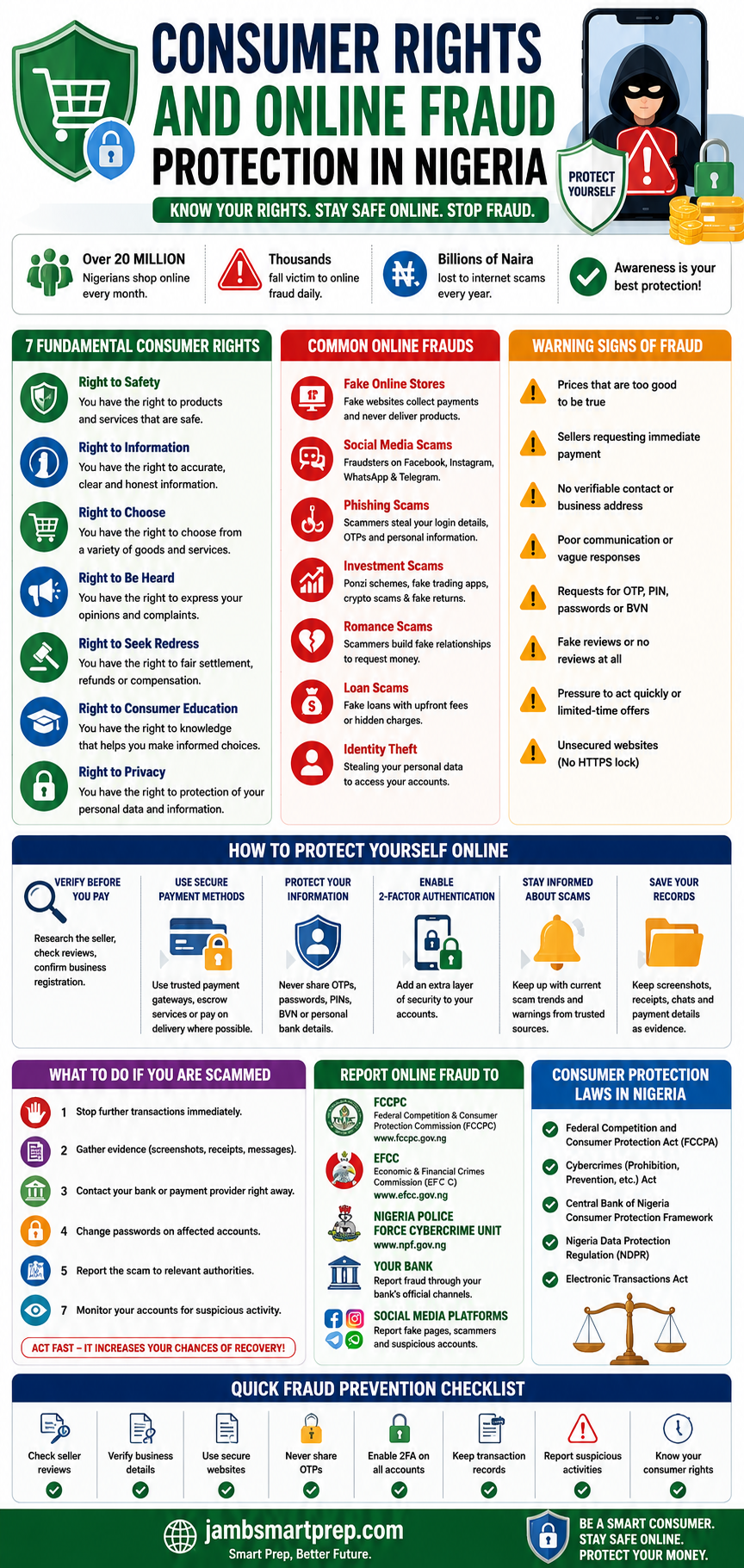
Visual Flow
Consumer Right → Common Threat → Protection Action → Safe Outcome
Frequently Asked Questions
What are consumer rights in Nigeria?
Consumer rights are legal protections that ensure buyers receive fair treatment, accurate information, safe products, and access to remedies when problems occur.
How can I protect myself from online fraud in Nigeria?
You can protect yourself by:
- Verifying sellers
- Using secure payment methods
- Avoiding suspicious links
- Enabling two-factor authentication
- Staying informed about scam trends
What should I do if I am scammed online?
Immediately:
- Stop further payments.
- Save evidence.
- Contact your bank.
- Change passwords.
- Report the fraud.
How do I report an online scammer in Nigeria?
You may report fraud to:
- FCCPC
- EFCC
- Nigeria Police Force Cybercrime Unit
- Financial institutions
- Social media platforms
Can I recover money lost to online fraud?
Recovery depends on:
- Payment method
- Speed of reporting
- Available evidence
- Nature of the fraud
Which agency handles consumer complaints in Nigeria?
The FCCPC is Nigeria’s primary consumer protection agency.
Are online shopping scams common in Nigeria?
Yes.
Common examples include:
- Fake vendors
- Non-delivery scams
- Counterfeit products
- Refund fraud
How can I verify an online seller?
Check:
- Reviews
- Contact information
- Business registration
- Website credibility
- Social media history
Conclusion
Consumer rights and online fraud protection in Nigeria have become more important than ever.
As digital transactions continue to grow, so do the risks associated with online fraud, fake vendors, phishing attacks, identity theft, and investment scams.
The good news is that consumers are not powerless.
Every Nigerian consumer has legal rights and access to protections designed to reduce fraud and promote fair treatment.
Key Takeaways
- Every Nigerian consumer has legal rights.
- Online fraud is increasing but can be prevented.
- Consumer awareness is the first line of defense.
- Verification and caution reduce fraud risks.
- Reporting scams helps protect others.
The most effective form of protection remains knowledge.
When consumers understand their rights and recognize scam tactics, they become far less attractive targets for fraudsters.
What You Need To Do
- Review your online security practices.
- Enable two-factor authentication on important accounts.
- Verify sellers before making payments.
- Learn about current scam trends.
- Report suspicious activities when you encounter them.
Have you ever experienced online fraud or a consumer rights violation?
Share your experience in the comments and help educate other Nigerians about staying safe online.
Important Links
- Telegram Scam Tricks in Nigeria: How to Spot, Avoid, and Report Telegram Scams
- How to Identify Fake Telegram Investment Groups in Nigeria
- How to Avoid Fake Vendors on WhatsApp in Nigeria
- Common Online Investment Scams in Nigeria
- How to Protect Yourself from Crypto Scams
- Safe Online Shopping Tips for Nigerians
By understanding your rights and staying alert, you can enjoy the benefits of the digital economy while minimizing the risks of online fraud.
