For many Nigerians, earning a small salary feels like a constant uphill battle. With rising food prices, transportation costs, and school fees, saving money seems nearly impossible. The common belief is that only those with six-figure monthly incomes can achieve financial stability or build wealth.
But here is the truth: wealth is not determined only by how much you earn. It is shaped by how you manage the little you have, the decisions you make with your money, and the habits you build over time. Even with a modest income, you can grow financially stronger by applying tested strategies.
This guide will walk you through proven money management tips for low income earners, budgeting strategies for small salary earners, and the best investments for low income earners in Nigeria. By the end, you will see that financial freedom is not just for high earners—it is possible for you too.
Understanding Wealth Beyond Salary
When we think about wealth, the first thing that comes to mind is income. But wealth is much more than a paycheck. Two people can earn the same salary, yet one grows financially while the other remains broke. Why? The difference lies in money habits.
-
Wealth is about control. It’s how much of your income you keep, not just what you earn.
-
Paying yourself first. Before settling bills or spending, set aside a portion for savings or investment. This habit is powerful for small salary earners.
-
Mindset shift. Move from being a consumer to becoming an investor. Instead of focusing on buying the latest gadgets, think of ways to grow your money.
Budgeting Strategies for Small Salary Earners
Budgeting is the foundation of wealth building. Without it, even a high salary can vanish quickly. For small salary earners, budgeting is not optional—it is survival.
The 50/30/20 Rule (Adapted for Small Salaries)
-
50% for needs (food, rent, transport, utilities).
-
30% for wants (entertainment, fashion, hobbies).
-
20% for savings and investment.
If your salary is ₦100,000, this means:
-
₦50,000 for essentials.
-
₦30,000 for personal wants.
-
₦20,000 for savings and investments.
For those earning less, this ratio can be tweaked. The goal is to always allocate something—no matter how small—for future growth.
Practical Nigerian Example
Ada earns ₦100,000 monthly. She spends ₦35,000 on rent, ₦20,000 on food, ₦10,000 on transport, and ₦5,000 on utilities. That leaves her with ₦30,000. Instead of spending it all on clothes and outings, she saves ₦10,000 and invests ₦10,000.
Over one year, that ₦20,000 monthly discipline becomes ₦240,000—enough to start a small side hustle or buy treasury bills.
Budgeting Tools for Nigerians
-
PiggyVest and Cowrywise for automated savings.
-
Expense Tracker apps like Money Manager or Mint.
-
Traditional notebook budgeting (simple but effective).
How to Save Money with a Small Salary
Saving money is tough when income barely covers expenses, but it is possible with discipline.
Practical Saving Tips
-
Automate savings. Deduct savings as soon as salary is received.
-
Set realistic goals. For example, aim to save ₦5,000 monthly if your salary is ₦50,000.
-
Join cooperative societies or ajo. Many Nigerians grow their savings faster through these group systems.
-
Avoid lifestyle inflation. Do not upgrade your expenses every time your salary increases.
A National Bureau of Statistics (NBS) survey shows that more than 60% of Nigerians spend most of their salary on food. This makes saving difficult, but by prioritizing essential needs and cutting waste, progress can still be made.
Also read: How Nigerians Can Transition from Student Visa to Work Permit
Best Investment Options for Low-Income Earners
Saving alone will not build wealth due to inflation. You must invest, even with small amounts.
Low-Risk Investments
-
Treasury Bills: Government-backed and safe.
-
Mutual Funds: Pooled investments managed by professionals. Some accept as low as ₦5,000.
-
Cooperative Societies: Members contribute and invest collectively.
Side Hustles as Investments
-
Freelancing (graphic design, writing, tutoring).
-
Agriculture (small-scale poultry or farming).
-
Mini importation or reselling products online.
Real Example
Tunde invests ₦15,000 monthly into a mutual fund with an annual return of 10%. After 5 years, his contribution of ₦900,000 grows to over ₦1.2 million. That is the power of consistency.
Building Wealth Habits That Compound Over Time
Wealth is not built overnight—it’s the result of small, consistent habits.
-
Track expenses. Know where your money goes each month.
-
Continuous learning. Read financial books or attend free seminars.
-
Avoid debt traps. Borrowing for non-essentials destroys financial growth.
-
Invest in skills. Enroll in affordable online courses to boost earning power. Platforms like Coursera and Udemy offer options under ₦10,000.
Real-Life Case Study: From Small Salary to Financial Stability
Chika, a schoolteacher in Enugu, earned ₦80,000 monthly. Initially, she spent almost everything on bills and family. After attending a financial literacy seminar, she decided to make changes:
-
Created a monthly budget.
-
Saved ₦10,000 consistently.
-
Joined a cooperative and invested ₦15,000 monthly.
-
Took an online certification that allowed her to start freelance teaching.
After 3 years, she had over ₦1.5 million saved and an additional income stream. Her journey shows that small consistent steps matter.
Also read: How to Apply for Commonwealth PhD Scholarships in Nigeria (2025 Guide)
Common Mistakes Small Salary Earners Make
-
Depending only on one source of income.
-
Spending before saving.
-
Not having an emergency fund.
-
Falling for Ponzi schemes like MMM or quick money apps.
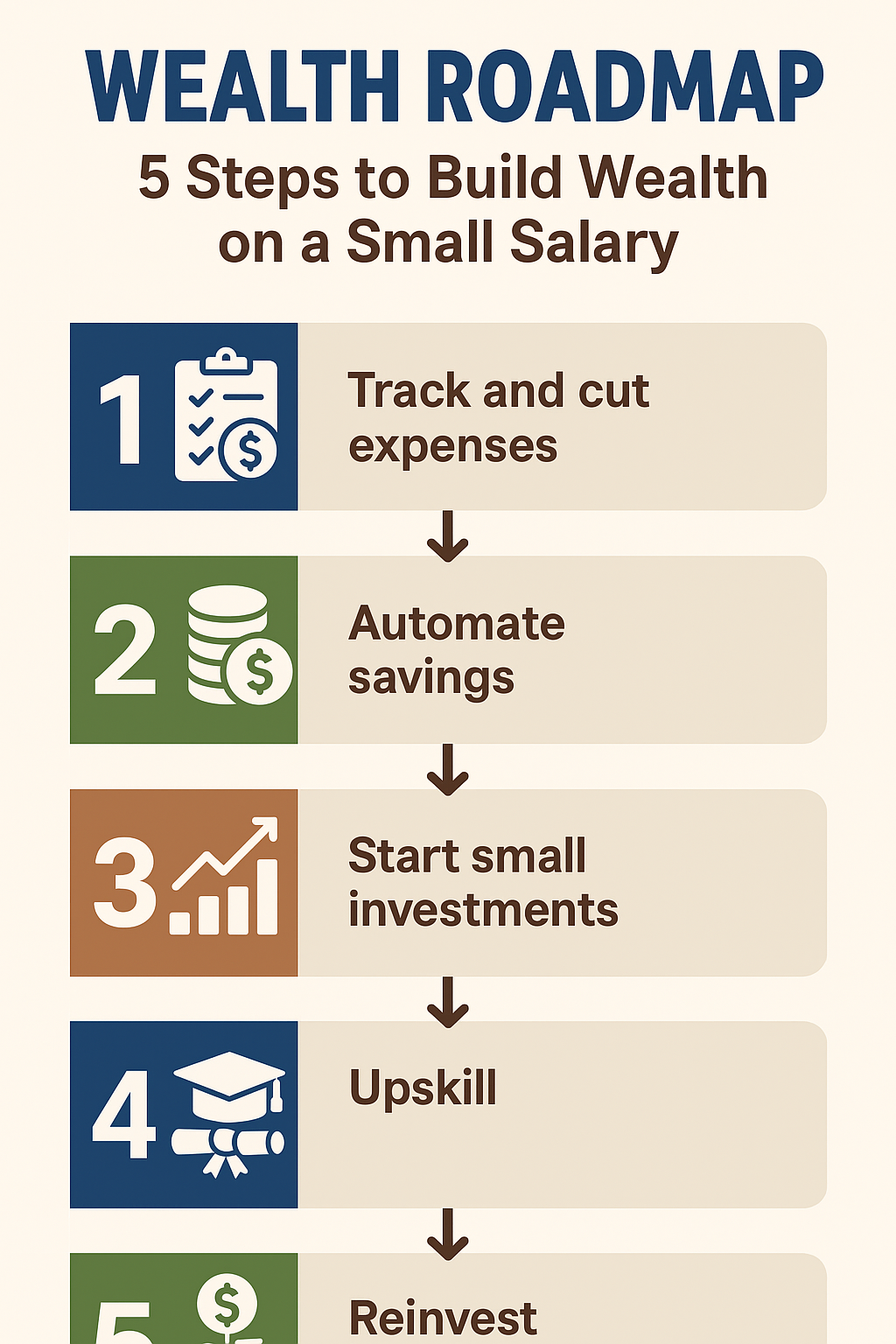
Step-by-Step Wealth-Building Roadmap for Low Income Earners
-
Track and cut expenses. Identify wasteful spending.
-
Automate savings. Treat savings like rent—it must be paid.
-
Start small investments. Treasury bills, mutual funds, or side hustles.
-
Upskill. Take free or low-cost online courses.
-
Reinvest and diversify. Expand into multiple income streams.
FAQs on Building Wealth with a Small Salary
Can I invest if I earn less than ₦100,000 monthly?
Yes. Start small with ₦5,000–₦10,000 in mutual funds or cooperative savings.
What is the fastest way to save money on a low income?
Automate savings, reduce wants, and join contribution groups (ajo or esusu).
Is it possible to buy land or property on a small salary?
Yes, through cooperative housing schemes or gradual payment plans. Many estates in Nigeria accept installments.
How do I avoid debt while earning little?
Live below your means, avoid impulse buying, and build an emergency fund.
Conclusion: Small Steps, Big Financial Future
Building wealth on a small salary is not about earning millions immediately. It is about forming the right habits, making intentional choices, and being consistent. Whether you earn ₦50,000 or ₦150,000, you can grow financially if you:
-
Budget wisely.
-
Save consistently.
-
Invest in both assets and yourself.
Start today with what you have. Your financial future will thank you.
Have you tried any of these wealth-building strategies? Share your experiences in the comments below.
1 thought on “How to Build Wealth on a Small Salary In Nigeria – Can You Really Build Wealth on a Small Salary?”