
Many students spend long hours reading, yet when the results come out, they still struggle to score above 200. It can feel confusing and even frustrating.
The real issue is not always effort. It is often the lack of a clear structure.
A common question students ask is simple: How many hours should I study per day for JAMB 2026?
This guide gives a direct and practical answer. By the end, you will understand exactly how to plan your daily study time, avoid burnout, and improve your chances of scoring high.
Why Study Hours Matter in JAMB Preparation
In any solid JAMB preparation guide, study hours play an important role. But it is not just about how long you read. It is about how well you use that time.
Many candidates fall into two extremes:
- Studying too little and falling behind
- Studying too long and getting tired without results
JAMB is a Computer-Based Test (CBT). It does not only test what you know. It tests:
- Speed
- Accuracy
- Understanding
According to past trends, over 1.5 million candidates register for JAMB yearly, but a large percentage score below 200. Poor study habits and lack of consistency are major reasons.
When you understand how to prepare for JAMB 2026 properly, you will realize that steady daily study beats irregular long sessions.
How Many Hours Should You Study Per Day for JAMB 2026? (Expert Answer)
The best answer is simple:
You should study between 2 to 4 hours daily.
This range works well for most students because it balances focus and rest.
Study Recommendations Based on Level
- Beginners: Start with 2 hours daily
- Intermediate students: 2.5 to 3 hours daily
- Advanced students: 3 to 4 hours daily
Why 2–4 Hours Daily Works Best
- Prevents mental fatigue
- Improves concentration
- Allows time for revision and practice
- Fits into a realistic daily routine
Studying beyond 5 or 6 hours daily often leads to stress and reduced productivity, especially if there are no breaks.
Best Daily Study Breakdown for JAMB Preparation
To make the most of your study time, structure matters.
Ideal Study Structure (Proven Method)
Use this simple cycle:
- 40 minutes focused reading
- 10 minutes break
- Repeat 3 to 4 times
This method helps your brain stay active without getting tired.
Sample Daily Study Allocation
| Time Spent | Activity |
|---|---|
| 1 hour | Learn new topics |
| 1 hour | Practice JAMB past questions |
| 30 minutes | Revision |
| 30 minutes | CBT practice |
This approach combines reading and practice, which is one of the best JAMB CBT study tips you can follow.
Best Time to Study for JAMB Exams
Many students ask about the best time to read for JAMB exams. The truth is, timing affects how well you understand and retain information.
Recommended Daily Routine
- Morning: Study difficult subjects (your brain is fresh)
- Afternoon: Practice questions and exercises
- Evening: Revise what you learned earlier
- Night: Light reading or rest
For example, a student preparing for Medicine might read Biology in the morning, solve Chemistry questions in the afternoon, and revise English in the evening.
Factors That Affect How Many Hours You Should Study
Not every student will follow the same schedule. Your study time depends on several factors:
- Your class level: SS2 students may need more time to build basics
- Subject difficulty: Physics and Mathematics may require extra time
- Learning speed: Some students understand faster than others
- School schedule: Extra lessons or school hours may reduce available time
Instead of copying another student’s timetable, create one that fits your routine.
How to Increase Study Hours Without Getting Tired
If you want to improve your study time gradually, do it carefully.
Practical Tips
- Start with 2 hours daily and increase slowly
- Take short breaks after each session
- Study in a quiet place
- Turn off phone notifications
Many Nigerian students struggle with distractions from phones or television. Creating a focused environment can make a big difference.
Quality vs Quantity: What Matters More in JAMB?
One of the biggest mistakes students make is focusing only on long hours.
In reality, quality matters more than quantity.
Why Smart Study Works Better
- You understand topics faster
- You remember more during exams
- You avoid unnecessary stress
Instead of reading one topic for hours, aim to:
- Understand key concepts
- Practice questions
- Test yourself
This is how to pass JAMB 2026 without feeling overwhelmed.
Best Study Techniques to Use Within Your Study Hours
1. Use JAMB Past Questions PDF
Past questions are one of the most powerful tools available.
- They reveal repeated questions
- They show exam patterns
- They improve accuracy
Many students who score above 250 rely heavily on JAMB past questions PDF.
2. Practice with CBT Apps
Since JAMB is computer-based, practice is essential.
- Simulate real exam conditions
- Improve speed
- Build confidence
Several Nigerian students now use CBT apps daily, even on their phones.
3. Use Active Recall and Revision
After studying, test yourself.
- Write short summaries
- Ask yourself questions
- Review difficult areas
This method helps you remember information better than passive reading.
Common Mistakes Students Make About Study Hours
Avoid these common errors:
- Reading for 8–10 hours without breaks
- Studying only when exams are close
- Ignoring revision
- Copying other students’ routines
These habits often lead to poor results, even after long hours of effort.
Real-Life Example: How Proper Study Hours Improved a JAMB Score
Consider a student named Chinedu from Lagos.
At first, he studied randomly. Some days he read for 6 hours, other days he did not read at all. His mock JAMB score was 190.
He decided to change his approach.
- Studied 3 hours daily
- Followed a simple timetable
- Practiced past questions every day
- Used a CBT app regularly
After a few months, his performance improved significantly.
In the main exam, he scored above 280.
The difference was not longer hours. It was better planning and consistency.
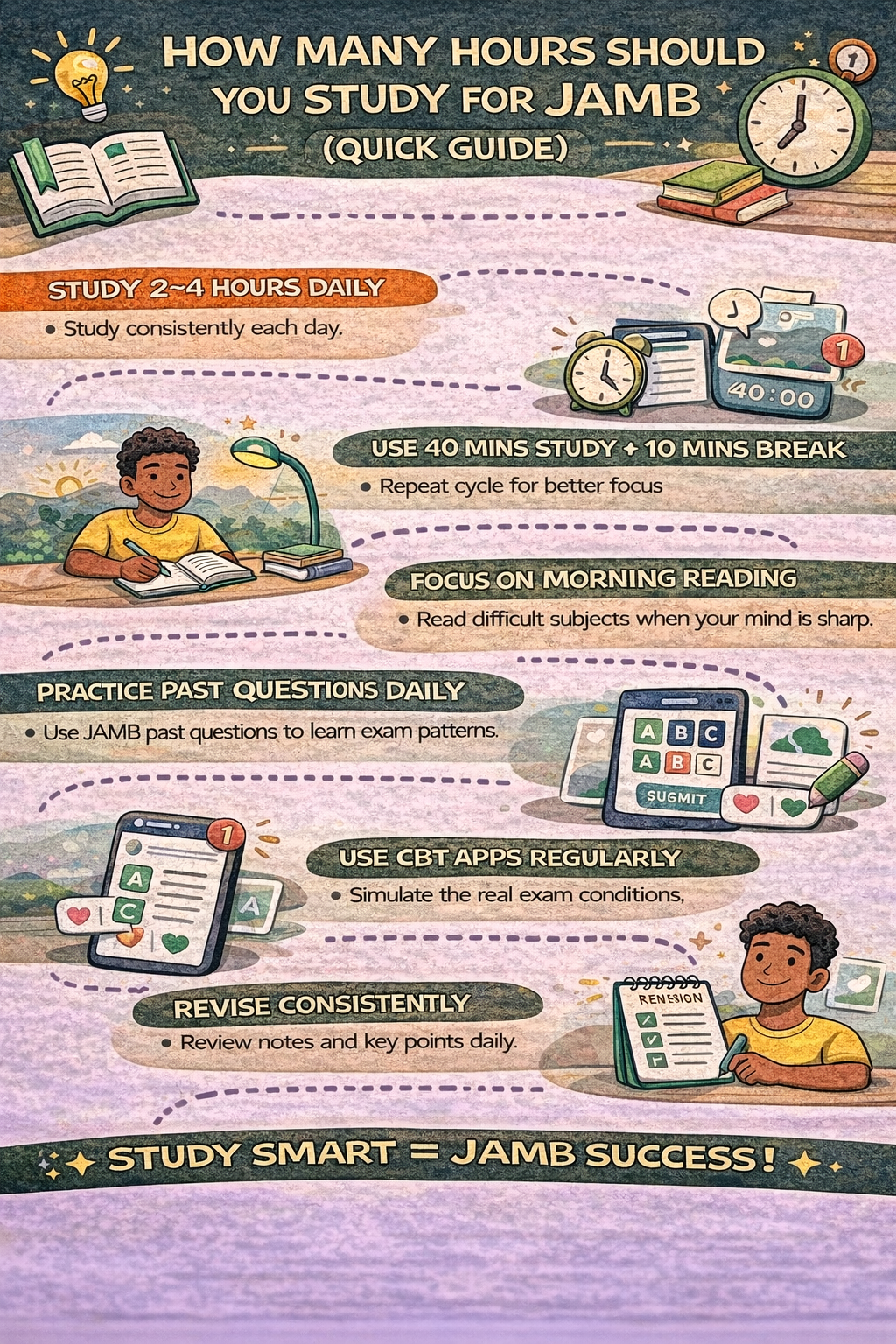
How Many Hours Should You Study for JAMB Daily (Quick Guide)
- Study 2–4 hours daily
- Use 40 mins study + 10 mins break
- Focus on morning reading
- Practice past questions daily
- Use CBT apps regularly
- Revise consistently
Frequently Asked Questions (FAQs)
How many hours should I study daily for JAMB?
2 to 4 hours of focused study is enough for most students.
Can I pass JAMB by studying only 2 hours daily?
Yes. If you study consistently and use effective techniques like past questions and CBT practice, 2 hours daily can be enough.
Is reading 8 hours daily necessary for JAMB?
No. It often leads to burnout and reduced concentration.
What is the best time to read for JAMB?
Morning is best for difficult subjects, while evening is good for revision.
How do I create a JAMB study timetable?
Divide your day into:
- Study time
- Practice sessions
- Revision
Make sure it fits your daily routine.
How can I score above 300 in JAMB?
- Study consistently
- Practice past questions daily
- Use CBT apps
- Focus on weak subjects
What is the best JAMB preparation strategy?
The best strategy combines:
- Smart study
- Regular practice
- Revision
- Time management
How long should I study each subject daily?
- Strong subjects: 30–45 minutes
- Weak subjects: 1 hour or more
Can I pass JAMB without coaching classes?
Yes. Many students succeed through self-study using textbooks, past questions, and CBT apps.
What are the best JAMB CBT study tips?
- Practice regularly
- Manage your time
- Answer easy questions first
- Stay calm during the exam
Conclusion: Study Smart, Not Just Long
Preparing for JAMB does not require extreme study hours. What matters is how you use your time.
A steady plan of 2 to 4 hours daily, combined with smart techniques, can produce strong results.
Focus on:
- Consistency
- Understanding
- Practice
With the right approach, passing JAMB becomes much more achievable.
Call to Action (CTA)
Start your JAMB preparation today:
- Create your personal study timetable
- Download JAMB past questions PDF
- Begin daily CBT practice
Engagement Prompt
How many hours do you currently study daily for JAMB?
Which subject do you find most difficult?
Which course are you planning to study in university? Let us know in the comments.