Every year, thousands of Nigerian students write the Post-UTME as part of the admission process into universities. After the stress of JAMB, this second hurdle often feels overwhelming. Many students worry: “How do I prepare for Post-UTME 2026 and pass without stress?”
The truth is, Post-UTME is not as difficult as many imagine. With the right approach, you can boost your admission chances significantly. By the end of this guide, you will know practical Post-UTME preparation tips, the best resources to use, and common mistakes to avoid.
Why Post-UTME Matters for Admission in 2026
While JAMB is the first step into higher education, universities rely on Post-UTME to screen applicants further. In fact, a candidate who scores 280 in JAMB may still miss admission if they fail to perform well in Post-UTME.
According to JAMB’s 2024 statistics, over 1.9 million students registered, yet universities across Nigeria collectively admit fewer than 600,000 yearly. Post-UTME helps schools select the best from this large pool.
Key Reasons Post-UTME is Important:
-
It complements your JAMB score.
-
It reduces reliance on malpractice in JAMB.
-
It gives universities a fair ground to test candidates directly.
Step-by-Step Guide on How to Prepare for Post-UTME 2026
1. Get the Right Study Materials
Your first step is ensuring access to updated Post-UTME past questions and answers 2026. Most universities repeat questions with slight modifications.
What to Use:
-
Official Post-UTME past questions (printed or PDF).
-
JAMB-recommended textbooks.
-
Online resources like educational blogs and academic YouTube channels.
⚠️ Be careful of fake materials sold by roadside vendors. Always confirm the authenticity before buying.
2. Create a Study Timetable
Studying randomly does not yield results. A proper Post-UTME study timetable helps you cover more ground.
-
Break down topics into weekly goals.
-
Dedicate 2–3 hours daily for revision.
-
Mix difficult subjects with easier ones.
-
Reduce TV, phone, and social distractions during study time.
3. Practice with CBT Apps and Mock Tests
Most universities now conduct Post-UTME as CBT (Computer-Based Tests). Practicing with CBT apps improves speed and accuracy.
Recommended app include:
-
JambSmartPrep – Nigerian-focused, with updated questions.
Take at least one mock test weekly to track your performance.
4. Understand Your University’s Exam Format
Every university has its own Post-UTME style. For example:
-
UNILAG: English, Mathematics, and General Knowledge.
-
UI: Mix of English, Mathematics, and science/social science questions.
-
UNN: Subject-based, depending on your JAMB combination.
-
UNILORIN: English proficiency and course-related subjects.
Visit your school’s official portal for the Post-UTME syllabus and past exam format.
5. Build Exam Confidence and Time Management
Time is one of the biggest challenges in Post-UTME. To overcome this:
-
Practice under timed conditions.
-
Use a stopwatch while answering questions.
-
Skip difficult questions first, then return later.
-
Reduce anxiety with deep breathing before exams.
6. Avoid Expo and Malpractice Temptations
Many students are misled into believing they need expo to succeed. This is dangerous. Most universities cancel results immediately if malpractice is detected.
Instead, focus on consistent preparation. For instance, a student who scored 243 in JAMB and 78% in UNILORIN Post-UTME got admitted without external help simply because he practiced past questions thoroughly.
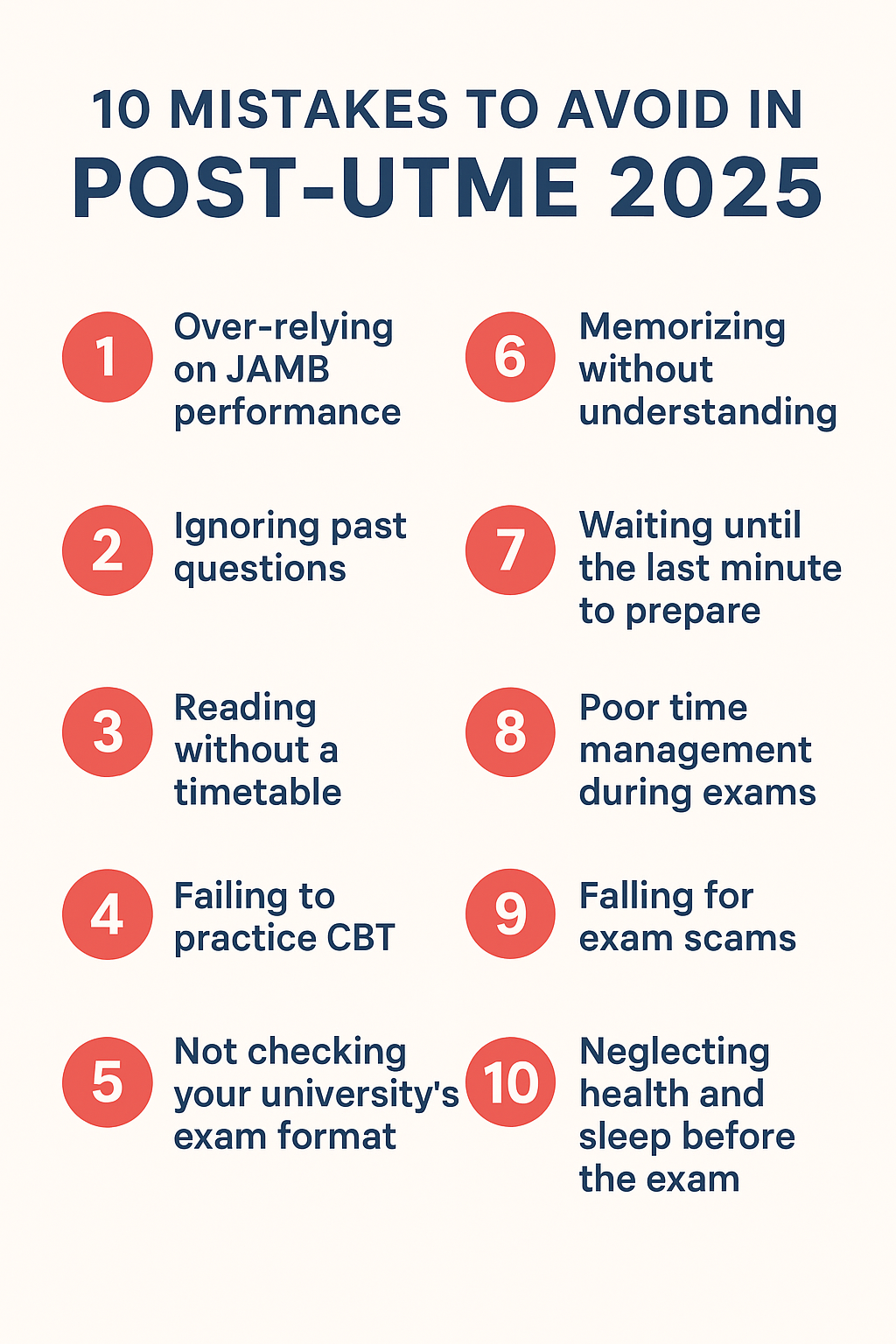
10 Common Mistakes Students Make in Post-UTME
-
Over-relying on JAMB performance.
-
Ignoring past questions.
-
Reading without a timetable.
-
Failing to practice CBT.
-
Not checking their university’s exam format.
-
Memorizing without understanding.
-
Waiting until the last minute to prepare.
-
Poor time management during exams.
-
Falling for exam scams.
-
Neglecting health and sleep before the exam.
Healthy Habits for Success in Post-UTME 2026
Academic preparation alone is not enough. Good health and balance matter.
-
Sleep: Aim for 6–8 hours per night.
-
Diet: Eat brain-friendly meals (fish, vegetables, fruits).
-
Exercise: Light jogging or stretching to reduce stress.
-
Relaxation: Short breaks while studying to refresh the brain.
Alternatives If You Don’t Score High in Post-UTME
Not everyone will perform excellently in Post-UTME, but that doesn’t mean the end of your academic journey.
Options to Consider:
-
JAMB CAPS: Apply for change of institution or course.
-
Polytechnics: Offer quality education and later HND–B.Sc. conversion.
-
Colleges of Education: Useful for education-related careers.
-
JUPEB/IJMB: One-year program for direct entry into 200 level.
-
NOUN: The National Open University of Nigeria admits without Post-UTME.
FAQs About Post-UTME 2026
1. What is the pass mark for Post-UTME 2026?
Most universities set 50% as the benchmark, but competitive schools may use higher cut-offs.
2. Do universities repeat Post-UTME past questions?
Yes. Many questions are recycled, though with slight modifications.
3. Can I use the same JAMB subject combination for Post-UTME?
In most cases, yes. But always confirm with your chosen university.
4. What is the best way to prepare for Post-UTME at home?
Use past questions, CBT apps, and a study timetable while minimizing distractions.
5. How can I pass Post-UTME without attending a tutorial?
Self-study with the right resources is enough if you are disciplined. Tutorials are optional, not compulsory.
Conclusion
The Post-UTME 2026 is not an impossible hurdle. With the right study materials, a consistent timetable, CBT practice, and healthy habits, you can perform excellently and secure admission.
Stay away from expo and shortcuts. Focus instead on honest preparation and confidence-building.
To make your journey easier, download free Post-UTME past questions, subscribe to our blog for admission updates, and check our guides on scholarships and alternative pathways.