
The West African Examinations Council (WAEC) is one of the most important exams in Nigeria and across West Africa. It is a qualifying examination for admission into universities, polytechnics, and colleges of education. Each year, more than 1.6 million candidates register for the WAEC May/June school examination in Nigeria alone, according to WAEC statistics.
Despite this large number, a significant portion of students fail to achieve the required five credits (including English and Mathematics) needed for higher education. Common reasons include:
-
Poor study habits
-
Over-reliance on “expo” or malpractice
-
Incomplete syllabus coverage
-
Lack of exam techniques
-
Fear and pressure in the exam hall
The good news is that WAEC is not an impossible exam. With the right preparation, focus, and strategy, you can pass WAEC in one sitting. This guide provides you with practical study tips, time management strategies, and mistakes to avoid, all tailored for Nigerian students preparing for WAEC 2026.
Also read: Top 10 Easiest Courses to Get Admission Into in Nigeria (2025 Update)
How to Pass WAEC 2026 in One Sitting – Study Guide for Nigerian Students
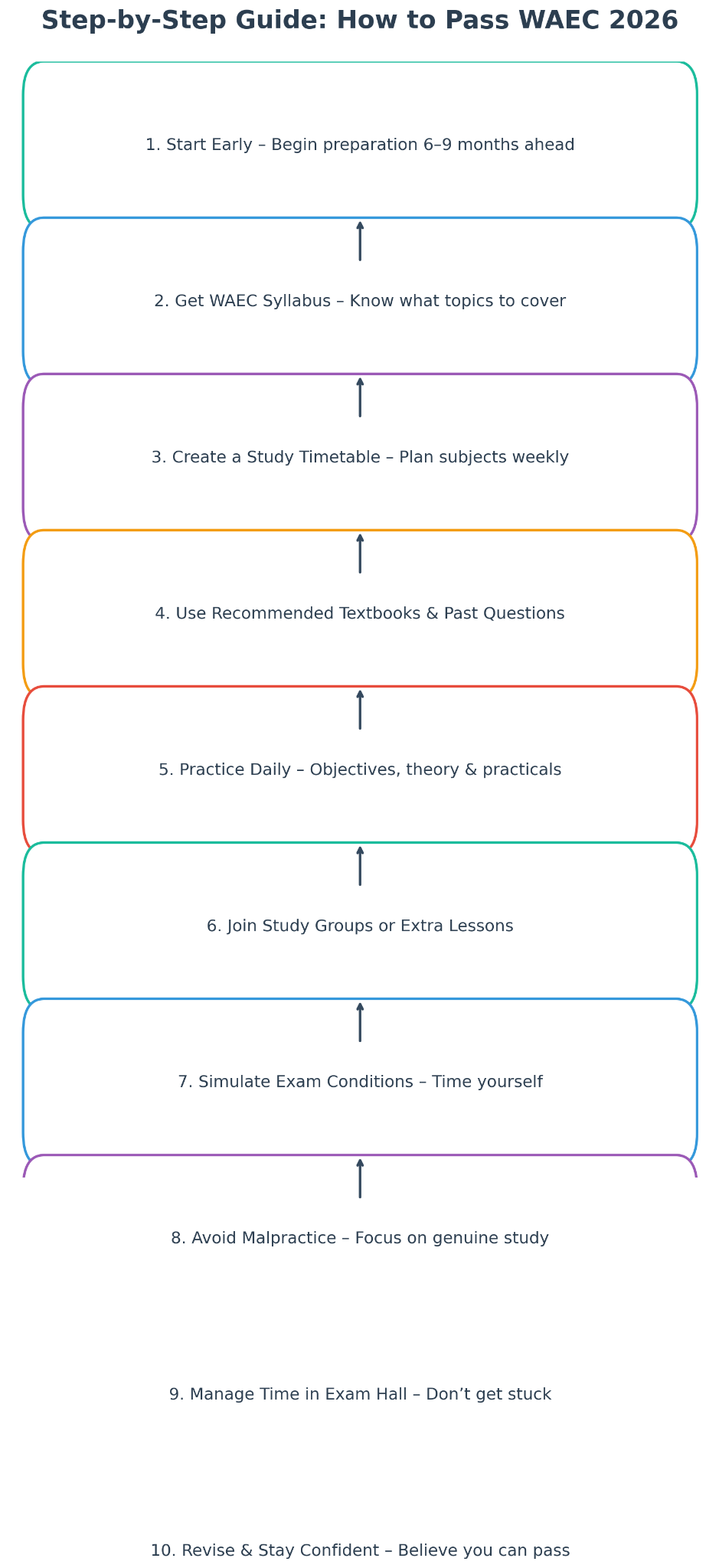
15 Smart Study Techniques for WAEC
-
Start Early – Begin preparation at least 6–9 months before the exam. Waiting until April is risky.
-
Know the WAEC Syllabus – Download the official WAEC syllabus (available from WAEC or school authorities) to know exactly what topics to cover.
-
Study with Past Questions – Past questions reveal WAEC’s style of setting papers. Many questions are repeated with slight variations.
-
Create a Reading Plan – Spread your subjects across weeks. For example, dedicate Mondays to Mathematics and Economics, Tuesdays to English and Biology, etc.
-
Use Recommended Textbooks – Rely on WAEC-approved books like Essential Biology, New General Mathematics, and Invisible Teacher (for Literature).
-
Practice Objective Questions Daily – Multiple-choice questions appear in all papers. Practicing them sharpens speed and accuracy.
-
Focus on Weak Subjects – If you struggle in Physics, give it extra hours instead of running away from it.
-
Join Study Groups – Peer discussion helps you understand difficult concepts better.
-
Make Short Notes – Write down key formulas, dates, and definitions for last-minute revision.
-
Use Memory Techniques – Acronyms, rhymes, or mnemonics make it easier to recall facts (e.g., “SOHCAHTOA” in trigonometry).
-
Attend Extra Lessons – Many schools organize WAEC prep classes. Don’t skip them.
-
Watch Educational Videos – Platforms like YouTube, uLesson, and EdustoreNG provide WAEC-focused tutorials.
-
Practice Essay Writing – For English and Literature, practice writing essays and comprehension answers clearly.
-
Simulate Exam Conditions – Time yourself while answering past questions.
-
Stay Consistent – Small daily progress is better than last-minute cramming.
Importance of Timetable & Past Questions
A personal study timetable keeps you disciplined. Break subjects into smaller units and spread them over the week. For instance:
-
Morning: Core subjects (Mathematics, English, Physics)
-
Afternoon: Reading subjects (Government, Literature, CRS)
-
Evening: Practice questions or revision
Also read: How to Check JAMB Result 2025 Online and via SMS
Past questions are equally powerful. For example, WAEC English comprehension passages often come from similar topics year after year. In Mathematics, quadratic equations, indices, and trigonometry never fail to appear. Studying past questions shows you these patterns and reduces surprises.
How to Manage Time in the Exam Hall
One of the biggest challenges in WAEC is time management. Here are strategies that work:
-
Read Instructions Carefully – Many students lose marks because they skip instructions.
-
Start with Easier Questions – Gain confidence before tackling difficult ones.
-
Divide Your Time – For a 2-hour paper with 60 questions, spend about 2 minutes per question.
-
Don’t Get Stuck – If a question is confusing, skip and return later.
-
Show All Calculations – Even if the final answer is wrong, WAEC examiners often award marks for correct steps.
-
Leave Time to Review – Reserve at least 10 minutes to cross-check your work.
15 Mistakes to Avoid in WAEC
-
Skipping the Syllabus – Many students study randomly.
-
Cramming Without Understanding – Leads to forgetting under exam pressure.
-
Not Practicing Past Questions – You miss WAEC’s question style.
-
Depending on “Expo” – Malpractice can lead to cancellation or blacklist.
-
Ignoring Practical Subjects – Science students must prepare for Physics, Chemistry, and Biology practicals.
-
Bad Handwriting – Examiners may struggle to read your work.
-
Incomplete Answers – Some students leave questions half-done.
-
Poor Time Management – Spending too long on one question reduces overall performance.
-
Not Following Instructions – Example: answering more questions than required.
-
Skipping English or Mathematics – Both are compulsory for admission.
-
Relying Only on School Teachers – Self-study is also vital.
-
Forgetting to Bring Required Materials – Calculators, mathematical sets, pens, etc.
-
Not Revising Before the Exam – Last-minute revision refreshes memory.
-
Overconfidence – Leads to carelessness.
-
Panic in the Exam Hall – Anxiety causes silly mistakes.
10 Motivation & Encouragement for Students
WAEC can feel overwhelming, but thousands of students succeed every year. You can too. Here are motivational reminders:
-
Believe in Yourself – Confidence boosts performance.
-
Remember Your Goal – Admission into your dream university depends on this exam.
-
Visualize Success – Imagine seeing “You Passed” on your result slip.
-
Celebrate Small Wins – Each solved question is progress.
-
Stay Disciplined – Consistency beats talent.
-
Avoid Negative Friends – Surround yourself with serious-minded students.
-
Take Breaks – Rest improves focus.
-
Pray and Stay Positive – Spiritual strength helps in difficult times.
-
Learn from Past Candidates – Many seniors who once feared WAEC are now in universities.
-
Never Give Up – Even if you find a subject hard, persistence pays off.
Conclusion
Passing WAEC in one sitting is not about luck. It requires early preparation, smart study techniques, effective use of past questions, and discipline in the exam hall. Avoid common mistakes, stay motivated, and focus on your long-term goal of gaining admission into higher institutions.
If you apply these strategies, WAEC 2026 can be your success story. Start today—your future depends on it.
Frequently Asked Questions (FAQs) on WAEC 2026
1. How many subjects should I register for in WAEC?
Most students register for 8–9 subjects, including English and Mathematics.
2. What is the minimum requirement to enter university with WAEC?
You need at least 5 credits including English and Mathematics in not more than two sittings (one sitting is preferable).
3. Can I combine WAEC and NECO results?
Yes, many Nigerian universities accept a combination of WAEC and NECO results.
4. Are WAEC past questions really repeated?
Yes. Questions are often repeated word-for-word or restructured. Studying past questions gives a huge advantage.
5. When will WAEC 2026 take place?
The May/June exam usually runs between April and June, while WAEC releases the timetable in March.
6. How long does it take WAEC to release results?
Results are typically released 45–60 days after the last paper.
7. How much is the WAEC registration fee for 2026?
As of 2025, the fee is about ₦27,000–₦30,000 for school candidates. It may change slightly in 2026.
8. Is WAEC harder than NECO?
WAEC is considered more competitive, but both exams test similar syllabuses.
9. Can I pass WAEC without attending special lessons?
Yes, if you are disciplined with self-study, though lessons provide guidance and practice.
10. What happens if I miss a paper in WAEC?
If you miss a paper without valid reason, it is counted as failure. WAEC rarely reschedules missed papers.
