You send money for a phone, a service, or even a supposed school-related fee. Minutes later, the seller stops replying. Soon, you are blocked. That sinking feeling sets in.
Many Nigerians face this situation every day. The mix of shock, regret, and confusion can make it hard to think clearly.
At this point, a few urgent questions come to mind:
- How can I recover money from a scammer in Nigeria?
- Can my bank reverse the transaction?
- Where can I report online fraud in Nigeria?
The truth is simple. What you do in the first few minutes or hours matters more than anything else.
This guide explains practical steps for scam recovery in Nigeria. It shows you who to contact, what to do, and how to improve your chances of getting your money back.
Understanding Scam Recovery in Nigeria
Scam recovery in Nigeria refers to the process of tracing, freezing, and possibly reversing funds sent to a fraudster.
With the growth of mobile banking and online payments, cases of online fraud in Nigeria have increased. According to reports from financial regulators, electronic fraud cases run into billions of naira annually.
However, recovery is not guaranteed.
What Determines Success?
- How quickly you report the incident
- Whether the money has been withdrawn
- The type of transaction used
Key Insight:
Speed and proper action give you the best chance to recover money from a scam in Nigeria.
What Should I Do Immediately After Being Scammed?
The first reaction is often panic. That is normal, but it does not help.
Also read: Safe Ways to Pay Online in Nigeria (Complete Guide to Secure Payments)
Focus on action instead.
Immediate Steps to Take:
- Contact your bank immediately
- Secure your account
- Save all transaction details
Important Reminders:
- Do not argue with the scammer
- Do not send more money
- Do not delay
Even a delay of one hour can reduce your chances.
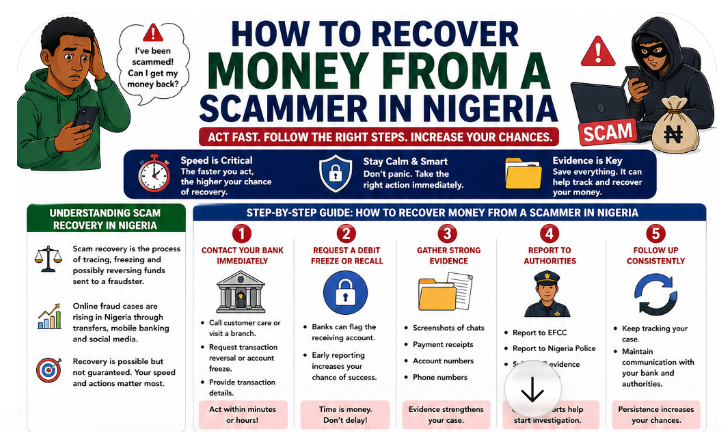
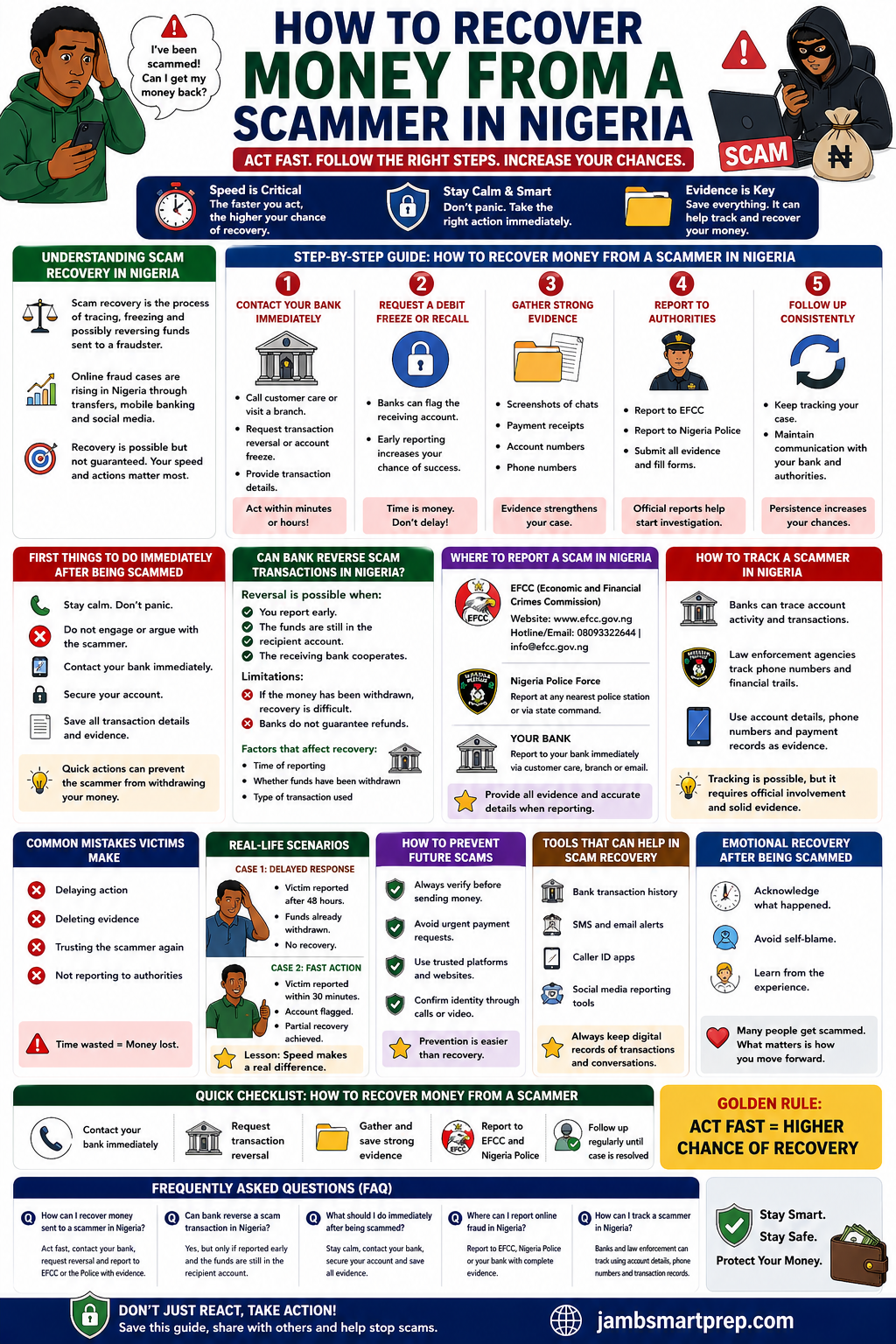
Step-by-Step Guide: How to Recover Money from a Scammer in Nigeria
This is the most important section. Follow these steps carefully.
Step 1: Contact Your Bank Immediately
Call your bank’s customer care or visit the nearest branch.
Provide:
- Amount sent
- Time of transaction
- Account number of the receiver
Request:
- Transaction reversal
- Account freeze
In many bank scam Nigeria cases, early reporting allows banks to flag the receiving account.
Step 2: Request a Debit Freeze or Recall
Banks can sometimes place a hold on the recipient account.
This works best when:
- The money has not been withdrawn
- You report within minutes or hours
Step 3: Gather Strong Evidence
You will need proof for both the bank and authorities.
Collect:
- Screenshots of chats
- Payment receipts
- Phone numbers
- Account details
Do not delete anything, even if it looks unimportant.
Step 4: Report to Authorities
You should report the case to:
- Economic and Financial Crimes Commission (EFCC)
- Nigeria Police Force
Submit:
- All evidence
- Transaction details
- A written complaint
Step 5: Follow Up Consistently
Do not assume the case will resolve itself.
- Stay in contact with your bank
- Follow up with authorities
- Keep records of all communication
Also read: How to Avoid Getting Scammed on Instagram in Nigeria
Key Takeaway:
If you act within minutes or hours, your chances improve significantly.
Can Bank Reverse a Scam Transaction in Nigeria?
This is one of the most common questions.
The answer is yes, but only in certain situations.
When Reversal Is Possible:
- The transaction is reported early
- The funds are still in the recipient account
- The receiving bank cooperates
Limitations:
- If the money is withdrawn, recovery becomes difficult
- Banks do not guarantee refunds
Factors That Affect Recovery:
- Time of reporting
- Transfer method (bank, POS, crypto)
- Cooperation between banks
How to Report a Scam in Nigeria
If you want real action, reporting is essential.
Where to Report:
- EFCC
- Nigeria Police
- Your bank
Steps to Report:
- Visit the nearest office or official website
- Submit your complaint
- Attach all evidence
- Fill required forms
Key Tip:
Strong documentation increases your chances of success.
How to Track a Scammer in Nigeria
Many victims ask if it is possible to track a scammer.
The answer is yes, but not by individuals alone.
How Tracking Works:
- Banks trace account activity
- Authorities track phone numbers and transactions
- Telecom providers assist investigations
What You Need:
- Accurate account details
- Phone numbers
- Payment records
Insight:
Tracking requires official involvement. Personal efforts rarely work.
Common Mistakes Victims Make During Scam Recovery
Many people reduce their chances of recovery by making avoidable mistakes.
Common Errors:
- Delaying action
- Deleting chat evidence
- Trusting the scammer again
- Failing to report
Insight:
Every minute wasted gives the scammer more time.
Real-Life Case Scenarios in Nigeria
Case 1: Late Reporting
A student paid for a laptop online.
He reported after two days.
The funds had already been withdrawn.
No recovery was possible.
Case 2: Quick Action
Another student sent money for exam materials.
She reported within 30 minutes.
The bank flagged the account.
She recovered part of the money.
Lesson:
Speed can determine the outcome.
How to Prevent Future Scams
Recovery is uncertain. Prevention is more reliable.
Practical Tips:
- Always verify before sending money
- Avoid urgent payment requests
- Use trusted platforms
- Confirm identity through calls or video
Many students fall victim during admission or scholarship processes. Always confirm details from official sources.
Tools That Can Help in Scam Recovery
Use available tools to strengthen your case.
Helpful Tools:
- Bank transaction history
- SMS alerts
- Email confirmations
- Caller ID apps
- Social media reporting tools
Tip:
Keep records. They can save you later.
Emotional Recovery After Being Scammed
Beyond money, scams affect confidence.
You may feel embarrassed or angry.
What Helps:
- Accept what happened
- Avoid blaming yourself
- Focus on learning
Many intelligent people fall victim to scams. What matters is how you respond.
Quick Checklist: How to Recover Money from a Scammer
✔ Contact your bank immediately
✔ Request transaction reversal
✔ Gather evidence
✔ Report to EFCC and police
✔ Follow up consistently
FAQs
How can I recover money sent to a scammer in Nigeria?
Act quickly. Contact your bank, request a reversal, and report to authorities with full evidence.
Can bank reverse a scam transaction in Nigeria?
Yes, but only if reported early and the funds have not been withdrawn.
What should I do immediately after being scammed?
Contact your bank, secure your account, and gather all evidence.
Where can I report online fraud in Nigeria?
You can report to EFCC, the Nigeria Police, and your bank.
How can I track a scammer in Nigeria?
Tracking is handled by banks and law enforcement using transaction and phone records.
How to Recover Money from a Scammer in Nigeria
Immediate Actions:
- Contact your bank
- Request reversal
- Save evidence
Report To:
- EFCC
- Police
Recovery Tips:
- Act fast
- Provide full details
- Follow up
Prevention Tips:
- Verify before payment
- Avoid urgency
- Use trusted platforms
Golden Rule:
Act fast = Higher chance of recovery
Conclusion
Recovering money from a scammer in Nigeria is possible, but it depends on how quickly you act.
Many people lose money simply because they wait too long or do not know the right steps.
If you remember one thing, let it be this: act immediately.
Save your bank’s contact lines. Always verify before sending money. Report any suspicious activity without delay.
If this guide has helped you, share it with someone else. You might prevent another person from losing their hard-earned money.
Now a simple question:
If this happened to you today, what would be the very first step you would take?
