
Many students prepare seriously for JAMB, yet one question keeps coming up after the results are released.
“Why did I score lower than expected even though I answered many questions?”
This confusion is common. The problem is not always poor preparation. In many cases, students do not fully understand how the JAMB marking scheme and grading system work.
If you are preparing for the exam, this knowledge can make a real difference. It helps you plan your study better, manage time during the exam, and avoid mistakes that cost marks.
In this guide, you will learn how JAMB scores are calculated, how marks are allocated per question, and what score you should realistically aim for.
What Is the JAMB Marking Scheme?
The JAMB marking scheme is the system used to calculate your total score after the exam.
JAMB uses a Computer-Based Test format, so your answers are graded automatically once you submit.
Here are the key features:
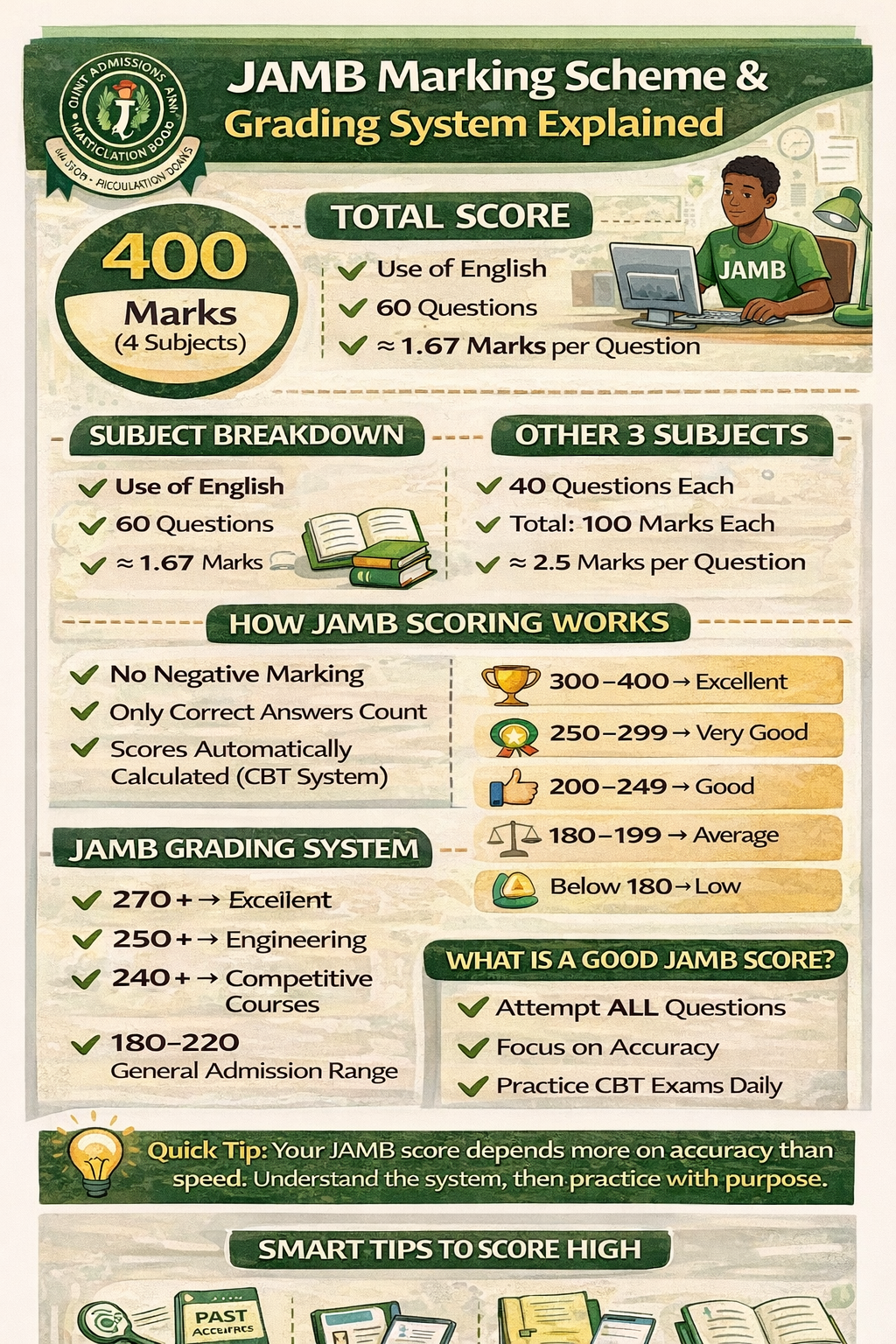
- You write four subjects
- Each subject is scored over 100
- The total score is 400
This means every subject carries equal weight in your final result.
Understanding this structure is important because it helps you distribute your study time properly across all subjects.
JAMB Grading System Explained
The JAMB grading system shows how your total score is classified.
Here is the general breakdown:
- 300 – 400: Excellent
- 250 – 299: Very Good
- 200 – 249: Good
- 180 – 199: Average
- Below 180: Low
These categories help you understand your performance level.
However, admission into universities depends on more than just this grading system. Each school sets its own cut-off mark.
For example:
- Medicine and Surgery often require 270 and above
- Law and Pharmacy usually require high scores
- Engineering may require around 250
- Some courses accept 180 or slightly above
How JAMB Scores Are Calculated
To understand how JAMB scores are calculated, you need to know how each subject contributes.
Each subject has a fixed number of questions, but all are scaled to 100 marks.
Subject Structure:
- Use of English: 60 questions
- Other subjects: 40 questions each
Despite the difference in question numbers, each subject still totals 100 marks.
Example:
If a student scores:
- English: 70
- Mathematics: 65
- Physics: 60
- Chemistry: 75
Total score = 270 out of 400
This shows that your overall score is simply the sum of all four subjects.
How Many Marks Is Each Question in JAMB?
Many students assume all questions carry equal marks across subjects. That is not correct.
Actual Breakdown:
- English Language:
- 60 questions
- Each question ≈ 1.67 marks
- Other Subjects:
- 40 questions
- Each question ≈ 2.5 marks
This means questions in other subjects carry slightly higher value.
Important Points:
- All questions within the same subject carry equal marks
- No question is more important than another within a subject
Does JAMB Use Negative Marking?
No, JAMB does not use negative marking.
This is one advantage candidates often overlook.
What this means for you:
- Wrong answers do not reduce your score
- You should attempt all questions
Leaving questions blank reduces your chances of scoring higher.
Even if you are unsure, it is better to make a careful guess.
JAMB CBT Scoring Explained
JAMB uses a fully digital scoring system.
Key Features:
- Automatic result calculation
- No manual marking
- Instant processing after submission
This system ensures fairness and removes human error.
However, it also means:
- You only get marks for correct answers
- There are no partial scores
Accuracy becomes very important.
What Is a Good Score in JAMB?
A good score depends on your chosen course and institution.
General Guide:
- 270 and above: Suitable for Medicine, Law, Pharmacy
- 250 and above: Good for Engineering and competitive courses
- 240 and above: Safe for many university courses
- 180 – 220: May qualify for less competitive programs
In Nigeria, competition varies each year. Some universities raise their cut-off marks when many students score high.
JAMB Score vs University Cut-Off Marks
It is important to understand the difference.
JAMB Score:
- Your UTME result
- Maximum of 400
University Cut-Off Mark:
- Minimum score set by each school
- Used for admission screening
Admission depends on:
- Post-UTME performance
- WAEC or NECO results
- Course demand
For instance, a student with 250 may still not gain admission into Medicine if the cut-off is higher.
Common Mistakes Students Make About JAMB Scoring
Many students lose marks due to simple misunderstandings.
Common mistakes include:
- Thinking all subjects have the same question value
- Leaving questions unanswered
- Ignoring the English section
- Not understanding the scoring system
English carries 60 questions, so it plays a major role in your final score.
Practical Tips to Improve Your JAMB Score
If you want to perform better, focus on strategy.
Here are practical tips:
- Focus on Accuracy
Take time to understand each question before answering. - Practice Past Questions
Many JAMB questions repeat in pattern. - Use CBT Practice App
Our Platform JambSmartPrep CBT simulate real exams. - Study with the JAMB Syllabus
This helps you avoid irrelevant topics. - Revise Weak Areas
Spend more time on difficult subjects.
Real-Life Example
Consider a student named Ada.
She studied for long hours and attempted almost all questions. Yet, she scored 215.
After reviewing her performance, she noticed a problem. She rushed through questions and made avoidable mistakes.
The next year, she changed her approach:
- Focused on understanding topics
- Practiced CBT exams regularly
- Paid attention to accuracy
Her score improved to 285.
This shows that correct answers matter more than the number of questions attempted.
FAQs About JAMB Marking Scheme and Grading System
How is JAMB scored out of 400?
Each of the four subjects is scored over 100 marks. The total adds up to 400.
How many marks is each question in JAMB?
- English: about 1.67 marks per question
- Other subjects: about 2.5 marks per question
Does JAMB use negative marking?
No. There is no penalty for wrong answers.
What is a good score in JAMB?
A score above 250 is considered strong. Competitive courses may require higher scores.
How can I calculate my JAMB score?
Estimate the number of correct answers in each subject and apply the scaling system.
JAMB Marking Scheme and Grading System
JAMB Score Overview
- Total Score: 400
- English: 60 questions → 100 marks
- Other subjects: 40 questions each → 100 marks
Grading Scale
- 300+ → Excellent
- 250+ → Very Good
- 200+ → Good
Key Tips
- No negative marking
- Attempt all questions
- Practice CBT exams regularly
Conclusion
Understanding the JAMB marking scheme and grading system gives you a clear advantage.
When you know how marks are allocated, you can prepare more effectively. You will focus on accuracy, manage your time better, and avoid common mistakes.
Success in JAMB is not just about reading for long hours. It is about smart preparation and consistency.
Start practicing with past questions today. Use CBT tools, revise regularly, and track your progress.
If you found this guide helpful, share it with your friends and explore more JAMB preparation resources.
What score are you aiming for in JAMB? Tell us in the comments.
