scholarships for Nigerian students 2026: Education remains one of the strongest investments in Nigeria, but it is also expensive. In 2024, the Joint Admissions and Matriculation Board (JAMB) reported that over 1.9 million candidates registered for the UTME, yet only a fraction gained admission due to costs and limited spaces. Scholarships provide a way for bright Nigerian students to overcome financial barriers, pursue higher education, and even study abroad without the heavy burden of tuition fees.
As 2025 begins, several fully funded and partial scholarships are open to Nigerian students across undergraduate, postgraduate, and professional levels. These opportunities cover tuition, living stipends, research grants, and in some cases, international travel.
This guide highlights the top 10 scholarships for Nigerian students in 2026, their benefits, eligibility, deadlines, and application tips.
Benefits of Scholarships for Nigerian Students
Scholarships go beyond just paying school fees. They open doors to opportunities that can change a student’s academic and career trajectory.
-
Financial Relief – Covers tuition, accommodation, and sometimes stipends.
-
Academic Access – Provides entry into top universities in Nigeria and abroad.
-
Global Opportunities – Fully funded international scholarships (e.g., Chevening, DAAD) connect students to global networks.
-
Career Boost – Many scholarship providers like MTN Foundation and NNPC/SNEPCo offer internships and employment pathways.
-
Reduced Dropout Rates – Students from low-income families can complete their education without dropping out due to fees.
Fully Funded Scholarships for Nigerian Students in 2026
Here are five of the most reliable fully funded scholarships Nigerian students can apply for in 2026:
1. MTN Foundation Scholarship 2026
-
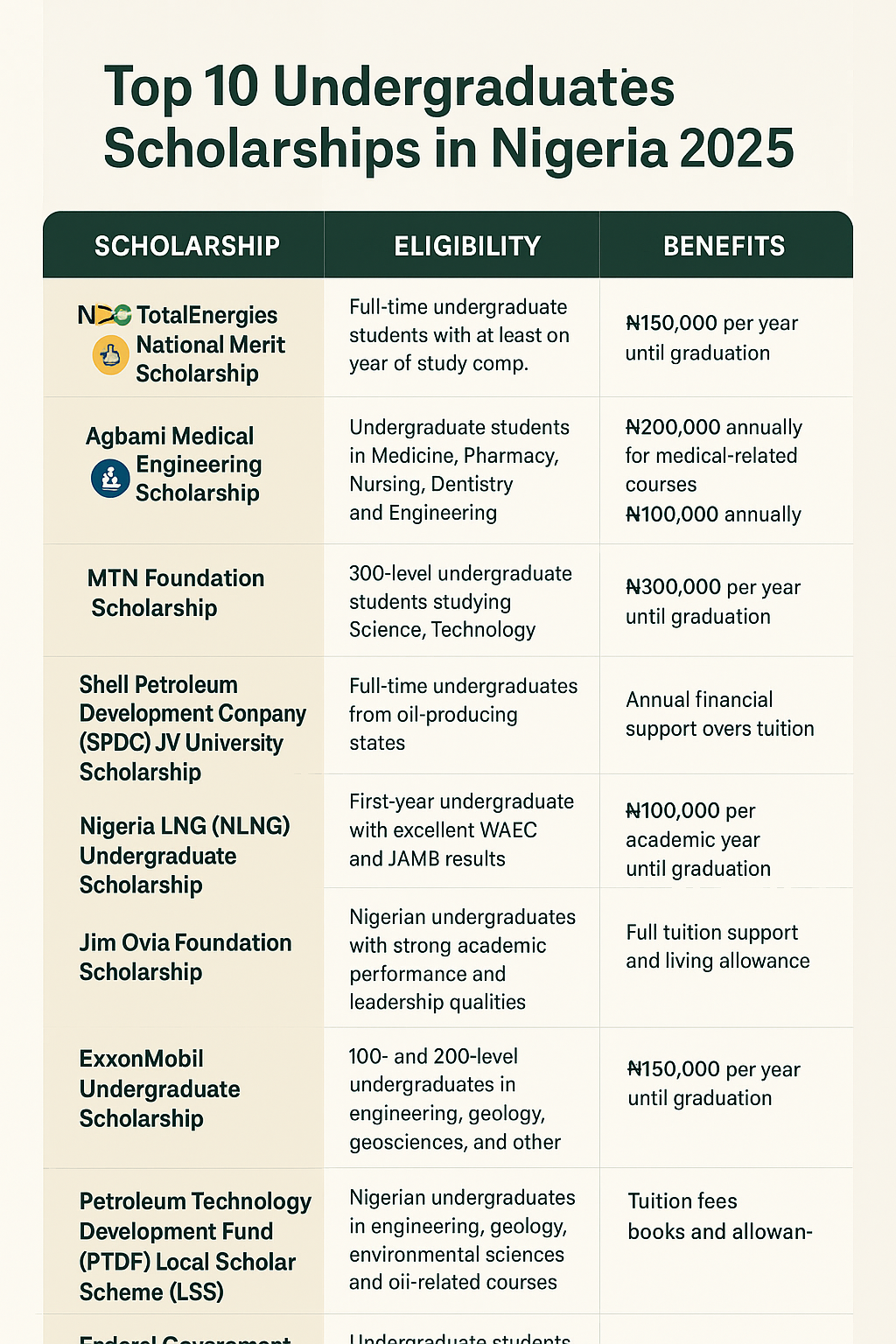
Coverage: ₦300,000 annually until graduation.
-
Eligibility: 200-level and 300-level students in science, technology, and business-related courses with a CGPA of 3.5 or above (2:1).
-
Application: Apply via MTN Scholarship Portal when announced. Read: How to Apply for the MTN Foundation Scholarship 2026 (Step-by-Step Guide)
-
Highlight: One of the most popular undergraduate scholarships in Nigeria.
2. NNPC/SNEPCo National University Scholarship
-
Coverage: Full tuition + annual stipend.
-
Eligibility: Nigerian undergraduates in accredited universities with a strong academic record.
-
Application: Open around May–July each year.
-
Highlight: Supports engineering, science, and business courses.
3. Chevening Scholarship (UK Government)
-
Coverage: Full tuition, living stipend, airfare, and visa.
-
Eligibility: Nigerian graduates with at least 2 years’ work experience.
-
Application: Runs August–November annually.
-
Highlight: Prestigious UK scholarship for master’s programs.
4. DAAD Scholarship (Germany)
-
Coverage: Full tuition + €992 monthly allowance.
-
Eligibility: Nigerian graduates applying for master’s or PhD in German universities.
-
Application: Deadlines vary per university.
-
Highlight: Ideal for STEM and social sciences.
5. Commonwealth Shared Scholarship
-
Coverage: Tuition, living allowance, airfare, research grants.
-
Eligibility: Nigerian students applying for postgraduate study in the UK.
-
Application: November–December each year.
-
Highlight: Open to developing Commonwealth countries, including Nigeria.
Partial Scholarships for Nigerian Students in 2026
Some scholarships cover part of tuition or offer stipends but still reduce financial pressure significantly.
6. PTDF Overseas and Local Scholarship (Partial Coverage)
-
Covers tuition and partial living allowance.
-
Supports oil and gas–related fields.
-
Graduate-level only.
7. Jim Ovia Scholarship
-
₦250,000 annually for tuition.
-
Undergraduate and postgraduate students in Nigerian universities.
-
Based on academic excellence.
8. Agbami Medical and Engineering Scholarship (Chevron Nigeria)
-
Covers tuition and stipends. The scholarship is ₦200,000 for medical students and ₦100,000 for engineering students annual awards.
-
For medical, nursing, and engineering undergraduates.
-
Deadline usually February–March.
9. SEPLAT JV Scholarship
-
₦200,000 annually.
-
Open to undergraduates in Nigerian universities. Here is the application link:
-
Popular among engineering and science students.
10. Nigeria LNG (NLNG) Undergraduate Scholarship
-
₦300,000 per year. Here is the application link: https://candidate.scholastica.ng/schemes/nlngugssn
-
Supports students in any accredited Nigerian university.
-
Highly competitive with nationwide reach.
General Application Requirements for Scholarships
While each scholarship has unique conditions, most Nigerian students will need:
-
WAEC/NECO/SSCE results.
-
JAMB admission letter or evidence of university admission.
-
Current student ID and admission number.
-
Transcript or CGPA (for undergraduates).
-
Passport photograph.
-
Personal statement or essay (for international scholarships).
-
Recommendation letters (academic or professional).
Deadlines and How to Apply
-
MTN Foundation: Opens around June–August yearly.
-
NNPC/SNEPCo: May–July.
-
Chevening: August–November.
-
DAAD: Varies by German institution.
-
Commonwealth: November–December.
Students should regularly check official scholarship portals and reputable education websites for updated deadlines.
10 Tips to Increase Your Scholarship Chances
-
Maintain a strong academic record (CGPA 3.5/5.0 and above).
-
Write a clear personal statement highlighting goals and achievements.
-
Apply early before the deadline.
-
Prepare all required documents in advance.
-
Get recommendation letters from lecturers or employers.
-
Tailor applications to each scholarship.
-
Improve writing and communication skills for interviews.
-
Stay active in community service or leadership roles.
-
Use official websites only to avoid scams.
-
Keep applying consistently; persistence pays off.
Conclusion
Scholarships remain one of the best ways for Nigerian students to secure quality education in 2026. Whether you are applying for the MTN Foundation Scholarship, NNPC/SNEPCo, or international programs like Chevening and DAAD, preparation is key.
Start early, gather your documents, and keep your academic record strong. If one application does not succeed, apply again next year. The right opportunity will eventually open.
If you found this guide helpful, consider subscribing to stay updated on new scholarship opportunities for Nigerian students in 2026.
Frequently Asked Questions (FAQs) on Scholarships for Nigerian Students 2026
Here are 30 carefully prepared FAQs to help Nigerian students succeed with scholarships:
General Questions
1. What are the top scholarships for Nigerian students in 2026?
The top scholarships include MTN Foundation, NNPC/SNEPCo, Chevening, DAAD, Commonwealth, and Jim Ovia.
2. Can WAEC or JAMB candidates apply for scholarships?
Most scholarships require you to already be in university, but some foundation programs may accept fresh JAMB candidates with admission letters.
3. Are Nigerian scholarships only for undergraduates?
No. Several scholarships like Chevening, DAAD, and PTDF are for postgraduate students.
4. What GPA is required for most Nigerian scholarships?
A minimum of 3.0/5.0 (Second Class Lower), but competitive scholarships require 3.5/5.0 (Second Class Upper) or above.
5. Can private university students apply?
Yes, MTN Foundation, Jim Ovia, and NLNG allow private university students, but some scholarships restrict applications to public universities.
Application Process
6. How do I apply for MTN Scholarship 2026?
Visit the official MTN Foundation website during the application window, fill out the form, and upload required documents.
7. What documents do I need for international scholarships?
You will need transcripts, IELTS/TOEFL scores, recommendation letters, CV, and a personal statement.
8. Do scholarships require an essay?
Yes, most competitive scholarships (Chevening, Commonwealth) require a strong essay or statement of purpose.
9. Can I apply for more than one scholarship?
Yes, but you cannot accept two fully funded scholarships at the same time.
10. How long does the application process take?
Between 2–6 months, depending on the scholarship.
Financial Coverage
11. Do all scholarships cover living expenses?
No. Fully funded scholarships like Chevening cover living expenses, while partial ones like SEPLAT only cover tuition.
12. How much is the MTN Foundation Scholarship worth?
It is ₦300,000 annually until graduation.
13. Do Nigerian scholarships cover international studies?
Some do, like PTDF (for oil and gas studies abroad) and NDDC scholarships.
14. Do I need to repay a scholarship?
No. Scholarships are not loans.
15. Can I use two partial scholarships together?
Yes, provided the providers allow it and there is no conflict.
Selection & Eligibility
16. How are winners selected?
Based on academic excellence, leadership qualities, and performance in aptitude tests or interviews.
17. Is there an age limit?
Most undergraduate scholarships prefer applicants under 25 years.
18. Can HND students apply?
Yes, some scholarships accept HND students, but opportunities are fewer compared to BSc.
19. Do medical and engineering students get more scholarships?
Yes, because many corporate scholarships target STEM, engineering, and health sciences.
20. Can postgraduate students abroad apply for Nigerian-based scholarships?
Most Nigerian corporate scholarships are for local study, but international schemes like Chevening accept Nigerians abroad.
Deadlines & Results
21. When is the MTN Scholarship 2026 deadline?
Usually between June–August. Exact dates will be announced on their portal.
22. When will scholarship winners be announced?
Between 2–4 months after application deadline.
23. How will I know if I have been shortlisted?
You will receive an email and sometimes an SMS notification.
24. Can I appeal if I am not selected?
No, scholarship results are final.
25. Are deadlines the same every year?
No. Always confirm on the official portal.
Success Tips
26. What is the biggest mistake Nigerian students make when applying?
Submitting incomplete documents or applying after the deadline.
27. How important is community service in scholarship applications?
Very important, especially for international scholarships like Chevening.
28. Do I need English tests for scholarships?
Yes, IELTS or TOEFL is required for most international scholarships.
29. Can I work while on a scholarship abroad?
Yes, but only part-time as allowed by visa regulations.
30. What should I do if I miss the deadline?
Prepare ahead and apply next year. Keep checking other opportunities.
BONUS FAQs on Scholarship Questions
1. What are the top scholarships for Nigerian students in 2026?
The top scholarships include Chevening Scholarship (UK), DAAD Scholarship (Germany), Fulbright Program (USA), Commonwealth Shared Scholarship (UK), Mastercard Foundation Scholarship (Africa/Canada), MTN Foundation Scholarship, NNPC/Total Scholarship, Agbami Scholarship, Jim Ovia Foundation Scholarship, and Seplat Scholarship.
2. Are these scholarships fully funded or partial?
Some are fully funded (covering tuition, flights, and living costs), such as Chevening and DAAD, while others like MTN or NNPC/Total provide partial coverage (tuition support and stipends).
3. Who can apply for international scholarships?
Nigerian students with strong academic performance, leadership potential, and relevant documents (WAEC, JAMB, degree transcripts, or IELTS/TOEFL for English-speaking countries) can apply.
4. Do I need to write IELTS or TOEFL for foreign scholarships?
Yes, most international scholarships (UK, USA, Canada) require proof of English proficiency. However, some universities waive this requirement for Nigerian students since English is the official language.
5. Are there scholarships without IELTS for Nigerians?
Yes. Many German universities under DAAD, some Canadian institutions, and even Chinese government scholarships often waive IELTS if you studied in English.
Eligibility and Requirements
6. What GPA or grade do I need to qualify?
Most international scholarships require a minimum of Second-Class Upper (2:1). Local scholarships like MTN or NNPC/Total often require a CGPA of 3.5/5.0 or above.
7. Can OND or HND students apply?
Yes, some scholarships like the MTN Foundation Scholarship and Jim Ovia Foundation accept HND/OND students, while most international postgraduate scholarships require at least a Bachelor’s degree.
8. Can Nigerian secondary school leavers apply?
Yes. Scholarships like the Mastercard Foundation and some local state government awards accept SSCE/WAEC graduates transitioning into universities.
9. Do I need admission first before applying?
For some (like Chevening, DAAD, Commonwealth), you need to apply alongside or after securing admission. For others (like MTN or NNPC/Total), you apply as a current student.
10. Can part-time students apply?
Most scholarships are for full-time students only. Part-time and distance learning students are rarely considered.
Application and Process
11. When do scholarship applications open for 2026?
-
Chevening: August 2024 – November 2024
-
DAAD: September 2024 – December 2024
-
Commonwealth: October 2024 – December 2024
-
Local scholarships (MTN, NNPC, Seplat): April – July 2025
- Coca-Cola Scholars Program: August 1, 2024, for students graduating in the 2025-2026 year.
12. How do I apply for these scholarships?
Applications are mostly online via official portals. For example:
-
Chevening → www.chevening.org
-
DAAD → www.daad.de
-
MTN → scholarship.mtn.ng
13. What documents are usually required?
-
WAEC/NECO or JAMB results (for undergraduates)
-
University transcript & CGPA (for postgraduates)
-
Admission letter (if applicable)
-
Personal statement/essay
-
Recommendation letters
-
International passport (for study abroad)
14. Can I apply for more than one scholarship?
Yes, but you must manage deadlines and requirements carefully.
15. Are application fees required?
Most scholarships are free of charge. Beware of fraudsters demanding payment.
Selection and Benefits
16. How are scholarship winners selected?
Selection is based on academic performance, leadership potential, financial need, and interview performance.
17. How much is the MTN Foundation Scholarship worth?
The MTN Foundation Scholarship gives ₦300,000 annually until graduation, covering tuition, books, and living costs.
18. How much does the Chevening Scholarship cover?
Chevening covers full tuition, flight tickets, visa, and a monthly stipend of around £1,200.
19. Do local scholarships pay cash or directly to schools?
Some (like NNPC/Total, Seplat) pay directly to institutions, while others (like MTN, Jim Ovia) provide direct stipends to students.
20. Do winners get internship or job opportunities?
Yes. For instance:
-
MTN Scholars often intern at MTN Nigeria.
-
Chevening alumni have networking opportunities in the UK and globally.
Challenges and Tips
21. Why do many Nigerian students fail to win scholarships?
Common reasons include late applications, incomplete documents, weak essays, low CGPA, or ignoring eligibility criteria.
22. What tips can help me win a scholarship?
-
Apply early.
-
Write a strong essay with personal examples.
-
Highlight leadership roles (church, community, student union).
-
Get good recommendation letters.
23. Can I reapply if I failed before?
Yes, most scholarships allow reapplication. For example, Chevening allows reapplying yearly.
24. Do I need connections to win a scholarship?
No. Legitimate scholarships are based on merit and fairness.
25. Are there state government scholarships in Nigeria?
Yes. States like Lagos, Rivers, Bayelsa, and Delta offer student bursaries and scholarships annually.
Post-Award
26. What happens after I win a scholarship?
You will either receive funds directly (local scholarships) or visa/admission support (international scholarships).
27. Can a scholarship be withdrawn?
Yes. If you fail to maintain academic standards or violate conditions, it can be revoked.
28. Can I combine two scholarships?
Some scholarships allow it, but most require you to accept only one funding source.
29. Do I need to return to Nigeria after studying abroad?
Some (like Commonwealth and Chevening) require you to return for at least 2 years after study. Others, like DAAD, do not strictly enforce this.
