
Many students preparing for WAEC study hard, yet still struggle to get the results they expect. The problem is not always lack of effort. In most cases, it is lack of structure.
Reading without a clear timetable often leads to confusion, missed topics, and burnout. You may spend hours with your books and still feel unprepared.
A good WAEC reading timetable changes everything. It gives direction, reduces stress, and helps you cover all your subjects without rushing.
By the end of this guide, you will know how to create a WAEC reading timetable that fits your daily routine and helps you prepare effectively for the exam.
Why You Need a WAEC Reading Timetable
A WAEC reading timetable is not just a plan. It is a system that keeps your preparation organized.
WAEC covers many subjects, and without a timetable, it is easy to focus too much on one subject and neglect others.
Benefits of a Good Study Timetable
- Better time management: You know what to read and when
- Balanced subject coverage: No subject is ignored
- Increased consistency: You build a daily reading habit
- Improved exam confidence: You feel prepared before the exam
Students who follow a structured timetable often perform better because their preparation is steady and focused.
What Makes a WAEC Reading Timetable Effective?
Not every timetable works. Some students create very strict schedules but fail to follow them after a few days.
An effective WAEC study timetable for students must be realistic and flexible.
Key Features of a Good Timetable
- Matches your daily routine
- Includes short breaks between study sessions
- Covers all your subjects
- Allows time for revision and practice
If your timetable feels too heavy or unrealistic, you will abandon it. The goal is consistency, not perfection.
Step-by-Step Guide to Creating a WAEC Reading Timetable
If you are wondering how to create a reading timetable for WAEC, follow these simple steps.
Step 1 – Know Your Subjects and Exam Dates
Start by listing all your WAEC subjects.
Then identify:
- Subjects you find difficult
- Subjects you are already strong in
This helps you decide where to focus more attention.
Step 2 – Set Clear Study Goals
Your timetable should have direction.
Set:
- Daily targets (e.g., finish one topic)
- Weekly goals (e.g., complete a subject section)
Focus on important topics from the WAEC syllabus rather than trying to read everything at once.
Step 3 – Allocate Time to Each Subject
Not all subjects need equal time.
- Give more time to difficult subjects
- Spend less time on subjects you already understand
For example:
- Mathematics and Physics may need more practice time
- English and Biology may need more reading and revision
Step 4 – Create a Daily Study Schedule
Divide your day into study sessions:
- Morning session (fresh and focused)
- Afternoon session (moderate work)
- Evening session (light reading or revision)
Always include breaks between sessions to avoid fatigue.
Step 5 – Include Revision and Practice
Reading alone is not enough.
Your WAEC timetable 2026 study plan should include:
- Weekly revision
- Practice with past questions
- Mock tests
This helps you understand exam patterns and improve speed.
Best WAEC Reading Timetable for Science Students
Science students often handle subjects that require both calculation and understanding.
Sample Daily Plan
- Morning: Mathematics or Physics
- Afternoon: Chemistry or Biology
- Evening: Revision or past questions
Weekly Focus
- Rotate subjects to avoid boredom
- Include at least one mock test weekly
This method helps balance theory and problem-solving.
WAEC Reading Timetable for Art and Commercial Students
Art and commercial students have subjects that involve reading, memorization, and writing.
Subject Distribution
- English, Literature, Government, CRS/IRS
- Accounting, Commerce, Economics
Study Strategy
- Combine reading with note-taking
- Practice essay writing regularly
- Revise key definitions and concepts
A good WAEC timetable for art and commercial students should include both reading and writing practice.
How Many Hours Should You Study for WAEC Daily?
Many students ask, how many hours should I study for WAEC daily?
The answer depends on your schedule, but generally:
- 3 to 6 hours daily is effective
Ideal Study Breakdown
- 2 to 3 study sessions per day
- 45 to 60 minutes per session
- 10 to 15 minutes break between sessions
Quality matters more than quantity. Focused study is more effective than long, distracted hours.
Common Mistakes to Avoid When Creating a Timetable
Many students struggle because of simple mistakes.
Avoid these:
- Creating unrealistic schedules
- Ignoring weak subjects
- Skipping breaks
- Not including revision time
A timetable should guide you, not overwhelm you.
Also Read: WAEC Grading System Explained: How WAEC Grades Your Papers
How to Stick to Your WAEC Reading Timetable
Creating a timetable is one thing. Following it is another.
Practical Tips
- Set reminders on your phone
- Study at the same time daily
- Keep your study area free from distractions
- Track your progress
Motivation Strategies
- Reward yourself after completing tasks
- Study with friends occasionally
- Stay focused on your exam goals
Consistency is what turns a timetable into results.
Best Study Techniques to Combine with Your Timetable
Your timetable becomes more effective when combined with good study methods.
Try these:
- Active recall: Test yourself after reading
- Past questions: Practice regularly
- Group study: Share ideas with classmates
- Teaching others: Explaining helps you understand better
These techniques improve retention and exam performance.
Sample WAEC Weekly Reading Timetable
Here is a simple weekly plan you can follow:
Example Plan
- Monday: Mathematics + English
- Tuesday: Biology + Chemistry
- Wednesday: Physics + English
- Thursday: Mathematics + Biology
- Friday: Chemistry + Physics
- Saturday: Full mock test
- Sunday: Revision and rest
You can adjust this based on your subjects and schedule.
Real-Life Example (Student Case Study)
Consider two students preparing for WAEC.
Student A studied randomly. He read whenever he felt like it and focused mostly on his favorite subjects. During the exam, he struggled with unfamiliar topics.
Student B created a structured WAEC reading timetable. She followed it daily, practiced past questions, and revised weekly.
At the end:
- Student A had average results
- Student B scored high and gained admission
The difference was not intelligence. It was planning.
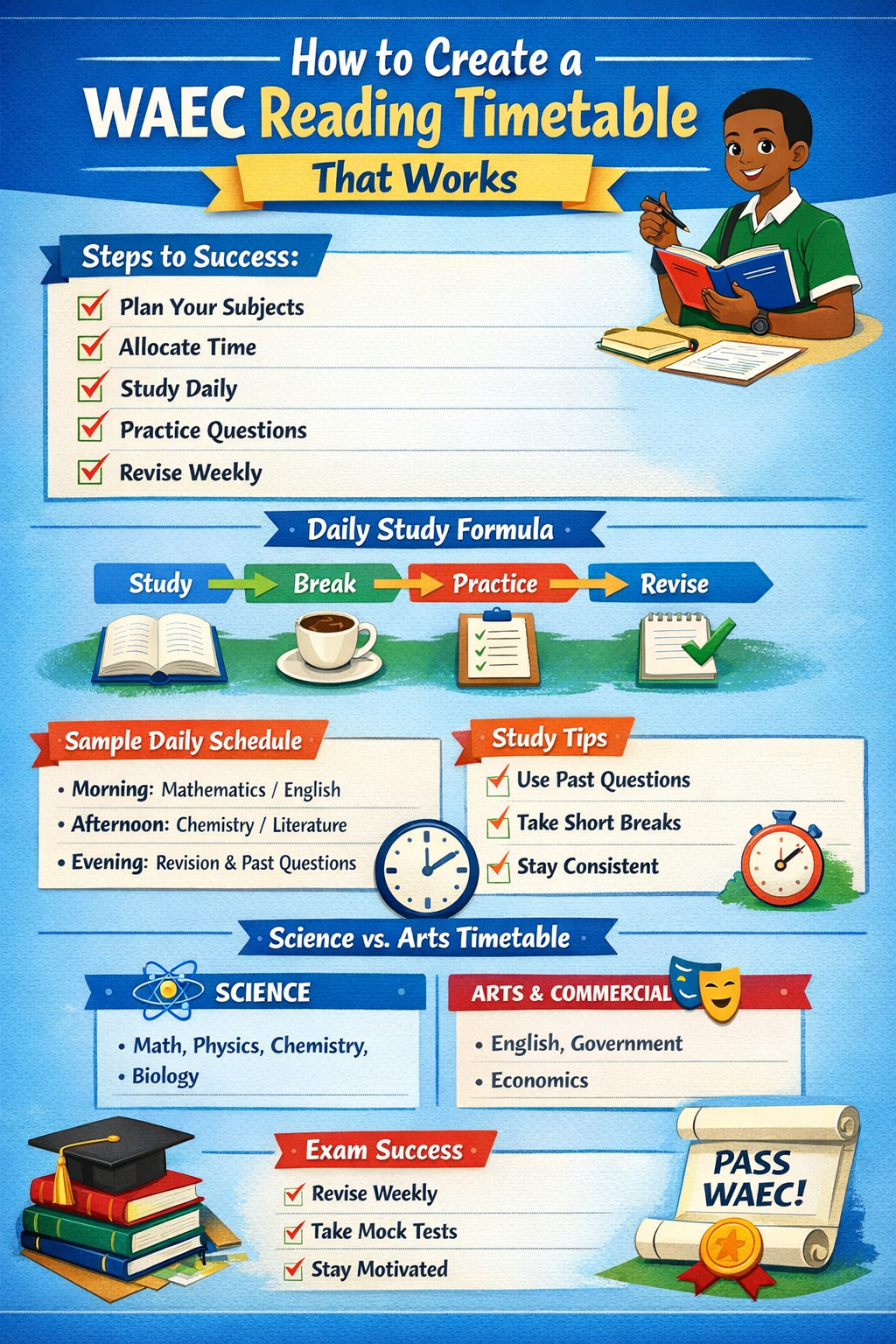
WAEC Reading Timetable Formula (At a Glance)
Steps to Success:
- Plan your subjects
- Allocate time
- Study daily
- Practice questions
- Revise weekly
Daily Formula:
Study → Break → Practice → Revise
Frequently Asked Questions (FAQs)
How do I create a reading timetable for WAEC?
Start by listing your subjects, assign time to each one daily, and include revision and practice sessions. Keep it simple and realistic.
What is the best WAEC reading timetable?
The best timetable is one that fits your daily routine, covers all subjects, and allows time for revision and past questions.
How many hours should I study daily for WAEC?
Between 3 and 6 hours of focused study is recommended. Break it into sessions for better concentration.
Can I pass WAEC without a timetable?
Yes, but it is more difficult. A timetable increases your chances by giving your study structure and consistency.
How do I stay consistent with my timetable?
Set clear goals, avoid distractions, and track your daily progress. Consistency comes from discipline, not motivation.
What is the best WAEC reading timetable for science students?
A balanced timetable that includes Mathematics, Physics, Chemistry, and Biology daily or weekly, along with practice questions.
How can I improve my WAEC preparation quickly?
Focus on key topics, practice past questions, and revise regularly. Avoid trying to read everything at once.
Conclusion
Preparing for WAEC is not just about how hard you study. It is about how well you plan your study.
A well-structured WAEC reading timetable helps you stay organized, cover all subjects, and reduce exam stress. It gives your effort direction and improves your chances of success.
Start small if you need to. Create a simple timetable today and follow it consistently. Adjust it as you go, but do not abandon it.
Don’t wait for motivation. Create your WAEC reading timetable today, start small, and stay consistent. Which subject do you struggle with the most? Share in the comments.
