
Many WAEC candidates spend long hours reading Physics theory, solving equations, and memorising formulas. Yet, when it comes to the practical exam, there is often uncertainty.
Students keep asking:
- Is Physics practical really important in WAEC?
- How many marks does it carry?
- Can it affect my overall result?
The confusion is understandable. Unlike theory papers, the practical exam feels different. It involves measurements, graphs, and real experiments, and many students are not sure how it is graded.
The truth is simple. If you understand how WAEC Physics practical marks work, you can turn it into a strong advantage.
In this guide, you will learn how many marks Physics practical carries in WAEC, how the marking scheme works, and how to prepare in a way that improves your final grade.
Overview of WAEC Physics Exam Structure
Before focusing on practical marks, it helps to understand the full WAEC Physics exam structure.
WAEC Physics is divided into three main papers:
Paper 1: Objective (Multiple Choice)
- About 40 questions
- Tests basic concepts and quick thinking
- Usually carries around 40 marks
Paper 2: Theory (Essay and Calculations)
- Includes structured questions and problem solving
- Tests deeper understanding
- Usually carries about 60 marks
Paper 3: Practical
- Hands-on experiment or alternative practical
- Focuses on measurements, graphs, and analysis
Key Insight
WAEC combines all three papers to produce your final Physics score. This means your performance in practical can raise or lower your overall grade.
Also Read: How Many Marks Does Biology Practical Carry in WAEC? (Complete Guide for Students)
How Many Marks Does Physics Practical Carry in WAEC?
This is the main question.
Direct Answer
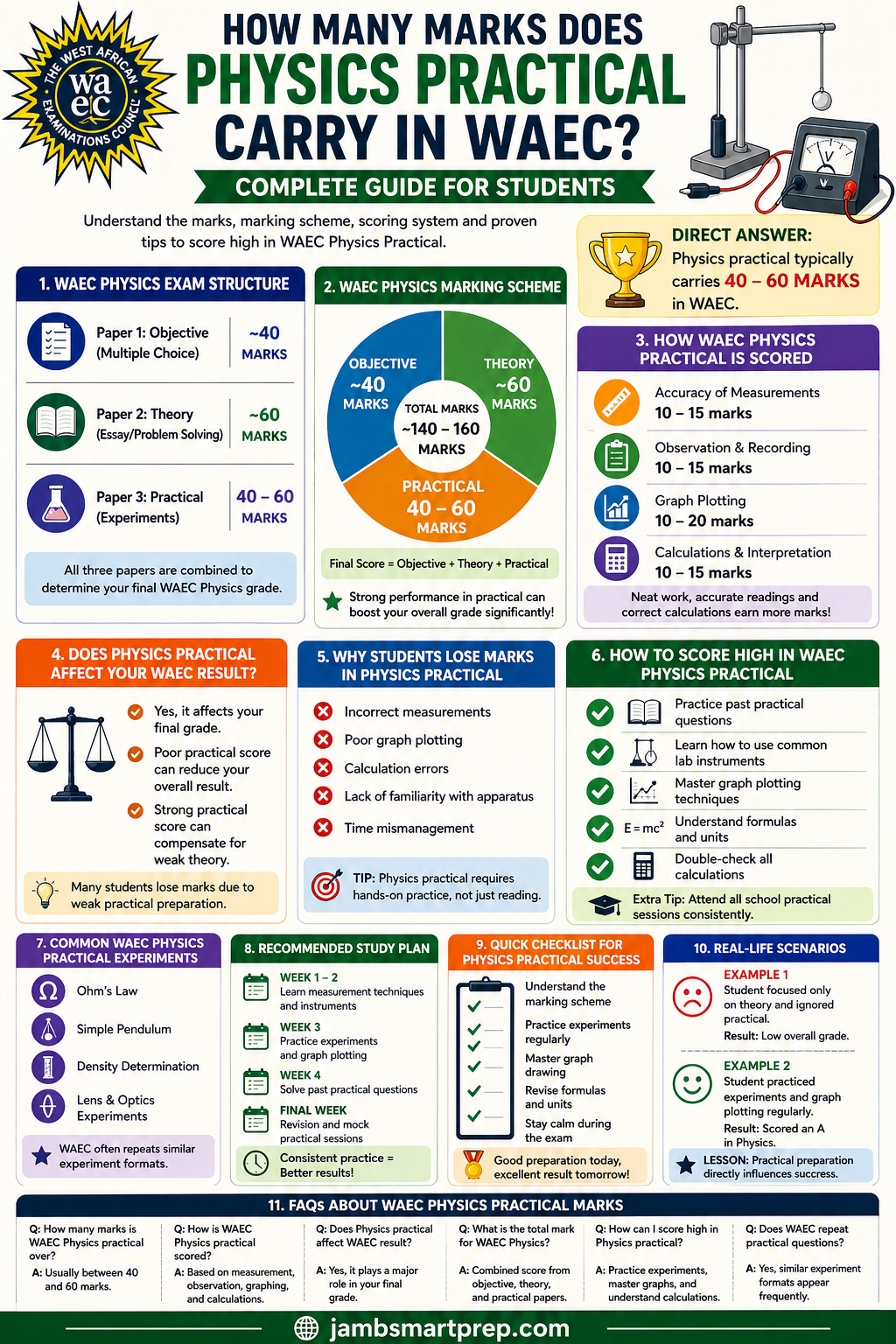
Physics practical typically carries between 40 and 60 marks, depending on the exam format for that year.
What This Means
- It is not a minor section
- It contributes a large part of your total score
- A strong practical score can significantly improve your grade
Important Note
WAEC may adjust the exact marks slightly from year to year. However, the practical exam always remains a major component of the overall assessment.
WAEC Physics Marking Scheme Explained
To understand WAEC Physics practical marks properly, you need to see how the entire subject is graded.
Typical Mark Distribution
- Objective: ~40 marks
- Theory: ~60 marks
- Practical: ~40–60 marks
How WAEC Calculates Your Result
Your final score is a combination of all three:
Final Score = Objective + Theory + Practical
What This Means for Students
- You cannot ignore any section
- Strong performance in practical can boost a weak theory score
- Balanced preparation gives the best results
Also read: How Will I Know If JAMB Has Given Me Admission 2026? (Complete Guide)
How WAEC Physics Practical Is Scored
Many students think practical is random. It is not. WAEC uses clear marking criteria.
Areas You Are Assessed On
- Accuracy of Measurements
- Correct readings from instruments
- Proper use of apparatus
- Observation and Recording
- Clear and neat tables
- Accurate values recorded
- Graph Plotting
- Proper axes and scale
- Straight lines or curves where required
- Calculations and Interpretation
- Correct formulas
- Accurate results
- Logical conclusions
Example of Mark Allocation
- Observation: 10–15 marks
- Graph: 10–20 marks
- Calculations: 10–15 marks
Key Insight
Even small mistakes in measurement or graph plotting can cost several marks.
Does Physics Practical Affect Your WAEC Result?
Yes, it does.
Why It Matters
- A low practical score can reduce your overall grade
- A strong practical score can help you move from C to B or from B to A
JAMB UTME Result Slips 2026: How to Check, Print, and Fix Common Issues
Real Situation
Some students perform well in theory but lose marks in practical. Others do the opposite. WAEC combines everything, so every mark counts.
Key Insight
Physics practical is not optional. It is a deciding factor in your final result.
Why Students Lose Marks in WAEC Physics Practical
Many students do not fail because they are not intelligent. They lose marks because of avoidable mistakes.
Common Mistakes
- Taking wrong measurements
- Drawing poor graphs
- Making calculation errors
- Not understanding how to use instruments
- Spending too much time on one question
Important Tip
Reading alone is not enough. Physics practical requires practice with real or simulated experiments.
How to Score High in WAEC Physics Practical
If you want a strong grade, you need a clear strategy.
Proven Methods
- Practice Past Practical Questions
- WAEC often repeats similar patterns
- Learn to Use Common Instruments
- Meter rule
- Stopwatch
- Ammeter and voltmeter
- Master Graph Plotting
- Use proper scales
- Label axes correctly
- Plot points accurately
- Understand Formulas and Units
- Know when to apply each formula
- Always include correct units
- Double-Check Your Work
- Confirm readings
- Recalculate if necessary
Extra Tip
Attend every practical class in school. Those sessions build confidence and reduce exam fear.
Common WAEC Physics Practical Experiments
WAEC tends to repeat certain experiment types.
Frequently Tested Experiments
- Ohm’s Law
- Simple pendulum
- Density determination
- Lens and optics experiments
Insight
If you master these areas, you are already well prepared for the practical exam.
Real-Life Scenario
Example 1
A student focused only on theory and ignored practical practice.
Result:
He scored well in theory but performed poorly in practical. His final grade dropped.
Example 2
Another student practised experiments regularly and understood graph plotting.
Result:
She scored high in practical and secured an A in Physics.
Lesson
Practical preparation can make the difference between an average and an excellent result.
Recommended Study Plan for Physics Practical
A structured plan helps you stay focused.
Week 1–2
- Learn measurement techniques
- Understand instruments
Week 3
- Practice experiments
- Focus on graph plotting
Week 4
- Solve past practical questions
Final Week
- Revise key concepts
- Attempt mock practical exams
Quick Checklist for WAEC Physics Practical Success
- Understand the WAEC Physics marking scheme
- Practice experiments regularly
- Master graph drawing
- Revise formulas and units
- Stay calm during the exam
How Many Marks Does Physics Practical Carry in WAEC?
Physics Exam Structure
- Objective
- Theory
- Practical
Practical Marks
- 40–60 marks
What You’re Graded On
- Measurement
- Observation
- Graph plotting
- Calculation
Tips to Score High
- Practice experiments
- Learn instruments
- Master graphs
Avoid
- Wrong readings ❌
- Poor graphs ❌
- Calculation errors ❌
FAQs About WAEC Physics Practical Marks
How many marks does Physics practical carry in WAEC?
Physics practical usually carries between 40 and 60 marks, depending on the exam year.
How many marks is WAEC Physics practical over?
It is typically graded over 40–60 marks as part of the total Physics score.
How is WAEC Physics practical scored?
It is scored based on measurements, observations, graph plotting, and calculations.
Does Physics practical affect WAEC result?
Yes, it plays a major role and can significantly influence your final grade.
What is the total mark for WAEC Physics?
The total mark combines objective, theory, and practical scores.
How can I score high in WAEC Physics practical?
Practice experiments, understand graphs, and improve your calculation accuracy.
Can I pass Physics without doing well in practical?
It is possible, but difficult. A low practical score can reduce your overall grade.
Does WAEC repeat practical questions?
Yes, similar experiment formats appear frequently over the years.
Conclusion
Physics practical carries a significant number of marks in WAEC. It is not just an additional paper. It is a core part of your final result.
Students who understand how WAEC Physics is graded and prepare properly often perform better. Those who ignore practical usually regret it later.
If you want a strong result:
- Start practising experiments early
- Focus on graphs and calculations
- Use past questions consistently
A steady and practical approach will always produce better results than last-minute reading.
Which part of Physics practical do you find most difficult: measurements, graphs, or calculations? Share your experience and learn from others.
