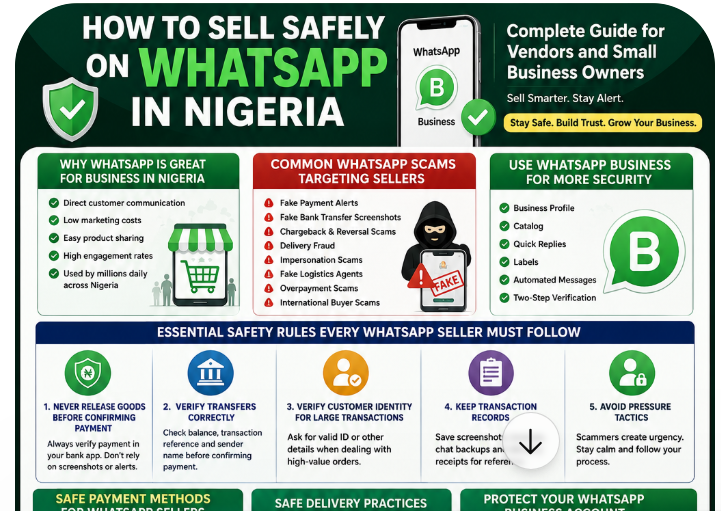
WhatsApp has evolved far beyond a simple messaging app. Today, it is one of the most powerful tools for buying and selling products in Nigeria. From fashion vendors in Lagos and gadget dealers in Abuja to food sellers in Port Harcourt and digital entrepreneurs across the country, thousands of businesses rely on WhatsApp every day to connect with customers and generate sales.
Its popularity is not surprising. Nigerians spend a significant amount of time on mobile devices, and WhatsApp remains one of the most widely used communication platforms. Instead of building expensive websites or renting physical stores, many entrepreneurs simply create a WhatsApp Business account and begin selling directly to customers.
However, this convenience comes with serious risks.
Cases of fake payment alerts, fraudulent buyers, account hacking, delivery scams, and identity theft have become increasingly common. Many small business owners have lost money, products, and even access to their business accounts because they failed to follow basic security practices.
If you have ever wondered:
- How do I sell safely on WhatsApp in Nigeria?
- How can I avoid fake payment alerts on WhatsApp?
- What are common WhatsApp scams targeting vendors?
- Is WhatsApp Business safe for online selling?
This comprehensive guide will answer all your questions.
By the end of this article, you will understand how to protect your business, verify customers, secure payments, avoid scammers, and build a trustworthy WhatsApp business that customers can confidently patronize.
Quick Statistics About WhatsApp and Online Commerce in Nigeria
Several reports consistently rank Nigeria among the countries with the highest WhatsApp usage in Africa.
Some important trends include:
- Millions of Nigerians actively use WhatsApp daily.
- Thousands of small businesses depend on WhatsApp Business for customer communication.
- Social commerce continues to grow rapidly in Nigeria.
- More buyers now prefer chatting with vendors directly before making purchases.
- Mobile commerce accounts for a significant share of online transactions.
These trends create enormous opportunities for entrepreneurs, but they also attract fraudsters looking for unsuspecting sellers.
That is why understanding safe online selling in Nigeria has become more important than ever.
Understanding the Risks of Selling on WhatsApp in Nigeria
Before learning how to protect yourself, it is important to understand the risks involved.
Many vendors assume that only buyers get scammed online. In reality, sellers are frequently targeted because scammers know they are eager to make sales.
Why WhatsApp Is Popular for Buying and Selling
Benefits of WhatsApp for Nigerian Businesses
WhatsApp offers several advantages that make it attractive for entrepreneurs.
Direct Customer Communication
Unlike websites where communication may be delayed, WhatsApp allows instant conversations.
Customers can:
- Ask questions
- Request product photos
- Negotiate prices
- Place orders immediately
This direct communication helps businesses close sales faster.
Low Marketing Costs
Running a WhatsApp business is relatively affordable.
Business owners can:
- Promote products through Status updates
- Share product catalogs
- Use broadcast lists
- Join niche groups
This reduces advertising expenses significantly.
Easy Product Sharing
Photos, videos, PDFs, and voice notes can be shared instantly.
This makes it easier to demonstrate products and answer customer questions.
High Engagement Rates
Most people check WhatsApp multiple times daily.
As a result, messages often receive quicker responses compared to emails or traditional marketing channels.
Common Products Sold on WhatsApp
Many categories of products thrive on WhatsApp.
Popular examples include:
Smartphones
New and fairly used phones remain among the most traded products online.
Fashion Items
- Clothing
- Shoes
- Bags
- Jewelry
- Watches
Fashion vendors generate significant revenue through WhatsApp sales.
Food Products
Many restaurants and food vendors accept orders directly through WhatsApp.
Cosmetics
Beauty products, skincare items, and makeup accessories are commonly marketed through WhatsApp catalogs.
Electronics
Laptops, televisions, gaming consoles, and accessories are frequently sold online.
Digital Products
These include:
- E-books
- Online courses
- Software subscriptions
- Graphic design templates
- Website services
Unfortunately, the popularity of these products also attracts scammers.
Common WhatsApp Scams Targeting Nigerian Sellers
Understanding scam tactics is the first step toward avoiding them.
Fake Payment Alerts
This is one of the most common scams in Nigeria.
A fraudster sends a fake bank alert or SMS notification claiming payment has been made.
The seller releases the product without confirming the payment.
Later, the seller discovers that no money entered the account.
Fake Bank Transfer Screenshots
Some scammers generate counterfeit transfer receipts using editing software.
The screenshot may appear genuine.
However, the actual transfer never occurred.
Chargeback and Reversal Scams
In some situations, scammers make payments using stolen accounts.
After receiving the product, the transaction gets reversed.
The vendor loses both the product and the payment.
Delivery Fraud
A customer requests delivery to a location.
Once the product arrives, the buyer becomes unreachable.
The seller bears transportation losses.
Impersonation Scams
Fraudsters sometimes pretend to be:
- Bank staff
- Existing customers
- Business partners
- Logistics personnel
Their goal is usually to obtain sensitive information.
Fake Logistics Agents
A scammer may claim to represent a delivery company and request payment before processing shipment.
After receiving money, they disappear.
Overpayment Scams
A fraudster intentionally sends proof of an amount greater than the agreed price.
They then request a refund of the “excess.”
Eventually, the original payment turns out to be fake.
International Buyer Scams
Some scammers pose as foreign buyers.
They may:
- Promise large purchases
- Request shipping
- Send fake payment confirmations
Many sellers lose products through these schemes.
How to Set Up a Secure WhatsApp Business Account
Your security begins with the right account setup.
Why You Should Use WhatsApp Business Instead of Personal WhatsApp
Many new vendors start selling through regular WhatsApp.
This works initially, but WhatsApp Business offers better security and professionalism.
Benefits of WhatsApp Business
- Professional business profile
- Product catalogs
- Quick replies
- Automated messages
- Better customer management
- Enhanced credibility
Customers are generally more comfortable buying from businesses that appear organized.
Features That Improve Security
WhatsApp Business includes features that help separate personal conversations from business activities.
This reduces confusion and improves account management.
Complete Your Business Profile Properly
A complete profile builds trust and discourages scammers.
Business Name
Use your registered business name whenever possible.
Avoid random nicknames.
Business Description
Clearly explain:
- What you sell
- Your location
- Delivery options
- Contact details
Business Address
Adding a verifiable address increases credibility.
Email Verification
Use an active email address linked to your business.
Business Hours
Display accurate operating hours to manage customer expectations.
Enable Two-Factor Authentication
One of the most important WhatsApp business security tips is enabling two-factor authentication.
Step-by-Step Guide
- Open WhatsApp.
- Go to Settings.
- Select Account.
- Click Two-Step Verification.
- Tap Enable.
- Create a six-digit PIN.
- Add a recovery email address.
Why It Protects Your Business
Even if someone obtains your SIM card or verification code, they cannot access your account without your PIN.
Many hacked WhatsApp accounts could have been protected through this simple feature.
Essential Safety Rules Every WhatsApp Seller Must Follow
Regardless of what you sell, certain rules should never be ignored.
Never Release Goods Before Confirming Payment
This rule alone can save your business from major losses.
Many vendors lose products because they trust screenshots rather than verifying payments.
How to Verify Transfers Correctly
Always:
- Check your banking app
- Confirm account balance changes
- Review transaction history
- Wait for bank confirmation
Never rely solely on screenshots.
Signs of Fake Payment Alerts
Watch for:
- Poor formatting
- Misspelled bank names
- Suspicious transaction references
- Screenshots without timestamps
- Edited notification messages
Bank Verification Methods
Use:
- Mobile banking apps
- Internet banking
- Official SMS alerts
- Bank customer service
Independent verification is always safer than trusting customer-provided evidence.
Avoid Pressure Tactics from Buyers
One of the oldest tricks used by scammers is creating unnecessary urgency.
They know that when vendors feel pressured, they are more likely to make mistakes.
A fraudster may claim that:
- They need the item immediately.
- Their driver is already waiting.
- They are traveling and cannot wait.
- The payment alert is delayed because of network issues.
- They are a loyal customer and should be trusted.
The goal is simple: convince you to release goods before completing proper verification.
Common Urgent Messages Scammers Use
Examples include:
- “Please send it now, the alert will enter shortly.”
- “My driver is already at your location.”
- “I have transferred the money, network is slow today.”
- “I am a pastor, doctor, or military officer. You can trust me.”
- “I need this urgently for a family emergency.”
While genuine customers may occasionally face urgent situations, a professional seller should never compromise security procedures.
How to Respond Professionally
Instead of arguing, simply state your policy.
For example:
“Thank you for your order. Our company policy requires payment confirmation before goods can be released.”
This keeps the conversation professional while protecting your business.
Verify Customer Identity Before Large Transactions
Small purchases may not require extensive verification. However, when dealing with expensive items, additional checks can reduce risk.
When Identity Verification Is Necessary
Consider verifying customers when selling:
- Smartphones worth ₦200,000 or more
- Laptops
- High-end electronics
- Jewelry
- Bulk inventory orders
- Business equipment
The higher the transaction value, the greater the need for verification.
Documents You Can Request
Depending on the transaction, you may request:
- National Identification Number (NIN)
- Driver’s License
- International Passport
- Voter’s Card
- Corporate business information
Do not collect unnecessary personal information. Only request details relevant to securing the transaction.
Keep Transaction Records
Proper documentation protects both sellers and buyers.
Good records can help resolve disputes and support investigations if fraud occurs.
Screenshots
Save screenshots of:
- Payment discussions
- Product agreements
- Delivery confirmations
- Customer instructions
Invoices
Always issue invoices, especially for expensive products.
A professional invoice should contain:
- Customer name
- Product description
- Quantity
- Price
- Payment status
- Date
Chat Backups
Regularly back up your WhatsApp chats.
This ensures valuable business records are not lost if your device is damaged or stolen.
Delivery Receipts
Maintain records of:
- Dispatch dates
- Tracking numbers
- Delivery confirmation
- Customer signatures where applicable
These documents may become critical during disputes.
Safe Payment Methods for WhatsApp Sellers in Nigeria
One of the most important aspects of safe online selling in Nigeria is choosing secure payment methods.
The right payment process can significantly reduce fraud risks.
Best Payment Options for WhatsApp Transactions
Bank Transfers
Bank transfers remain the most common payment method for Nigerian online businesses.
Benefits include:
- Easy verification
- Instant notifications
- Transaction records
- Broad customer acceptance
However, sellers must independently confirm every transfer.
Payment Gateways
Using trusted payment platforms can improve security.
Examples include:
- Paystack
- Flutterwave
- Monnify
These platforms generate payment links and reduce the need for manual verification.
Benefits include:
- Automated payment confirmation
- Reduced fraud risks
- Detailed transaction records
- Professional customer experience
POS Payments
For physical transactions, POS terminals offer secure payment options.
Customers can pay directly using debit cards.
Escrow Services
For expensive transactions, escrow services provide an additional layer of protection.
The buyer’s money is held by a trusted third party until the seller fulfills delivery requirements.
This approach reduces risks for both parties.
Payment Methods to Be Careful With
Not all payment methods offer equal protection.
Cryptocurrency Payments
Cryptocurrency transactions can be legitimate, but they require caution.
Risks include:
- Price volatility
- Limited regulation
- Fraudulent wallets
- Irreversible transfers
If you accept cryptocurrency, ensure you fully understand the process.
Third-Party Transfers
Some buyers may ask another person to pay on their behalf.
While this can be genuine, it increases the complexity of verification.
Always confirm the relationship between the payer and buyer.
International Transfers
Cross-border payments can take time to clear.
Do not ship products until funds are fully received and verified.
How to Detect Fake Bank Alerts
Many Nigerian vendors have lost products because they trusted fake alerts.
Understanding how these scams work is essential.
Common Red Flags
Watch for:
- Alerts arriving only as screenshots
- Unusual sender information
- Incorrect account details
- Poor spelling and formatting
- Missing transaction references
- Edited images
Verification Checklist
Before releasing any product:
✅ Check your banking application
✅ Confirm account balance increase
✅ Verify transaction reference
✅ Confirm payment amount
✅ Review transaction history
✅ Wait for official bank confirmation
Real-Life Scam Example
A Lagos-based phone vendor advertised a smartphone worth ₦350,000 on WhatsApp.
A buyer claimed to have transferred payment and sent a screenshot showing a successful transfer.
The customer also sent a dispatch rider immediately to create urgency.
Trusting the screenshot, the vendor released the phone.
Later, he discovered the payment receipt had been digitally altered.
The money never entered his account.
The lesson is simple: screenshots do not equal payment.
Always verify independently.
Safe Delivery Practices for WhatsApp Businesses
Delivery is another stage where vendors often face losses.
Many successful scammers exploit weaknesses in delivery processes.
How to Deliver Products Securely
A secure delivery process protects both your goods and your reputation.
Use Trusted Logistics Companies
Work with reputable delivery services that provide:
- Tracking numbers
- Delivery updates
- Proof of delivery
- Customer support
Avoid unknown or unverified dispatch riders for expensive items.
Keep Delivery Records
Every delivery should have documentation.
Important records include:
- Delivery date
- Customer address
- Tracking number
- Recipient details
These records provide evidence if disputes arise.
Obtain Proof of Delivery
Always request confirmation after successful delivery.
Examples include:
- Signed delivery slips
- Delivery photographs
- Digital confirmations
- SMS acknowledgements
Proof of delivery can prevent false claims.
Best Delivery Tips for High-Value Products
Expensive products require extra precautions.
Phones
- Use insured delivery services.
- Record device IMEI numbers.
- Photograph packaging before shipment.
Laptops
- Use tamper-proof packaging.
- Document serial numbers.
- Require signature upon delivery.
Electronics
- Package carefully.
- Record product condition before shipment.
- Use tracked logistics providers.
Jewelry
- Consider specialized insured delivery services.
- Avoid publicly disclosing package contents.
Meeting Buyers Physically? Follow These Safety Tips
Sometimes customers prefer physical pickup.
While this can reduce delivery costs, it introduces personal safety risks.
Choose Public Locations
Ideal meeting locations include:
- Shopping malls
- Bank premises
- Busy commercial centers
- Established business locations
Public places reduce security risks.
Avoid Isolated Areas
Never agree to meet:
- In remote streets
- Empty compounds
- Unknown residential locations
- Poorly lit environments
Inform Someone Before Meeting
Always tell a trusted person:
- Where you are going
- Who you are meeting
- Expected return time
For high-value transactions, consider taking someone with you.
Security Measures for Physical Meetups
Additional precautions include:
- Meeting during daylight hours
- Verifying payment before handing over goods
- Keeping emergency contacts available
- Avoiding cash-heavy transactions
How to Protect Your WhatsApp Business Account from Hackers
Many vendors focus on payment fraud while ignoring account security.
Unfortunately, losing access to your WhatsApp account can be equally damaging.
A hacked account can:
- Scam your customers
- Steal business information
- Damage your reputation
- Disrupt operations
Signs Your WhatsApp Account Has Been Compromised
Recognizing early warning signs can help you respond quickly.
Unusual Activity
Watch for:
- Messages you did not send
- Deleted conversations
- Unknown contacts appearing
OTP Requests
Scammers often trick users into revealing verification codes.
Never share:
- OTPs
- Verification codes
- Security PINs
WhatsApp staff will never request these details.
Unauthorized Logins
If WhatsApp logs you out unexpectedly, investigate immediately.
This may indicate an attempted account takeover.
Security Features Every Seller Should Activate
Strong account security is one of the most effective WhatsApp business security tips.
Two-Step Verification
This remains your first line of defense.
Device Lock
Enable:
- Fingerprint lock
- Face ID
- Device password protection
Email Recovery
Add a recovery email to improve account recovery options.
Linked Device Management
Regularly review devices connected to your account.
Remove unfamiliar devices immediately.
These simple habits can dramatically reduce your chances of becoming a victim of account hijacking.
Building Customer Trust While Staying Safe
Many WhatsApp vendors focus entirely on avoiding scams. While that is important, there is another side of the equation: building trust.
Customers are becoming increasingly cautious about who they buy from online. Every week, social media platforms are filled with stories of fake vendors, undelivered products, and fraudulent online stores.
If buyers cannot trust your business, they may never place an order.
The good news is that you can build credibility while maintaining strong security practices.
How to Look Legitimate to Buyers
A trustworthy business profile helps customers feel comfortable making purchases.
Professional Product Photos
One of the quickest ways to lose credibility is by using poor-quality images.
Your product photos should be:
- Clear
- Well-lit
- High resolution
- Accurate representations of the product
If possible:
- Take your own photographs.
- Show products from multiple angles.
- Include short demonstration videos.
For example, if you sell smartphones, show the front, back, accessories, and packaging.
Customers appreciate transparency.
Clear Pricing
Many buyers become suspicious when vendors refuse to display prices.
Whenever possible:
- Display product prices clearly.
- Mention delivery fees.
- State payment requirements upfront.
Transparency reduces misunderstandings.
Customer Reviews
Positive reviews can significantly improve conversion rates.
Potential buyers often look for proof that previous customers received what they paid for.
Useful review formats include:
- Screenshots of customer feedback
- Video testimonials
- Product delivery confirmations
- Repeat customer comments
Business Branding
Even small businesses can benefit from simple branding.
Consider:
- A professional logo
- Consistent business colors
- Branded invoices
- Branded packaging
Strong branding makes your business appear more established and trustworthy.
Creating a Trustworthy WhatsApp Catalog
The WhatsApp Business catalog feature is one of the most valuable tools available to sellers.
A properly organized catalog can improve customer confidence and reduce unnecessary questions.
Product Descriptions
Every product should include:
- Product name
- Features
- Available sizes or colors
- Warranty information
- Delivery options
Detailed descriptions reduce confusion and increase trust.
Pricing Transparency
Avoid hidden charges.
If delivery costs vary by location, explain this clearly.
Customers appreciate honesty.
Return Policies
A clear return policy demonstrates professionalism.
Your policy should explain:
- Return eligibility
- Refund conditions
- Time limits
- Exchange procedures
Even if you operate a small business, having a written return policy can improve credibility.
How Reviews Help Reduce Suspicion
Trust is one of the biggest challenges in online selling.
Reviews help bridge that gap.
Collecting Testimonials
After successful deliveries, politely ask customers for feedback.
Questions you can ask include:
- Were you satisfied with the product?
- Was delivery timely?
- Would you recommend our service?
Most happy customers are willing to share positive experiences.
Displaying Customer Feedback
Testimonials can be displayed through:
- WhatsApp Status
- Catalog images
- Instagram pages
- Facebook business pages
- Website review sections
Seeing genuine customer experiences often encourages new buyers to proceed with confidence.
Legal Considerations for WhatsApp Sellers in Nigeria
Many small business owners overlook legal requirements.
However, operating professionally can improve trust and reduce future problems.
Understanding Consumer Rights
Consumers in Nigeria have certain rights when purchasing goods and services.
These include:
- Receiving products as advertised
- Access to accurate information
- Fair treatment
- Reasonable complaint resolution
Misleading advertisements can damage your reputation and potentially create legal issues.
Always describe products honestly.
Keeping Proper Business Records
Record keeping is essential.
Important records include:
- Sales records
- Payment records
- Customer invoices
- Delivery receipts
- Inventory records
These records can help:
- Resolve disputes
- Track business performance
- Support tax compliance
- Protect against fraudulent claims
Why Business Registration Improves Credibility
Many customers feel more comfortable dealing with registered businesses.
Business registration demonstrates commitment and professionalism.
Benefits of Registering With the Corporate Affairs Commission (CAC)
The Corporate Affairs Commission is responsible for business registration in Nigeria.
Benefits of registration include:
- Improved customer trust
- Legal business identity
- Easier access to business banking
- Better opportunities for partnerships
- Increased credibility during disputes
A registered business often appears more trustworthy than an anonymous online seller.
Real-Life WhatsApp Scam Stories and Lessons for Sellers
Understanding how scams occur can help you avoid similar mistakes.
Case Study 1: Fake Alert Scam
What Happened
A fashion vendor in Abuja received an order worth ₦180,000.
The buyer sent what appeared to be a successful transfer receipt.
Moments later, a dispatch rider arrived for pickup.
Believing payment had been made, the vendor released the products.
Hours later, she discovered that the transfer never occurred.
The receipt had been digitally manipulated.
Lessons Learned
- Never trust screenshots alone.
- Verify payments independently.
- Do not allow urgency to influence decisions.
- Release goods only after payment confirmation.
Case Study 2: Delivery Scam
What Happened
A gadget seller shipped a laptop to a customer in another state.
The customer provided an incorrect address and became unreachable.
The delivery company struggled to locate the recipient.
The seller eventually paid additional logistics fees and experienced significant delays.
Lessons Learned
- Verify addresses before dispatch.
- Confirm customer phone numbers.
- Use delivery companies with tracking systems.
- Keep detailed shipping records.
Case Study 3: Account Hijacking Scam
What Happened
A vendor received a message claiming to be from WhatsApp support.
The scammer requested an OTP code for account verification.
The vendor unknowingly shared the code.
Within minutes, the account was taken over.
The hacker then contacted customers pretending to be the vendor and requested payments.
Lessons Learned
- Never share OTPs.
- Enable two-step verification.
- Be suspicious of unsolicited security requests.
- Verify communications through official channels.
Best Tools for Running a Safe WhatsApp Business
Technology can help you manage your business more securely and efficiently.
WhatsApp Business Features You Should Use
Many business owners only use a fraction of the tools available.
Catalog
Catalogs allow customers to browse products without requesting photos individually.
Benefits include:
- Professional presentation
- Faster customer service
- Better organization
Quick Replies
Quick Replies save frequently used messages.
Examples include:
- Payment instructions
- Delivery information
- Return policies
- Product details
This improves consistency and professionalism.
Labels
Labels help organize conversations.
Examples include:
- New Customers
- Pending Payment
- Processing Orders
- Completed Orders
Good organization reduces errors.
Automated Messages
Automated messages help maintain communication when you are unavailable.
Examples include:
- Welcome messages
- Away messages
- Order acknowledgements
Customers appreciate prompt responses.
Helpful Business Tools
In addition to WhatsApp, several tools can improve business operations.
Accounting Apps
Accounting tools help track:
- Income
- Expenses
- Profits
- Cash flow
Examples include:
- Wave
- Zoho Books
- QuickBooks
Inventory Management Tools
Inventory software can help you:
- Monitor stock levels
- Prevent overselling
- Track product movement
This becomes increasingly important as your business grows.
Invoice Generators
Professional invoices increase credibility.
Good invoice tools can:
- Generate branded invoices
- Track payment status
- Maintain transaction records
Delivery Tracking Platforms
Tracking platforms improve transparency.
Benefits include:
- Real-time shipment updates
- Delivery confirmation
- Improved customer confidence
How to Sell Safely on WhatsApp in Nigeria: Complete Guide for Vendors and Small Business Owners
Step 1: Set Up a Secure WhatsApp Business Account
✅ Use WhatsApp Business
✅ Complete your business profile
✅ Enable two-step verification
✅ Add a recovery email
Step 2: Verify Every Payment
✅ Check your banking app
✅ Confirm balance updates
✅ Ignore screenshots
✅ Verify transaction references
Step 3: Protect Deliveries
✅ Use trusted logistics companies
✅ Keep tracking records
✅ Obtain proof of delivery
✅ Verify customer addresses
Step 4: Secure Your Account
✅ Use strong passwords
✅ Review linked devices
✅ Enable biometric lock
✅ Never share OTP codes
Step 5: Build Customer Trust
✅ Use professional photos
✅ Display reviews
✅ Maintain transparent pricing
✅ Create a detailed catalog
Step 6: Maintain Records
✅ Save invoices
✅ Backup chats
✅ Store delivery receipts
✅ Keep payment records
Final Safety Rule
“Never release goods until payment has been independently confirmed.”
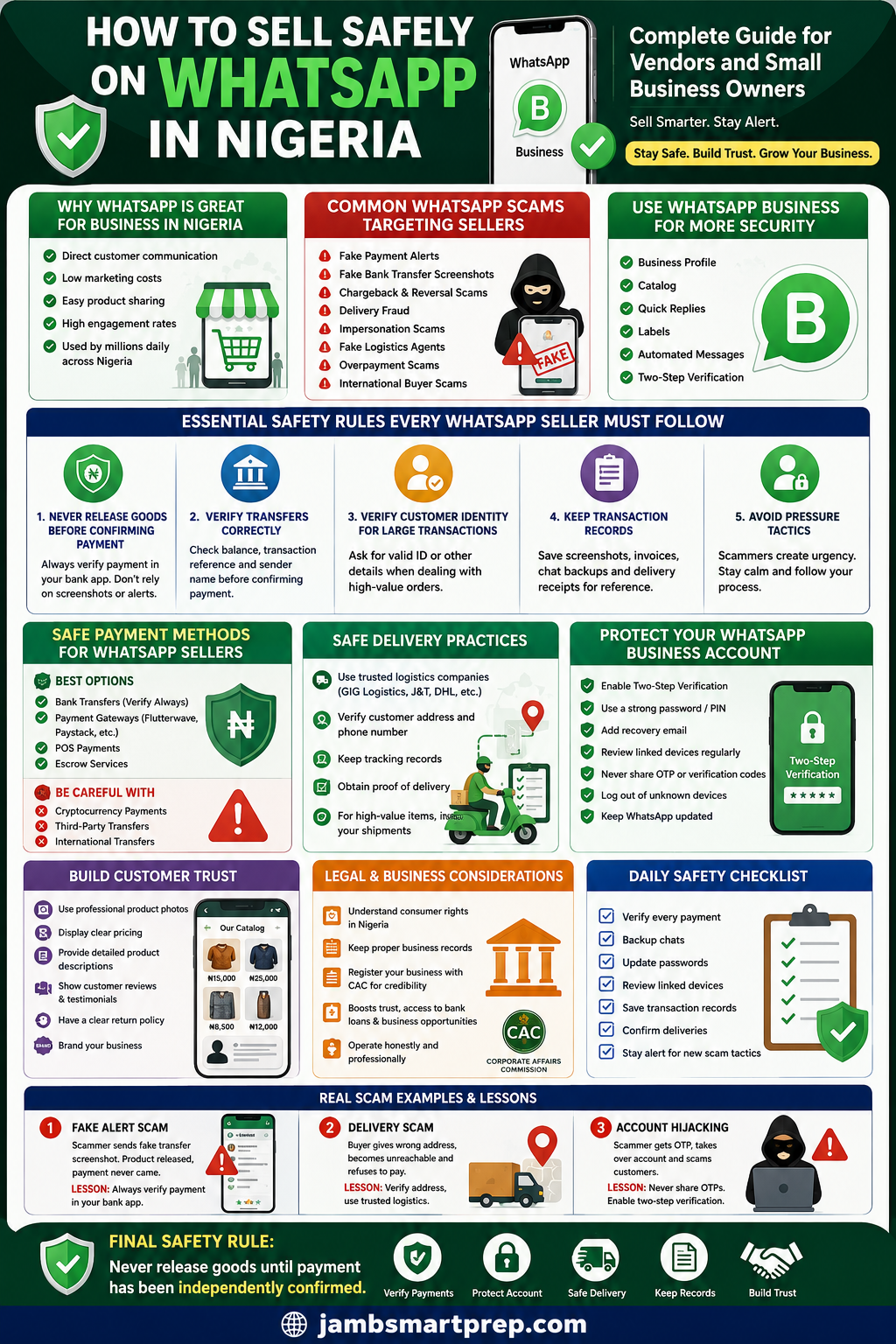
WhatsApp Selling Safety Checklist
Successful vendors follow consistent security routines.
A daily checklist can prevent costly mistakes.
Daily Checklist for Vendors
Verify Payments
☐ Confirm every transfer independently
☐ Check transaction references
☐ Review account balance
Backup Chats
☐ Enable automatic backups
☐ Secure important conversations
Update Passwords
☐ Review security settings
☐ Strengthen passwords when necessary
Review Linked Devices
☐ Remove unfamiliar devices
☐ Monitor account activity
Save Transaction Records
☐ Store invoices
☐ Save payment records
☐ Maintain delivery documentation
Confirm Deliveries
☐ Verify successful deliveries
☐ Obtain customer confirmation
☐ Update records
Businesses that consistently follow these habits are less likely to become victims of fraud or operational mistakes.
Frequently Asked Questions (FAQs)
One of the best ways to improve safe online selling in Nigeria is by learning from the experiences of other vendors. Below are answers to some of the most common questions Nigerian business owners ask about selling on WhatsApp.
Is WhatsApp Safe for Selling in Nigeria?
Yes, WhatsApp can be very safe for selling in Nigeria when used correctly.
Thousands of Nigerian entrepreneurs successfully run profitable businesses through WhatsApp every day. From clothing vendors and gadget dealers to food businesses and digital service providers, WhatsApp has become a major sales channel.
However, WhatsApp itself does not guarantee protection against fraud.
Your safety depends largely on:
- Verifying payments properly
- Protecting your account
- Using trusted delivery methods
- Keeping transaction records
- Avoiding common scam tactics
When these measures are followed, WhatsApp can be one of the most effective platforms for online business.
How Do I Know If a WhatsApp Payment Alert Is Fake?
Fake alerts remain one of the biggest threats facing Nigerian vendors.
A payment alert may be fake if:
- It only exists as a screenshot
- Your account balance has not changed
- The transaction reference cannot be verified
- The sender is pressuring you to release goods immediately
- The alert contains formatting errors
The safest approach is simple:
Never rely on screenshots.
Always verify transactions directly through:
- Your banking app
- Internet banking
- Official bank notifications
- Customer service verification
What Should I Do If a Buyer Sends a Fake Transfer Receipt?
If you suspect that a payment receipt is fake:
Step 1: Do Not Release the Product
No matter how convincing the buyer sounds, do not release goods until payment is confirmed.
Step 2: Verify Independently
Check:
- Your account balance
- Transaction history
- Payment reference number
Step 3: Save Evidence
Keep:
- Chat screenshots
- Transfer receipts
- Phone numbers
- Customer details
Step 4: Block Suspicious Users
If fraud is confirmed, block the individual and report the account.
Step 5: Warn Staff Members
If you operate with employees or dispatch personnel, inform them immediately to prevent accidental product release.
Can I Report WhatsApp Scammers in Nigeria?
Yes.
Victims of online fraud can report incidents to relevant authorities.
Potential reporting channels include:
- Your bank’s fraud department
- Law enforcement agencies
- Relevant cybercrime units
- WhatsApp’s reporting feature
When making a report, provide:
- Screenshots
- Phone numbers
- Payment details
- Transaction records
- Delivery information
The more evidence you provide, the stronger your case becomes.
What Is the Safest Payment Method for WhatsApp Transactions?
For most Nigerian businesses, verified bank transfers remain one of the safest payment options.
Other secure options include:
- Payment gateways
- Escrow services
- POS payments
- Verified business payment links
The key factor is not necessarily the payment method itself but proper verification.
Even legitimate payment systems can be abused if vendors fail to verify transactions independently.
How Can I Protect My WhatsApp Business Account From Hackers?
One of the most important WhatsApp business security tips is adopting multiple layers of protection.
Recommended security measures include:
Enable Two-Step Verification
This adds an additional security PIN to your account.
Add a Recovery Email
A recovery email improves account recovery options.
Use Device Locks
Enable:
- Fingerprint authentication
- Face recognition
- Strong passwords
Monitor Linked Devices
Review connected devices regularly.
Remove anything unfamiliar immediately.
Never Share OTPs
No legitimate WhatsApp representative will request your OTP code.
Anyone asking for it is almost certainly a scammer.
Should I Meet WhatsApp Buyers in Person?
Sometimes physical meetings are necessary, especially for expensive products.
However, certain precautions should always be followed.
Recommended Meeting Locations
Meet at:
- Shopping malls
- Bank premises
- Office complexes
- Busy public areas
Locations to Avoid
Avoid:
- Isolated roads
- Unfamiliar compounds
- Empty parking lots
- Remote residential areas
Additional Safety Tips
- Inform someone about the meeting.
- Meet during daytime.
- Verify payment before releasing goods.
- Bring a colleague when handling high-value transactions.
Personal safety should always come before making a sale.
How Do Successful WhatsApp Vendors Avoid Scams?
Experienced vendors usually follow strict business procedures.
Common habits include:
- Verifying every payment
- Using WhatsApp Business
- Keeping detailed records
- Working with trusted logistics companies
- Backing up chats regularly
- Enabling two-factor authentication
- Refusing to rush transactions
The most successful sellers understand that protecting their business is just as important as generating sales.
Expert Recommendations for Safe Online Selling in Nigeria
After examining common scams, payment methods, delivery procedures, and account security measures, several best practices consistently stand out.
If you remember only a few lessons from this guide, make them these:
Create Written Business Policies
Every vendor should establish clear policies regarding:
- Payment verification
- Delivery timelines
- Refund requests
- Product exchanges
Written policies reduce confusion and protect your business.
Separate Personal and Business Activities
Using WhatsApp Business instead of a personal account creates a more professional structure.
It also improves organization and customer management.
Invest in Business Reputation
Trust remains one of the most valuable assets in online commerce.
Focus on:
- Honest communication
- Product quality
- Customer satisfaction
- Consistent service
A strong reputation often becomes your best marketing tool.
Stay Updated on New Scam Trends
Fraud tactics evolve constantly.
Follow:
- Banking security updates
- Cybersecurity news
- Business communities
- E-commerce forums
Awareness is one of the strongest defenses against fraud.
Treat Every Transaction Professionally
Whether you are selling a ₦5,000 fashion item or a ₦1 million gadget, maintain the same verification procedures.
Many scammers specifically target vendors who become careless during small transactions.
Conclusion
Selling on WhatsApp has created tremendous opportunities for entrepreneurs across Nigeria.
Today, thousands of vendors use WhatsApp Business to reach customers, promote products, process orders, and build successful businesses without needing expensive websites or physical stores.
However, the same platform that creates opportunities also attracts fraudsters.
Understanding how to sell safely on WhatsApp in Nigeria is no longer optional. It is an essential business skill.
From fake payment alerts and delivery scams to account hacking and impersonation fraud, sellers face numerous risks that can lead to financial losses if proper precautions are not taken.
Fortunately, most of these threats can be prevented by following proven safety practices.
Key Takeaways
Before ending this guide, remember these important principles:
Verify Every Payment Independently
Never release products based solely on screenshots or customer assurances.
Always confirm payments through official banking channels.
Protect Your WhatsApp Account With Security Features
Enable:
- Two-step verification
- Device locks
- Recovery email options
Strong account security reduces the risk of hacking.
Use Trusted Delivery Methods
Reliable logistics partners help protect your products and provide valuable delivery records.
Maintain Detailed Transaction Records
Keep:
- Invoices
- Screenshots
- Delivery receipts
- Payment confirmations
Documentation can protect you during disputes.
Build Customer Trust While Staying Alert
Professional branding, transparent pricing, customer reviews, and excellent service help attract genuine buyers.
At the same time, remain cautious and follow your security procedures consistently.
Now Over To Know
Have you ever experienced a WhatsApp scam as a buyer or seller in Nigeria?
What lessons did you learn from the experience?
Share your story in the comments to help other entrepreneurs stay safe.
If you found this guide useful, consider bookmarking it and sharing it with fellow business owners, students running side hustles, online vendors, and anyone interested in safe online selling in Nigeria.
The more people understand how to avoid WhatsApp scams, the safer Nigeria’s digital marketplace becomes for everyone.
