
Welcome to JambSmartPrep.com. In this guide, you will learn how to verify a NECO result online, confirm certificate authenticity, avoid fake results, and complete NECO result verification successfully.
Interestingly, verifying a NECO result has become an essential step for many Nigerian students and graduates. Whether you are applying for admission into a university, seeking employment, applying for a scholarship, or planning to study abroad, organizations increasingly want to confirm that your examination result is genuine before making a final decision.
Over the past decade, the demand for authenticated academic credentials has increased due to the growing number of altered and fake examination results. Universities, employers, government agencies, and foreign institutions now rely on official verification processes to protect the integrity of admissions and recruitment.
Many candidates mistakenly believe that checking a result online is the same as verifying it. These are actually two different processes. Checking a NECO result simply allows a candidate to view their grades, while NECO result verification confirms that those grades genuinely belong to the candidate and exist in the official NECO database.
Understanding this difference can save applicants from unnecessary delays during admission screening, scholarship applications, employment background checks, or immigration procedures.
This comprehensive NECO Result Verification Guide explains everything you need to know, including:
- What NECO result verification means
- Why verification is important
- Who can verify a NECO result
- NECO result verification requirements
- Various verification methods
- Step-by-step online verification procedures
- Common verification mistakes
- Solutions to verification problems
- Frequently asked questions
Whether you are a student, parent, school administrator, employer, scholarship organization, or international institution, this guide will help you understand the complete NECO verification process.
What Is NECO Result Verification?
NECO result verification is the official process of confirming that a candidate’s examination record is authentic and matches the records maintained by the National Examinations Council (NECO).
Unlike simply checking examination grades, verification confirms that the result presented by a candidate has not been altered or forged.
During verification, the relevant information is compared with official NECO records to establish its authenticity.
Result Checking vs Result Verification
Many students confuse these two services.
NECO Result Checking
Result checking allows candidates to:
- View examination grades
- Confirm subject performance
- Print or save result information
- Know whether they passed the examination
This service is mainly for candidates.
NECO Result Verification
Result verification is different.
It is designed to:
- Confirm authenticity
- Validate examination records
- Detect fake results
- Support institutional screening
- Assist employers during recruitment
Verification is commonly requested by organizations rather than individual candidates.
When Is NECO Result Verification Required?
Verification may be required in several situations, including:
- University admission
- Polytechnic admission
- College of Education admission
- Direct Entry screening
- Scholarship applications
- Civil service recruitment
- Banking jobs
- Military recruitment
- Immigration applications
- Foreign university admission
- Professional licensing
For example, a university admission office may verify an applicant’s NECO result before offering admission, while an employer may verify the same result during recruitment.
Why NECO Result Verification Is Important
Verification protects both candidates and institutions.
It ensures that academic qualifications presented by applicants are genuine and issued by NECO.
Below are some of the major reasons why verification has become increasingly important.
Prevents Certificate Fraud
Unfortunately, fake examination certificates continue to appear in various sectors.
Verification helps institutions detect:
- Forged certificates
- Altered grades
- Fake candidate information
- Fraudulent academic claims
This protects the credibility of Nigeria’s educational system.
Confirms Result Authenticity
Verification assures institutions that the examination result belongs to the candidate presenting it.
This builds trust during:
- Admissions
- Recruitment
- Scholarship selection
- Academic evaluation
Required for University Admissions
Many tertiary institutions conduct their own admission screening exercises.
During this process, they compare applicants’ O’Level results with official records.
If inconsistencies are found, candidates may be required to provide additional documentation before admission can proceed.
Employment Verification
Employers increasingly verify academic qualifications before hiring new staff.
This is common in:
- Banks
- Government ministries
- Oil and gas companies
- Telecommunications firms
- Manufacturing companies
- Educational institutions
Graduate recruitment programmes often include academic credential verification as part of background checks.
Scholarship Screening
Scholarship providers invest significant resources in successful applicants.
To protect these investments, they often verify academic records before awarding scholarships.
Examples include:
- Federal Government scholarships
- State government scholarships
- Petroleum Trust Development Fund (PTDF) scholarships
- International scholarship programmes
- Private educational foundations
Verification helps ensure that awards are given to qualified candidates.
International Study Applications
Students applying abroad may be asked to submit verified academic credentials.
Foreign universities often request confirmation that:
- The examination was officially conducted.
- The candidate genuinely obtained the stated grades.
- The certificate is authentic.
This is especially common for applicants seeking admission into undergraduate or postgraduate programmes overseas.
Who Can Verify a NECO Result?
Although candidates may request verification for personal purposes, several organizations regularly verify NECO results as part of their official procedures.
Individual Candidates
Students sometimes verify their own results before:
- Applying for admission
- Applying for scholarships
- Applying for employment
- Traveling abroad
Personal verification also helps candidates detect any discrepancies early.
Universities
Universities verify NECO results during:
- Post-UTME screening
- Admission processing
- Direct Entry applications
- Academic record verification
This helps maintain admission integrity.
Polytechnics
Federal, state, and private polytechnics also verify O’Level qualifications before offering admission.
Colleges of Education
Teacher training institutions rely on authentic examination records before admitting students into various education programmes.
Employers
Many employers verify applicants’ qualifications before employment.
Examples include:
- Commercial banks
- Insurance companies
- Government agencies
- Hospitals
- Schools
- Manufacturing firms
Academic verification has become a standard part of modern recruitment.
Government Agencies
Government organizations may verify examination records during:
- Civil service recruitment
- Public sector employment
- Security agency recruitment
- Professional registration
Verification helps maintain transparency in public service recruitment.
Scholarship Organizations
Both local and international scholarship providers often verify applicants’ academic credentials before making final selections.
Foreign Institutions
International universities, credential evaluation agencies, and immigration authorities may also request official verification when Nigerian applicants submit NECO qualifications.
NECO Result Verification Requirements
Before beginning the verification process, candidates or requesting institutions should gather the necessary information.
Having complete and accurate details helps avoid delays.
The commonly required information includes:
- Examination Number
- Examination Year
- Examination Type (SSCE Internal, SSCE External, BECE, etc.)
- Candidate’s Full Name
- Result Checker Token (where applicable for result access)
- Valid Means of Identification (when required)
- Authorization Letter (if verification is requested on behalf of another person)
NECO Result Verification Checklist
Before submitting a verification request, ensure you have:
- ✅ Correct examination number
- ✅ Correct examination year
- ✅ Correct examination type
- ✅ Candidate’s full official name
- ✅ Supporting identification (where required)
- ✅ Authorization documents (if acting on another person’s behalf)
- ✅ Stable internet connection for online verification
- ✅ Printed copies of relevant examination records for reference
Preparing these documents in advance will make the verification process smoother and reduce the chances of errors.
Methods of Verifying a NECO Result
There are several ways to verify a NECO result depending on the purpose of the verification and the organization requesting it.
Some methods are suitable for individual candidates, while others are commonly used by universities, employers, and government agencies.
The main methods include:
- Online NECO result verification via https://everify.neco.gov.ng/
- Verification through a NECO office
- Verification through educational institutions
- Employer verification procedures
- Third-party verification for international organizations
Each method serves a different purpose and may require different supporting documents.
In the next section, we will explain each verification method in detail and provide a complete step-by-step guide to verifying your NECO result successfully.
Methods of Verifying a NECO Result
There are several official ways to complete NECO result verification, depending on who is requesting the verification and the purpose for which it is needed. A student verifying a result for personal records may use a different approach from an employer conducting a background check or a university confirming an applicant’s credentials.
Regardless of the method used, always rely on official NECO channels or recognized institutional procedures. This helps ensure that the verification is valid and accepted.
Method 1: Online NECO Result Verification
Online verification is one of the most convenient methods for confirming the authenticity of a NECO result. It allows candidates and authorized institutions to verify examination records without visiting a physical office.
This method is commonly used for:
- University admission
- Scholarship applications
- Employment screening
- Personal verification
- Academic record confirmation
Information You Will Need
Before starting the verification process, ensure you have:
- Examination number
- Examination year
- Examination type (SSCE Internal, SSCE External, BECE, etc.)
- Candidate’s full name
- Any additional details requested by the official verification platform
Advantages of Online Verification
- Faster processing
- Convenient access from any location
- Reduces paperwork
- Suitable for institutions and individuals
- Easy to print or save confirmation records where available
Method 2: Verification Through a NECO Office
Some verification requests require physical processing through a NECO office, especially where official documents or additional authentication are needed.
Candidates or institutions may visit the appropriate NECO office with the necessary documents.
Typical requirements include:
- Examination details
- Means of identification
- Supporting documents
- Verification request information
Processing time may vary depending on the type of request.
This option is often useful for complex verification cases or situations that require official clarification.
Method 3: Verification Through Educational Institutions
Many Nigerian universities, polytechnics, and colleges verify candidates’ NECO results during admission screening.
This usually occurs during:
- Post-UTME screening
- Direct Entry admission
- Departmental screening
- Final admission verification
Candidates are generally required to provide accurate examination details so the institution can complete its verification process.
Institutions rely on official records to ensure applicants meet admission requirements.
Method 4: Employer Verification
Employers increasingly verify academic qualifications before offering employment.
This is particularly common in sectors such as:
- Banking
- Telecommunications
- Government ministries
- Oil and gas
- Aviation
- Education
- Healthcare
Human Resource departments may request official confirmation that an applicant’s NECO result is authentic before finalizing recruitment.
Verification protects employers from credential fraud and helps ensure fairness during recruitment.
Method 5: Third-Party Verification Requests
Some organizations outside Nigeria also request official verification of NECO results.
Examples include:
- Foreign universities
- Credential evaluation agencies
- Immigration authorities
- International employers
- Professional licensing bodies
These organizations may require confirmation directly from official sources before recognizing Nigerian academic qualifications.
Step-by-Step Guide to Verifying Your NECO Result Online
If you are wondering, “How do I verify my NECO result online?”, the following guide outlines the general process.
Always ensure you are using official NECO services or approved verification procedures.
Step 1: Gather Your Examination Information
Before beginning, prepare the following:
- Examination number
- Examination year
- Examination type
- Candidate’s official name
Having accurate information reduces the chance of verification errors.
Step 2: Access the Official Verification Platform
Use the official NECO verification service or the authorized verification process applicable to your institution or organization.
Avoid unofficial websites that promise instant verification without proper authorization.
Step 3: Enter Your Examination Number
Carefully type your examination number exactly as it appears on your registration documents or result.
Even a single incorrect digit can prevent successful verification.
Step 4: Select the Examination Year
Choose the correct year in which you sat for the examination.
Candidates occasionally select the wrong year, especially if they have written multiple examinations.
Always double-check this information.
Step 5: Select the Correct Examination Type
Choose the correct examination category.
Examples include:
- SSCE Internal
- SSCE External
- BECE
- NCEE
Selecting the wrong examination type may prevent the system from locating your records.
Step 6: Complete the Verification Request
Review all information before proceeding.
Ensure:
- Name matches official records.
- Examination number is correct.
- Year is correct.
- Examination type is accurate.
Step 7: Review the Verification Result
If the verification is successful, carefully review the information displayed.
Check:
- Candidate name
- Examination details
- Subjects
- Grades (where applicable)
- Authentication status
Report any discrepancies immediately through the appropriate official channel.
Step 8: Save or Print the Verification Record
Where available, save or print the verification confirmation.
Keeping a copy can be useful for:
- University admission
- Employment
- Scholarship applications
- Future academic reference
Digital backups are also recommended.
Common Reasons Why NECO Result Verification Fails
Occasionally, verification requests may not produce the expected result.
This does not always mean the examination result is invalid.
Many verification failures occur because of simple errors during data entry.
1. Wrong Examination Number
Entering an incorrect examination number is the most common reason verification fails.
Common mistakes include:
- Missing digits
- Swapped numbers
- Typographical errors
Always compare the number with your original registration slip or result before submitting.
Solution
Verify the examination number carefully before trying again.
2. Wrong Examination Year
Selecting the wrong examination year can also prevent successful verification.
For example, choosing 2023 instead of 2022 will produce incorrect search results.
Solution
Confirm the examination year from your official records.
3. Incorrect Candidate Information
Differences in names or other personal details may affect verification.
Examples include:
- Misspelled surname
- Incorrect first name
- Wrong middle name
Solution
Ensure your information matches your official NECO records exactly.
4. Invalid Verification Details
Using incomplete or incorrect information may prevent verification.
Examples include:
- Incorrect examination type
- Missing required information
- Invalid candidate details
Solution
Review every field carefully before submitting.
5. Network or System Issues
Temporary technical problems may interrupt verification.
Possible causes include:
- Poor internet connection
- Temporary server maintenance
- Browser issues
Solution
Wait a short time and try again using a stable internet connection.
6. Attempting Verification Before Results Are Officially Available
Verification cannot be completed if examination results have not yet been officially released or uploaded.
Solution
Confirm that the examination results have been officially published before attempting verification.
7. Fake or Altered Certificates
Where a certificate has been altered or is not genuine, verification may fail because the information does not correspond with official NECO records.
This is one of the primary reasons employers and educational institutions insist on official verification.
Difference Between Result Checking and Result Verification
Many people use these terms interchangeably, but they serve different purposes.
| Result Checking | Result Verification |
|---|---|
| Used to view examination grades | Used to confirm authenticity of records |
| Mainly for candidates | Mainly for institutions and employers |
| Helps candidates know their performance | Confirms that the result is genuine |
| May involve a result checker token | Uses official verification procedures |
| Displays examination grades | Confirms official examination records |
Understanding this difference helps candidates know which service they need.
If you simply want to see your grades, result checking is appropriate.
If a university, employer, scholarship board, or government agency wants to confirm that your result is genuine, NECO result verification is the correct process.
NECO Result Verification for University Admission
One of the most common reasons candidates verify their NECO results is for admission into higher institutions.
During admission screening, institutions must ensure that applicants genuinely possess the O’Level qualifications they claim.
Verification may occur during:
- JAMB admission processing
- Post-UTME screening
- Direct Entry admission
- Departmental clearance
- Final registration after admission
For example, a candidate applying to study Nursing may present NECO results showing credits in English Language, Mathematics, Biology, Chemistry, and Physics. Before confirming admission, the institution may verify that these results match the official records.
Using authentic and accurate examination records helps prevent admission delays and ensures a smooth screening process.
NECO Result Verification for Scholarships
Scholarship providers invest significant financial resources in students, so they must ensure that every applicant meets the stated academic requirements. This is one reason why NECO result verification is often included in the scholarship screening process.
Whether you are applying for a government-funded scholarship or an international award, presenting a genuine and verifiable NECO result strengthens your application and reduces the chances of delays during document screening.
Scholarship organizations that may verify academic results include:
- Federal Government Scholarship Board (FSB)
- State Government Scholarship Boards
- Petroleum Technology Development Fund (PTDF)
- Nigeria LNG (NLNG) Scholarship Scheme
- MTN Foundation Scholarship
- Agbami Scholarship
- NNPC Joint Venture Scholarship Programmes
- International scholarship providers
- Private educational foundations
Why Scholarship Providers Verify Results
Verification helps scholarship organizations to:
- Confirm that applicants meet academic requirements.
- Detect forged or altered certificates.
- Ensure fairness during the selection process.
- Maintain the credibility of scholarship programmes.
For example, a student applying for an engineering scholarship may be required to present credits in Mathematics, English Language, Physics, Chemistry, and Further Mathematics (where applicable). The scholarship board may verify these grades before awarding the scholarship.
NECO Result Verification for Employment
Academic verification has become a standard part of recruitment in both the public and private sectors.
Many employers no longer rely solely on printed certificates. Instead, they verify examination records to confirm that applicants possess the qualifications listed on their CVs.
Employers That Commonly Verify NECO Results
Verification is common during recruitment by:
- Federal Government agencies
- State Civil Service Commissions
- Commercial banks
- Insurance companies
- Oil and gas firms
- Telecommunications companies
- Hospitals
- Schools
- Manufacturing companies
- International organizations
Why Employers Verify Academic Records
Employers use verification to:
- Confirm educational qualifications.
- Reduce recruitment fraud.
- Protect organizational integrity.
- Ensure applicants meet minimum educational requirements.
For example, a bank recruiting graduate trainees may verify an applicant’s NECO result alongside university credentials before issuing an employment offer.
Likewise, government agencies often include academic verification as part of their background screening process.
NECO Certificate Verification
Many people use the terms result verification and certificate verification interchangeably, but they are not exactly the same.
Although both involve confirming academic records, they serve different purposes.
What Is NECO Certificate Verification?
Certificate verification focuses specifically on confirming that the physical NECO certificate issued to a candidate is genuine and matches official records.
This process may be required years after a candidate has completed secondary school.
Difference Between Result Verification and Certificate Verification
| Result Verification | Certificate Verification |
|---|---|
| Confirms examination results | Confirms authenticity of the physical certificate |
| Often used shortly after examinations | Commonly used years later |
| Frequently required during admissions | Frequently required during employment or international applications |
| Focuses on examination records | Focuses on the issued certificate and records |
Both processes rely on official NECO records and should only be carried out through authorized channels.
How to Identify Fake NECO Results
With advancements in digital editing tools, forged examination results have become more sophisticated. However, there are still several warning signs that institutions, employers, and candidates should watch for.
1. Incorrect Candidate Information
Fake results often contain inconsistencies such as:
- Misspelled names
- Incorrect examination numbers
- Wrong examination year
- Mismatched personal details
Always compare the result with official documents like the registration slip or certificate.
2. Altered Grades
Some forged results show grades that have been manually changed.
For example:
- A “C6” altered to an “A1”
- An “F9” changed to a “B3”
Such alterations may appear convincing at first glance but can be detected during official verification.
3. Suspicious Formatting
Look out for:
- Poor print quality
- Misaligned text
- Inconsistent fonts
- Missing security features
- Unusual spacing
Official NECO documents follow a consistent format.
4. Missing Official Records
If the candidate’s details cannot be matched with official NECO records, this is a strong indication that further investigation is required.
5. Inconsistent Examination Details
Warning signs include:
- Wrong examination type
- Incorrect centre information
- Invalid examination number format
- Candidate information that differs from official records
Advice for Employers and Institutions
To avoid accepting fraudulent qualifications:
- Request official verification where necessary.
- Compare submitted documents carefully.
- Avoid relying solely on printed copies.
- Follow official verification procedures for high-stakes decisions.
Common Mistakes During NECO Result Verification
Verification problems are often caused by simple errors rather than system failures.
Below are some of the mistakes candidates and institutions frequently make.
Typing the Wrong Examination Number
One incorrect digit can prevent successful verification.
Always copy the examination number directly from your registration slip, result printout, or certificate.
Selecting the Wrong Examination Year
Candidates who sat for multiple examinations sometimes choose the wrong year.
Double-check your examination year before submitting a verification request.
Choosing the Wrong Examination Type
Selecting SSCE Internal instead of SSCE External (or vice versa) may prevent the system from locating your records.
Always confirm the correct examination category.
Using Incorrect Candidate Information
Verification may fail if:
- Names are misspelled.
- Middle names are omitted.
- Candidate information differs from official records.
Consistency across all academic documents is important.
Using Unofficial Websites
Some websites claim to provide instant verification services without any connection to NECO.
These unofficial services may provide inaccurate information or expose your personal data.
Always use official channels.
What to Do If Your NECO Result Cannot Be Verified
A failed verification does not automatically mean your result is invalid.
Several factors may cause verification to fail, and many can be resolved with the right approach.
Step 1: Review Your Information
Check:
- Examination number
- Examination year
- Examination type
- Candidate name
Correct any errors before trying again.
Step 2: Compare With Your Registration Records
Review your:
- Registration slip
- Examination photo card
- Result printout
- Certificate (if issued)
These documents often help identify mistakes.
Step 3: Contact Your School
If you were a school candidate, your examination officer may be able to assist in confirming your registration details.
Step 4: Contact NECO
Where necessary, contact the appropriate NECO office for guidance on resolving verification issues.
Provide all relevant supporting documents when making enquiries.
Step 5: Request Official Assistance
If verification is required urgently for:
- Admission
- Employment
- Scholarship
- Immigration
Follow the official procedures recommended by NECO or the requesting institution.
Avoid paying unofficial agents who claim they can “fix” verification problems.
Expert Tips for Successful NECO Result Verification
Following these practical tips can help ensure a smooth verification process.
1. Keep All Examination Documents Safe
Retain:
- Registration slip
- Examination photo card
- Result printout
- Certificate
- Payment receipts
These documents may be required during future verification.
2. Save Digital Copies
Scan your important documents and save them:
- On your computer
- In cloud storage
- On a secure flash drive
- In your email account
Digital backups protect you against loss or damage.
3. Use Official Verification Channels
Only use authorized NECO verification procedures.
This helps ensure your verification request is accepted by universities, employers, and scholarship providers.
4. Verify Every Detail Carefully
Before submitting any request, confirm that:
- Examination number is correct.
- Year is correct.
- Examination type matches your records.
- Candidate name is accurate.
5. Protect Your Examination Number
Avoid sharing sensitive examination information with unauthorized individuals.
Protecting your personal records reduces the risk of fraud.
Real-Life Verification Scenarios
Case Study 1: University Admission Verification
A student applying for admission into a federal university was asked to present NECO results during Post-UTME screening.
The admission office compared the submitted examination details with official records before issuing an admission offer.
Because the student’s information was accurate, the verification process was completed without delay.
Case Study 2: Employer Background Check
A graduate applying for a graduate trainee position listed NECO qualifications on the application form.
During the recruitment process, the employer verified the academic records as part of routine background screening before confirming employment.
Case Study 3: Scholarship Application Verification
A scholarship applicant met all academic requirements on paper.
Before announcing successful candidates, the scholarship organization verified the applicant’s examination records to confirm their authenticity.
The successful verification strengthened the candidate’s application and allowed the award process to proceed smoothly.
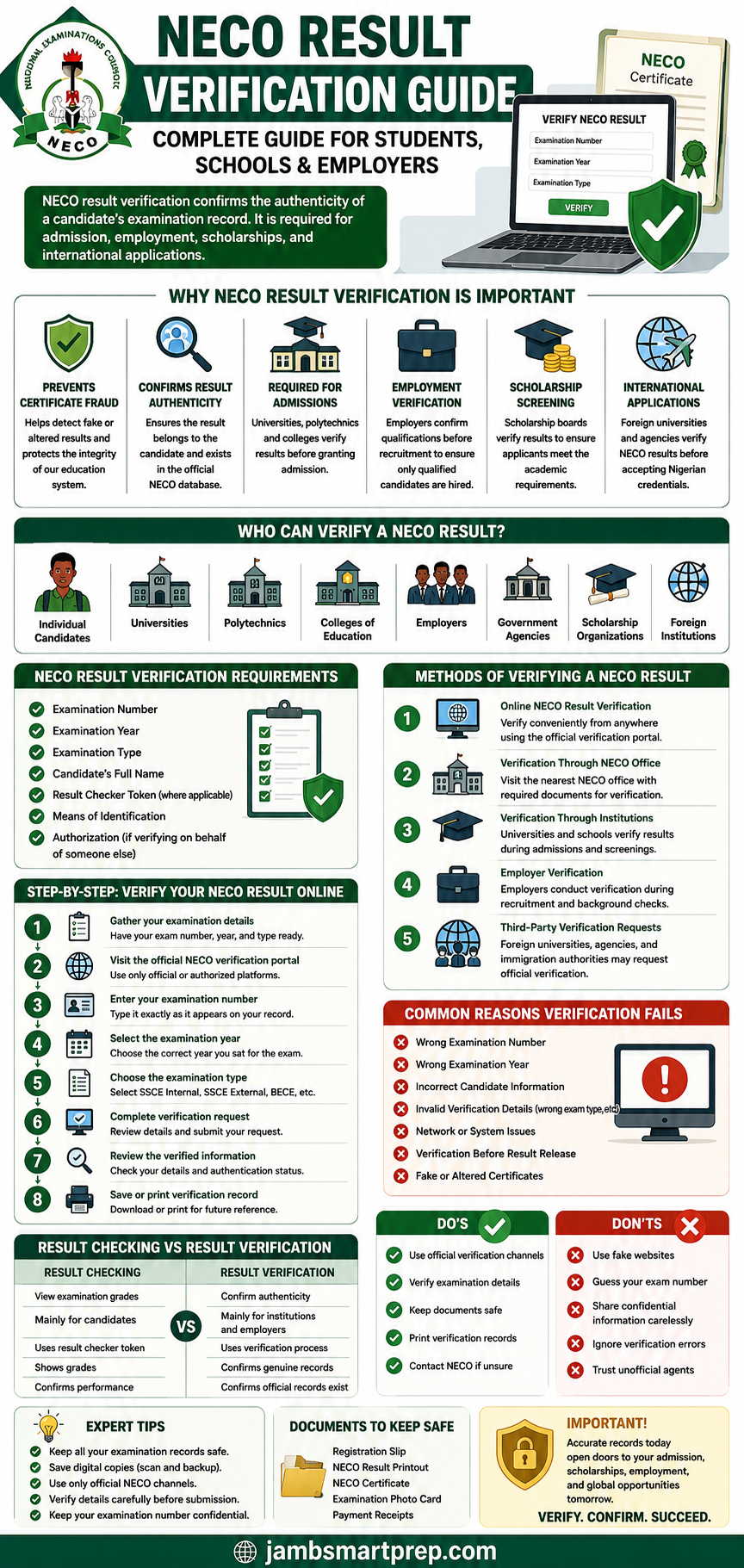
NECO Result Verification Guide (Complete Guide for Students, Schools & Employers)
Verify Your NECO Result in 8 Easy Steps
1️⃣ Gather your examination details
⬇️
2️⃣ Confirm your examination number
⬇️
3️⃣ Select the correct examination year
⬇️
4️⃣ Choose the correct examination type
⬇️
5️⃣ Use the official NECO verification process
⬇️
6️⃣ Review the verified information carefully
⬇️
7️⃣ Save or print your verification record
⬇️
8️⃣ Keep all examination documents secure
Quick Verification Tips
- ✅ Use only official verification channels
- ✅ Double-check every examination detail
- ✅ Keep digital and printed copies of your records
- ✅ Report any discrepancies promptly
- ✅ Store your certificate safely
Common Verification Errors
- Wrong examination number
- Incorrect examination year
- Wrong examination type
- Candidate information mismatch
- Typing errors
- Using unofficial verification websites
NECO Result Verification Do’s and Don’ts
Following the right verification practices can save you time and prevent unnecessary complications. The table below summarizes the most important things every candidate, school, employer, or scholarship provider should remember.
| Do | Don’t |
|---|---|
| Use official NECO verification channels | Use unofficial or fake verification websites |
| Verify your examination number before submission | Guess or enter the wrong examination number |
| Keep your registration slip and certificate safe | Throw away important examination documents |
| Save printed and digital copies of your records | Depend on a single printed copy |
| Review every verification detail carefully | Ignore errors or mismatched information |
| Contact NECO if you encounter verification issues | Pay unauthorized agents to “fix” verification problems |
| Use accurate personal information | Enter names that differ from your official records |
| Keep your examination details confidential | Share sensitive information carelessly |
Following these simple guidelines will help ensure a smooth verification process and reduce the risk of delays.
Frequently Asked Questions (FAQ)
How Do I Verify My NECO Result?
You can verify your NECO result by using the official NECO verification process and providing the correct examination details, including your examination number, examination year, and examination type.
Always ensure that the information entered matches your official NECO records.
Can I Verify My NECO Result Online?
Yes. Online verification is one of the most convenient ways to verify a NECO result.
Ensure you use the official verification platform or the verification procedure accepted by the requesting institution.
Is NECO Result Verification Free?
Verification requirements and any applicable fees may vary depending on the service being requested and the official procedures in place at the time.
Candidates should confirm current requirements through official NECO channels before beginning the process.
What Documents Are Required for NECO Result Verification?
Commonly required documents and information include:
- Examination number
- Examination year
- Examination type
- Candidate’s full name
- Valid means of identification (where applicable)
- Supporting documents if additional verification is required
Some institutions may request additional documentation depending on the purpose of the verification.
How Long Does NECO Result Verification Take?
Processing time varies depending on:
- The verification method used
- The nature of the request
- The volume of applications
- Whether additional verification is required
Simple online verification may be completed more quickly than requests requiring manual review.
Can Employers Verify My NECO Result?
Yes.
Many employers verify applicants’ academic qualifications during recruitment to confirm that the information provided is genuine.
This practice has become increasingly common across both public and private organizations.
Can Universities Verify My NECO Result?
Yes.
Universities frequently verify NECO results during:
- JAMB admission processing
- Post-UTME screening
- Direct Entry admission
- Final registration
Verification helps institutions ensure that admitted candidates meet academic requirements.
What If My NECO Result Cannot Be Verified?
If verification fails:
- Check your examination details carefully.
- Review your registration documents.
- Contact your school if you registered through a school.
- Contact the appropriate NECO office for guidance.
- Follow the official procedure to resolve any discrepancies.
Avoid making assumptions until you have confirmed the cause of the issue.
Is Checking a Result the Same as Verification?
No.
Result checking allows candidates to view their examination grades.
Result verification confirms that those grades are authentic and match official NECO records.
These are two separate services with different purposes.
Can Someone Verify My Result on My Behalf?
Yes, in certain situations.
However, the person requesting verification may be required to provide proper authorization and any supporting documents required under the applicable verification procedure.
Related NECO Guides
To better understand the NECO examination process, you may also find these guides helpful:
- How to Check NECO Result Online
- How to Buy a Genuine NECO Result Checker Token
- How to Recover a Lost NECO Examination Number
- Common NECO Registration Mistakes (And How to Avoid Them)
- How to Print Your NECO Result
- How to Correct Errors on Your NECO Result
- NECO Registration Requirements
- NECO Certificate Collection Guide
These related resources provide practical guidance on registration, result checking, corrections, certificate collection, and examination preparation.
Quick Verification Checklist
Before starting your NECO result verification, confirm that you have the following:
Candidate Information
- ✅ Correct examination number
- ✅ Correct examination year
- ✅ Correct examination type
- ✅ Correct spelling of your full name
Supporting Records
- ✅ Registration slip
- ✅ NECO result printout (if available)
- ✅ NECO certificate (if issued)
- ✅ Valid means of identification (where required)
Verification Preparation
- ✅ Reliable internet connection
- ✅ Official verification platform or authorized institution
- ✅ Printed or digital copies of important documents
- ✅ Secure storage for your verification records
Keeping these items ready will make the verification process faster and more efficient.
Conclusion
Verifying your NECO result is more than an administrative step. It is an important way of confirming that your academic records are authentic and can be trusted by universities, employers, scholarship providers, and government agencies.
As the demand for verified educational credentials continues to grow, understanding the NECO Result Verification Guide is essential for every Nigerian student and graduate. Whether you are applying for admission through JAMB, seeking employment, pursuing a scholarship, or planning to study abroad, accurate and verifiable examination records can make the process smoother.
Throughout this guide, we have explained the difference between result checking and verification, the various verification methods, common reasons verification may fail, and practical steps to resolve challenges. We also discussed the importance of safeguarding your registration slip, examination number, certificate, and other relevant documents.
To avoid unnecessary delays, always ensure that the information you provide during verification matches your official NECO records exactly. Use only approved verification channels, keep both printed and digital copies of your documents, and report any discrepancies promptly through the appropriate official procedures.
Good record keeping today can save you considerable time and stress in the future. By staying organized and following the correct verification process, you will be better prepared whenever your academic credentials are required for admission, employment, scholarships, or professional opportunities.
NOW OVER TO YOU
Have you ever completed a NECO result verification for university admission, a scholarship application, or a job interview?
Did you encounter any challenges, or was the process straightforward?
Share your experience, questions, or helpful tips in the comments below. Your insights could help other candidates complete their verification successfully.
If you found this guide useful, consider sharing it with classmates, friends, and family members preparing for admission, employment, or scholarship opportunities. You can also explore our other NECO guides to learn more about result checking, registration, certificate collection, examination number recovery, and other essential topics that will help you throughout your academic journey.
