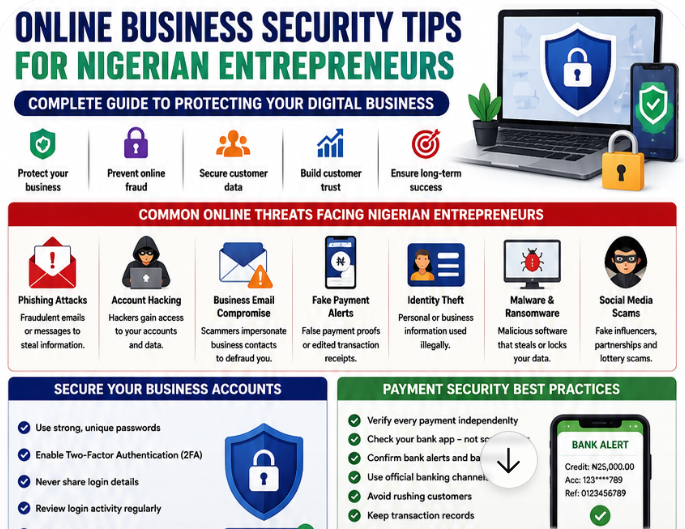
Nigeria’s digital economy has expanded rapidly over the last decade.
Today, thousands of entrepreneurs run businesses entirely online through websites, social media platforms, e-commerce stores, WhatsApp Business accounts, and digital marketplaces.
From fashion brands and gadget stores to online coaching businesses and freelance agencies, digital entrepreneurship has become one of the fastest-growing sectors in the country.
However, this growth has also attracted cybercriminals.
Business owners now face challenges such as:
- Account hacking
- Fake payment alerts
- Website attacks
- Identity theft
- Phishing scams
- Customer data breaches
- Business email fraud
Unfortunately, many entrepreneurs focus heavily on making sales while paying little attention to security.
The result is often financial loss, damaged reputation, and loss of customer trust.
This comprehensive guide will show you:
- How to protect your online business in Nigeria
- Cybersecurity tips for small businesses
- Online fraud prevention Nigeria strategies
- E-commerce security best practices
- How to secure customer information
- How to respond to cyberattacks
Whether you run a small side hustle or a growing online company, these security practices can help protect your digital assets.
Why Online Businesses Are Growing Rapidly in Nigeria
Several factors have contributed to the growth of online businesses.
Increased Internet Access
More Nigerians now have access to smartphones and affordable internet services.
This has expanded opportunities for:
- Online shopping
- Social commerce
- Digital marketing
- Remote work
Rise of Social Commerce
Platforms such as:
have made it easier for entrepreneurs to sell directly to customers.
Growth of Digital Payments
The increasing adoption of mobile banking and digital payment systems has simplified online transactions.
Also read: How to Sell Safely on WhatsApp in Nigeria: Complete Guide for Vendors and Small Business Owners
Lower Startup Costs
Many online businesses can be launched with significantly lower capital compared to traditional brick-and-mortar stores.
These opportunities are exciting, but they also create security challenges.
Why Business Security Is Essential for Long-Term Success
Many entrepreneurs assume cybercriminals only target large corporations.
That assumption is dangerous.
Small businesses are often targeted because:
- Security measures are weaker
- Owners lack cybersecurity training
- Monitoring systems are limited
A single security breach can result in:
- Financial loss
- Customer complaints
- Loss of trust
- Legal complications
- Business disruption
Protecting your business is no longer optional.
It is a necessity.
Understanding Online Security Risks for Nigerian Businesses
Before learning how to defend your business, you must understand the threats.
Why Online Businesses Are Prime Targets for Cybercriminals
Growth of E-Commerce and Social Selling
As more businesses move online, cybercriminals have more opportunities to exploit vulnerabilities.
Every transaction creates a potential target.
Increased Digital Transactions
The growing use of:
- Online banking
- Payment gateways
- Mobile wallets
creates opportunities for fraud.
Limited Cybersecurity Awareness
Many small business owners have never received cybersecurity training.
This makes them vulnerable to common attacks.
High Use of Mobile Devices
Most Nigerian entrepreneurs manage their businesses through smartphones.
While convenient, mobile devices can become security risks if not properly protected.
Common Online Threats Facing Nigerian Entrepreneurs
Phishing Attacks
Phishing remains one of the most common cyber threats.
A scammer sends a fake message designed to trick victims into revealing:
- Passwords
- Banking information
- Login credentials
These messages often appear legitimate.
Business Email Compromise
Business Email Compromise (BEC) occurs when attackers gain access to business email accounts.
They may:
- Request fraudulent payments
- Steal sensitive information
- Impersonate business owners
BEC attacks have caused significant losses worldwide.
Account Hacking
Hackers target:
- Social media accounts
- Email accounts
- Websites
- Payment platforms
Once access is gained, they can disrupt operations or scam customers.
Fake Payment Alerts
This is one of the most common forms of online fraud prevention Nigeria discussions.
Scammers create fake bank alerts or edited payment receipts to deceive sellers.
Many businesses lose products because they release orders before verifying payments.
Identity Theft
Fraudsters may steal:
- Business names
- Logos
- Customer information
- Personal details
These details are then used for fraudulent activities.
Customer Data Theft
Businesses often collect valuable customer information such as:
- Names
- Addresses
- Phone numbers
- Email addresses
Without proper protection, this data can be stolen.
Social Media Scams
Fraudsters frequently exploit:
- Instagram accounts
- Facebook pages
- WhatsApp Business profiles
Their goal is often to deceive customers or steal login credentials.
Malware and Ransomware Attacks
Malware refers to malicious software designed to damage systems.
Ransomware is particularly dangerous because it can lock business data and demand payment before access is restored.
Fake Vendor Scams
Some criminals create fake supplier accounts to deceive business owners.
Victims may:
- Pay for goods that never arrive
- Share sensitive information
- Expose financial data
Insider Threats
Not every threat comes from outside.
Employees or contractors with access to sensitive information can accidentally or intentionally create security risks.
How to Secure Your Online Business Accounts
Strong account security forms the foundation of cybersecurity for small businesses.
Without proper account protection, even the best business model can become vulnerable.
Why Strong Account Security Matters
Every business account is a potential entry point for attackers.
This includes:
- Email accounts
- Social media profiles
- Payment platforms
- Website administration panels
Risks of Weak Passwords
Weak passwords remain one of the biggest security problems.
Examples include:
- 123456
- password
- business123
- your name
These passwords can often be cracked within seconds.
Risks of Shared Credentials
Many businesses allow multiple people to use the same login details.
This creates accountability and security problems.
Each team member should ideally have separate access credentials.
Risks of Password Reuse
Using one password across multiple platforms is dangerous.
If one account is compromised, attackers may gain access to all related accounts.
Creating Strong Passwords
A strong password is one of the simplest yet most effective security measures.
Password Best Practices
Use passwords that contain:
- Uppercase letters
- Lowercase letters
- Numbers
- Special characters
Aim for at least 12 to 16 characters.
Common Password Mistakes
Avoid:
- Names
- Birthdates
- Phone numbers
- Business names
- Predictable patterns
Password Management Tools
Password managers help store and organize credentials securely.
Popular options include:
- Bitwarden
- 1Password
- LastPass
- Dashlane
These tools reduce the temptation to reuse passwords.
Enable Two-Factor Authentication (2FA)
One of the best online business security tips for Nigerian entrepreneurs is enabling Two-Factor Authentication.
What Is Two-Factor Authentication?
Two-Factor Authentication requires a second verification step after entering a password.
This may include:
- SMS codes
- Authentication apps
- Security keys
Even if a password is stolen, attackers cannot easily access the account.
Platforms That Should Have 2FA Enabled
Email Accounts
Business emails should always be protected with 2FA.
Social Media Accounts
Secure:
- WhatsApp Business
- TikTok
Banking Apps
Financial platforms should have maximum protection.
E-Commerce Platforms
Protect your online stores and customer data.
Payment Gateways
Platforms such as Paystack and Flutterwave should always have 2FA enabled.
How to Avoid Phishing Attacks
Phishing remains one of the biggest cybersecurity threats.
Common Phishing Tactics
Fake Emails
Messages pretending to come from:
- Banks
- Payment providers
- Government agencies
Fake Login Pages
Attackers create websites that look identical to legitimate platforms.
Fraudulent Links
Links designed to steal login credentials.
SMS Phishing
Fraudulent text messages requesting sensitive information.
Recognizing Suspicious Messages
Common warning signs include:
- Urgent requests
- Spelling mistakes
- Unusual links
- Requests for passwords
- Unexpected attachments
Verification Methods
Before responding:
- Visit official websites directly
- Contact companies through verified channels
- Confirm requests independently
Never trust unexpected messages without verification.
This simple habit can prevent many security incidents.
Online Payment Security Tips for Nigerian Entrepreneurs
One of the most important aspects of online business security in Nigeria is protecting your payment process.
Many cybercriminals focus on payment systems because they know business owners are eager to complete sales quickly.
A single mistake during payment verification can lead to significant financial losses.
Whether you run a WhatsApp business, Instagram store, e-commerce website, or freelance service, payment security should be a top priority.
Safe Payment Practices
The safest businesses follow strict payment verification procedures.
These procedures help reduce fraud and protect both sellers and customers.
Verify Every Payment Independently
Never assume payment has been made simply because a customer says so.
Always verify transactions directly through:
- Banking applications
- Internet banking platforms
- Official bank alerts
- Transaction history
Independent verification remains one of the most effective online fraud prevention Nigeria strategies.
Never Trust Screenshots Alone
Many scammers use edited payment receipts and fake screenshots.
Modern editing software makes it easy to create convincing fake transfer confirmations.
A screenshot should never be treated as proof of payment.
Only trust official banking records.
Confirm Bank Alerts
Always compare:
- Payment amount
- Transaction reference
- Sender information
- Account balance changes
If anything appears unusual, investigate before releasing products or services.
Use Official Banking Channels
Avoid relying on:
- Third-party confirmations
- Customer-provided screenshots
- Unverified payment notifications
Official banking platforms remain the safest source of confirmation.
Best Payment Methods for Online Businesses
Some payment methods offer stronger protection than others.
Bank Transfers
Bank transfers remain one of the most popular payment methods in Nigeria.
Benefits include:
- Easy verification
- Transaction history
- Broad customer acceptance
However, proper verification is still required.
Payment Gateways
Payment gateways provide additional security and automation.
Examples include:
- Paystack
- Flutterwave
- Monnify
Advantages include:
- Automated confirmation
- Fraud monitoring
- Professional checkout experience
- Transaction tracking
Many successful online businesses use these platforms to reduce risk.
Escrow Services
Escrow services provide protection for both buyers and sellers.
Funds remain with a trusted intermediary until transaction conditions are fulfilled.
This method is particularly useful for expensive purchases.
POS Payments
For physical transactions, POS payments provide immediate verification and reduce cash handling risks.
Payment Methods That Require Extra Caution
Certain payment methods involve additional risks.
Cryptocurrency Transactions
Cryptocurrency can be legitimate, but entrepreneurs should exercise caution.
Potential risks include:
- Fraudulent wallets
- Irreversible transactions
- Price volatility
- Limited consumer protection
Only accept cryptocurrency if you fully understand the process.
International Payments
Cross-border payments may require additional verification.
Never release goods or services until funds are fully received.
Third-Party Payments
A customer may ask someone else to make payment on their behalf.
While often genuine, this increases verification complexity.
Always confirm relationships and payment details.
How to Detect Fake Payment Proof
Many entrepreneurs ask:
How do Nigerian entrepreneurs prevent online fraud involving fake alerts?
The answer begins with understanding common warning signs.
Warning Signs
Be cautious if:
- Payment proof exists only as a screenshot
- The customer creates urgency
- Account balance remains unchanged
- Transaction references cannot be verified
- The buyer becomes aggressive when asked for verification
These are common indicators of fraud.
Verification Checklist
Before releasing products or services:
✅ Check your banking application
✅ Confirm balance increase
✅ Verify transaction reference
✅ Review transaction history
✅ Confirm payment amount
✅ Wait for official bank confirmation
Following this checklist consistently can prevent costly mistakes.
Real-Life Example
A Nigerian online gadget store received an order worth ₦650,000.
The customer sent what appeared to be a legitimate payment receipt.
The business owner almost approved shipment immediately.
Fortunately, the owner checked the banking application and discovered no funds had been received.
The receipt had been digitally altered.
Because proper verification procedures were followed, the business avoided a significant loss.
Social Media Security for Business Owners
Social media accounts often serve as primary business channels.
Unfortunately, they are also common targets for cybercriminals.
Protecting these accounts is a critical component of digital business security tips.
Protecting Your WhatsApp Business Account
Many Nigerian businesses operate primarily through WhatsApp Business.
This makes account protection extremely important.
Two-Step Verification
Enable WhatsApp’s Two-Step Verification feature immediately.
Benefits include:
- Extra login security
- Reduced hacking risks
- Better account protection
Device Management
Regularly review linked devices.
Remove:
- Unknown devices
- Unused devices
- Suspicious connections
Recovery Email
Always link a recovery email to improve account recovery options.
Linked Device Monitoring
Check connected devices frequently.
Unauthorized access often begins through forgotten or compromised linked devices.
Protecting Your Instagram Business Account
Instagram has become one of Nigeria’s largest social commerce platforms.
As a result, scammers frequently target Instagram vendors.
Login Alerts
Enable login notifications.
These alerts help identify suspicious access attempts.
2FA Setup
Two-Factor Authentication should be mandatory for every business account.
It significantly reduces hacking risks.
Fake Influencer Scams
Scammers often pretend to be influencers.
They may request:
- Free products
- Advertising fees
- Partnership payments
Always verify influencers before collaborating.
Fake Partnership Offers
Fraudsters frequently impersonate:
- International brands
- Marketing agencies
- Sponsorship organizations
Research all partnership opportunities carefully.
Protecting Your Facebook Business Page
Many businesses depend on Facebook Pages for marketing and customer engagement.
Page Role Management
Only assign administrative access to trusted individuals.
Regularly review user roles.
Admin Access Control
Limit permissions whenever possible.
Not every team member needs full administrative access.
Facebook Security Settings
Enable:
- Two-factor authentication
- Login alerts
- Page security monitoring
These settings improve protection significantly.
Protecting TikTok Business Accounts
TikTok continues to grow as a business marketing platform.
Security should not be overlooked.
Password Security
Use strong, unique passwords.
Avoid reusing passwords from other platforms.
Login Monitoring
Review login activity regularly.
Investigate unfamiliar access attempts immediately.
Content Security
Protect original content from misuse.
Maintain backups of important business videos and promotional materials.
Website Security Tips for Nigerian Entrepreneurs
Many entrepreneurs eventually build websites to expand their businesses.
A website can increase credibility and sales, but it also creates new security responsibilities.
Why Website Security Is Important
Website security affects more than technical performance.
It directly impacts customer trust and revenue.
Customer Trust
Visitors are less likely to purchase from websites that appear unsafe.
Security problems can damage confidence.
Search Engine Rankings
Search engines favor secure websites.
Security issues can negatively affect rankings.
Revenue Protection
Website attacks can disrupt sales and business operations.
Preventing attacks is often far less expensive than recovering from them.
Essential Website Security Measures
Strong website security should become a standard business practice.
SSL Certificates
SSL certificates encrypt communication between visitors and your website.
Benefits include:
- Secure transactions
- Better trust
- Improved search visibility
Always ensure your website uses HTTPS.
Secure Hosting
Choose reputable hosting providers that prioritize security.
Good hosting companies offer:
- Malware protection
- Backups
- Security monitoring
- Technical support
Regular Backups
Backups allow businesses to recover quickly after incidents.
Maintain:
- Website backups
- Database backups
- Customer records backups
Software Updates
Outdated software creates vulnerabilities.
Update regularly:
- Content management systems
- Themes
- Plugins
- Extensions
Security Plugins
Security plugins help detect:
- Malware
- Unauthorized access
- Suspicious activity
These tools add additional protection layers.
By securing payments, social media accounts, and websites, entrepreneurs can dramatically reduce their exposure to cybercrime while building stronger, more trustworthy businesses.
How to Protect Customer Data in Nigeria
Customer data is one of the most valuable assets any business possesses.
Whether you run a WhatsApp business, Instagram store, online coaching platform, e-commerce website, or digital agency, you likely collect information such as:
- Names
- Phone numbers
- Email addresses
- Delivery addresses
- Payment information
Customers trust businesses with this information.
Failing to protect it can damage your reputation and expose your business to legal and financial risks.
Why Customer Data Protection Matters
Many cybercriminals target customer databases because they contain valuable information.
Stolen data may be used for:
- Identity theft
- Fraudulent transactions
- Phishing attacks
- Social engineering scams
Protecting customer information should therefore be a top business priority.
Secure Data Collection
Collect only information you genuinely need.
For example:
- Delivery businesses need addresses.
- Digital service providers may only require names and email addresses.
Avoid requesting unnecessary personal information.
The less sensitive data you store, the lower your risk exposure.
Data Encryption
Encryption helps protect information even if systems are compromised.
Encrypted data is much more difficult for attackers to use.
Businesses should prioritize encryption for:
- Customer databases
- Payment information
- Internal communications
- Sensitive documents
Customer Privacy Policies
Every professional online business should have a privacy policy.
A privacy policy explains:
- What information is collected
- Why it is collected
- How it is stored
- How it is protected
Clear privacy policies improve trust and credibility.
Compliance Best Practices
Good compliance habits include:
- Restricting access to customer data
- Using secure storage systems
- Updating security procedures regularly
- Training employees on data protection
These practices help reduce risk and improve customer confidence.
Cybersecurity Tips for E-Commerce Businesses
E-commerce businesses face unique security challenges because they process transactions and customer information regularly.
Protecting Online Stores
Every online store should implement multiple layers of protection.
Customer Account Security
Allow customers to:
- Create strong passwords
- Enable account verification
- Secure their accounts
Compromised customer accounts can damage business reputation.
Checkout Security
The checkout process should be:
- Secure
- Encrypted
- Monitored
Customers must feel confident when entering payment information.
Payment Security
Payment systems should:
- Use trusted gateways
- Encrypt transactions
- Monitor suspicious activity
Security at checkout directly impacts customer trust.
Fraud Detection Systems
Fraud detection tools help identify:
- Unusual transactions
- High-risk orders
- Suspicious customer behavior
Many successful e-commerce businesses rely on automated fraud monitoring.
Preventing Order Fraud
Order fraud remains a significant challenge for online businesses.
Address Verification
Confirm delivery addresses before shipping products.
Red flags include:
- Incomplete addresses
- Frequent address changes
- Inconsistent customer details
Verification reduces losses.
Transaction Monitoring
Monitor transactions for unusual patterns such as:
- Multiple failed payment attempts
- High-value purchases from new customers
- Repeated orders from suspicious accounts
These patterns often indicate fraud.
Customer Verification
High-risk transactions may require additional verification.
For expensive purchases, consider confirming:
- Customer identity
- Contact information
- Delivery details
This extra step can prevent costly mistakes.
Securing Inventory and Business Systems
Security extends beyond customer information.
Internal systems also require protection.
Inventory Management Security
Inventory systems should be protected from unauthorized access.
Benefits include:
- Reduced stock manipulation
- Better tracking accuracy
- Improved operational control
Employee Access Controls
Not every employee needs access to every system.
Access should be granted based on responsibilities.
This reduces internal risks.
Audit Logs
Audit logs track:
- System activity
- User actions
- Access attempts
These records can be extremely useful during investigations.
Email Security Tips for Business Owners
Email remains one of the most important business communication tools.
Unfortunately, it is also one of the most common attack targets.
Why Email Security Matters
A compromised email account can expose:
- Customer information
- Financial records
- Internal communications
- Business accounts
Strong email security is essential.
Customer Communication Risks
Attackers may impersonate your business and contact customers.
This can damage trust and reputation.
Financial Fraud Risks
Many cybercriminals use email to request fraudulent payments.
These attacks can result in significant losses.
Securing Business Emails
Strong email security should be a standard practice.
Strong Passwords
Email passwords should be:
- Unique
- Complex
- Frequently reviewed
Avoid using the same password across multiple services.
Multi-Factor Authentication
Multi-factor authentication provides an additional layer of protection.
Even if a password is compromised, unauthorized access becomes much more difficult.
Email Filtering
Modern email filtering tools help detect:
- Phishing attempts
- Spam messages
- Malicious attachments
These tools reduce risks significantly.
Spam Protection
Spam filters prevent many malicious emails from reaching inboxes.
Regularly review security settings to ensure protection remains effective.
How to Avoid Business Email Compromise (BEC)
Business Email Compromise is one of the most expensive forms of cybercrime.
BEC attacks occur when criminals gain access to or impersonate business email accounts.
Common BEC Scams
Examples include:
- Fake supplier invoices
- Fraudulent payment requests
- CEO impersonation scams
- Vendor payment redirection
Many businesses have lost substantial sums through these schemes.
Verification Procedures
Before approving payments:
- Verify requests independently
- Contact the requester directly
- Confirm banking information
Never rely solely on email instructions.
Staff Awareness
Employees should be trained to recognize:
- Unusual requests
- Urgent payment demands
- Suspicious email addresses
Awareness significantly reduces risks.
Employee and Team Security Practices
Even the strongest technical security can fail if employees are not properly trained.
People often become the weakest link in cybersecurity.
Building a Security-Conscious Team
Every business should create a culture of security awareness.
Employee Training
Training should cover:
- Phishing awareness
- Password security
- Safe internet usage
- Data protection
Well-trained employees make fewer costly mistakes.
Cybersecurity Awareness
Regular awareness sessions help staff stay informed about emerging threats.
Cybercriminal tactics evolve constantly.
Continuous education is essential.
Internal Policies
Businesses should establish clear security policies.
These policies should define:
- Acceptable system usage
- Password requirements
- Data handling procedures
- Incident reporting processes
Managing Access Rights
Controlling access reduces security risks.
Role-Based Access
Employees should only access systems necessary for their duties.
This principle limits potential damage if accounts are compromised.
Removing Former Employee Access
One of the most common security mistakes is forgetting to remove access when staff leave.
Immediately disable:
- Email accounts
- Software access
- Administrative permissions
This simple step can prevent future problems.
Device Security
Business devices should be protected through:
- Passwords
- Encryption
- Antivirus software
- Screen locks
Unsecured devices create significant vulnerabilities.
Remote Work Security Tips
Many Nigerian businesses now operate remotely.
While remote work offers flexibility, it also introduces security challenges.
Secure Wi-Fi Usage
Avoid conducting business activities on public Wi-Fi networks whenever possible.
If necessary:
- Use secure connections
- Avoid sensitive transactions
- Enable additional protections
VPNs
Virtual Private Networks (VPNs) encrypt internet traffic.
Benefits include:
- Improved privacy
- Secure remote access
- Reduced interception risks
VPNs are particularly useful for remote teams.
Device Protection
Remote workers should:
- Update devices regularly
- Use antivirus software
- Enable device encryption
- Lock devices when unattended
Strong device security supports overall business protection.
Data Backup and Disaster Recovery
No security strategy is complete without backups.
Even well-protected businesses can experience:
- Cyberattacks
- Hardware failures
- Human error
- Software problems
Backups ensure that important information can be recovered.
Why Every Business Needs Backups
Businesses that lack backups often struggle to recover from incidents.
Cyberattacks
Ransomware can lock files and systems.
Backups allow recovery without paying attackers.
Device Failure
Hardware eventually fails.
Backups prevent permanent data loss.
Human Error
Accidental deletion remains a common problem.
Backups provide protection against mistakes.
Best Backup Practices
Strong backup strategies include multiple layers.
Cloud Backups
Cloud services provide:
- Automatic synchronization
- Remote access
- Disaster protection
They are increasingly popular among small businesses.
External Storage
External drives provide an additional backup layer.
These should be stored securely.
Automated Backups
Automation reduces the risk of forgotten backups.
Regular automated backups help ensure data remains protected.
Creating a Business Recovery Plan
Preparation improves recovery speed.
Recovery Procedures
Document:
- Recovery steps
- Responsible personnel
- Priority systems
A clear plan reduces confusion during emergencies.
Emergency Contacts
Maintain updated contact lists for:
- Hosting providers
- Banks
- IT support teams
- Service providers
Quick access to support can reduce downtime.
Business Continuity Planning
A continuity plan outlines how operations will continue during disruptions.
Businesses with recovery plans often recover faster and experience fewer long-term losses.
How to Detect and Respond to Cybersecurity Incidents
No matter how secure your business becomes, it is important to understand that cybersecurity incidents can still happen.
The difference between a minor issue and a major disaster often comes down to how quickly you identify and respond to threats.
Businesses that react promptly usually recover faster and suffer fewer losses.
Signs Your Business Has Been Compromised
Many business owners fail to recognize warning signs until significant damage has already occurred.
Knowing what to look for can help prevent further harm.
Unusual Activity
Watch for:
- Unexpected account changes
- Unknown user activity
- Unfamiliar emails being sent
- Sudden changes to business profiles
Any unusual activity should be investigated immediately.
Unauthorized Transactions
Monitor financial accounts regularly.
Warning signs include:
- Unexpected withdrawals
- Unknown payment requests
- Unauthorized transfers
- Strange transaction records
Suspicious Logins
Pay attention to login alerts involving:
- Unknown devices
- Unfamiliar locations
- Unusual login times
These often indicate attempted account compromise.
Missing Data
If important files, records, or customer information suddenly disappear, investigate immediately.
Missing data can indicate:
- Malware infections
- Internal misuse
- Cyberattacks
Immediate Response Steps
When a security incident occurs, speed matters.
Secure Accounts
Immediately:
- Log out suspicious sessions
- Revoke unauthorized access
- Disable compromised accounts
This can stop further damage.
Change Passwords
Update passwords for:
- Email accounts
- Banking platforms
- Social media accounts
- Website administration panels
Prioritize affected systems first.
Contact Service Providers
Notify relevant providers, including:
- Banks
- Hosting companies
- Payment processors
- Technology vendors
Many providers have dedicated fraud response teams.
Inform Customers
If customer data or accounts may have been affected, communicate honestly.
Transparency helps preserve trust.
Reporting Cybercrime in Nigeria
Many entrepreneurs ask:
How do I report cybercrime in Nigeria?
Reporting incidents is important because it helps protect both your business and other potential victims.
Reporting Channels
Depending on the incident, multiple reporting options may be available.
Banking Fraud Reporting
If financial fraud occurs:
- Contact your bank immediately.
- Request transaction investigation.
- Follow fraud reporting procedures.
The faster fraud is reported, the greater the possibility of recovery.
Law Enforcement Reporting
Serious cybercrime incidents should be reported to relevant authorities.
Provide:
- Screenshots
- Transaction records
- Communication logs
- Supporting evidence
Detailed documentation improves investigations.
Cybercrime Agencies
Businesses affected by cybercrime can also report incidents to relevant Nigerian cybercrime authorities and specialized units responsible for handling digital fraud cases.
Legal and Regulatory Considerations
Cybersecurity is not only a technical issue.
There are also legal and business responsibilities involved.
Understanding Data Protection Responsibilities
Businesses that collect customer information have a responsibility to protect that data.
Examples include:
- Customer names
- Email addresses
- Phone numbers
- Delivery addresses
Responsible handling improves trust and reduces risk.
Customer Privacy Requirements
Customers increasingly expect businesses to:
- Protect personal information
- Explain data usage
- Prevent unauthorized access
Clear privacy practices demonstrate professionalism.
Record Keeping Best Practices
Maintain records of:
- Transactions
- Invoices
- Customer communications
- Security incidents
Good records can help resolve disputes and support investigations.
Business Registration and Credibility
Business registration remains an important part of long-term growth.
Registered businesses often enjoy higher levels of customer trust.
Benefits of Registering With the Corporate Affairs Commission (CAC)
The Corporate Affairs Commission provides official business registration services in Nigeria.
Benefits include:
- Increased credibility
- Legal recognition
- Improved banking opportunities
- Better partnership prospects
Customers are often more comfortable dealing with registered businesses.
Real-Life Cybersecurity Case Studies
Learning from real situations can help entrepreneurs avoid costly mistakes.
Case Study 1: Fake Payment Alert Scam
What Happened
An online electronics vendor received an order worth ₦850,000.
The customer provided what appeared to be a successful transfer receipt and pressured the seller to dispatch immediately.
The vendor almost released the product.
Fortunately, payment verification procedures revealed that the transfer never occurred.
Lessons Learned
- Never trust screenshots alone.
- Verify payments independently.
- Do not allow urgency to override security procedures.
Case Study 2: Instagram Account Hacking
What Happened
A fashion entrepreneur received a message claiming Instagram wanted to verify her account.
She clicked a fraudulent link and entered her login details.
The attacker gained access to her account and began messaging customers requesting payments.
Lessons Learned
- Avoid suspicious links.
- Enable Two-Factor Authentication.
- Monitor login alerts regularly.
Case Study 3: Business Email Fraud
What Happened
A small company received an email appearing to come from a supplier.
The message requested payment to a “new” bank account.
Without verification, the company transferred funds.
The email had been sent by a scammer impersonating the supplier.
Lessons Learned
- Verify payment requests independently.
- Confirm account changes through direct communication.
- Train employees to recognize email fraud.
Best Security Tools for Nigerian Entrepreneurs
Technology can help strengthen your defenses.
The right tools reduce risk and improve business security.
Password Managers
Password managers help store and generate secure passwords.
Recommended Options
- Bitwarden
- 1Password
- Dashlane
- LastPass
These tools reduce password-related risks.
Antivirus Software
Antivirus software helps detect and remove malicious programs.
Recommended Solutions
- Microsoft Defender
- Bitdefender
- Norton
- ESET
- Kaspersky
Regular updates are essential.
Website Security Tools
Businesses operating websites should invest in website protection.
Security Plugins
Examples include:
- Wordfence
- Sucuri
- iThemes Security
Monitoring Tools
Monitoring systems help identify suspicious activity early.
This allows businesses to respond quickly.
Payment Security Tools
Payment security tools reduce fraud risks.
Fraud Prevention Tools
Useful features include:
- Risk scoring
- Transaction monitoring
- Fraud alerts
Payment Verification Tools
Payment gateways often provide:
- Automated verification
- Fraud detection
- Secure processing
Online Business Security Tips for Nigerian Entrepreneurs: Complete Guide to Protecting Your Digital Business
Step 1: Secure Your Accounts
✅ Enable Two-Factor Authentication
✅ Use Strong Passwords
✅ Monitor Login Activity
✅ Update Security Settings
Step 2: Protect Payments
✅ Verify Every Payment
✅ Ignore Screenshots
✅ Confirm Account Balances
✅ Monitor Transactions
Step 3: Secure Customer Data
✅ Encrypt Sensitive Information
✅ Use Secure Storage
✅ Restrict Access
✅ Maintain Privacy Policies
Step 4: Protect Your Website
✅ Install SSL Certificates
✅ Update Software
✅ Perform Backups
✅ Use Security Plugins
Step 5: Train Your Team
✅ Conduct Security Training
✅ Create Policies
✅ Manage Access Rights
✅ Monitor Devices
Golden Rule
Never sacrifice security for convenience.
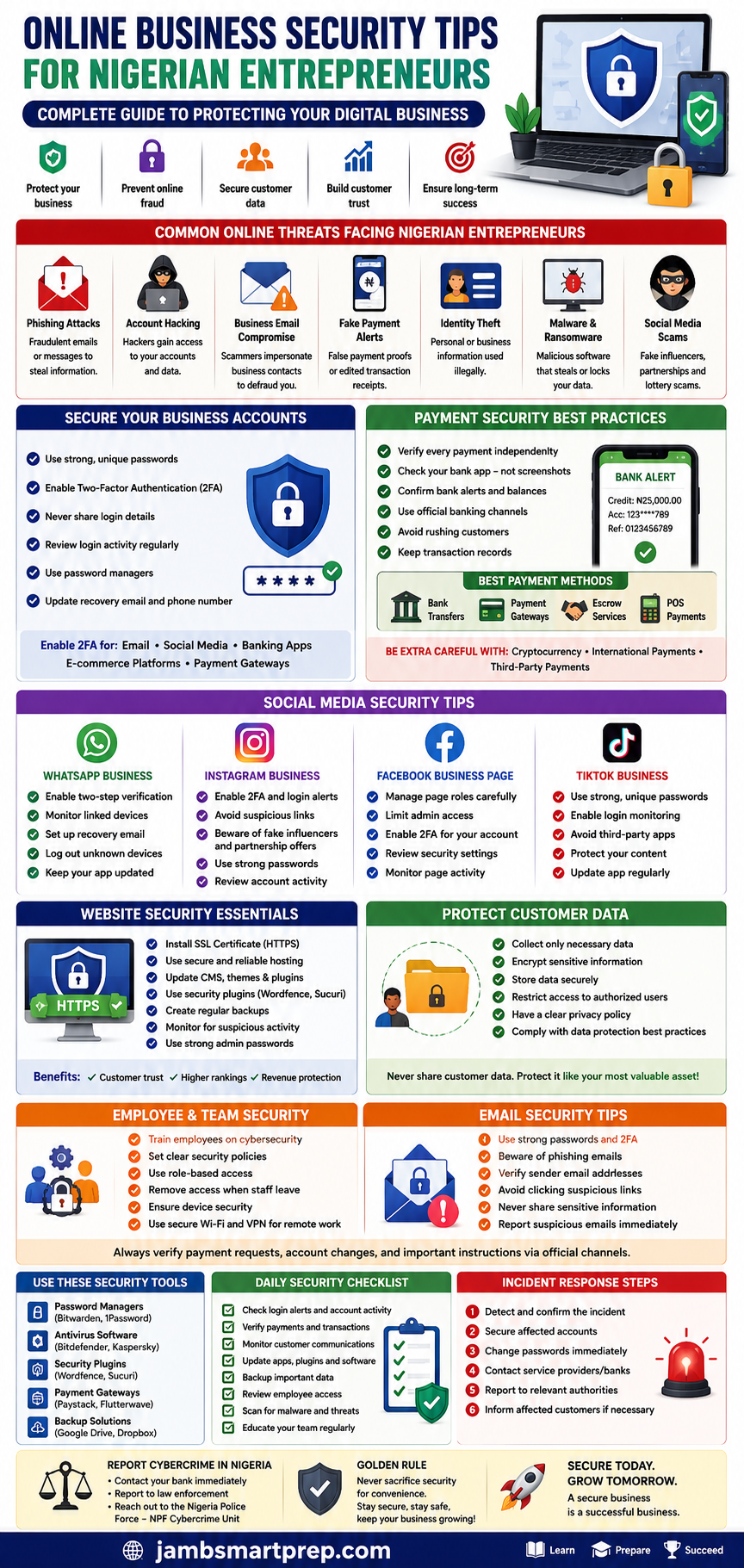
Online Business Security Checklist
Daily Security Checklist
Review Account Activity
☐ Check login alerts
☐ Review unusual activity
Verify Payments
☐ Confirm transactions independently
☐ Review payment records
Monitor Customer Communications
☐ Watch for phishing attempts
☐ Review suspicious messages
Check Website Performance
☐ Monitor uptime
☐ Review security notifications
Backup Important Data
☐ Verify backup completion
☐ Secure backup storage
Update Security Tools
☐ Install updates
☐ Review protection status
Review Employee Access
☐ Remove unnecessary permissions
☐ Audit user accounts
Frequently Asked Questions (FAQs)
How Can I Protect My Online Business in Nigeria?
Focus on:
- Strong passwords
- Two-Factor Authentication
- Payment verification
- Employee training
- Data backups
These measures provide a strong security foundation.
What Is the Biggest Cybersecurity Threat to Nigerian Entrepreneurs?
There is no single threat, but common risks include:
- Phishing attacks
- Fake payment alerts
- Account hacking
- Business email compromise
Awareness remains one of the best defenses.
How Do I Prevent Fake Payment Scams?
Always:
- Verify payments independently
- Check account balances
- Confirm transaction references
Never rely solely on screenshots.
Is Two-Factor Authentication Necessary for Small Businesses?
Absolutely.
Even the smallest business can become a target.
2FA significantly reduces unauthorized access risks.
What Should I Do If My Business Account Is Hacked?
Immediately:
- Change passwords.
- Revoke unauthorized access.
- Contact service providers.
- Notify affected customers.
- Review security settings.
How Often Should I Back Up My Business Data?
Critical business data should ideally be backed up automatically and regularly.
The frequency depends on business operations and data volume.
How Do I Report Cybercrime in Nigeria?
Report incidents to:
- Your bank
- Relevant authorities
- Cybercrime units
- Service providers involved in the incident
Maintain evidence throughout the process.
What Security Tools Should Every Entrepreneur Use?
At minimum:
- Password manager
- Antivirus software
- Two-Factor Authentication
- Backup solution
- Payment security platform
Can Small Businesses Afford Cybersecurity Protection?
Yes.
Many essential security measures are either free or relatively inexpensive.
The cost of prevention is usually much lower than the cost of recovery after a security breach.
Conclusion
Running an online business in Nigeria presents tremendous opportunities.
From social commerce and e-commerce to freelancing and digital services, entrepreneurs now have access to customers across the country and beyond.
However, these opportunities come with responsibilities.
Understanding online business security tips for Nigerian entrepreneurs is no longer optional.
Cybercriminals continue to target businesses of all sizes, making proactive protection essential.
Fortunately, many security incidents can be prevented through simple, consistent practices.
Key Takeaways
Before leaving this guide, remember these essential lessons:
Secure All Business Accounts
Enable strong passwords and Two-Factor Authentication across all platforms.
Verify Every Payment Independently
Never trust screenshots or unverified payment notifications.
Protect Customer Data
Store information securely and limit access where possible.
Train Employees on Cybersecurity
Human error remains one of the leading causes of security incidents.
Backup Important Information
Regular backups improve recovery after cyberattacks or technical failures.
Stay Informed About Emerging Threats
Cybersecurity is an ongoing process, not a one-time task.
Now Over To You
Has your business ever experienced a cyberattack, scam, fake payment alert, account hack, or security breach?
Share your experience in the comments and help other Nigerian entrepreneurs learn from real-world situations.
If you found this guide helpful, bookmark it, share it with fellow business owners, and subscribe for more practical resources on cybersecurity for small businesses, digital business security tips, online fraud prevention in Nigeria, and e-commerce security best practices.
