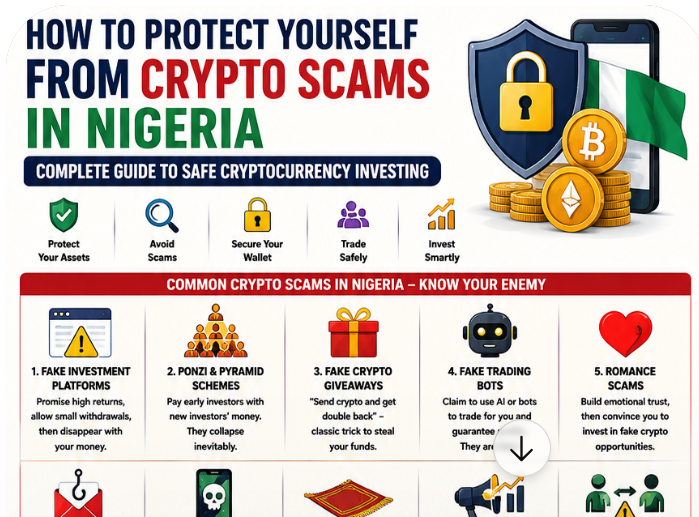
Cryptocurrency has become one of the most talked-about financial innovations in Nigeria.
Over the past few years, millions of Nigerians have embraced digital assets such as Bitcoin, Ethereum, and stablecoins for trading, investing, remittances, and wealth preservation.
Nigeria consistently ranks among the world’s leading countries for cryptocurrency adoption. Many young Nigerians are attracted by the opportunities offered by digital assets, especially in an economy where traditional investment options may seem limited.
However, this rapid growth has also attracted scammers.
Every year, thousands of Nigerians lose money to fake investment platforms, fraudulent trading schemes, fake crypto giveaways, phishing attacks, and fake P2P transactions.
Some victims lose a few thousand naira.
Others lose their life savings.
This makes cryptocurrency security more important than ever.
In this comprehensive guide, you will learn:
- How to protect yourself from crypto scams in Nigeria
- Common cryptocurrency scams targeting Nigerians
- Safe crypto investing Nigeria strategies
- Cryptocurrency security tips for beginners
- How to secure your wallet and exchange accounts
- How to avoid fake crypto investment schemes
- How to trade crypto safely in Nigeria
By the end of this guide, you will have a clear understanding of how to protect your digital assets and avoid becoming the next victim of crypto fraud.
Cryptocurrency Adoption in Nigeria
Nigeria remains one of the largest cryptocurrency markets in Africa.
Several factors have contributed to this growth:
- Rising interest in digital investments
- Global accessibility of cryptocurrencies
- Peer-to-peer (P2P) trading opportunities
- Cross-border payment solutions
- Youth participation in technology-driven finance
While this growth creates opportunities, it also increases exposure to fraud.
Many first-time investors enter the market without understanding the risks.
Scammers take advantage of this lack of knowledge.
Understanding Cryptocurrency and Why Scammers Target Investors
Before discussing crypto scams Nigeria investors face, it is important to understand what cryptocurrency is and why it attracts fraudsters.
What Is Cryptocurrency?
Cryptocurrency is a digital form of money that operates on blockchain technology.
Unlike traditional currencies controlled by governments or central banks, cryptocurrencies are decentralized.
Transactions are recorded on public blockchain networks.
Some of the most popular cryptocurrencies include:
Bitcoin
Bitcoin is the first and most widely recognized cryptocurrency.
It is often referred to as digital gold because many investors use it as a store of value.
Ethereum
Ethereum is the second-largest cryptocurrency.
Its blockchain supports smart contracts and decentralized applications.
Stablecoins
Stablecoins are cryptocurrencies designed to maintain stable values.
Popular examples include:
- USDT (Tether)
- USDC
- DAI
Many Nigerian traders use stablecoins for P2P transactions.
Altcoins
Altcoins refer to cryptocurrencies other than Bitcoin.
Examples include:
- Solana
- Cardano
- Avalanche
- XRP
- Polygon
While some altcoins are legitimate projects, others may be risky or fraudulent.
Why Cryptocurrency Is Attractive to Investors
Understanding why people invest in crypto helps explain why scammers target the industry.
Potential Returns
Many investors are attracted by the possibility of significant gains.
Stories of early Bitcoin investors becoming wealthy continue to inspire new participants.
Fast Transactions
Cryptocurrency transactions can often be completed quickly, especially for international transfers.
Global Accessibility
Anyone with internet access can participate in the crypto economy.
This accessibility has contributed to rapid adoption.
Financial Independence
Many users appreciate the ability to control their assets without relying entirely on traditional financial institutions.
Why Crypto Attracts Scammers
Unfortunately, the same features that make cryptocurrency attractive also create opportunities for fraud.
Lack of Investor Knowledge
Many beginners enter the market without understanding:
- Wallet security
- Exchange verification
- Scam detection
- Risk management
Scammers exploit this knowledge gap.
Irreversible Transactions
Unlike some traditional payment systems, cryptocurrency transactions are generally irreversible.
Once funds are sent, recovering them can be extremely difficult.
This makes crypto particularly attractive to fraudsters.
Anonymous Transactions
Although blockchain transactions are transparent, participants can often operate without revealing their identities.
Scammers use this feature to hide their activities.
Fear of Missing Out (FOMO)
One of the biggest drivers of crypto fraud is FOMO.
Scammers create urgency by promising:
- Limited-time opportunities
- Guaranteed profits
- Exclusive access
- Fast returns
Investors who rush into decisions without proper research often become victims.
Common Crypto Scams in Nigeria
Understanding common scam types is one of the best forms of cryptocurrency scam awareness.
Fake Investment Platforms
Fake investment platforms are among the most common crypto scams in Nigeria.
Also read: How to Sell Safely on WhatsApp in Nigeria: Complete Guide for Vendors and Small Business Owners
These websites or apps claim to generate profits through cryptocurrency trading, mining, or investment management.
How They Work
The scam typically follows this pattern:
- Investors are promised high returns.
- Small withdrawals may initially be allowed.
- Victims invest larger amounts.
- Withdrawals become impossible.
- The platform disappears.
Warning Signs
Be suspicious if a platform:
- Guarantees profits
- Promises unusually high returns
- Provides little company information
- Lacks transparency
- Uses aggressive marketing tactics
Ponzi and Pyramid Schemes
Ponzi schemes have existed for decades but continue to evolve.
Cryptocurrency has become one of their favorite tools.
Common Promises
Ponzi promoters often claim:
- Daily returns
- Weekly profits
- Risk-free investments
- Guaranteed income
These promises should immediately raise concerns.
Real Examples
Nigeria has witnessed several investment schemes that used cryptocurrency-related marketing to attract investors.
Many collapsed after attracting large numbers of participants.
Why They Collapse
Ponzi schemes depend on new investors providing funds to pay earlier investors.
Once recruitment slows, the scheme becomes unsustainable.
Eventually, it collapses.
Fake Crypto Giveaways
Fake giveaways are extremely common on social media.
Fraudsters pretend to offer free cryptocurrency in exchange for a “small verification payment.”
Social Media Giveaway Scams
Victims may be told:
“Send 0.01 BTC and receive 0.1 BTC back.”
The promised return never arrives.
Celebrity Impersonation Scams
Scammers often impersonate:
- Crypto influencers
- Business leaders
- Technology entrepreneurs
Their goal is to gain credibility and attract victims.
Fake Exchange Promotions
Fraudsters may pretend to represent major cryptocurrency exchanges and advertise fake promotional campaigns.
Legitimate exchanges do not require users to send cryptocurrency to receive giveaways.
Fake Crypto Trading Bots
Automated trading bots have become popular among investors.
Unfortunately, scammers have exploited this trend.
How Fraudulent Bots Operate
Fake bots typically promise:
- Guaranteed profits
- Automated wealth generation
- Minimal risk
Users deposit funds into systems they do not control.
Eventually, withdrawals become impossible.
Red Flags
Warning signs include:
- Guaranteed returns
- Lack of transparency
- Anonymous developers
- No verifiable trading history
Legitimate trading always involves risk.
Any platform claiming otherwise should be treated with caution.
Romance Crypto Scams
Romance scams have become one of the fastest-growing forms of cryptocurrency fraud globally, and Nigerian investors are not immune.
In these scams, fraudsters build emotional relationships with victims before introducing cryptocurrency investment opportunities.
How Scammers Build Trust
The scam usually starts on:
- Telegram
- Dating platforms
The scammer may spend weeks or even months communicating with the victim.
They often present themselves as:
- Successful crypto traders
- Foreign investors
- Business professionals
- Military personnel working overseas
The goal is to gain trust before discussing investments.
Investment Manipulation Tactics
After building a relationship, the scammer introduces a “profitable investment opportunity.”
They may:
- Recommend a fake platform
- Promise guaranteed returns
- Offer to “mentor” the victim
- Show fake screenshots of profits
Eventually, the victim deposits funds and loses everything.
How to Avoid Romance Crypto Scams
- Never invest based solely on personal recommendations.
- Verify every platform independently.
- Be cautious when online relationships quickly turn to investment discussions.
- Avoid sending crypto to people you have never met.
Phishing Scams
Phishing remains one of the biggest threats to cryptocurrency investors.
A phishing attack is designed to steal sensitive information such as:
- Login credentials
- Wallet passwords
- Recovery phrases
- Two-factor authentication codes
Fake Wallet Websites
Scammers create websites that look identical to legitimate crypto wallets.
Victims enter their credentials and unknowingly hand over access to their funds.
Fake Exchange Login Pages
Fake versions of popular exchanges are common.
Victims receive links through:
- Telegram
- Social media
The login details entered on these fake sites are immediately captured.
Email Phishing
Fraudulent emails may claim to come from:
- Crypto exchanges
- Wallet providers
- Security teams
They often contain urgent messages such as:
- “Your account has been suspended.”
- “Verify your wallet immediately.”
- “Unauthorized login detected.”
These messages are designed to create panic.
SMS Phishing
Known as “smishing,” these attacks use text messages to direct victims to fake websites.
Always verify links before clicking.
Fake Crypto Wallet Apps
Wallet applications are supposed to protect your assets.
Unfortunately, scammers also create fake wallet apps.
Malicious Applications
These apps may:
- Steal passwords
- Capture recovery phrases
- Monitor activity
- Transfer funds without permission
App Store Impersonation
Some fake wallet apps imitate popular wallets.
Before downloading any application:
- Verify the developer name.
- Read reviews carefully.
- Download only from official sources.
- Cross-check links from the wallet’s official website.
Rug Pull Scams
Rug pulls have become increasingly common in the cryptocurrency market.
What Is a Rug Pull?
A rug pull occurs when developers create a cryptocurrency project, attract investors, and then disappear with the funds.
Investors are left holding worthless tokens.
Common Warning Signs
Watch out for:
- Anonymous development teams
- No whitepaper
- Unrealistic promises
- Sudden hype campaigns
- No independent audits
- Extremely low liquidity
Legitimate projects are generally transparent about their team and operations.
Pump-and-Dump Schemes
Pump-and-dump scams are especially common on social media and messaging platforms.
How They Work
The organizers:
- Buy large amounts of a low-value coin.
- Promote the coin aggressively.
- Encourage others to buy.
- Create artificial demand.
- Sell their holdings at inflated prices.
The price then collapses.
How Investors Lose Money
Late investors buy at the peak.
Once the organizers sell, the value drops sharply.
Many investors suffer heavy losses.
Warning Signs
Be suspicious when:
- Unknown coins suddenly become “the next Bitcoin.”
- Social media hype appears overnight.
- Influencers aggressively push little-known projects.
- No legitimate fundamentals exist.
Fake P2P Buyer and Seller Scams
Peer-to-peer (P2P) trading is extremely popular in Nigeria.
Unfortunately, scammers frequently target P2P traders.
Common Tactics
Some scammers:
- Send fake payment alerts
- Use edited bank receipts
- Reverse payments after receiving crypto
- Pressure sellers into releasing assets quickly
How to Stay Safe
Always:
- Verify payments independently
- Confirm account balance changes
- Use exchange escrow systems
- Avoid external communication channels when trading
Never release cryptocurrency based solely on screenshots.
Red Flags That Every Nigerian Crypto Investor Should Know
Recognizing warning signs early is one of the best cryptocurrency security tips available.
Guaranteed Profit Claims
No legitimate investment can guarantee profits.
Markets fluctuate.
Risks always exist.
If someone promises:
- “100% profit guaranteed”
- “Risk-free returns”
- “Double your money”
You should immediately be cautious.
Unrealistic Returns
High returns are possible in crypto, but unrealistic promises often signal fraud.
Examples include:
- 10% daily returns
- 50% weekly profits
- Guaranteed monthly growth
These claims are usually unsustainable.
Pressure to Invest Quickly
Scammers often create urgency.
Common phrases include:
- “Offer ends today.”
- “Limited slots available.”
- “You must act now.”
Pressure reduces critical thinking.
Legitimate investments remain legitimate tomorrow.
Lack of Transparency
Trustworthy projects provide:
- Clear documentation
- Team information
- Business details
- Public communication
Be wary of projects that reveal little information.
Anonymous Founders
While anonymity exists in crypto, investors should exercise caution when founders cannot be verified.
Questions to ask:
- Who created the project?
- What is their experience?
- Are they publicly accountable?
No Verifiable Business Information
Legitimate businesses generally have:
- Official websites
- Contact information
- Public records
- Customer support channels
Scammers often avoid verifiable identities.
Requests for Private Keys
Your private key provides complete access to your wallet.
Nobody should ever request it.
Not:
- Exchanges
- Wallet providers
- Customer support agents
No legitimate service needs your private key.
Requests for Seed Phrases
Your seed phrase is the master key to your wallet.
Anyone who obtains it can control your funds.
Never share it.
Never upload it.
Never send it through email, WhatsApp, Telegram, or social media.
Fake Customer Testimonials
Many fraudulent platforms display fabricated success stories.
Warning signs include:
- Stock photos
- Generic reviews
- Repeated comments
- Unverifiable claims
Look for independent reviews instead.
Fake Regulatory Claims
Some scams falsely claim:
- Government approval
- International licenses
- Regulatory endorsements
Always verify such claims independently.
Do not trust logos or badges displayed on a website without verification.
Why Many Nigerians Fall Victim to Crypto Scams
Understanding investor psychology helps explain why scams succeed.
Common factors include:
Fear of Missing Out (FOMO)
People fear missing the next Bitcoin opportunity.
Scammers exploit this fear.
Greed
Promises of extraordinary profits can cloud judgment.
Lack of Research
Many victims invest without:
- Reading reviews
- Verifying platforms
- Understanding risks
Trust in Social Proof
Fake testimonials and influencer endorsements often create false confidence.
Financial Pressure
Individuals seeking quick financial relief may become more vulnerable to unrealistic promises.
Understanding these psychological triggers can help investors make better decisions and avoid costly mistakes.
How to Verify a Crypto Platform Before Investing
One of the most effective ways to prevent crypto fraud is to verify every platform before depositing money.
Many investors lose funds because they invest first and conduct research later.
A few minutes of investigation can save you from losing thousands or even millions of naira.
Research the Company
Never invest in a platform you know nothing about.
Before creating an account, investigate the company thoroughly.
Website Review
Start by reviewing the platform’s website.
Check for:
- Professional design
- Clear business information
- Privacy policy
- Terms and conditions
- Customer support details
Be cautious if the website:
- Contains numerous grammatical errors
- Has broken pages
- Provides little company information
- Was recently created
You can also use domain lookup tools to determine how long the website has existed.
Many scam websites are only a few weeks old.
Business Registration Checks
If a platform claims to operate legally, verify its registration.
Questions to ask include:
- Is the company registered?
- Does it provide a physical address?
- Can its registration information be verified?
A lack of verifiable business information should raise concerns.
Founder Verification
Legitimate projects are usually transparent about their founders.
Research:
- Founder names
- Professional backgrounds
- LinkedIn profiles
- Industry experience
Anonymous teams are not automatically scams, but they deserve additional scrutiny.
Read Independent Reviews
Never rely solely on testimonials displayed on a company’s website.
Independent feedback is far more valuable.
Reddit Discussions
Reddit often contains honest discussions about cryptocurrency projects.
Search for:
- User experiences
- Scam allegations
- Security concerns
- Customer complaints
Pay attention to recurring issues.
Community Feedback
Check discussions on:
- Telegram
- Discord
- X (formerly Twitter)
- Crypto forums
Healthy communities usually contain both positive and critical discussions.
A community filled only with praise may indicate manipulation.
Trust Signals
Positive trust indicators include:
- Active community engagement
- Transparent communication
- Long operating history
- Consistent updates
These signs generally indicate a more credible platform.
Verify Exchange Reputation
If you intend to trade cryptocurrency, choosing the right exchange is critical.
Trading Volume
Large exchanges typically process significant daily trading volume.
Higher volume often indicates:
- Better liquidity
- Larger user base
- Greater trust
Security Record
Research the exchange’s history.
Questions to ask:
- Has it experienced major hacks?
- How were incidents handled?
- Were customers compensated?
No platform is perfect, but transparency matters.
Regulatory Compliance
Exchanges that comply with applicable regulations often demonstrate stronger operational standards.
Although regulation varies globally, compliance efforts generally improve credibility.
Check Social Media Presence
Social media can reveal a great deal about a crypto project.
Genuine Community Activity
Look for:
- Real discussions
- User questions
- Technical updates
- Transparent communication
Legitimate projects engage openly with their communities.
Fake Follower Detection
A large follower count does not guarantee legitimacy.
Warning signs include:
- Thousands of followers with little engagement
- Repetitive comments
- Generic praise
- Sudden follower growth
Many scammers purchase fake followers to appear credible.
How to Protect Your Crypto Wallet
Wallet security is one of the most important aspects of safe crypto investing Nigeria investors must understand.
If your wallet is compromised, recovering funds can be extremely difficult.
Why Wallet Security Matters
Your wallet controls access to your cryptocurrency.
Unlike traditional banking systems, there is often no customer service department that can reverse unauthorized transactions.
Direct Asset Control
One of crypto’s biggest advantages is direct ownership.
However, direct ownership also means direct responsibility.
You are responsible for protecting your funds.
Irreversible Transactions
Most blockchain transactions cannot be reversed.
Once funds leave your wallet, recovering them may be impossible.
This makes wallet security essential.
Types of Crypto Wallets
Different wallet types provide different levels of security and convenience.
Hardware Wallets
Hardware wallets are physical devices designed to store cryptocurrency securely.
Examples include:
- Ledger
- Trezor
Advantages:
- Strong security
- Offline storage
- Reduced hacking risk
Disadvantages:
- Purchase cost
- Physical storage responsibility
For large investments, hardware wallets are often considered the safest option.
Software Wallets
Software wallets are installed on computers.
Advantages:
- Easy access
- Convenient management
Disadvantages:
- Exposure to malware
- Device security dependence
Mobile Wallets
Mobile wallets operate on smartphones.
Advantages:
- Convenience
- Accessibility
Disadvantages:
- Vulnerability if the device is compromised
Examples include popular cryptocurrency wallet applications available through official app stores.
Web Wallets
Web wallets operate through browsers.
Advantages:
- Easy access
- No software installation required
Disadvantages:
- Greater exposure to phishing attacks
Use caution when accessing web-based wallets.
Essential Wallet Security Practices
Following proper security practices significantly reduces risks.
Enable Two-Factor Authentication
Two-factor authentication (2FA) provides an additional security layer.
Even if someone obtains your password, they still need the second verification factor.
Enable 2FA wherever available.
Use Strong Passwords
A secure password should include:
- Uppercase letters
- Lowercase letters
- Numbers
- Symbols
Avoid:
- Birthdays
- Names
- Simple patterns
Each account should have a unique password.
Store Seed Phrases Offline
Your seed phrase is the master backup for your wallet.
Store it:
- Offline
- Securely
- Away from internet-connected devices
Many experienced investors use written backups stored in safe locations.
Never Share Recovery Phrases
No legitimate company needs your recovery phrase.
Never share it with:
- Support agents
- Friends
- Family members
- Social media contacts
Anyone who requests it is likely attempting fraud.
Avoid Public Wi-Fi
Public Wi-Fi networks can expose sensitive information.
Avoid accessing:
- Exchanges
- Wallets
- Financial platforms
when using unsecured networks.
Keep Software Updated
Updates often contain security improvements.
Regularly update:
- Wallet applications
- Operating systems
- Browsers
- Security software
Outdated software creates vulnerabilities.
Safe Crypto Trading Practices in Nigeria
Trading safely is just as important as investing safely.
Many scams occur during transactions rather than investments.
Choosing a Trusted Crypto Exchange
The exchange you choose plays a major role in your overall security.
Exchange Reputation
Choose exchanges with:
- Strong track records
- Large user bases
- Positive reviews
Reputation matters.
Security Features
Look for features such as:
- Two-factor authentication
- Withdrawal protection
- Login alerts
- Device management
Strong security tools help protect users.
User Reviews
Read reviews from actual users.
Pay attention to:
- Withdrawal experiences
- Customer support quality
- Security incidents
Customer Support
Reliable support becomes valuable during emergencies.
Test support channels before making large deposits.
Safe P2P Trading Tips
Peer-to-peer trading remains popular among Nigerian crypto users.
However, it also attracts scammers.
Verify Counterparties
Review the trading history of the person you are dealing with.
Look for:
- High completion rates
- Positive reviews
- Long trading history
Avoid newly created accounts with limited activity.
Use Escrow Services
Always use the exchange’s escrow system.
Escrow protects both buyers and sellers.
Never bypass escrow for convenience.
Confirm Payments Properly
Before releasing cryptocurrency:
- Verify payment independently
- Check account balance
- Review transaction history
Never trust screenshots alone.
Avoid External Transactions
Scammers often encourage users to leave the exchange platform.
Common excuses include:
- Lower fees
- Faster transactions
- Better exchange rates
Avoid this.
Exchange protections usually disappear once you move outside the platform.
How to Detect Fake Payment Alerts
Fake payment alerts remain one of the most common crypto scams Nigeria traders encounter.
Verification Checklist
Before releasing crypto:
✅ Confirm account balance changes
✅ Verify transaction references
✅ Check banking applications
✅ Review transaction history
✅ Confirm payment amount
Common Fraud Tactics
Scammers often use:
- Edited screenshots
- Fake SMS alerts
- Pressure tactics
- Urgent requests
A common tactic involves claiming:
“The bank network is slow. Please release the crypto first.”
Never release cryptocurrency without complete payment verification.
That single rule can prevent many losses.
How to Verify a Crypto Platform Before Investing
One of the most effective ways to prevent crypto fraud is to verify every platform before depositing money.
Many investors lose funds because they invest first and conduct research later.
A few minutes of investigation can save you from losing thousands or even millions of naira.
Research the Company
Never invest in a platform you know nothing about.
Before creating an account, investigate the company thoroughly.
Website Review
Start by reviewing the platform’s website.
Check for:
- Professional design
- Clear business information
- Privacy policy
- Terms and conditions
- Customer support details
Be cautious if the website:
- Contains numerous grammatical errors
- Has broken pages
- Provides little company information
- Was recently created
You can also use domain lookup tools to determine how long the website has existed.
Many scam websites are only a few weeks old.
Business Registration Checks
If a platform claims to operate legally, verify its registration.
Questions to ask include:
- Is the company registered?
- Does it provide a physical address?
- Can its registration information be verified?
A lack of verifiable business information should raise concerns.
Founder Verification
Legitimate projects are usually transparent about their founders.
Research:
- Founder names
- Professional backgrounds
- LinkedIn profiles
- Industry experience
Anonymous teams are not automatically scams, but they deserve additional scrutiny.
Read Independent Reviews
Never rely solely on testimonials displayed on a company’s website.
Independent feedback is far more valuable.
Reddit Discussions
Reddit often contains honest discussions about cryptocurrency projects.
Search for:
- User experiences
- Scam allegations
- Security concerns
- Customer complaints
Pay attention to recurring issues.
Community Feedback
Check discussions on:
- Telegram
- Discord
- X (formerly Twitter)
- Crypto forums
Healthy communities usually contain both positive and critical discussions.
A community filled only with praise may indicate manipulation.
Trust Signals
Positive trust indicators include:
- Active community engagement
- Transparent communication
- Long operating history
- Consistent updates
These signs generally indicate a more credible platform.
Verify Exchange Reputation
If you intend to trade cryptocurrency, choosing the right exchange is critical.
Trading Volume
Large exchanges typically process significant daily trading volume.
Higher volume often indicates:
- Better liquidity
- Larger user base
- Greater trust
Security Record
Research the exchange’s history.
Questions to ask:
- Has it experienced major hacks?
- How were incidents handled?
- Were customers compensated?
No platform is perfect, but transparency matters.
Regulatory Compliance
Exchanges that comply with applicable regulations often demonstrate stronger operational standards.
Although regulation varies globally, compliance efforts generally improve credibility.
Check Social Media Presence
Social media can reveal a great deal about a crypto project.
Genuine Community Activity
Look for:
- Real discussions
- User questions
- Technical updates
- Transparent communication
Legitimate projects engage openly with their communities.
Fake Follower Detection
A large follower count does not guarantee legitimacy.
Warning signs include:
- Thousands of followers with little engagement
- Repetitive comments
- Generic praise
- Sudden follower growth
Many scammers purchase fake followers to appear credible.
Social Media Crypto Scam Prevention
Social media has become one of the biggest channels for cryptocurrency scams.
Fraudsters use social platforms because they can quickly reach thousands of potential victims.
Understanding how these scams work can significantly improve your cryptocurrency scam awareness.
Crypto Scams on WhatsApp
WhatsApp groups have become a popular tool for crypto scammers.
Fake Investment Groups
Scammers create groups claiming to offer:
- Exclusive investment opportunities
- Insider trading signals
- Guaranteed profits
- Crypto mentorship
New members are often shown fake screenshots of profits to encourage participation.
Pump Signals
Some groups promote little-known cryptocurrencies and encourage members to buy quickly.
The organizers usually own large amounts of the coin and sell after the price rises.
Late investors often lose money.
Fake Mentors
Fraudsters may pretend to be successful traders.
They often:
- Display luxury lifestyles
- Share fake trading results
- Charge mentorship fees
- Promote fraudulent platforms
Always verify credentials before trusting any mentor.
Crypto Scams on Telegram
Telegram is widely used within the crypto industry.
Unfortunately, scammers use it heavily.
Fake Admin Accounts
Scammers impersonate:
- Exchange administrators
- Wallet support teams
- Community moderators
They contact users directly and request sensitive information.
Legitimate support teams rarely initiate private conversations first.
Impersonation Scams
Fraudsters often clone legitimate profiles.
They may copy:
- Profile pictures
- Usernames
- Bios
Always verify identities carefully.
Fake Airdrops
Many fake airdrops promise free cryptocurrency.
Victims are often asked to:
- Connect wallets
- Reveal seed phrases
- Pay verification fees
Legitimate airdrops do not require access to your recovery phrase.
Crypto Scams on Instagram
Instagram remains a major source of crypto-related fraud.
Fake Influencers
Scammers pretend to be successful investors.
Common tactics include:
- Luxury lifestyle content
- Fake earnings screenshots
- Fabricated testimonials
Their objective is to attract victims into fraudulent investments.
Fake Trading Experts
Many self-proclaimed experts promise:
- Daily profits
- Guaranteed returns
- Secret strategies
Real trading professionals acknowledge risks.
Giveaway Scams
Fake giveaways often claim:
“Send crypto and receive double in return.”
Legitimate giveaways do not operate this way.
Crypto Scams on Facebook
Facebook remains one of the largest social networks in Nigeria.
Scammers take advantage of its large audience.
Investment Groups
Many fraudulent schemes operate through Facebook groups.
Be cautious of groups focused entirely on profit claims.
Fake Testimonials
Scammers frequently post fabricated success stories.
Do not rely solely on screenshots.
Sponsored Scam Ads
Some scams use paid advertising.
Remember that an advertisement does not automatically indicate legitimacy.
Always conduct independent research.
How to Avoid Crypto Phishing Attacks
Phishing remains one of the most dangerous threats facing crypto investors.
What Is Crypto Phishing?
Crypto phishing involves attempts to steal:
- Wallet credentials
- Exchange logins
- Recovery phrases
- Authentication codes
The goal is to gain access to your funds.
Common Phishing Techniques
Fake Emails
Scammers may impersonate:
- Exchanges
- Wallet providers
- Security teams
Always verify the sender before responding.
Fake Websites
Phishing websites often look identical to legitimate platforms.
Even experienced users can be fooled.
Fake Support Teams
Scammers frequently pretend to provide customer support.
They may request:
- Passwords
- Recovery phrases
- Authentication codes
Legitimate support teams do not need these details.
Browser Extension Scams
Some malicious browser extensions are designed to:
- Capture passwords
- Monitor wallet activity
- Redirect transactions
Only install extensions from trusted sources.
Verification Steps Before Clicking Links
Before clicking any crypto-related link:
- Examine the URL carefully.
- Verify the sender.
- Search for official announcements.
- Avoid clicking links in unsolicited messages.
Taking a few seconds to verify links can prevent significant losses.
How Bookmarking Websites Improves Security
Many experienced investors bookmark official websites.
This practice reduces the risk of:
- Visiting fake websites
- Clicking malicious links
- Falling victim to phishing attacks
Using bookmarks is one of the simplest cryptocurrency security tips available.
How to Protect Your Devices from Crypto Theft
Wallet security alone is not enough.
Your devices also require protection.
Smartphone Security Tips
Many Nigerian investors manage crypto entirely through mobile devices.
Screen Locks
Enable:
- PINs
- Fingerprint authentication
- Face recognition
These protections help prevent unauthorized access.
App Permissions
Review app permissions regularly.
Be cautious of apps requesting unnecessary access.
Software Updates
Updates often contain important security fixes.
Always install updates promptly.
Computer Security Tips
Desktop and laptop users should also follow strong security practices.
Antivirus Protection
Reliable antivirus software helps detect:
- Malware
- Spyware
- Trojans
Security software should remain updated.
Firewall Settings
Firewalls help prevent unauthorized network access.
Keep firewall protection enabled.
Browser Security
Use reputable browsers and keep them updated.
Avoid installing unnecessary extensions.
Public Wi-Fi Risks
Public Wi-Fi networks create security risks.
Attackers may attempt to intercept sensitive information.
Avoid accessing:
- Exchanges
- Wallets
- Financial platforms
on unsecured networks.
VPN Usage
Virtual Private Networks (VPNs) encrypt internet traffic.
Benefits include:
- Improved privacy
- Reduced interception risks
- Better protection on public networks
Secure Connections
Always verify that websites use secure HTTPS connections before entering sensitive information.
What to Do If You Become a Victim of a Crypto Scam
Even careful investors can sometimes become victims.
Knowing how to respond quickly can reduce losses.
Immediate Steps to Take
Secure Your Accounts
Immediately:
- Log out suspicious sessions
- Enable additional security
- Review account activity
Change Passwords
Update passwords for:
- Exchanges
- Wallets
- Email accounts
Prioritize affected accounts.
Move Remaining Assets
If your wallet may be compromised:
- Create a new secure wallet
- Transfer remaining assets immediately
Speed is important.
Gather Evidence
Documentation may assist investigations.
Transaction Records
Save all transaction information.
Wallet Addresses
Record wallet addresses involved in the incident.
Screenshots
Keep screenshots of:
- Conversations
- Websites
- Payment records
Report the Incident
Reporting helps protect other investors.
Exchange Support
Notify relevant exchanges immediately.
Some exchanges may flag suspicious accounts.
Relevant Authorities
Report incidents to appropriate authorities when necessary.
Cybercrime Reporting Channels
Provide:
- Wallet addresses
- Screenshots
- Transaction IDs
- Communication records
The more information you provide, the stronger the report.
How to Warn Other Investors
Sharing your experience may prevent future victims.
Consider posting factual accounts in:
- Community forums
- Crypto discussion groups
- Social media communities
Avoid emotional accusations and focus on verifiable facts.
Real-Life Crypto Scam Stories and Lessons
Case Study 1: Fake Investment Platform
What Happened
A Nigerian investor deposited funds into a platform promising 20% weekly returns.
Initially, withdrawals worked.
Encouraged by these results, he invested more money.
A few weeks later, withdrawals stopped and the platform disappeared.
Lessons Learned
- Avoid guaranteed returns.
- Research platforms thoroughly.
- Start with caution.
Case Study 2: Fake P2P Payment Alert
What Happened
A P2P seller received a screenshot showing payment confirmation.
Believing payment had been received, he released cryptocurrency.
Later, he discovered that the payment never entered his account.
Lessons Learned
- Verify payments independently.
- Ignore screenshots.
- Use escrow systems.
Case Study 3: Wallet Phishing Attack
What Happened
A user clicked a fake wallet update link.
The website requested the wallet recovery phrase.
Moments after entering it, funds disappeared from the wallet.
Lessons Learned
- Never share seed phrases.
- Verify website URLs.
- Bookmark official websites.
Best Security Tools for Crypto Investors
Security tools can significantly improve protection.
Password Managers
Useful options include:
- Bitwarden
- 1Password
- Dashlane
These tools help generate and store strong passwords.
Hardware Wallets
Popular hardware wallets include:
- Ledger
- Trezor
Hardware wallets remain among the safest storage solutions for long-term investors.
Two-Factor Authentication Apps
Useful applications include:
- Google Authenticator
- Microsoft Authenticator
- Authy
Authentication apps are generally safer than SMS-based verification.
Anti-Phishing Browser Extensions
These tools help identify suspicious websites and reduce phishing risks.
Crypto Portfolio Tracking Apps
Portfolio trackers help monitor:
- Holdings
- Performance
- Transactions
Choose reputable applications with strong security records.
How to Protect Yourself from Crypto Scams in Nigeria: Complete Guide to Safe Cryptocurrency Investing
Step 1: Research Before Investing
✅ Verify the platform
✅ Check reviews
✅ Confirm team identity
Step 2: Secure Your Wallet
✅ Use strong passwords
✅ Store seed phrases offline
✅ Enable 2FA
Step 3: Avoid Scam Offers
✅ Ignore guaranteed profits
✅ Avoid pressure tactics
✅ Verify promotions
Step 4: Trade Safely
✅ Use trusted exchanges
✅ Verify payments
✅ Use escrow services
Step 5: Protect Your Devices
✅ Update software
✅ Install security tools
✅ Avoid public Wi-Fi
Golden Rule
If an investment opportunity sounds too good to be true, it probably is.
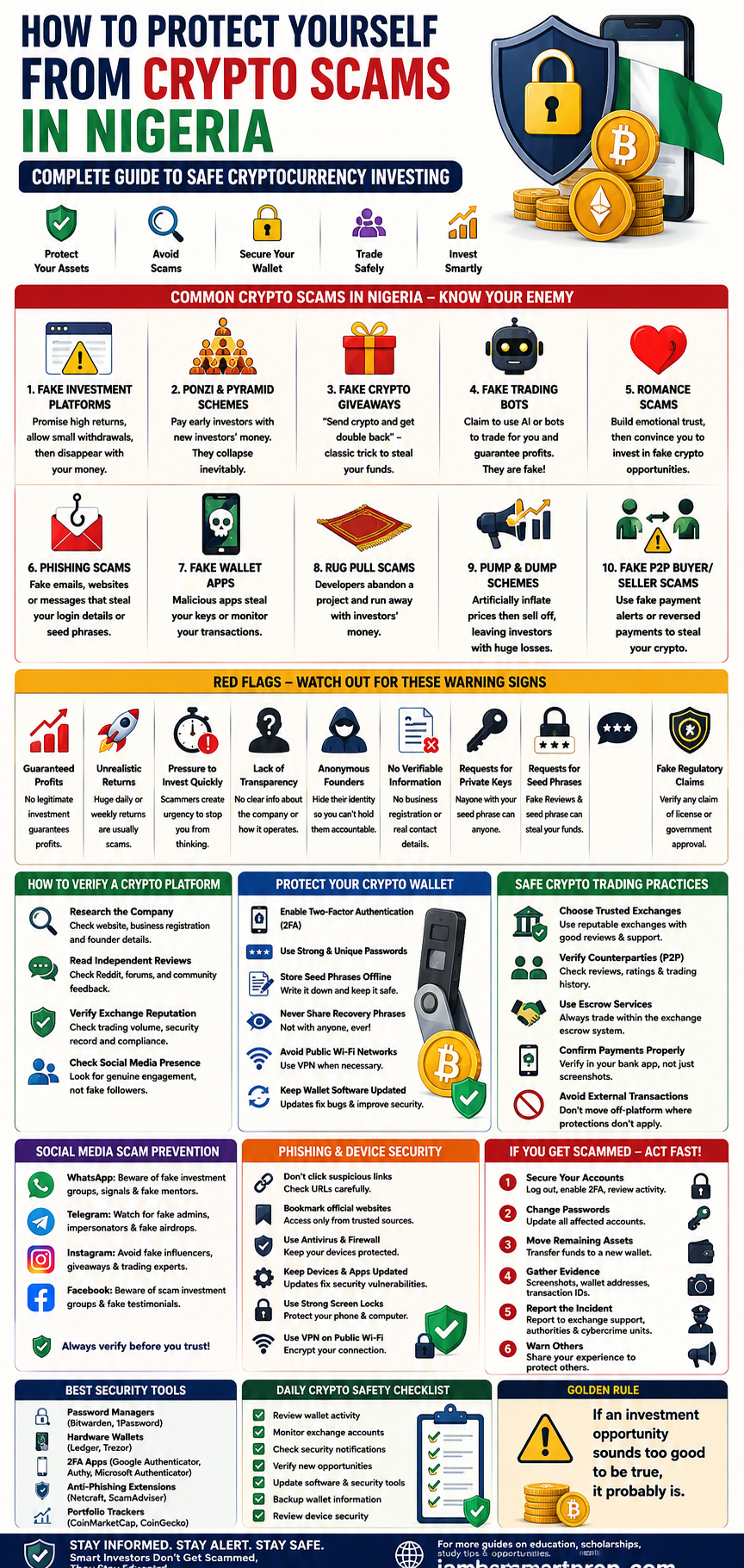
Crypto Safety Checklist
Daily Security Checklist
☐ Review wallet activity
☐ Monitor exchange accounts
☐ Check security notifications
☐ Verify new opportunities
☐ Update software
☐ Backup wallet information
☐ Review device security
Frequently Asked Questions (FAQs)
How can I identify crypto scams in Nigeria?
Look for warning signs such as guaranteed returns, anonymous founders, pressure tactics, and requests for seed phrases.
Is Cryptocurrency Legal in Nigeria?
Cryptocurrency ownership and trading exist in Nigeria, but regulations continue to evolve. Always stay informed about current policies.
How Do I Know if a Crypto Platform Is Legitimate?
Research the company, read independent reviews, verify founders, and examine community feedback before investing.
What Should I Do if I Send Crypto to a Scammer?
Act quickly by securing accounts, reporting the incident, documenting evidence, and notifying relevant platforms.
Can Stolen Cryptocurrency Be Recovered?
Recovery is difficult and depends on the circumstances. Prevention remains the best strategy.
What Is the Safest Crypto Wallet?
Hardware wallets are generally considered among the safest options for long-term storage.
How Do I Avoid Fake P2P Buyers?
Use escrow systems, verify payments independently, and never release cryptocurrency based on screenshots.
How Can I Protect My Crypto Investments From Hackers?
Use strong passwords, enable 2FA, secure devices, avoid phishing links, and store recovery phrases safely.
Should Beginners Invest in Cryptocurrency?
Beginners should invest cautiously, start with education, and never invest money they cannot afford to lose.
Conclusion
Cryptocurrency offers exciting opportunities for Nigerians seeking new ways to invest, save, and participate in the digital economy.
However, these opportunities come with risks.
Learning how to protect yourself from crypto scams in Nigeria is one of the most important skills any investor can develop.
Throughout this guide, we have examined common crypto scams, wallet security practices, safe trading strategies, phishing protection methods, and fraud prevention techniques.
The good news is that many scams are preventable.
By following proper security practices, conducting thorough research, and maintaining healthy skepticism, you can significantly reduce your chances of becoming a victim.
Key Takeaways
Research Every Platform Before Investing
Never invest without conducting independent research.
Never Share Your Seed Phrase
Your recovery phrase should remain private at all times.
Use Trusted Exchanges
Reputable exchanges generally provide stronger security protections.
Enable Strong Security Measures
Use:
- Two-factor authentication
- Strong passwords
- Hardware wallets where appropriate
Avoid Unrealistic Profit Promises
Guaranteed profits are one of the biggest warning signs in crypto.
Stay Informed About New Scam Tactics
Cybercriminals constantly adapt.
Continuous learning remains one of your strongest defenses.
Now Over To You
Have you ever encountered a crypto scam in Nigeria?
Share your experience in the comments and help other investors stay safe in the cryptocurrency market.
If you found this guide useful, bookmark it, share it with friends, and subscribe for more cryptocurrency security tips, investment safety guides, and online fraud prevention resources.
Source prompt and article specifications referenced from the uploaded document.
