Every year, thousands of Nigerian students sit for the West African Senior School Certificate Examination (WASSCE) conducted by WAEC. After the exams, one of the biggest questions is: “How does WAEC grade our papers?”
Many candidates see results like B3 in English or C6 in Mathematics but have no clear idea what these grades mean in terms of raw marks. This confusion often creates panic, especially for students seeking admission into universities, polytechnics, or applying for scholarships.
By the end of this guide, you’ll fully understand the WAEC grading system, how examiners calculate marks, the importance of grades for admission, and how to improve your performance.
Overview of WAEC and Its Importance
The West African Examinations Council (WAEC) was established in 1952 to conduct standardized exams across West Africa. It is recognized in:
-
Nigeria
-
Ghana
-
Sierra Leone
-
Liberia
-
The Gambia
WAEC conducts two major examinations:
-
May/June WASSCE (for school candidates).
-
Nov/Dec GCE (for private candidates).
WAEC results play a critical role in:
-
University admissions (most Nigerian universities require at least 5 credits including English and Mathematics).
-
Scholarships (e.g., MTN Foundation Scholarship requires strong WAEC grades).
-
Employment (some entry-level jobs ask for WAEC credits in core subjects).
WAEC Grading System: Marks and Grade Interpretation
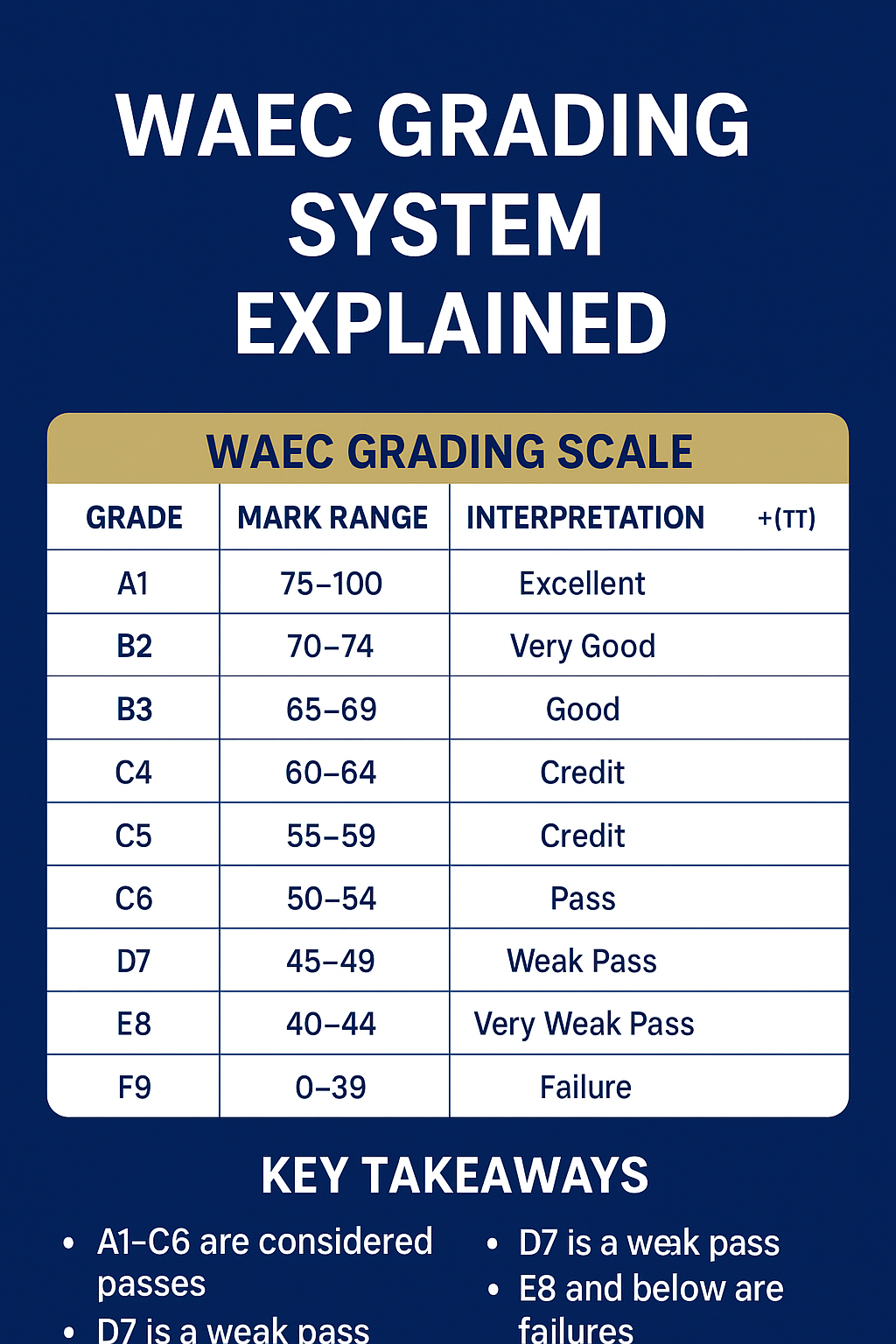
WAEC uses a nine-point grading system. Below is the official breakdown:
| Grade | Mark Range | Interpretation | Equivalent |
|---|---|---|---|
| A1 | 75–100 | Excellent | Distinction |
| B2 | 70–74 | Very Good | Distinction |
| B3 | 65–69 | Good | Credit |
| C4 | 60–64 | Credit | Credit |
| C5 | 55–59 | Credit | Credit |
| C6 | 50–54 | Credit | Credit |
| D7 | 45–49 | Pass | Weak Pass |
| E8 | 40–44 | Pass | Very Weak Pass |
| F9 | 0–39 | Fail | Failure |
To qualify for admission into most Nigerian universities, you need at least 5 credits (A1–C6) including English and Mathematics.
How WAEC Actually Grades Your Papers
Many students assume WAEC just “decides” results. In reality, the process is detailed and standardized:
-
Script Collection and Sorting
After the exams, scripts are collected from centers and sent to marking venues. -
Objective Papers (Multiple Choice)
These are graded using Optical Mark Recognition (OMR) scanners, ensuring accuracy and speed. -
Essay/Theory Papers
Marked manually by trained examiners using WAEC-approved marking schemes. -
Standardization
Chief examiners review random scripts to ensure all markers are consistent. -
Final Computation
Marks are converted into grades (A1–F9) using the official scale.
Common Misunderstandings About WAEC Grades
There are several myths among students:
-
❌ “WAEC favors some schools.”
✔️ False. All scripts are anonymized before marking. -
❌ “You can pass WAEC only with expo.”
✔️ Wrong. With stricter supervision and CCTV in centers, malpractice leads to withheld results. -
❌ “WAEC results depend on luck.”
✔️ No. Results are based on raw scores and standardized marking.
What WAEC Grades Mean for University Admission in Nigeria
-
JAMB + WAEC correlation: To gain admission, universities require minimum 5 credits including English and Mathematics.
-
Example: UNILAG, UNIBEN, and UNILORIN insist on credit passes in English, Mathematics, and relevant subjects.
-
D7/E8/F9 in core subjects: Even with a high JAMB score, admission may be denied if you lack credit in English or Mathematics.
How to Improve Your WAEC Grades Before the Exam
-
Study with WAEC past questions – They often repeat questions.
-
Use WAEC-approved textbooks – Don’t waste time with random materials.
-
Practice with JAMB/WAEC CBT apps – e.g., JambSmartPrep CBT app.
-
Join group study or lessons – Discussing with peers improves retention.
-
Follow the WAEC timetable strictly – Plan revision ahead of time.
WAEC Grading System vs NECO & GCE
| Exam Body | Highest Grade | Credit Range | Pass Range |
|---|---|---|---|
| WAEC | A1 (75–100) | C4–C6 (50–64) | D7–E8 (40–49) |
| NECO | A1 (75–100) | C (50–59) | D–E (40–49) |
| GCE | Same as WAEC | Same as WAEC | Same as WAEC |
-
WAEC is more widely recognized internationally compared to NECO.
-
GCE (Nov/Dec) follows the same WAEC grading but is for private candidates.
FAQs: WAEC Grading System Explained
1. What is the pass mark for WAEC?
The pass mark is 40% (E8), but universities require credits (50% and above).
2. Can I gain admission with D7 in WAEC?
Generally, no. Most universities require C6 or above in core subjects.
3. How does WAEC grade practicals?
Practicals in subjects like Chemistry, Physics, and Agric Science are marked separately and added to theory/obj scores.
4. Does WAEC use negative marking?
No, WAEC does not deduct marks for wrong answers.
5. Is C6 a credit?
Yes, C6 is a credit pass, though lower than C5 or C4.
6. Can WAEC results expire?
No. WAEC results remain valid for life.
7. How are withheld results handled?
If malpractice is confirmed, results may be canceled. Otherwise, they can be released after investigation.
8. Is WAEC harder than NECO?
Both are similar, but many students see WAEC as stricter in marking.
Conclusion: Understanding WAEC Grading = Exam Confidence
WAEC grading may seem complicated, but once you understand the system, you realize it is transparent, fair, and standardized. Knowing how grades are calculated helps reduce exam fear and gives you the confidence to prepare wisely.
If you’re preparing for WAEC, start with past questions, use official textbooks, and focus on consistent study habits.
Call to Action: Check our WAEC study guides and past questions download to boost your performance and secure admission into your dream university.