
Every year, thousands of Nigerian students sit for the NECO Mathematics exam, yet many continue to struggle because they do not fully understand the exam pattern. Unlike English or Civic Education, Mathematics requires not just memory but consistent practice with real exam-style questions.
The truth is that most students make the same mistakes over and over again because they have never practiced past questions under exam conditions. Some even study only their textbooks without seeing how examiners set the papers.
If you want to pass NECO Mathematics with confidence, past questions are your best companion. They show you the pattern, the repeated topics, and how marks are awarded. By the end of this guide, you will:
-
Access a free NECO Mathematics past questions PDF download.
-
Learn the right way to use these questions for effective preparation.
-
Discover exam strategies that increase your chances of getting A1 or B2.
Overview of NECO Mathematics Exam
What is NECO?
The National Examinations Council (NECO) is Nigeria’s official examination body established in 1999 to conduct Senior Secondary Certificate Examinations (SSCE). Just like WAEC, NECO is accepted by Nigerian universities, polytechnics, and even abroad in some cases.
Structure of NECO Mathematics Exam
The Mathematics paper usually has two main parts:
-
Objective (Multiple Choice) – 50 questions to be answered in about 1 hour.
-
Theory/Essay Section – 11 to 13 questions where students must show detailed workings.
Sometimes, practical calculation questions such as graph plotting, statistics, and geometry are included.
The National Examinations Council (NECO) is one of Nigeria’s recognized exam bodies alongside WAEC. It conducts the Senior Secondary Certificate Examination (SSCE), both internal (June/July) and external (Nov/Dec GCE).
Why is Mathematics Compulsory?
Mathematics is one of the five compulsory subjects for admission into Nigerian universities through JAMB. Courses like Engineering, Medicine, Economics, and even Social Sciences require a credit pass in Mathematics. This makes NECO Mathematics not just compulsory, but critical for your future studies.
Why is Mathematics compulsory? Because it is a gateway subject required for admission into Nigerian universities through JAMB UTME. Without credit passes in Mathematics and English, many courses become inaccessible.
15 Benefits of Using NECO Mathematics Past Questions
Practicing with past questions is more than a routine—it’s a proven strategy. Here are 15 reasons why you must use them:
-
Familiarity with exam pattern.
-
Exposure to repeated questions across years.
-
Better understanding of how NECO frames word problems.
-
Improved time management under real exam conditions.
-
Higher confidence levels before the exam.
-
Identification of your weak topics (e.g., Geometry, Algebra).
-
Direct practice with NECO examiner’s style.
-
Understanding how marks are awarded for each step.
-
Reduced chances of exam tension and panic.
-
Ability to practice offline without data.
-
Opportunity to revise Mathematics formulas through real questions.
-
Great for group discussions and tutorials.
-
Increases your chances of getting A1 or B2.
-
Helps you avoid careless mistakes.
-
Builds exam discipline and consistency.
NECO Mathematics Grading System Explained
NECO grades Mathematics using a point scale similar to WAEC.
-
Objective Section – Each question carries equal marks. Accuracy is key.
-
Theory Section – Marks are awarded for steps, not just the final answer. For instance, if you solve a quadratic equation and make a small mistake at the end, you can still earn 3 out of 5 marks for showing correct steps.
Importance of Showing Workings
Examiners always emphasize: “No steps, no marks.” Writing down formulas, substitution, and calculations is as important as the final solution.
NECO vs WAEC Grading
Both bodies grade using A1 (Excellent) to F9 (Fail). The only difference is that NECO results are released faster, usually within 60 days.
Students often wonder: How does NECO mark Mathematics papers?
-
Objective Section: Marked using OMR scanners, which record correct answers instantly.
-
Theory Section: Marked manually by subject examiners. Here, examiners award marks step by step. Showing your working process is as important as the final answer.
Grading Example (similar to WAEC):
-
A1 (75–100%) – Excellent
-
B2 (70–74%) – Very Good
-
B3 (65–69%) – Good
-
C4–C6 (50–64%) – Credit Pass
-
D7–E8 (40–49%) – Pass
-
F9 (0–39%) – Fail
This means that even if your final answer is wrong, you can still earn partial marks if your steps are correct.
NECO Mathematics Past Questions and Answers PDF (Free Download Link)
Here are downloadable past questions for practice:
| Year | Paper Type | Download Link |
|---|---|---|
| 2021 | Obj & Theory | [Download PDF] |
| 2022 | Obj & Theory | [Download PDF] |
| 2023 | Obj & Theory | [Download PDF] |
| 2024 | Obj & Theory | [Download PDF] |
Having these offline means you can practice without internet data—perfect for students in rural areas.
Sample NECO Mathematics Questions and Answers (Solved)
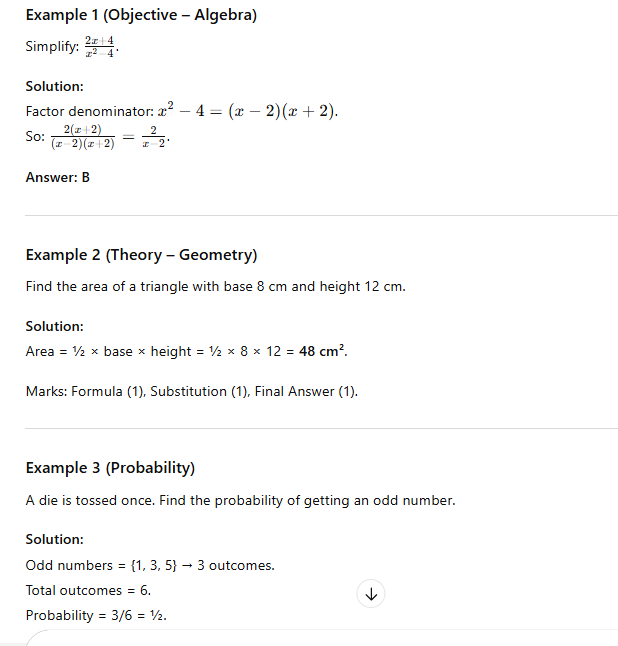
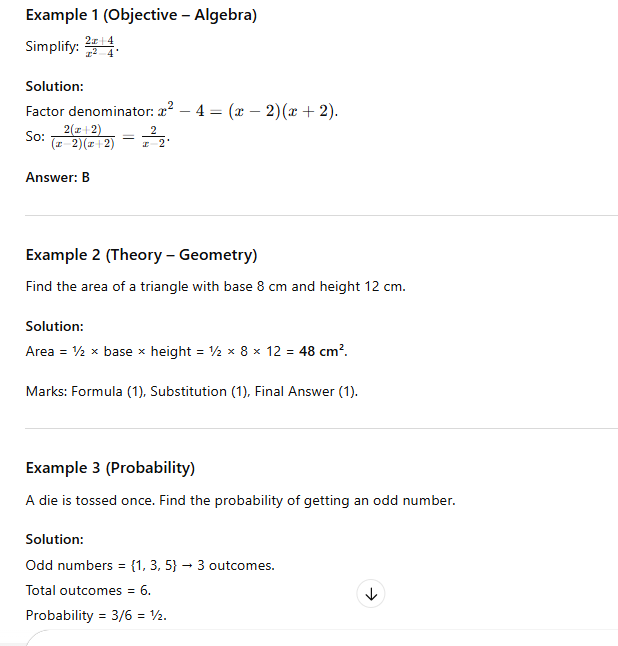
Let’s look at a few solved examples:
Example 1 (Objective – Algebra)
Simplify: 2x+4×2−4\frac{2x + 4}{x^2 – 4}.
Solution:
Factor denominator: x2−4=(x−2)(x+2)x^2 – 4 = (x-2)(x+2).
So: 2(x+2)(x−2)(x+2)=2x−2\frac{2(x+2)}{(x-2)(x+2)} = \frac{2}{x-2}.
Answer: B
Example 2 (Theory – Geometry)
Find the area of a triangle with base 8 cm and height 12 cm.
Solution:
Area = ½ × base × height = ½ × 8 × 12 = 48 cm².
Marks: Formula (1), Substitution (1), Final Answer (1).
Example 3 (Probability)
A die is tossed once. Find the probability of getting an odd number.
Solution:
Odd numbers = {1, 3, 5} → 3 outcomes.
Total outcomes = 6.
Probability = 3/6 = ½.
Simplify: 2×3+x2\dfrac{2x}{3} + \dfrac{x}{2}.
Solution:
4x+3×6=7×6\dfrac{4x + 3x}{6} = \dfrac{7x}{6}
Find the mean of 5, 8, 10, 7, 5.
Solution:
Mean=5+8+10+7+55=355=7\text{Mean} = \dfrac{5+8+10+7+5}{5} = \dfrac{35}{5} = 7
Solve: 2x+5=152x + 5 = 15.
Solution:
2x=10⇒x=52x = 10 \quad \Rightarrow \quad x = 5
In a triangle, the angles are in ratio 2:3:4. Find the largest angle.
Solution:
Sum of angles = 180.
2+3+4=9⇒49×180=80∘2+3+4 = 9 \quad \Rightarrow \quad \dfrac{4}{9} \times 180 = 80^\circ
Examiner Tip: Always show working steps. Even wrong answers may attract partial marks.
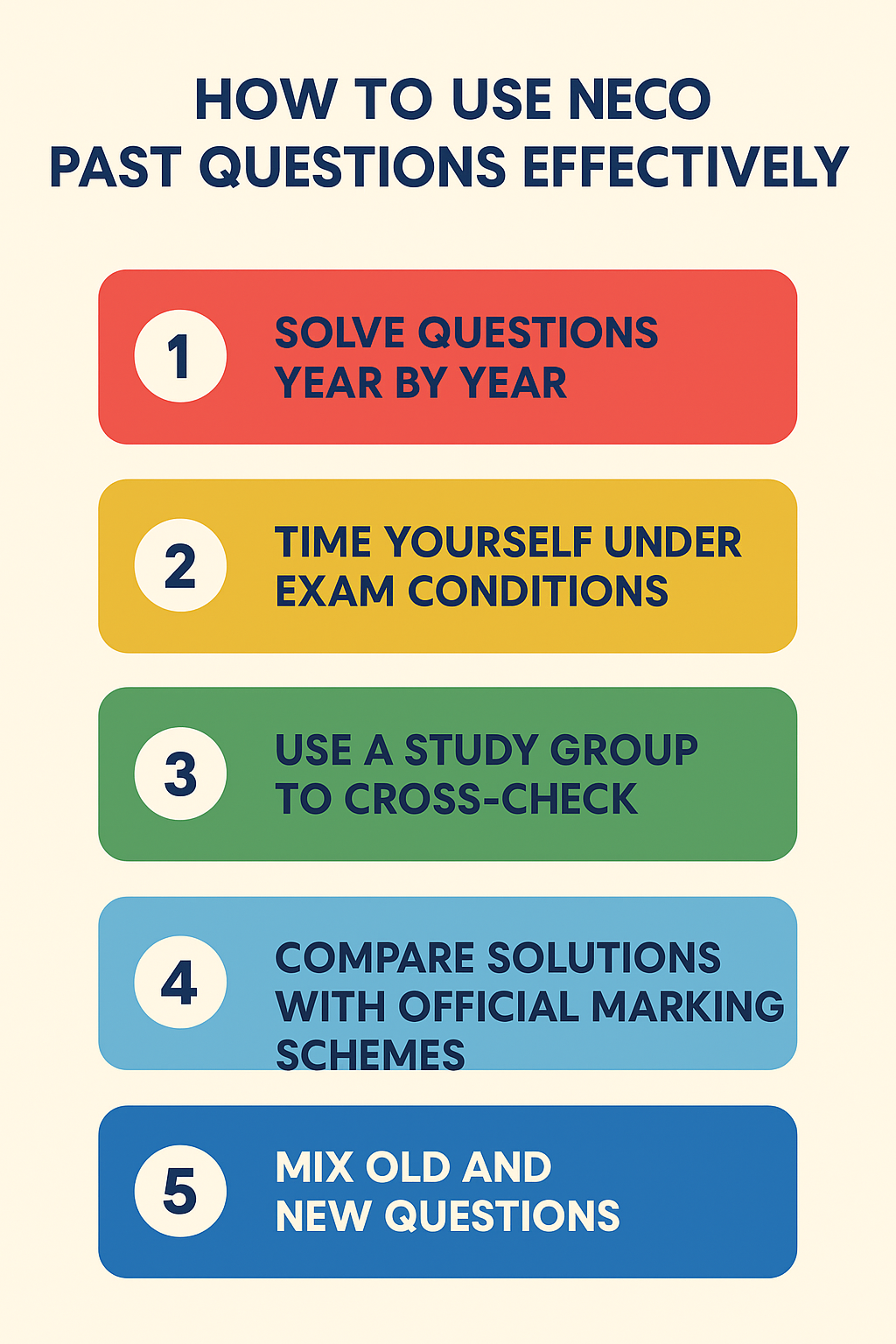
How to Study NECO Mathematics Past Questions Effectively
To get the best results:
-
Solve questions year by year – Don’t jump randomly.
-
Time yourself – e.g., 40 minutes for 50 objectives.
-
Use a study group – Cross-check answers with friends.
-
Compare with marking schemes – Learn how marks are awarded.
-
Mix old and new questions – Identify repeated trends.
10 Mistakes Students Make in NECO Mathematics
-
Cramming formulas without real understanding.
-
Skipping objective questions that carry easy marks.
-
Ignoring graph and construction questions.
-
Not labeling diagrams correctly.
-
Poor handwriting and unclear steps.
-
Rushing calculations, leading to errors.
-
Forgetting units (e.g., cm², m).
-
Leaving theory questions blank.
-
Depending on “expo” instead of preparation.
-
Starting late—some only practice a week before the exam.
NECO vs WAEC Mathematics Past Questions: Which Is Harder?
Many students ask if NECO is harder than WAEC. The truth is:
-
WAEC is sometimes broader in scope.
-
NECO questions are usually straightforward but require detailed steps.
-
Universities accept both, so your grade matters more than the exam body.
Tip: Practice both WAEC and NECO past questions for the best preparation.
FAQs: NECO Mathematics Past Questions and Answers
1. Where can I download free NECO Mathematics past questions PDF?
You can download them from educational blogs, student forums, and the official NECO-approved sites.
2. How many years of past questions should I study?
At least 10 years is recommended. Patterns repeat every 5–7 years.
3. Are NECO and WAEC Mathematics questions the same?
Not exactly, but they cover the same syllabus. Some questions overlap.
4. Does NECO repeat past questions?
Yes, especially objectives. Word-for-word repeats are common.
5. Can I pass NECO without expo?
Absolutely. With consistent practice, many students score A1 without malpractice.
6. How is NECO Mathematics marked?
Objective is computer-marked. Theory is manually marked, with marks for steps.
7. Is NECO accepted abroad?
Some universities abroad accept NECO, but WAEC is more widely recognized.
8. Can I use a calculator in NECO Mathematics?
Yes, but programmable calculators are not allowed.
9. What topics come out most in NECO Mathematics?
Algebra, Geometry, Statistics, Probability, and Trigonometry.
10. How do I overcome fear of Mathematics?
Practice daily with past questions. Confidence grows with familiarity.
Conclusion: Practice + Past Questions = Success
Passing NECO Mathematics is not about luck—it is about preparation. With the right past questions, consistent practice, and smart study habits, you can move from average grades to A1 or B2.
Download the free NECO Mathematics past questions PDF now and begin your preparation. The earlier you start, the better your results will be.
Also, check out related guides:
With focus, discipline, and these resources, your NECO success is within reach.
