Welcome to Jambsmartprep.com, your no. 1 guide for Jamb, WAEC, NECO and admissions. In today’s post, we will be covering virtually everything you need to know about How to Use WAEC Past Questions Effectively: A Complete Study Guide.
Yes, during the course of this online guide, you will learn how to use WAEC past questions effectively, review mistakes, study by topic, practise under time, and prepare smarter for your WASSCE exams. All you need to do to get what you want is to keenly follow all the instructions outlined in this post.
As you may know, preparing for WAEC can become stressful when you have plenty of materials but do not know how to use them.
You may have downloaded several years of WAEC past questions, bought a past-question booklet, or installed a practice app. Yet after answering hundreds of questions, you may still feel unprepared when you meet a question that looks different from what you have practised.
The problem is not always the number of questions you solve.
It is how you use them.
WAEC past questions can help you understand question formats, practise recalling information, identify weak areas, improve speed, and become more comfortable with examination conditions. However, they work best when combined with proper study of the syllabus, textbooks, class notes, marking guidance and careful review of mistakes.
This guide explains exactly how to use WAEC past questions effectively, whether you are preparing for Mathematics, English Language, Biology, Chemistry, Physics, Government, Economics, Literature or another WASSCE subject.
You will also learn how many years of past questions to practise, whether to study by year or topic, how to use past questions with the WAEC syllabus, how to create a mistake log, how to use Chief Examiners’ Reports and what to do when your practice scores remain low.
Most importantly, you will learn how to turn past questions from a collection of old exam papers into a practical study system.
What Are WAEC Past Questions?
WAEC past questions are questions taken from previous West African Senior School Certificate Examination papers.
Students use them to practise before their own examination.
Depending on the subject, past-question materials may include objective questions, theory questions, essay questions, calculations, practical-related questions, diagrams and other forms of assessment.
For a Nigerian student preparing for WASSCE, past questions can answer an important question:
What does an examination question actually look like?
Reading a textbook tells you what a topic means.
A past question shows you how you may be expected to apply that knowledge.
For example, you may spend time studying probability in Mathematics. You understand the formulas and examples in your textbook.
When you meet a WAEC question that presents probability through a word problem, however, you may discover that your difficulty is not the formula.
Your difficulty may be understanding what the question is asking.
That is one reason past questions are valuable.
They expose the difference between knowing a topic and being able to answer an examination question about that topic.
Why Are WAEC Past Questions Important?
Past questions are useful because they turn studying from a passive activity into an active one.
Instead of simply reading a Biology chapter repeatedly, you can close your book and attempt questions that require you to recall and apply what you learned.
This is closely related to retrieval practice, a learning approach in which students deliberately retrieve information from memory rather than simply rereading it. Research reviewed in the Annual Review of Psychology found that practising retrieval can support later retention and slow forgetting.
For a WAEC candidate, this means a past question can do more than show you an old examination problem.
It can become a learning exercise.
1. Past questions help you practise recall
Suppose you studied the functions of the kidney in Biology yesterday.
You could read the same notes again today.
Or you could close the textbook and answer:
“State three functions of the kidney.”
The second activity requires you to retrieve the information.
If you cannot answer, you have discovered a learning gap.
That is useful information.
2. They help you understand how questions are worded
WAEC questions may use command words such as:
- State
- Define
- Explain
- List
- Describe
- Calculate
- Compare
- Distinguish
- Give reasons
- Illustrate
- Discuss
These words matter.
A question asking you to state something may require a different response from one asking you to explain it.
Students sometimes know the topic but lose marks because they do not answer the actual demand of the question.
3. They reveal weak areas
You may believe you are good at Mathematics because you can follow examples in class.
Then you attempt a past paper and discover that you repeatedly miss questions involving graphs.
That is not bad news.
You have just identified an area that needs attention.
4. They help you practise speed
Knowing an answer is useful.
Knowing it within the time available in the examination is even more useful.
Timed past-question practice helps you discover whether you spend too long on certain questions.
5. They help you become familiar with examination conditions
The first time you sit down to complete a full paper under time pressure should not be the actual examination.
Regular practice can make the process more familiar.
6. They help you test whether you really understand a topic
A student can recognise an answer without being able to produce it independently.
For example, if you see the solution to a Chemistry question and think, “Yes, I understand this,” that does not necessarily mean you can solve a similar question without assistance.
The real test is whether you can produce the solution yourself.
Can You Pass WAEC by Studying Only Past Questions?
Past questions can be a major part of WAEC preparation, but relying on them alone is risky.
The better approach is:
WAEC syllabus + textbooks or class notes + past questions + marking guidance + mistake review
Past questions show you what has been tested before.
They do not cover every piece of knowledge you may need.
Imagine that you memorise the answer to a particular Mathematics question.
If a future question tests the same mathematical principle using different numbers or a different situation, memorisation may not help.
The same problem can occur in Biology, Chemistry, Physics, Government and other subjects.
The goal should therefore be to understand the concept behind the question.
What happens when you rely only on past questions?
You may:
- Memorise answers without understanding them
- Become dependent on familiar wording
- Miss topics that have not appeared frequently
- Struggle with reworded questions
- Develop false confidence
- Ignore parts of the syllabus
- Repeat the same mistakes
Past questions should therefore be treated as a practice and diagnostic tool, not a replacement for learning.
How to Use WAEC Past Questions Effectively
The most useful way to approach past questions is to follow a repeatable process.
Use this seven-step method:
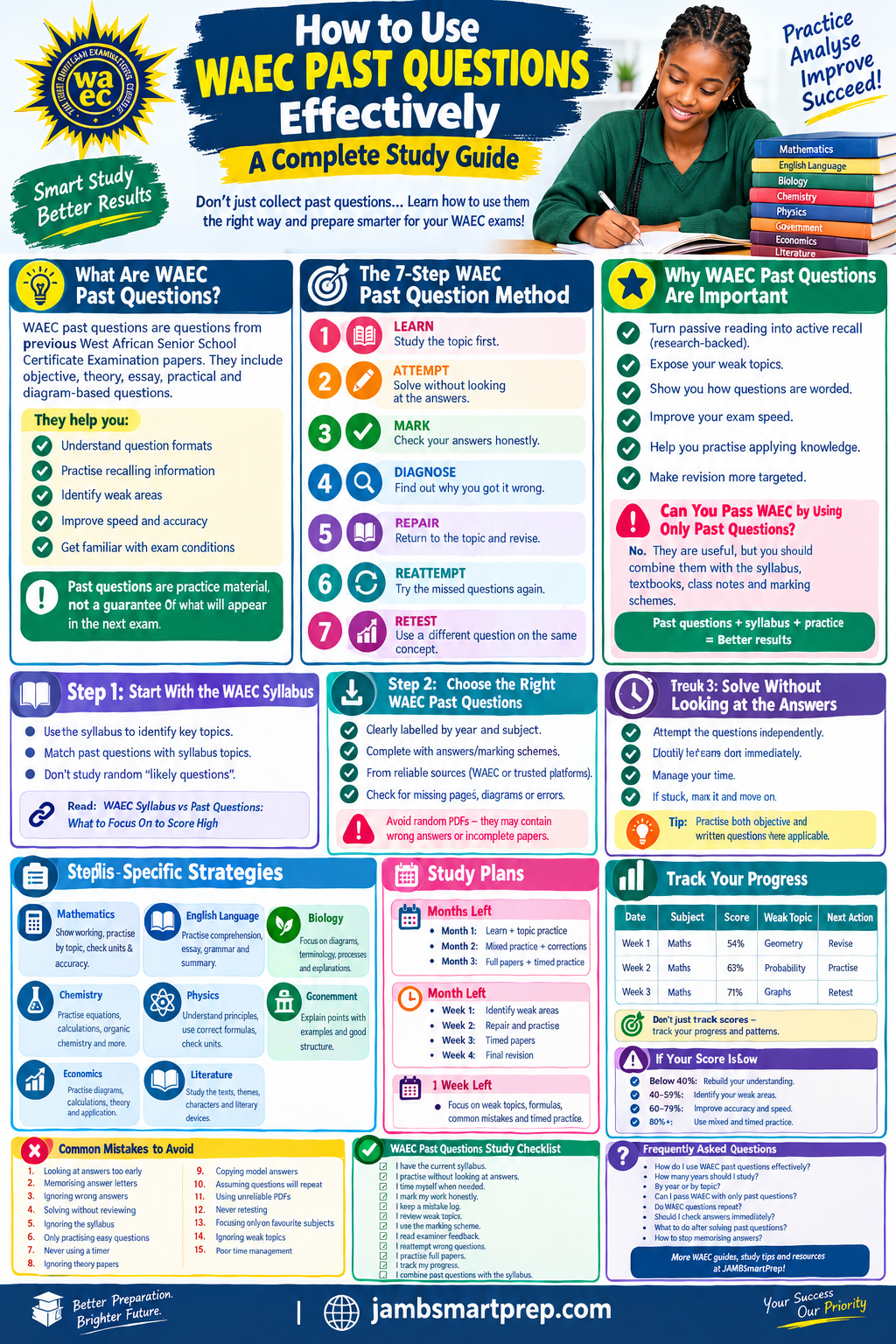
The WAEC 7-Step Past Question Method
1. Learn
Study the topic first.
2. Attempt
Answer questions without looking at the solution.
3. Mark
Check your answers honestly.
4. Diagnose
Find out why you got each wrong answer.
5. Repair
Return to the relevant topic and correct your understanding.
6. Reattempt
Try the question again later.
7. Retest
Answer another question that tests the same concept.
This is much more effective than simply completing one paper, checking your score and moving to another paper.
Step 1: Start With the WAEC Syllabus
Before opening ten years of past questions, understand what you are expected to study.
The syllabus provides direction.
Past questions provide practice.
You need both.
For example, if you are preparing for Biology, use your syllabus to identify the topics you need to cover.
After studying a topic, look for past questions that test that area.
This creates a simple cycle:
Syllabus topic → Learn topic → Practise questions → Review mistakes → Revise → Retest
Also read this article: WAEC Syllabus vs Past Questions: What to Focus On to Score High
Why should you use the syllabus first?
Without the syllabus, you may spend too much time studying whatever topics happen to appear frequently in your past-question booklet.
That can create gaps.
A past-question archive tells you what has appeared before.
The syllabus helps you organize what you are expected to learn.
Example
Imagine that a student has 10 years of Mathematics past questions.
He notices that some topics appear frequently.
He spends most of his revision time on those topics.
But he ignores several other syllabus areas because they have appeared less often in the questions he reviewed.
That is a risky strategy.
The better approach is to use past questions to practise and diagnose, while using the syllabus to make sure your preparation remains broad enough.
Step 2: Choose the Right WAEC Past Questions
Not every past-question resource deserves the same level of trust.
When choosing WAEC past questions, look for materials that are:
- Clearly labelled by examination year
- Correctly organized by subject
- Complete where possible
- Based on authentic examination material
- Accompanied by reliable answers
- Consistent with the applicable syllabus
- Clear enough to read diagrams and tables
Be especially careful with random PDFs shared through social media.
A file may be labelled “WAEC Past Questions and Answers” while containing:
- Incorrect answers
- Missing pages
- Poorly reproduced diagrams
- Wrong examination years
- Incomplete papers
- Unverified solutions
If an answer appears suspicious, do not automatically assume the answer key is correct.
Check your textbook, teacher, reliable solution or another trusted source.
Step 3: Start Solving Without Looking at the Answers
This is one of the most important rules.
Do not keep the answers beside you while solving.
If you look at the answer immediately after reading each question, you may confuse recognition with knowledge.
For example:
You read Question 4.
You think about it.
You check the answer.
You see that the correct option is C.
You say, “Yes, C makes sense.”
Then you move to Question 5.
You may finish the entire paper feeling confident.
But you have not necessarily tested your ability to retrieve the information independently.
A better method
- Read the question.
- Think carefully.
- Attempt the answer.
- Move on.
- Finish the section or paper.
- Mark your answers afterwards.
This creates a more honest picture of what you know.
How Long Should You Spend on a Difficult Question?
Do not spend an unreasonable amount of time on one question during normal practice.
If you genuinely cannot answer it:
- Mark it.
- Move to the next question.
- Return to it later.
- Check the solution only after you have made a genuine attempt.
This teaches an important examination skill.
Sometimes the best decision is not to fight one difficult question for too long.
Step 4: Mark Your WAEC Past Questions Properly
Checking your score is not enough.
You need to understand why you lost marks.
Suppose you answer 50 objective questions and score 30.
Your score is 60%.
That number tells you something.
But it does not tell you why the other 20 questions were wrong.
Were they all from one topic?
Did you misunderstand the questions?
Did you make careless mistakes?
Did you forget formulas?
Did you run out of time?
The real value comes from answering those questions.
Use a simple tracking table
| Question | Topic | My Answer | Correct Answer | Why I Missed It | Action |
|---|---|---|---|---|---|
| 4 | Algebra | B | D | Formula gap | Revise formula |
| 11 | Geometry | C | C | Correct | Keep practising |
| 18 | Probability | A | B | Misread question | Practise wording |
| 25 | Graphs | D | C | Calculation error | Redo calculation |
This turns a past-question session into a study session.
Step 5: Create a WAEC Mistake Log
A mistake log is one of the simplest tools you can use to improve your preparation.
Instead of writing:
“I got Question 14 wrong.”
write:
“I got Question 14 wrong because I confused mean with median.”
That information is much more useful.
Category 1: Knowledge mistake
You did not know the information.
Solution: Study the topic again.
Category 2: Conceptual mistake
You knew the terms but misunderstood the idea.
Solution: Find a clearer explanation and work through examples.
Category 3: Interpretation mistake
You misunderstood what the question was asking.
Solution: Practise reading questions carefully and identifying command words.
Category 4: Calculation mistake
You knew the correct method but made an arithmetic error.
Solution: Redo the calculation carefully.
Category 5: Memory mistake
You understood the topic but could not recall an important fact, formula or term.
Solution: Use active recall and spaced revision.
Category 6: Careless mistake
You knew the answer but rushed.
Solution: Slow down and develop a checking habit.
Category 7: Time-management mistake
You knew how to answer the question but spent too long elsewhere.
Solution: Practise with a timer.
Category 8: Instruction mistake
You failed to follow what the question required.
Solution: Read the question and its instructions carefully before answering.
This type of mistake analysis is especially valuable because WAEC’s own Chief Examiners’ Reports repeatedly identify problems such as misinterpretation, failure to follow rubrics, inadequate explanations, weak technical terminology and incomplete preparation.
Step 6: Go Back to the Topic After a Mistake
This is where many students stop too early.
They check the correct answer and move on.
Instead, ask:
Why did I get this wrong?
Then return to the relevant topic.
For example, imagine that you miss five questions involving probability.
Do not simply memorise those five answers.
Review probability.
Look at:
- Basic probability
- Complementary events
- Combined events
- Probability rules
- Word problems
Then attempt different questions on the same topic.
Your goal is not to remember Question 12.
Your goal is to become better at probability questions.
Step 7: Reattempt Questions You Got Wrong
Do not let your mistake log become a graveyard for wrong answers.
Use it actively.
A useful revision pattern is:
First attempt → correction → later reattempt → new question on the same topic
For example:
Monday: Attempt probability questions.
Monday evening: Review mistakes.
Wednesday: Reattempt missed questions.
Saturday: Solve different probability questions.
Following week: Test yourself again.
This helps you determine whether the correction actually worked.
Should You Study WAEC Past Questions by Year or by Topic?
Both methods are useful.
The best choice depends on where you are in your preparation.
When to Study by Topic
Topic-based practice is particularly useful when you are still learning or repairing weak areas.
For example:
Mathematics
- Algebra
- Geometry
- Statistics
- Probability
- Trigonometry
You can collect questions from different years that belong to one topic.
Then practise them together.
Why topic-based practice works
It helps you see how the same concept can be tested in different ways.
For example, one year may ask a direct question.
Another year may present a word problem.
Another may combine two related concepts.
You learn the underlying skill rather than memorising the wording.
When to Study by Year
Year-by-year practice is more useful when you want to simulate an examination.
Choose one complete paper.
Set a timer.
Remove your textbook.
Do not check answers.
Complete the paper.
Then mark it afterwards.
This gives you a more realistic picture of your preparation.
The Best Combination
Use this progression:
Topic practice → Mixed practice → Full paper → Timed examination simulation
This is more useful than choosing one method and ignoring the other.
How Many Years of WAEC Past Questions Should You Study?
There is no magic number of years that guarantees a particular WAEC grade.
You may see websites recommending five years, ten years or even more.
The number itself is less important than what you do with the questions.
Five years of carefully analysed practice can be more useful than ten years of questions that you rush through without reviewing.
Consider:
- How much time you have left
- Your current knowledge
- The subject
- The availability of reliable papers
- Changes to the syllabus
- Whether you have reviewed your previous mistakes
If you have plenty of preparation time
Work through several years gradually.
Focus on understanding and analysis.
If you have limited time
Do not attempt to race through a huge archive.
Identify your weak areas.
Practise those topics.
Then complete selected full papers under timed conditions.
The important rule
Do not ask only:
“How many questions have I solved?”
Ask:
“What have I learned from the questions I solved?”
That is a much better measure of productive practice.
How to Use WAEC Past Questions With the Marking Scheme
A marking scheme can teach you more than the correct answer.
This is especially important for theory and essay subjects.
Suppose you answer:
“Photosynthesis is the process by which plants make food.”
That may demonstrate some knowledge.
But if the question asks you to explain the process, a brief definition may not satisfy the full demand.
You need to understand what the question requires and how marks are allocated.
When reviewing a theory answer, ask:
- Did I answer the actual question?
- Did I provide enough points?
- Did I explain my points?
- Did I include relevant examples?
- Did I show the required working?
- Did I use correct terminology?
- Did I follow the instructions?
This is one reason past-question practice should not be limited to multiple-choice questions.
How to Use WAEC Chief Examiners’ Reports
This is an underused resource for many students.
WAEC’s official e-learning resources provide examples of previous examination performance, candidate weaknesses, strengths, expected answers and suggested remedies.
The Council also states that Chief Examiners’ Reports provide feedback on candidates’ performance and can help schools and private candidates prepare for subsequent examinations.
This gives students something more valuable than simply seeing old questions.
You can learn about common mistakes candidates make.
For example, WAEC examiner feedback in different subjects has highlighted problems involving:
- Misinterpreting questions
- Poor explanations
- Failure to follow rubrics
- Weak knowledge of topics
- Poor technical terminology
- Poor diagrams
- Incomplete answers
- Poor written expression
- Spending too much time on certain sections
These observations can be turned into your own checklist.
How to combine a Chief Examiners’ Report with past questions
Use this process:
Read question → Attempt question → Mark answer → Read examiner feedback → Identify common weakness → Revise → Reattempt
That gives you a deeper understanding of what the examination demands.
How to Use WAEC Past Questions for Different Subjects
One mistake students make is assuming that every WAEC subject should be practised in exactly the same way.
The general method is similar.
However, the skills you need to improve can be very different.
A Mathematics candidate may need more calculation practice.
A Literature student may need stronger interpretation and essay development.
A Biology student may need to improve diagrams, terminology and explanations.
A Government candidate may need to work on explaining points rather than simply listing them.
Here is how to adapt your past-question strategy.
How to Use WAEC Mathematics Past Questions
Mathematics past questions should not be treated as a collection of answers to memorise.
They should be used to develop problem-solving ability.
Focus on the method
When you get a Mathematics question wrong, ask:
- Which topic is this?
- What principle should I have used?
- Did I choose the wrong formula?
- Did I interpret the question incorrectly?
- Did I make a calculation error?
- Did I round off too early?
- Did I include the correct unit?
- Did I show enough working?
WAEC Chief Examiners’ Reports for General Mathematics have repeatedly identified weaknesses involving graphs, geometry, word problems, units, accuracy, interpretation, rubrics and excessive dependence on calculators.
That means your Mathematics practice should go beyond getting the final number.
Always show your working where required
Do not train yourself to jump directly to the answer.
Practise the process.
For calculation questions, record:
Given information → Formula or principle → Substitution → Working → Final answer → Unit
Practise difficult topics separately
If you repeatedly miss questions involving:
- Geometry
- Graphs
- Probability
- Statistics
- Bearings
- Mensuration
- Financial mathematics
- Algebra
create separate practice sessions for those areas.
Example
If you score 55% in a Mathematics paper and most of your mistakes come from geometry, do not simply solve another random paper.
Spend time repairing geometry.
Then test yourself again.
That is targeted revision.
How to Use WAEC English Language Past Questions
English Language requires more than memorising correct options.
Depending on the paper and syllabus, your preparation may involve areas such as:
- Comprehension
- Summary
- Essay writing
- Lexis and structure
- Oral English
- Grammar and usage
Practise comprehension actively
Do not read the passage and immediately check the answers.
Read the passage.
Answer independently.
Then check.
For every wrong answer, return to the passage and identify the part that supports the correct answer.
This helps you distinguish between what the passage actually says and what you assumed it said.
Practise essay writing
Past questions are particularly useful for learning how to respond to different writing situations.
Practise:
- Understanding the audience
- Identifying the purpose
- Organising ideas
- Writing introductions
- Developing paragraphs
- Using appropriate vocabulary
- Writing conclusions
Do not only read model essays.
Write your own.
Practise summary questions
After answering a summary question, compare your response with the expected points.
Ask:
- Did I identify the required points?
- Did I avoid unnecessary details?
- Did I express the ideas clearly?
- Did I follow the required format?
How to Use WAEC Biology Past Questions
Biology past questions are particularly useful for identifying areas where you know a definition but cannot properly explain or apply it.
WAEC Biology examiner reports have highlighted issues such as weak knowledge of basic topics, poor interpretation, incorrect spelling of biological terms, weak diagrams and difficulty applying biological principles.
Use your past questions to practise:
- Definitions
- Processes
- Functions
- Structures
- Adaptations
- Genetics
- Ecology
- Classification
- Diagrams
- Practical applications
Practise diagrams
If a past question requires a diagram, draw it.
Do not simply look at the answer.
Check:
- Shape
- Proportion
- Labels
- Guidelines
- Title where required
- Relevant structures
Practise scientific terminology
If you repeatedly miss marks because you cannot spell important biological terms correctly, create a terminology list.
Review it regularly.
How to Use WAEC Chemistry Past Questions
Chemistry requires a mixture of knowledge, calculations and application.
Use past questions to identify whether your weakness is:
- Chemical equations
- Mole calculations
- Stoichiometry
- Acids and bases
- Organic chemistry
- Periodic trends
- Chemical bonding
- Qualitative analysis
- Practical chemistry
Do not memorise calculations
If you repeatedly miss mole questions, do not memorise the answer to one past question.
Practise the underlying process.
For example:
Identify what is given → identify what is required → choose the relevant relationship → calculate → check units and reasonableness
Then solve a different question.
How to Use WAEC Physics Past Questions
Physics past questions should help you develop both conceptual understanding and calculation skills.
When reviewing a wrong answer, ask:
- Did I understand the physical principle?
- Did I choose the correct formula?
- Did I substitute correctly?
- Did I use the correct unit?
- Did I interpret the diagram?
- Did I calculate correctly?
A student who memorises formulas without understanding their meaning may struggle when the question is presented differently.
Use past questions to practise applying formulas to different situations.
How to Use WAEC Government Past Questions
Government requires more than memorising definitions.
You should practise explaining ideas clearly.
For example, if a question asks you to explain the functions of a particular institution, do not simply write isolated keywords.
Develop each point.
A strong practice routine is:
Point → Explanation → Relevant example
WAEC’s Government examiner feedback has specifically identified problems such as misinterpretation, violation of rubrics, inadequate preparation and answers that are too brief to earn satisfactory marks.
That means your past-question practice should include learning how to develop an answer, not just identify a keyword.
How to Use WAEC Economics Past Questions
Economics past questions can help you practise:
- Definitions
- Calculations
- Diagrams
- Theory
- Application
- Interpretation
When practising Economics, ask yourself whether you can explain the concept without looking at the textbook.
For diagrams, practise drawing and labelling them yourself.
For calculations, show the process.
For theory questions, explain the relationship between the ideas rather than memorising a paragraph.
How to Use WAEC Literature-in-English Past Questions
Literature requires particularly careful use of past questions.
WAEC examiner reports have identified weaknesses including shallow knowledge of prescribed texts, wrong interpretation of questions, irrelevancies, poor expression and failure to follow rubrics.
This means students should not prepare by reading only summary notes.
Read the prescribed texts required for your examination.
Then use past questions to practise interpretation.
Ask yourself:
- What exactly is the question asking?
- Which character or theme is involved?
- What evidence from the text supports my point?
- Am I answering the question or simply discussing the topic?
- Have I developed my points?
- Am I using relevant references?
Past questions should help you practise thinking about the text, not replace reading the text.
How to Practise WAEC Past Questions Under Exam Conditions
There are two modes of past-question practice.
Learning mode
Use this when you are still learning a topic.
You can:
- Pause
- Review notes
- Study explanations
- Ask a teacher for help
- Rework difficult questions
The goal is understanding.
Examination mode
Use this when you want to measure your readiness.
You should:
- Select a complete paper.
- Set the appropriate time.
- Remove your textbook.
- Put your phone away if possible.
- Do not check answers during the test.
- Follow the paper instructions.
- Complete the paper.
- Mark it afterwards.
- Analyse your mistakes.
Both modes are important.
You should not spend your entire preparation in examination mode.
If you are still weak in a topic, you need learning mode.
How to Track Your WAEC Past Question Scores
Do not depend on memory.
Create a simple record.
| Date | Subject | Paper | Score | Main Weakness | Next Action |
|---|---|---|---|---|---|
| Week 1 | Mathematics | Paper 2 | 54% | Geometry | Revise |
| Week 2 | Mathematics | Paper 2 | 63% | Probability | Practise |
| Week 3 | Mathematics | Paper 2 | 71% | Graphs | Retest |
| Week 4 | Mathematics | Full Paper | 78% | Time | Timed practice |
Your objective is not to make every practice score perfect.
Your objective is to identify a pattern of improvement.
What should you track?
Track:
- Score
- Time taken
- Questions missed
- Topics missed
- Type of mistakes
- Repeated mistakes
- Topics successfully improved
This creates a personal performance record.
What to Do If Your WAEC Past Question Score Is Low
A low score is not automatically a sign that you cannot succeed.
It is information.
Suppose you score 42% on your first serious practice paper.
Instead of saying:
“I am not good at this subject.”
ask:
“Why did I lose the 58%?”
Maybe:
- 20% was from topics you had never studied
- 15% was from careless mistakes
- 10% was from poor time management
- 8% was from misreading questions
- 5% was from calculation errors
Now you have a plan.
If most mistakes are knowledge gaps
Study the relevant topics.
If most mistakes are interpretation problems
Practise reading questions carefully.
If most mistakes are calculations
Work through more examples.
If most mistakes are careless errors
Slow down and introduce a checking routine.
If most mistakes come from time pressure
Practise timed papers.
The important point is that a score should lead to diagnosis, not discouragement.
What If You Keep Getting the Same WAEC Questions Wrong?
If you get the same question wrong repeatedly, stop and investigate.
Do not simply answer it again and again without understanding why.
Ask:
Do I understand the topic?
If no, study it.
Do I understand the question?
If no, practise similar questions.
Do I know the procedure?
If no, work through examples.
Do I forget the information?
If yes, use active recall and spaced revision.
Do I rush?
If yes, practise more carefully.
The goal is to eliminate the cause of the mistake.
How to Identify Repeated WAEC Topics Without Assuming Questions Will Repeat
Past questions can help you notice recurring concepts and question styles.
But be careful with the phrase “repeated WAEC questions.”
There is a major difference between:
- A topic appearing repeatedly
- A concept being tested repeatedly
- A similar question format appearing
- An exact question appearing again
You should not assume that because a question appeared several times, the exact same question will appear in your examination.
A better approach
Compare several years.
Create a table:
| Topic | Year 1 | Year 2 | Year 3 | Year 4 | Priority |
|---|---|---|---|---|---|
| Algebra | ✓ | ✓ | ✓ | ✓ | High |
| Probability | ✓ | – | ✓ | – | Medium |
| Topic C | – | ✓ | – | ✓ | Medium |
This can help you identify concepts that deserve attention.
Then return to the syllabus.
Ask:
Have I actually learned this topic?
Do not turn the exercise into a prediction game.
Can WAEC Past Questions Repeat?
Topics and concepts can recur across examinations, and similar question structures may appear in different years.
However, students should not treat past questions as a guarantee of exact repetition.
A question can be:
- Reworded
- Presented with different numbers
- Asked from another angle
- Combined with another concept
- Applied to a new situation
Therefore, study the principle behind the question.
If you understand the principle, you are better prepared for variations.
Is Memorising WAEC Past Questions a Good Strategy?
Memorising answers alone is not a reliable strategy.
Consider this simple example.
You memorise:
Question: What is the probability of an event?
You remember the exact answer from an old paper.
But the new question changes the numbers.
If you memorised the answer instead of learning the method, you may become stuck.
Now consider another student.
She learns the probability principle.
She practises several different examples.
The wording changes, but the underlying concept remains understandable.
That is the type of preparation you should aim for.
Use the “Why?” test
After answering a past question, ask:
Why is this the correct answer?
If you cannot explain why, you probably need to study the concept again.
How to Use WAEC Past Questions With Three Months Left
If you have approximately three months before the examination, divide your preparation into stages.
Month 1: Learn and practise
Focus on:
- Syllabus coverage
- Weak topics
- Topic-based past questions
- Understanding concepts
- Building your mistake log
Month 2: Mixed practice
Move toward:
- Mixed-topic questions
- More past papers
- Timed sections
- Regular mistake review
- Reattempting difficult questions
Month 3: Examination practice
Focus on:
- Full papers
- Timed practice
- Weak areas
- Marking schemes
- Final revision
- Reducing repeated mistakes
Do not spend the entire third month memorising answer keys.
Use it to test whether you can actually solve problems independently.
How to Use WAEC Past Questions With One Month Left
One month is still enough time to improve your preparation if you study strategically.
Week 1
Identify your weak topics.
Use past questions diagnostically.
Week 2
Repair those weaknesses.
Study the relevant topics and practise targeted questions.
Week 3
Complete timed papers.
Review every important mistake.
Week 4
Focus on:
- Weak areas
- Common mistakes
- Formulas
- Definitions
- Diagrams
- Essay structure
- Time management
- Full-paper practice
Avoid spending the final week randomly jumping between hundreds of questions.
How to Use WAEC Past Questions One Week Before the Exam
At this stage, your goal should be consolidation rather than trying to learn an entire subject from scratch.
Prioritise:
- Your mistake log
- Weak topics
- Important formulas
- Key definitions
- Common question formats
- Essay practice
- Timed sections
- Previously missed questions
Also make sure you understand the examination instructions.
Do not sacrifice sleep simply to increase the number of questions you complete.
A tired student may make avoidable mistakes.
The 60-Minute WAEC Past Question Study Session
Here is a simple routine you can use at home.
Minutes 0–10: Review
Review the topic you are about to practise.
Minutes 10–35: Attempt
Solve questions without looking at the answers.
Minutes 35–45: Mark
Check your answers.
Minutes 45–55: Diagnose
Record why you missed each important question.
Minutes 55–60: Plan
Write down what you need to revise before your next session.
This is more productive than spending an hour simply clicking through questions.
How to Use WAEC Past Questions When Studying at Home
Not every Nigerian student has access to a private tutor or a quiet study room.
You can still create an effective system.
If you use printed booklets
Keep a separate notebook for mistakes.
Do not write all your answers directly beside the original questions if you intend to repeat the exercise later.
If you use PDFs
Organise them by:
- Subject
- Examination year
- Paper
Avoid downloading dozens of files without actually using them.
If you use a phone
Turn off unnecessary notifications during practice.
If possible, download materials for offline use where legitimate and available.
If you use a CBT platform
Use timed practice and performance reports when available.
But do not become dependent on instant answers.
The learning still comes from attempting, reviewing and correcting.
WAEC Past Questions PDF vs CBT Practice
Both can be useful.
| Method | Main Advantage |
|---|---|
| Printed past questions | Good for written practice |
| Easy to store and review | |
| CBT practice | Useful for timed objective practice |
| Topic practice | Good for weak areas |
| Full paper | Good for exam simulation |
| Marking scheme | Helps you understand expected responses |
You do not have to choose only one.
For example, you might study Mathematics using printed theory questions while using a digital platform for quick objective practice.
Common Mistakes Students Make When Using WAEC Past Questions
1. Looking at answers too early
This creates false confidence.
2. Memorising answer letters
Knowing that the answer was “B” does not teach you the concept.
3. Ignoring wrong answers
A wrong answer is useful only if you learn from it.
4. Solving too many questions without reviewing
Volume is not the same as effective practice.
5. Ignoring the syllabus
Past questions do not necessarily represent every topic you need to know.
6. Practising only easy questions
Your difficult areas deserve attention too.
7. Never using a timer
Eventually you need to practise under realistic conditions.
8. Ignoring theory
Objective practice alone is not enough for subjects that contain substantial written responses.
9. Copying model answers
Copying can make you feel productive without developing your own ability.
10. Assuming every repeated topic will appear
Patterns are useful for revision.
They are not guarantees.
11. Using unreliable answer keys
An incorrect solution can teach you the wrong method.
12. Never retesting yourself
If you do not revisit your mistakes, you may repeat them.
How to Know If You Are Actually Improving
Your improvement should not be measured only by your score.
Look for these signs.
You make fewer repeated mistakes
If you repeatedly missed probability questions but now solve them correctly, that is progress.
You finish faster
Improved speed can indicate greater familiarity and understanding.
You can explain your answers
Being able to explain why an answer is correct is stronger evidence of understanding than recognising it.
You can solve unfamiliar questions
This is one of the best tests.
If the wording changes and you can still solve the problem, you are learning the concept rather than memorising the question.
You need fewer hints
Gradually, you should become more independent.
WAEC Past Questions Study Checklist
Before each study session, ask:
☐ Do I know the topic I am practising?
☐ Am I using a reliable past-question source?
☐ Am I attempting the questions before checking answers?
☐ Am I timing myself when appropriate?
☐ Am I marking honestly?
☐ Am I recording important mistakes?
☐ Do I know why each wrong answer was wrong?
☐ Have I returned to the relevant topic?
☐ Have I reattempted difficult questions?
☐ Am I tracking my progress?
☐ Am I combining past questions with the syllabus?
☐ Am I practising both objective and written questions where required?
Frequently Asked Questions About WAEC Past Questions
How do I use WAEC past questions effectively?
Study the relevant topic first, attempt questions without looking at answers, mark your work, identify why you made mistakes, revise the weak areas and reattempt similar questions later.
How many years of WAEC past questions should I study?
There is no magic number that guarantees a particular grade. Use enough reliable papers to expose yourself to different question styles while leaving enough time to review mistakes and cover the syllabus.
Should I study WAEC past questions by year or topic?
Use both. Topic-based practice is useful for learning and repairing weak areas. Year-by-year papers are useful for full-paper and timed examination practice.
Can I pass WAEC by studying only past questions?
Past questions can be extremely useful, but relying on them alone is risky. Combine them with the syllabus, textbooks, lessons, revision and proper mistake analysis.
Do WAEC questions repeat?
Topics and concepts can recur, and similar question formats may appear across different examinations. However, students should not assume that an exact question is guaranteed to appear again.
Should I check WAEC answers immediately?
For most practice sessions, it is better to attempt the question first and check the answers afterwards. This gives you a more accurate picture of what you can recall independently.
What should I do after solving WAEC past questions?
Mark your answers, identify mistakes, classify the reasons for those mistakes, revise weak topics and reattempt the questions later.
How can I improve my WAEC past-question score?
Find out why you are losing marks. Your problem may be knowledge, interpretation, calculation, memory, careless errors or time management. Address the specific cause instead of simply solving more random questions.
How do I stop memorising WAEC past-question answers?
Focus on the concept behind each question. After checking an answer, explain why it is correct and solve another question that tests the same concept differently.
How can I use WAEC past questions with the syllabus?
Use the syllabus to identify what you need to learn. Then use past questions to practise those topics and test whether you can apply what you have learned.
How do I use WAEC past questions for Mathematics?
Practise by topic, show your working, check units and accuracy, review calculation errors and eventually complete full papers under timed conditions.
How do I use WAEC past questions for English?
Practise comprehension, summary, essay writing, grammar and other applicable areas independently. Review not just whether an answer is correct but why it is correct.
How do I use WAEC past questions for Biology?
Use them to practise definitions, processes, diagrams, genetics, ecology, terminology, explanations and application questions.
How do I use WAEC past questions for Chemistry?
Practise both theory and calculations. Review equations, mole concepts, chemical principles, organic chemistry and practical-related questions where applicable.
How do I use WAEC past questions for Physics?
Focus on understanding principles, selecting the right formulas, showing working, using correct units and applying concepts to different situations.
Where can I find reliable WAEC study materials?
Start with official WAEC resources and reputable educational platforms. Check that past questions are correctly identified and that answers or explanations are reliable.
WAEC Syllabus vs Past Questions: What to Focus On to Score High
This is the natural next article to read if you are unsure whether you should spend more time studying the syllabus or practising past questions.
How to Use the WAEC Syllabus to Prepare Smarter
Use this guide to turn the syllabus into a practical study roadmap.
WAEC Study Timetable
Use a timetable to divide your subjects, revision sessions and past-question practice throughout the week.
WAEC Past Questions and Answers
Use a dedicated past-question resource for the subjects you are preparing for.
WAEC Exam Day Tips
After your preparation is complete, learn how to approach the examination day itself.
Final Thoughts: How to Use WAEC Past Questions Effectively
Having WAEC past questions is useful.
Knowing how to use them is even more important.
Do not measure your preparation only by the number of questions you have answered.
A student who solves 500 questions without reviewing mistakes may learn less than a student who solves 150 carefully selected questions and studies every mistake.
The most effective approach is simple:
Learn → Attempt → Mark → Diagnose → Repair → Reattempt → Retest
Start with the WAEC syllabus.
Learn the topic.
Attempt relevant past questions without looking at the answers.
Mark your work honestly.
Find out exactly why you got questions wrong.
Return to the topic.
Then test yourself again.
As your examination approaches, gradually move from topic-based practice to mixed questions and finally to full papers under timed conditions.
Most importantly, do not turn past questions into a guessing exercise.
Your objective is not to predict the next WAEC paper.
Your objective is to become capable of answering questions even when the wording, numbers or context changes.
That is the difference between memorising past questions and learning from past questions.
For a Nigerian student preparing for WASSCE, this approach can also make revision more organised. Instead of wondering what to study every evening, you can identify a topic, learn it, practise it, record your weaknesses and work on them.
You do not need to solve every question ever written.
You need to use the questions you have intelligently.
Start with one subject today.
Choose one topic from the syllabus.
Study it.
Find relevant WAEC past questions.
Attempt them without looking at the answers.
Mark your work.
Write down your mistakes.
Then use those mistakes to decide what you will study next.
That is how past questions become more than old examination papers.
They become a personal study and revision system.
