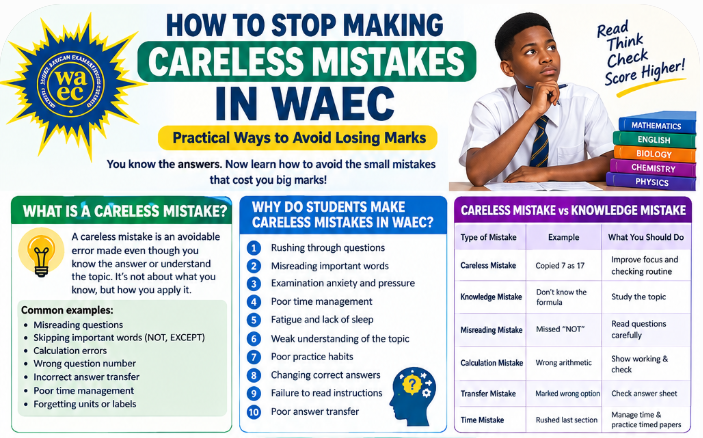
To stop making careless mistakes in WAEC, find out which mistakes you actually make (by keeping an error log from past papers), build simple habits that block each one (underlining command words, writing formulas before substituting, adding units, labelling diagrams, numbering answers correctly), plan your time so you’re not rushing, and leave a few minutes at the end of every paper for a targeted check. WAEC’s examiners regularly point out the same avoidable errors: not following instructions, poor expression, missing working and units, and weak diagrams.
This guide lists the most common careless mistakes by type and subject, gives a habit to fix each one, shows how to use an error log, and includes a short checking routine you can use in every paper.
- Read twice: underline the command word and the number of points or questions required.
- Show working: write the formula, substitute, include units.
- Label everything: diagrams, graphs and tables with titles and units.
- Number answers exactly as the questions are numbered.
- Plan time by marks so you don’t rush the last questions.
- Check at the end using a short, targeted checklist.
- Keep an error log from past papers to find your personal patterns.
In this guide:
- Why careless mistakes happen
- The most common careless mistakes
- Reading the instructions
- A time plan that stops you rushing
- Careless mistakes by subject
- Worked examples
- Diagrams and graphs
- Practical papers
- Essay and theory answers
- Admin mistakes
- A four-week plan
- Staying focused
- Finding your patterns with an error log
- Habits that prevent mistakes
- A checking routine
- For teachers and parents
- Objective paper mistakes
- Practising accuracy
- FAQs
Why careless mistakes happen
- Rushing because of poor time planning.
- Reading too fast and missing key words like “not”, “two” or “explain”.
- Working in your head instead of writing steps.
- Tiredness from poor sleep during the exam period.
- Anxiety, which narrows attention.
- Habits from practice: if you skip units or labels when practising, you’ll skip them in the exam.
The good news: careless mistakes are the easiest marks to recover, because you already know the material.
The most common careless mistakes
| Mistake | What it looks like | Habit to fix it |
|---|---|---|
| Ignoring the command word | Listing points when asked to “explain” | Underline the command word before answering |
| Wrong number of points | Giving three when four are asked for | Circle the number; tick each point as you write |
| Answering the wrong number of questions | Answering four when five are required, or too many from one section | Read the rubric; write the plan on rough paper (where allowed) |
| Missing units | “Answer: 25” instead of “25 m/s” | Write units with every quantity |
| No working | Only the final answer | Write formula → substitution → answer |
| Copying numbers wrongly | Using 36 instead of 63 from the question | Underline given values; check once after copying |
| Unlabelled diagrams | Drawings without titles or labels | Title, ruled labels, magnification (Biology) |
| Wrong question numbers | Answer to 3(b) labelled 3(a) | Write the number before each answer |
| Spelling and grammar slips | Lost marks in English and essay subjects | Read answers back in the last minutes |
| Unfinished paper | No time for the last question | Plan time by marks; move on when time is up |
Reading the instructions: where most marks leak
Before you write a single answer, the rubric on the front of the question paper tells you how many questions to answer, which sections are compulsory, and how much time you have. WAEC’s chief examiners’ reports, which WAEC publishes for candidates and teachers, often point out candidates who answered more questions than required, skipped compulsory questions, or answered from the wrong section. Those are not knowledge problems; they are reading problems.
A 60-second rubric routine
- Find the total: “Answer five questions in all.” Write “5” in the margin of your answer booklet or on rough paper where permitted.
- Find the compulsory part: “Question 1 is compulsory” or “Answer all questions in Section A.” Circle it.
- Find the split: “Answer two questions from Section B and two from Section C.” Write “B2 C2”.
- Find the time: note the paper length and work out your finishing time for each question (see the time plan below).
- Find special instructions: “Use a separate answer booklet for each section”, “Credit will be given for clarity of expression”, “Show all working”. These lines decide marks.
Command words and what they ask for
The command word tells you the depth of answer the examiner expects. Writing a one-word answer to an “explain” question, or a paragraph to a “state” question, both cost you: one loses marks, the other loses time.
| Command word | What the examiner wants | Typical length |
|---|---|---|
| State / List / Name | A short fact, term or point, no explanation | A word or a line |
| Define | The precise meaning of a term | One sentence |
| Describe | What something is like or what happens, step by step | A few sentences |
| Explain | Why or how something happens: point plus reason | Two or three sentences per point |
| Discuss | Points for and against, or several sides, with explanation | A developed paragraph per point |
| Compare / Distinguish | Similarities and/or differences, side by side | Paired points, often a table |
| Calculate | A numerical answer with working | Formula, substitution, answer, unit |
| Outline | The main points briefly, without detail | A line per point |
| Illustrate / Draw | A labelled diagram, sometimes with notes | Diagram plus labels |
| Comment on / Assess / Evaluate | A judgement backed by reasons | Points with a conclusion |
Worked example: same topic, different command word
Topic: functions of money (Economics).
- “State four functions of money.” → “Medium of exchange; measure of value; store of value; standard of deferred payment.” Four lines, done.
- “Explain four functions of money.” → Each function needs a sentence or two: “Money serves as a medium of exchange: it is generally accepted in payment for goods and services, which removes the need for a double coincidence of wants that existed under barter.” Writing only the four names here could earn you a fraction of the marks.
Underlining the command word before answering is the single cheapest habit in this guide.
A time plan that stops you rushing
Rushing causes more careless mistakes than anything else. The fix is to share your time according to marks, not according to how hard a question feels.
The marks-per-minute method
- Note the paper length in minutes. Take off 5–10 minutes for reading the paper at the start and checking at the end.
- Divide the remaining minutes by the total marks. That’s your minutes per mark.
- Multiply by each question’s marks to get its time budget.
- Write your finishing clock time next to each question number.
Worked example
Suppose a theory paper lasts 2 hours 30 minutes (150 minutes), you must answer five questions, and each carries 20 marks (100 marks total). The paper length here is an example; always use the time printed on your own paper and timetable.
- Reserve 5 minutes for reading and choosing questions, and 10 minutes for checking: 135 minutes left.
- 135 ÷ 100 = 1.35 minutes per mark.
- Each 20-mark question gets 27 minutes.
- If you start at 9:05 after reading, finish Q1 by 9:32, Q2 by 9:59, Q3 by 10:26, Q4 by 10:53, Q5 by 11:20, and check until 11:30.
When a question’s time is up, leave space, move on, and come back if you have time at the end. Five complete-ish answers almost always score more than three perfect ones and two blank ones.
Objective papers
For an objective paper, divide the time by the number of questions and set checkpoints. For example, 50 questions in 50 minutes means you should be around question 25 after about 23 minutes, leaving a few minutes at the end to check shading. Skip any question that takes too long and mark it on the question paper (not the answer sheet) so you can return.
Careless mistakes by subject
English Language
- Wrong essay format (for example, a formal letter without a title).
- Exceeding or ignoring the word guidance.
- Copying long sentences in the summary instead of using your own words.
- Answering comprehension questions with whole paragraphs from the passage.
- Tense and concord errors that you’d spot on a second read.
Mathematics
- Sign errors (+/−) and dropped negatives.
- Not giving answers to the required decimal places or significant figures.
- Misreading graph scales.
- Rubbing out construction lines.
- Calculator entry errors, especially with powers and brackets.
Physics
- Not converting units (cm to m, g to kg, °C to K).
- Forgetting units in the final answer.
- Graphs without labelled axes or with uneven scales.
- Reading instruments with parallax error in practicals.
Chemistry
- Unbalanced equations or missing state symbols.
- Wrong mole ratio from the equation.
- Incorrect IUPAC names.
- Recording expected rather than observed results in practicals.
Biology
- Diagrams without titles, ruled labels or magnification.
- Shading or sketchy lines in drawings.
- Vague answers (“it helps the body”) instead of precise functions.
- Confusing similar terms (osmosis/diffusion, artery/vein).
Essay subjects (Government, Economics, Literature, History, CRS/IRS)
- Listing points without explanation.
- Answering a different question from the one asked.
- No examples.
- Writing about the wrong text or character in Literature.
Financial Accounting
- Wrong format for accounts and statements.
- Arithmetic errors in totals.
- Missing headings and dates.
Worked examples: spotting the careless mistake
Here are short, original practice examples showing a typical careless answer, what goes wrong, and the corrected version. Use them to train your eye.
Example 1: Mathematics (accuracy instruction)
Question: Evaluate 3.2 × 4.75 ÷ 1.9, correct to two significant figures.
Careless answer: 8.00
What went wrong: 3.2 × 4.75 = 15.2, and 15.2 ÷ 1.9 = 8. The candidate wrote “8.00”, which is three significant figures. The instruction said two.
Correct answer: 8.0 (2 s.f.)
Habit: underline the accuracy instruction (“2 s.f.”, “3 d.p.”, “nearest whole number”) and check your final line against it.
Example 2: Mathematics (sign error)
Question: Solve 5 − 2(x − 3) = 3x − 4.
Careless working: 5 − 2x − 6 = 3x − 4 → −1 − 2x = 3x − 4 → 3 = 5x → x = 0.6
What went wrong: −2 × −3 = +6, not −6.
Correct working: 5 − 2x + 6 = 3x − 4 → 11 − 2x = 3x − 4 → 15 = 5x → x = 3.
Check: left side 5 − 2(0) = 5; right side 9 − 4 = 5. ✔
Habit: when expanding a bracket with a negative outside, write each multiplication separately, and substitute your answer back in.
Example 3: Physics (units)
Question: A force of 20 N acts on an area of 50 cm². Calculate the pressure.
Careless answer: P = F/A = 20/50 = 0.4 N/m²
What went wrong: the area was not converted. 50 cm² = 50 × 10⁻⁴ m² = 0.005 m².
Correct answer: P = 20 ÷ 0.005 = 4000 N/m² (4000 Pa).
Habit: convert every quantity into SI units in a “Given” list before you substitute.
Example 4: Chemistry (balancing)
Question: Write a balanced equation for the combustion of methane.
Careless answer: CH₄ + O₂ → CO₂ + H₂O
What went wrong: not balanced; no state symbols.
Correct answer: CH₄(g) + 2O₂(g) → CO₂(g) + 2H₂O(l)
Habit: count atoms of each element on both sides, then add state symbols as a final step.
Example 5: Biology (precision)
Question: State one function of the red blood cell.
Careless answer: It helps in blood.
Correct answer: It transports oxygen from the lungs to body tissues (as oxyhaemoglobin).
Habit: answer with a precise verb and object: transports what, from where, to where.
Example 6: English (summary)
Question: In one sentence each, summarise three reasons the writer gives for the decline of reading culture.
Careless answer: A paragraph copied from the passage containing all three reasons and several examples.
What went wrong: not one sentence each; copied lifted text; examples included.
Better answer: (i) Young people spend more of their free time on phones. (ii) Books have become too expensive for many families. (iii) Few schools have functioning libraries.
Habit: number your summary sentences, keep each to one idea, and use your own words where you can.
Example 7: Financial Accounting (format)
Careless answer: A trading account with figures but no heading and no date.
Correct approach: start with a full heading, for example “Trading Account of [business name] for the year ended 31 December 20XX”, then lay out the figures in the standard format your teacher uses.
Habit: write the heading first, before any figure.
Example 8: Literature (wrong focus)
Question: Discuss the role of a named minor character in a prescribed novel.
Careless answer: A retelling of the whole plot with only two sentences about the character.
What went wrong: the answer doesn’t address the question. Examiners reward analysis of the character’s role, not a plot summary.
Better approach: open with a sentence on the character’s role, then give three or four points, each tied to a specific event in the text and explained: what the character does, and how it affects the plot, other characters or the themes.
Habit: after every paragraph, ask “does this answer the question?” If not, cut it short and return to the focus.
Diagrams and graphs without lost marks
Diagrams are one of the most common places WAEC candidates drop easy marks in Biology, Agricultural Science, Geography, Physics and Technical Drawing.
Diagram checklist
- Title under or above the diagram, saying what it shows (“Diagram of a longitudinal section of a dicot flower”).
- Size: big enough to label clearly; a tiny drawing in a corner is hard to mark.
- Lines: clean, continuous lines with a sharp HB pencil; no shading unless asked.
- Labels: ruled label lines that touch the part, don’t cross each other, and end in neatly printed words, usually on one side.
- Magnification where required (Biology), for example “×2”.
- Proportions that look roughly correct.
Graph checklist
- Title.
- Both axes labelled with quantity and unit, e.g. “Time (s)”.
- Even, sensible scale that uses most of the grid.
- Points plotted clearly (small crosses or dots with circles).
- Best-fit line or smooth curve as instructed, not dot-to-dot unless asked.
- When reading from the graph, show the lines you drew to read it.
Practical papers: careless mistakes under pressure
- Not reading the whole instruction sheet first. Some steps depend on earlier ones.
- Recording what you expected instead of what you observed. Examiners mark observations.
- Tables without units in the column headings.
- Inconsistent decimal places in readings (for example, 2.1, 2.15, 2).
- No precautions listed when asked, or vague ones (“I was careful”). Write specific precautions such as “I avoided parallax error by reading the meniscus at eye level.”
- Running out of time because of a slow start. Set up apparatus as soon as you’re allowed.
Essay and theory answers: structure that prevents slips
In essay subjects, careless mistakes usually come from writing before thinking. A two-minute plan fixes most of them.
The PEE structure for each point
- Point: state it clearly in the first sentence.
- Explain: say why or how, in a sentence or two.
- Example: give a relevant example, preferably Nigerian or West African where it fits.
Government example: “One function of the legislature is law-making. The legislature debates bills and passes them into law, which the executive then implements. In Nigeria, the National Assembly passes federal laws, which take effect when the President assents to them or when the Assembly overrides a withheld assent as the Constitution provides.”
Essay-planning checklist
- Underline the command word and the number of points.
- Jot down more points than you need, then pick the strongest.
- Number your points in the plan so you don’t repeat one.
- Start each point on a new paragraph; examiners find separate paragraphs easier to mark.
- Cross out the plan neatly afterwards if instructed, but don’t waste time rewriting it.
English essay format slips
| Essay type | Common careless slip | Fix |
|---|---|---|
| Formal letter | Missing one of the two addresses, date, title or formal closing | Write the full skeleton first: addresses, date, salutation, title, body, closing, name |
| Informal letter | Using a formal title or formal closing | One address and date; friendly salutation; informal closing |
| Speech / talk | No address to the audience or closing | Open by addressing the audience; end by thanking them |
| Article | No headline or writer’s name where expected | Headline at the top; name at the end if required |
| Argumentative essay | Arguing both sides when told to take a side | Read whether you are asked to argue for or against, and stay on that side |
Check your English teacher’s preferred layout and WAEC’s own sample answers through the e-learning portal; layouts vary slightly, and what matters is that all expected parts are present.
Admin mistakes that have nothing to do with knowledge
Some of the most costly slips happen outside the answers themselves:
- Wrong or missing examination number on answer booklets or the objective answer sheet. Copy it carefully from your registration details and check digit by digit.
- Wrong paper code or subject shaded on the objective sheet. Follow the supervisor’s instructions exactly.
- Loose sheets not tied into the booklet or not labelled with your number.
- Missing the paper because you misread the timetable. Write each paper’s date, time and session on your own copy and confirm with your school. See our night-before guide.
- Bringing banned items such as phones, which can lead to sanctions. Read the WAEC rules before the first paper.
A four-week plan to cut careless mistakes
| Week | Focus | What to do |
|---|---|---|
| 1 | Diagnose | Do one timed past paper per main subject. Mark it strictly. Start your error log. |
| 2 | Fix the top two | Pick your two most frequent mistake types. Write one habit for each on a card. Do short drills (20–30 minutes) targeting them. |
| 3 | Timed practice | Do full timed papers with your time plan. Practise your end-of-paper check every time. Keep logging. |
| 4 | Exam simulation | Sit papers at the same time of day as your timetable. Compare this week’s error count with week 1. |
Most students see their careless errors fall quickly once they can name them. If a mistake keeps appearing in week 4, it may be a gap in understanding rather than carelessness; revise that topic properly.
Staying focused through a long paper
- Sleep: tiredness is a major cause of slips. Protect your sleep during the exam period.
- Eat and drink sensibly before papers so you’re not distracted by hunger.
- Breathe: if you panic, pause, take a few slow breaths, and restart with the next easy step. See how to stay calm during WAEC and NECO.
- Don’t compare your progress with the candidate next to you.
- Re-read the question when you get stuck; the answer often depends on a word you missed.
Finding your patterns with an error log
Everyone makes different careless mistakes. An error log shows you yours.
| Date | Subject | Question | Mistake | Type | Habit to fix it |
|---|---|---|---|---|---|
| 3 Mar | Physics | Q4(b) | Used cm instead of m | Units | Convert all units before calculating |
| 3 Mar | English | Summary | Copied whole sentences | Instructions | One point per sentence in my own words |
| 5 Mar | Maths | Q7 | Lost a negative sign | Arithmetic | Circle negative signs; check each line |
After every past paper, add each careless mistake. After two or three weeks, count the types. Your top two or three types are your personal checklist for the exam.
Habits that prevent mistakes
- Read the question twice, the second time with your pen under each word.
- Underline command words, numbers and key terms.
- Plan before writing essay answers: a few words per point.
- Write every step in calculations.
- Box or underline final answers with units.
- Use a ruler for labels, tables and graphs.
- Write the question number first, then the answer.
- Keep to your time plan; move on when time is up.
A checking routine
Leave five to ten minutes at the end of each paper. Don’t re-read everything; check the things you’re most likely to get wrong:
- ☐ Correct number of questions answered, from the right sections
- ☐ Question numbers correct on every answer
- ☐ Units on every numerical answer
- ☐ Diagrams titled and labelled
- ☐ Command words followed (explain vs state)
- ☐ Personal details and exam number correct
- ☐ Your personal top-three mistakes from your error log
Subject check cards
Write one small card per subject and read it in the last minutes of the paper:
| Subject | Final check |
|---|---|
| English | Essay format complete; summary sentences numbered; tense and concord; word guidance |
| Mathematics | Signs; accuracy instruction; units; working shown; construction lines kept |
| Physics | SI units converted; units on answers; graph axes labelled |
| Chemistry | Equations balanced; state symbols; mole ratios; names correct |
| Biology | Diagram titles, ruled labels, magnification; precise terms |
| Economics / Government | Each point explained with an example; correct number of points |
| Literature | Correct text and character; quotations or references to events |
| Financial Accounting | Headings and dates; totals added twice |
For teachers and parents: helping a student reduce slips
- Mark practice papers strictly, the way an examiner would, including units, labels and format. Lenient marking hides careless habits.
- Ask “what kind of mistake was this?” rather than just “why did you get it wrong?” Naming the type helps the student build the right habit.
- Review WAEC’s chief examiners’ reports with the class; they describe the weaknesses examiners saw across the country.
- Give short timed drills on one habit at a time, such as ten unit conversions in five minutes.
- Protect rest in exam weeks. A tired student makes more slips, however well prepared.
- Praise accurate checking, not only correct answers, so students value the last five minutes.
Objective paper mistakes
- Shading the wrong row after skipping a question. Fix: check that the question number matches each time you shade.
- Incomplete shading or stray marks. Fix: shade fully with an HB pencil; erase cleanly.
- Misreading “NOT” or “EXCEPT”. Fix: underline them in the question.
- Changing correct answers without a clear reason. Fix: change only if you find an actual error.
Practising accuracy
- Do timed past papers and mark them strictly, including units, labels and format.
- Use WAEC’s examiners’ comments to see what costs marks. See how to use the WAEC e-learning portal.
- Practise checking: build the last five minutes into every practice paper.
- Swap scripts with a friend to spot each other’s careless errors.
- Repeat weak question types until the habit sticks.
Frequently asked questions
How can I avoid careless mistakes in WAEC Mathematics?
Show every step, watch signs, give answers to the required accuracy, and check calculator entries.
Why do I make silly mistakes even when I know the answer?
Usually rushing, anxiety or habits from practice. Better time planning and a short checking routine fix most of them.
Should I check all my answers at the end?
Check strategically: your personal top mistakes, units, labels, question numbers and details.
Do examiners deduct marks for no units?
Missing units can cost marks in calculations. Always include them.
How long should I spend checking?
Five to ten minutes at the end of a paper, planned into your timing.
Is it a careless mistake or a knowledge gap?
If you can correct it immediately when you see the marking, it’s careless. If you can’t explain the right answer, it’s a knowledge gap and needs revision, not a checklist.
Should I write in pencil or pen?
Follow the instructions for each paper. Objective answer sheets are usually shaded with an HB pencil; theory answers are normally written in pen, while diagrams and graphs are drawn in pencil. Confirm with your school and the paper’s instructions.
What if I realise I answered too many questions?
If time allows, cross out clearly the answer you want ignored, following the instructions on the paper, so the examiner marks the ones you choose. Better still, decide which questions to answer before you start.
Does handwriting matter?
Examiners can only mark what they can read. Write clearly, leave a line between answers, and number every part.
Can careless mistakes really change my grade?
Yes. A few lost marks per paper from units, labels or misread instructions can move a result across a grade boundary, so these are worth fixing.
Related guides: WAEC e-learning portal · The night before a WAEC exam · Stay calm during exams · WAEC rules
