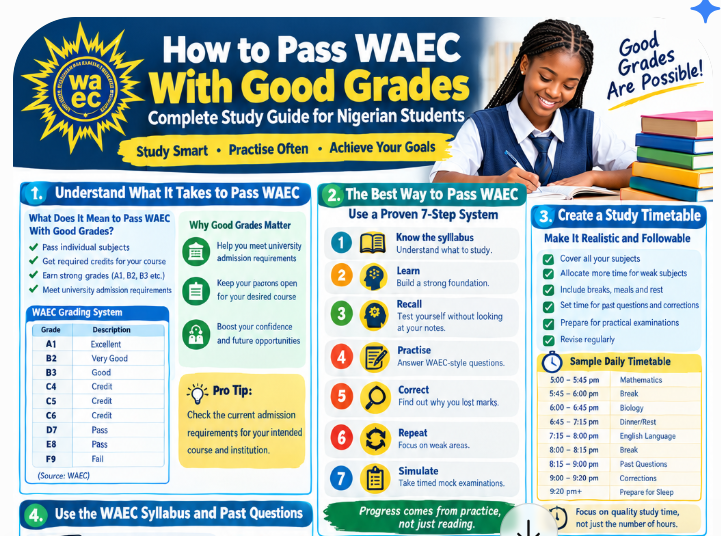
To pass WAEC with good grades, follow a system rather than relying on long hours or luck:
- Study from the syllabus.
- Practise past questions under timed conditions.
- Correct every mistake.
- Prepare properly for practicals, essays and theory papers.
Your target is clear. Most university courses need five credits (A1–C6), including English Language and Mathematics, and higher grades help where institutions score O’level results during screening.
The 2026 results show both the opportunity and the challenge. Of 1,950,726 school candidates who sat the WASSCE in Nigeria, 1,200,514 (61.54%) earned five credits including English and Mathematics. Nearly four in ten didn’t, and 167,486 had results withheld over alleged malpractice. This guide gives you a complete 7-step system and a subject-by-subject strategy. It also includes timetables for 3 months and 1 month, a plan for the computer-based papers, exam-day technique, and the habits that separate A and B grades from bare passes.
- Know your target subjects: five or more credits your course needs, including English and Mathematics.
- Turn the syllabus into a checklist for every subject.
- Diagnose weak areas with one past paper per subject.
- Follow a realistic timetable that gives weak subjects more time.
- Learn actively and practise past questions after every topic.
- Write theory answers and revise practicals every week.
- Take timed full papers in the final weeks, and review every mistake.
In this guide:
- What 2026 WAEC results tell us
- What “good grades” means for you
- The 7-step system
- Subject-by-subject strategy
- Preparing for computer-based papers
- 3-month and 1-month plans
- Exam technique: how to write for marks
- Habits of A and B students
- Mistakes that cost candidates their credits
- FAQs
What 2026 WAEC Results Tell Us
| 2026 WASSCE for school candidates (Nigeria) | Figure |
|---|---|
| Registered | 1,959,668 |
| Sat | 1,950,726 |
| Five credits and above including English and Mathematics | 1,200,514 (61.54%), down 1.42 percentage points from 2025 |
| Results withheld over alleged malpractice | 167,486 (8.59%) |
| Format | WAEC’s second computer-based WASSCE for school candidates |
| Results released | 5 August 2026 |
Three lessons follow from these numbers:
- English and Mathematics decide most outcomes. Nearly 40% of candidates missed the five-credit benchmark that includes them.
- Malpractice is expensive. One in twelve candidates had results withheld. Honest preparation is the only safe route.
- Computer-based papers are now part of the exam. Practise in the format you’ll face.
What “Good Grades” Means for You
| Grade | Meaning | What it does for you |
|---|---|---|
| A1, B2, B3 | Distinction | Strong position for competitive courses and scholarships |
| C4, C5, C6 | Credit | Meets most admission requirements |
| D7, E8 | Pass | Usually not enough for admission requirements |
| F9 | Fail | No credit |
Start by listing the subjects your intended course needs. Aim for credits at least in all of them, and distinctions where you can, especially if your institution scores O’level grades in screening. See how WAEC grades are calculated.
Choose the Right Subjects at Registration
Good grades start before you study: with the right subject choices.
- Include every subject your intended course requires, plus English and Mathematics.
- Add one or two “backup” subjects related to your course, in case a required subject falls short and your course accepts alternatives.
- Check your UTME subject combination matches. See JAMB subject combinations.
- Don’t register for subjects you’ve never studied just to fill numbers; they waste preparation time.
When to Start
| Time before WAEC | What to focus on |
|---|---|
| SS2 / 12+ months | Understand topics as they’re taught; keep good notes; attend practicals |
| 6 months | Syllabus checklists; diagnostic papers; start a timetable |
| 3 months | Full coverage of weak topics; weekly theory practice; mock exam |
| 1 month | Timed full papers; mistakes review; summary sheets |
| 1 week | Light revision; materials ready; rest |
It’s never too late to improve, but every extra month gives you more room to turn weak subjects into credits.
The 7-Step System
Step 1: Turn the syllabus into a checklist
Get the WAEC syllabus for every subject. List every topic on a page per subject. This is your map: WAEC questions come from it. See how to use the WAEC syllabus.
Step 2: Find your weak areas
Take one past paper per subject, marked honestly. Note which topics cost you marks. Mark each topic red (weak), yellow (average) or green (strong).
Step 3: Build a realistic timetable
Give the most sessions to red topics in required subjects, especially English and Mathematics. Use 45–60 minute sessions. See the WAEC reading timetable.
Step 4: Learn actively
After each topic, close your notes and write what you remember, then check. Testing yourself is far more effective than rereading.
Step 5: Practise past questions
Do past questions topic by topic straight after studying, then full papers in the final weeks. See how to use WAEC past questions.
Step 6: Write theory answers and revise practicals
Write at least one full theory answer per session. For science subjects, revise practicals weekly; they carry large marks (Biology 80, Chemistry 50, Physics 50 in WAEC’s syllabuses). See how to prepare for WAEC practicals.
Step 7: Simulate the exam and review mistakes
In the last weeks, take full papers under exam timing. Keep a mistakes notebook and redo wrong questions a week later.
Subject-by-Subject Strategy
English Language
- Essays and letters: master the format of each type (formal, informal and semi-formal letters, articles, speeches, narratives, argumentative essays). Practise one a week.
- Comprehension: read the questions first, then the passage; answer in your own words where asked.
- Summary: follow instructions exactly; one point per sentence.
- Objectives: lexis, structure and oral English daily with past questions.
Mathematics
- Practise daily: 10–15 problems on one topic.
- Master high-frequency topics: indices, logarithms, algebra, mensuration, geometry, trigonometry, statistics and probability.
- Show full working in theory answers.
Sciences
- Learn definitions and laws precisely; draw labelled diagrams; practise calculations with units.
- Revise practicals weekly. See practical marks.
Arts and social sciences
- Learn key terms; answer theory in clear points with explanations and examples.
- Literature: know set texts in detail and practise essays.
Commercial subjects
- Financial Accounting: practise full accounts with correct formats.
- Economics and Commerce: definitions, graphs and applied examples.
English: essay and letter formats at a glance
| Type | Must-have features |
|---|---|
| Formal letter | Writer’s address and date; recipient’s address; “Dear Sir/Madam”; title; formal paragraphs; “Yours faithfully”; signature and full name |
| Informal letter | Writer’s address and date; “Dear [first name]”; friendly opening; conversational paragraphs; warm closing; first name |
| Semi-formal letter | Addresses and date; “Dear Mr/Mrs [surname]”; polite tone; “Yours sincerely”; full name |
| Article | Title; writer’s name (and sometimes address); engaging introduction; clear body; conclusion |
| Speech/talk | Vocatives (e.g. “The Principal, teachers, fellow students…”); introduction; points; conclusion; thanks |
| Narrative/descriptive | Clear sequence or vivid description; strong opening and ending |
| Argumentative/debate | Clear stand; strong points with examples; counter-arguments answered; conclusion |
Mathematics: high-frequency topics
| Area | Topics to master |
|---|---|
| Number | Indices, logarithms, surds, number bases, standard form, percentages, ratios |
| Algebra | Simplification, linear/quadratic/simultaneous equations, inequalities, variation, sequences |
| Geometry and mensuration | Angles, circle theorems, areas, volumes, surface areas, constructions, loci |
| Trigonometry | Ratios, bearings, angles of elevation and depression, sine and cosine rules |
| Statistics and probability | Mean, median, mode, frequency tables, histograms, probability |
Sciences: topics that need extra time
| Subject | Topics many candidates find hard |
|---|---|
| Biology | Genetics, ecology, transport, nutrition, reproduction, classification |
| Chemistry | Mole concept, organic chemistry, electrolysis, equilibrium, periodic trends |
| Physics | Electricity, waves and optics, motion, heat, modern physics |
Arts and commercial subjects: where marks are won
- Literature: specific references to set texts; analysis of themes and characters; literary devices with examples.
- Government: precise definitions; organised points; Nigerian examples.
- Economics: accurate graphs; correct calculations (elasticity, costs); definitions.
- CRS/IRS: correct references to passages and lessons.
- Financial Accounting: correct formats, headings and dates; arithmetic that balances.
Preparing for Computer-Based Papers
WAEC described the 2026 WASSCE for school candidates as its second computer-based WASSCE for school candidates. Ask your school which papers you’ll take on computer, then:
- Practise objective questions on a computer or phone with a timer.
- Learn to navigate quickly: moving between questions, reviewing and submitting.
- Watch the on-screen timer, and pace yourself.
- Know the rules: use only your assigned computer, and report faults immediately. See WAEC rules.
3-Month and 1-Month Plans
3 months
| Month | Focus |
|---|---|
| 1 | Diagnose; cover red topics in required subjects; daily English and Mathematics |
| 2 | Cover remaining topics; weekly theory and practical practice; mock exam |
| 3 | Full timed papers; mistakes review; summary sheets; rest before exams |
1 month
Focus on high-yield topics in required subjects, daily theory practice, practicals and timed papers. See our 28-day WAEC/NECO plan.
Worked Example: Building Your Plan
This is an illustrative example. Chiamaka wants to study Nursing, which typically needs English, Mathematics, Biology, Chemistry and Physics. Her mock grades: English C6, Mathematics D7, Biology C5, Chemistry E8, Physics C6, plus four other subjects at B3–C4.
- Priorities: Chemistry (E8) and Mathematics (D7) first; then English and Physics (borderline C6); then Biology.
- Weekly sessions (about 18): Chemistry 4, Mathematics 4, English 3, Physics 3, Biology 2, other subjects 2 in rotation.
- Diagnosis: Chemistry marks are lost in mole calculations and organic chemistry; Mathematics in algebra and mensuration.
- Practicals: one session each week for Biology, Chemistry and Physics, rising to two in the final month.
- Checkpoints: a timed past paper in each priority subject every two weeks.
After six weeks, her past papers show Chemistry at C6 and Mathematics at C5, so she shifts a session from Mathematics to Physics to push it up. That’s the system working.
Summary Sheets and the Mistakes Notebook
Two simple tools make the final weeks far more effective:
- Summary sheets: one page per topic with definitions, formulas, diagrams, essay formats or quotations. Write them from memory, then check and correct.
- Mistakes notebook: every wrong answer from past papers, with the correct answer and the reason you got it wrong. Redo those questions a week later.
In the last fortnight, these two tools replace your textbooks.
Use Your School Mock Exam
- Prepare for it seriously, so it shows your real level.
- After results, re-rank every subject and list the topics that cost you marks.
- Rebuild your timetable around those topics for the remaining weeks.
- Ask teachers to show you full-mark answers for questions you struggled with.
Daily Schedules That Work
School day
| Time | Activity |
|---|---|
| 5:30–6:15 am | Mathematics problems |
| School | Attend fully; note topics to ask about |
| 5:00–6:00 pm | Weakest required subject: topic + past questions |
| 6:15–7:00 pm | One timed theory answer |
| 8:00–8:45 pm | English practice |
| 9:00 pm | Mistakes notebook; plan tomorrow; sleep by 10 pm |
Holiday or full study day
| Time | Activity |
|---|---|
| 7:00–8:00 am | Mathematics theory |
| 8:15–9:15 am | Weak required subject 1 |
| 9:30–10:15 am | English |
| 11:30 am–12:30 pm | Weak required subject 2 + theory |
| 2:00–3:00 pm | Other subject + past questions |
| 3:15–4:00 pm | Practicals or essays |
| Evening | Light review; sleep by 10:30 pm |
Memory Techniques That Work
| Technique | How to use it |
|---|---|
| Active recall | Close the book; write everything you remember; check |
| Spaced repetition | Review after a day, three days, a week and two weeks |
| Teaching | Explain a topic aloud to a friend or family member |
| Diagrams and mind maps | Draw processes and connections from memory |
| Mnemonics | Memorable phrases for lists and sequences |
Exam Technique: How to Write for Marks
- Read all instructions and plan your time by marks.
- Answer your strongest questions first where there’s a choice.
- Match depth to marks. A 2-mark “state” question needs two clear points.
- Use key terms from the syllabus.
- Show working and units in calculations.
- Draw neat, labelled diagrams in pencil.
- Don’t leave questions blank. Partial answers can earn marks.
- Check your details and question numbers at the end.
Command Words: What Examiners Want
| Command word | What it asks for | Typical length |
|---|---|---|
| State / list / name | Brief facts, no explanation | One line per point |
| Define | An exact meaning | One or two sentences |
| Describe | What something is like, or what happens | A short paragraph |
| Explain | Why or how; reasons and causes | Point plus reason for each mark |
| Compare / distinguish | Similarities and/or differences | A table or paired points |
| Calculate | A numerical answer with working | Formula, substitution, answer, units |
| Discuss / evaluate | Arguments, examples and a conclusion | Several paragraphs |
| With the aid of a diagram | A labelled diagram plus explanation | Diagram and short notes |
Worked example: turning a weak answer into a strong one
Question (Government, 4 marks): “Explain two functions of the legislature.”
Weak answer: “The legislature makes laws and checks the executive.”
Strong answer:
- Law-making: the legislature debates and passes bills, which become laws when assented to. For example, the National Assembly passes the federal budget as an Appropriation Act.
- Oversight of the executive: the legislature monitors how the executive implements laws and spends public funds, for example through committee investigations and the screening of ministerial nominees.
The strong answer states each function, explains it and gives an example. That’s what “explain” means, and that’s where the marks are.
Worked example: a Biology theory answer
Question (4 marks): “State two adaptations of the leaf for photosynthesis and explain how each helps.”
- Broad, flat lamina: provides a large surface area to absorb more light.
- Many stomata, mainly on the lower surface: allow carbon dioxide to diffuse into the leaf for photosynthesis.
Each point names the adaptation and explains how it helps. Writing only “broad lamina; stomata” would earn at most half the marks.
Worked example: method marks in Mathematics
Question: Solve 2x² − 5x − 3 = 0.
- Factorise: 2x² − 6x + x − 3 = 0 → 2x(x − 3) + 1(x − 3) = 0.
- Group: (2x + 1)(x − 3) = 0.
- Solve: 2x + 1 = 0 or x − 3 = 0, so x = −½ or x = 3.
Even if you made a small arithmetic error at step 3, steps 1 and 2 could still earn method marks. A bare answer with no working risks losing everything if it’s wrong. Always show your steps.
How to Use Past Questions Properly
- Topic by topic first: after studying a topic, answer every past question on it from several years.
- Attempt before checking: commit to your answer, then check.
- Find the reason for every mistake: knowledge gap, misreading, careless error or time.
- Redo wrong questions a week later.
- Full papers under time in the final weeks.
- Understand, don’t memorise: WAEC changes wording, so memorised answers can fail.
See WAEC questions that tend to repeat.
Habits of A and B Students
- They start early and study a little every day.
- They practise more than they read.
- They review mistakes instead of moving on.
- They ask teachers for feedback on theory answers.
- They protect sleep, especially in exam weeks.
- They ignore expo and stay away from malpractice.
Exam-Week Routine
| Time | Days with a paper | Days without a paper |
|---|---|---|
| Morning | Light breakfast; quick look at summary sheets; arrive early | Timed past paper for the next subject |
| After the paper / midday | Rest; don’t dwell on answers | Mark the paper; review mistakes |
| Afternoon | Revise weak topics for the next paper | Weak topics; practicals if relevant |
| Evening | Pack materials; light review; early sleep | Summary sheets; early sleep |
See what to do the night before a WAEC exam and what to carry to the hall.
Studying at Home Effectively
- Set up a study spot with good light, a table and your materials ready.
- Agree study hours with your family so chores don’t take over.
- Keep your phone in another room during sessions.
- Prepare for power cuts with a rechargeable lamp and printed past papers.
- Find a study partner to quiz and mark each other’s theory answers.
Real Situations and What to Do
“I’m strong in most subjects but always fail Mathematics”
Make Mathematics a daily habit: 10–15 problems on one topic, with full working. Target the most frequent topics first. Ask a teacher to explain two or three topics you find impossible. Daily practice for eight to ten weeks moves many students from D7 to a credit.
“My English essays always get low marks”
Check format first: most students lose easy marks there. Then work on structure (introduction, clear paragraphs, conclusion) and accuracy (grammar, spelling, punctuation). Write one essay a week and ask a teacher to mark it.
“I panic in the exam hall and forget everything”
Do timed past papers under exam conditions every week, so the real exam feels familiar. Use a short breathing routine before each paper, and start with a question you know well.
“I don’t have money for lessons”
Many students pass with self-study: the syllabus, a good textbook per subject, past questions and teacher feedback. Form a free study group with classmates.
The Final Week Before WAEC
| Day | Focus |
|---|---|
| 7 days before | Timed paper in your first scheduled subject; review mistakes |
| 6 days before | Timed paper in your second scheduled subject; review |
| 5 days before | English: one essay, one summary, lexis past questions |
| 4 days before | Mathematics: mixed problems on high-frequency topics |
| 3 days before | Practical revision (sciences) or essay practice (arts) |
| 2 days before | Summary sheets and mistakes notebook for your first papers |
| 1 day before | Light review; pack permitted materials; check timetable and venue; early night |
Don’t try to learn big new topics in the final week. Consolidate what you know, rest well, and arrive at your first paper calm and prepared.
Study Groups That Actually Help
A small group of three or four serious students can lift everyone’s grades if it’s run well:
- Meet with a plan: one subject, one topic, 60–90 minutes.
- Quiz each other on definitions, formulas, quotations and essay formats.
- Swap theory answers and mark them against a marking guide.
- Teach each other: explaining a topic is one of the best ways to learn it.
- Take a timed paper together, then compare mistakes.
- Keep phones away and end on time.
A study group supports your timetable; it doesn’t replace your own sessions. Choose members who are as committed as you are, rotate who leads each meeting, and agree on the topic and past questions in advance so no time is wasted deciding what to do. Groups that drift into chatting should be paused, not abandoned, so get back on track at the next meeting with a clear agenda.
Track Your Progress
| Subject | Diagnostic grade | Mock grade | Latest past paper | Target |
|---|---|---|---|---|
| English | D7 | C6 | C5 | B3 |
| Mathematics | E8 | D7 | C6 | C4 |
| Chemistry | D7 | C6 | C5 | B3 |
| … |
Example figures for illustration. Update the table every two weeks. When a subject reaches its target, move one session from it to a subject that’s still behind. Seeing grades rise on paper is also one of the best ways to stay motivated through a long preparation period.
Why Some Students Improve Faster Than Others
Two students can study the same number of hours and get very different results. The difference usually comes down to:
- Feedback: students who get their theory answers marked improve faster than those who never check.
- Focus: students who target the topics costing them marks improve faster than those who reread what they already know.
- Testing: students who test themselves remember more than those who only read.
- Consistency: daily practice beats occasional marathons.
Look After Yourself
- Sleep 7–9 hours. Memory consolidates during sleep.
- Eat regular, simple meals and drink enough water.
- Move every day, even a short walk.
- Take breaks between sessions and one lighter day a week.
- Talk to someone if stress feels heavy. See how to stay calm during WAEC and NECO.
After the Exam: Results and Next Steps
| Step | What to do |
|---|---|
| Results release | Check your result at waecdirect.org (2026 results came out on 5 August) |
| Check details | Name, subjects and grades; report errors through official channels |
| JAMB upload | Upload to your JAMB profile. In 2026, JAMB introduced an online route for WAEC results. See O’level upload. |
| If a subject falls short | Consider a private WAEC series or NECO GCE, and combine sittings where your course allows |
Your WAEC Success Checklist
- ☐ I know which credits my course needs.
- ☐ I have the syllabus for every subject as a checklist.
- ☐ My timetable gives most time to weak required subjects.
- ☐ I practise English and Mathematics almost every day.
- ☐ I write at least one theory answer per session.
- ☐ I revise practicals weekly (science).
- ☐ I take timed full papers in the final weeks.
- ☐ I keep a mistakes notebook and summary sheets.
- ☐ I know which papers are computer-based and have practised on screen.
- ☐ I’ll take no phone or notes into the hall.
For Parents
- Provide a quiet study space and protect study time.
- Make sure your child has the syllabus, past questions and exam materials.
- Ask about progress: “What did your last past paper show?”
- Protect sleep, especially in exam weeks.
- Never pay for expo or “special centres”; 167,486 results were withheld in 2026 over alleged malpractice.
Mistakes That Cost Candidates Their Credits
- Neglecting English or Mathematics.
- Reading without practising questions.
- Ignoring theory writing and practicals.
- Studying only favourite subjects.
- Cramming the night before.
- Bringing a phone into the hall. See WAEC rules.
- Relying on expo. See how to pass WAEC without expo.
Frequently Asked Questions
How can I pass WAEC in one sitting?
Focus on the subjects your course needs, especially English and Mathematics. Study from the syllabus, practise past questions, write theory answers, revise practicals and take timed papers.
What percentage of candidates pass WAEC?
In 2026, 61.54% of school candidates in Nigeria earned five credits including English and Mathematics.
How many hours should I study for WAEC daily?
About 2–3 focused hours on school days and 4–5 at weekends. See our study-hours guide.
Is it better to study alone or in a group for WAEC?
Mostly alone, with a small group once or twice a week for quizzing and marking theory answers. Group time works best when it’s focused and short, with a clear topic and past questions chosen in advance by whoever is leading the group that particular week, so everyone arrives ready.
What’s the minimum I need to pass WAEC for university?
Usually five credits (C6 or better) in subjects relevant to your course, including English Language and Mathematics. Some competitive courses or institutions expect higher grades, and some allow two sittings.
How many subjects can I register for in WAEC?
Most school candidates sit eight or nine subjects. Make sure they include all the subjects your intended course needs.
Should I focus on objectives or theory?
Both matter. Objectives reward wide coverage and speed; theory rewards depth and clear writing. Practise both every week.
How do I improve my WAEC English grade quickly?
Secure format marks in letters and essays, practise summary and comprehension weekly, and do lexis and structure past questions daily. Ask a teacher to mark your essays.
How do I improve my WAEC Mathematics grade?
Practise every day on the most frequent topics, show full working for method marks, and take timed papers in the final weeks.
Do WAEC questions repeat?
Topics and question styles recur often, which is why past questions are so valuable. Learn the concepts, not memorised answers.
Can I pass WAEC without lessons?
Yes. Many students pass with self-study using the syllabus, a good textbook, past questions and teacher feedback.
Can I get A1 in all my WAEC subjects?
Some candidates do, with thorough preparation. For most students, the smart goal is strong credits in every required subject, then distinctions where possible.
Which WAEC subjects do most students fail?
Mathematics and English are where many candidates fall short, which is why the five-credit rate including those two subjects was 61.54% in 2026.
Should I write WAEC and NECO?
Many students do, for two chances at credits. The same preparation serves both. See NECO vs WAEC.
How do I avoid my result being withheld?
Follow every exam rule, especially no phones or notes in the hall, and stay away from expo and “assistance”. See WAEC rules.
Is WAEC computer-based now?
WAEC described the 2026 school WASSCE as its second computer-based WASSCE for school candidates. Ask your school which papers you’ll take on computer.
Related guides: WAEC tips for first-time candidates · WAEC reading timetable · Using WAEC past questions · WAEC grading system
