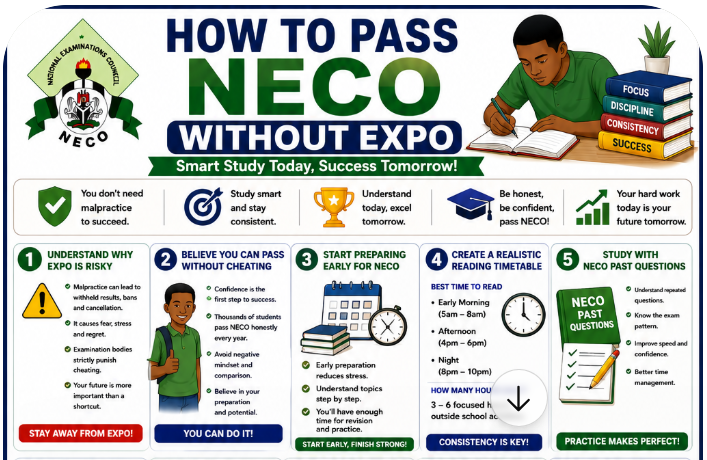
You can pass NECO without expo or malpractice by preparing the way successful candidates do: cover the syllabus, practise past questions, write theory answers, revise practicals, and walk into the hall with a clear time plan. That’s not just the honest route; it’s the safer and more reliable one. Most “expo” sold online is fake or arrives too late to help, and malpractice can lead to your result being cancelled. NECO recorded 1,406 candidates involved in malpractice in the 2026 SSCE Internal, and 9,016 candidates were booked for offences in the 2025 SSCE External. Those candidates risked their results, and some lost them.
This guide explains why expo is a trap, and what counts as malpractice, including things many students don’t realise are offences. It then gives you a practical plan to pass NECO with credits in the subjects you need, plus how to handle pressure from friends, “special centres” and the WhatsApp groups that appear every exam season.
- Know your target: credits (C6 or better) in at least five subjects your course needs, including English and Mathematics.
- Use the syllabus to cover every topic, starting with your weakest required subjects.
- Practise past questions daily, both objectives and theory.
- Revise practicals weekly for science subjects.
- Do a timed past paper every weekend and review every mistake.
- Stay away from expo groups, “runs” and “special centres”. They put your result at risk.
In this guide:
- What “expo” is, and why it’s a trap
- What counts as malpractice
- What can happen if you’re caught
- The numbers: malpractice in recent NECO exams
- A step-by-step plan to pass NECO the right way
- Subject strategies that replace expo
- Exam-hall strategy
- Handling pressure from friends and “helpers”
- Avoiding “special” or “miracle” centres
- FAQs
What “Expo” Is, and Why It’s a Trap
“Expo” (short for “exposed”) refers to questions or answers supposedly leaked before an exam. Every NECO and WAEC season, sellers advertise expo on WhatsApp, Telegram, Instagram and websites, often with “subscription” packages.
Why expo fails
| Problem | What actually happens |
|---|---|
| Most of it is fake | Sellers send old past questions, guesses or invented “answers” |
| Timing | Even when something real circulates, it often arrives too late or in a confusing form |
| Different papers | Questions, versions and arrangements can differ, so “answers” don’t match |
| Wrong answers | Candidates copy wrong answers confidently and lose marks they’d otherwise have earned |
| Scam payments | You pay, and the seller disappears or demands more money |
| Evidence trail | Messages, payments and group memberships can be traced |
| Identical answers | Examiners can notice identical patterns across scripts, which can lead to investigations |
Even if you never use it in the hall, time spent chasing expo is time not spent on past questions that actually raise your score.
Why Students Turn to Expo (and What to Do Instead)
| The real reason | The better answer |
|---|---|
| “I started preparing too late.” | Use a focused one-month plan on past papers and weak required subjects. See our one-month plan. |
| “Mathematics or English feels impossible.” | Target specific high-frequency topics and practise daily; ask a teacher for help with two or three topics |
| “Everyone else is doing it.” | Most candidates pass honestly. Those caught risk everything. |
| “I’m scared of failing.” | Fear shrinks with preparation: timed past papers make the exam feel familiar |
| “My parents expect excellent grades.” | Show them your plan and progress; a cancelled result is far worse than a C |
What Counts as Malpractice
Malpractice is any act that breaks the exam rules to gain an unfair advantage, or helps someone else do so. Common examples:
- bringing prohibited items into the hall (phones, smartwatches, notes, textbooks), even if you don’t use them;
- copying, or allowing someone to copy your work;
- talking, signalling or passing notes during the exam;
- impersonation, where someone else writes the exam for a candidate;
- obtaining, sharing or using leaked questions;
- inserting prepared answers into scripts, or swapping scripts;
- colluding with officials or “helpers” at the centre;
- disobeying officials or disrupting the exam.
Some students think being in an expo WhatsApp group is harmless. It isn’t wise. It connects you to the problem, wastes your time and can create suspicion.
What Can Happen If You’re Caught
| Consequence | Effect |
|---|---|
| Cancellation of the subject or entire result | You lose the result you worked for. See NECO result cancellation. |
| Withheld result while investigated | Delays to JAMB uploads and admission. See withheld results. |
| Possible bar from future exams | Depending on the offence, sanctions can extend beyond one sitting |
| Legal penalties | Nigeria’s Examination Malpractices Act provides for penalties, including fines and imprisonment, for offences such as leaking questions and impersonation |
| School sanctions | Supervisors can be blacklisted and centres de-recognised, affecting future students |
| Lost admission | Institutions verify results; a cancelled or questioned result can end an admission |
How copying and expo use are spotted
Many students assume that if nobody sees them in the hall, they’re safe. But malpractice can also come to light later:
- Invigilators and monitors report what they see during the exam.
- Examiners can notice identical wording, identical wrong answers, unusual patterns or foreign materials when they mark scripts.
- Centre-wide patterns, such as many candidates at one centre giving the same unusual answers, can trigger investigations.
- Digital trails such as group chats and payments can link people to leaked material.
That’s why results are sometimes withheld first and cancelled later, after the exam is long over.
The Numbers: Malpractice in Recent NECO Exams
| Exam | Reported malpractice figures |
|---|---|
| 2026 SSCE Internal | 1,406 candidates involved (down from 3,878 in 2025) |
| 2025 SSCE External (GCE) | 9,016 candidates booked; five supervisors blacklisted; four centres recommended for de-recognition |
Meanwhile, in the 2026 SSCE Internal, 804,948 candidates (58.67%) earned five credits including English and Mathematics, honestly, through preparation. You can be one of them.
A Step-by-Step Plan to Pass NECO the Right Way
Step 1: Know exactly what you need
Most university courses need credits in five subjects, including English and Mathematics. Check your course’s requirements and list your must-pass subjects. See the NECO grading system.
Step 2: Diagnose your weak areas
Take one past paper in each required subject. Mark it honestly and list the topics where you lost marks. These are your priorities.
Step 3: Build a realistic timetable
About 2–3 focused hours on school days and 4–5 at weekends, with the most sessions for weak required subjects. See how to create a NECO reading timetable.
Step 4: Cover the syllabus
Go through every topic in your weak subjects using the NECO syllabus. Don’t skip “hard” topics; they appear in exams too.
Step 5: Practise past questions daily
Past questions are the honest version of expo: they show you exactly how NECO asks questions, and topics recur year after year. Practise them topic by topic, then as full papers.
Step 6: Write theory answers
Theory papers carry many marks. Practise full answers with key terms, working and diagrams, under time limits.
Step 7: Revise practicals
Use every school lab session, and practise recording observations and readings in tables with units.
Step 8: Take weekly timed past papers
Every weekend, take a full paper under exam conditions, mark it, and add every mistake to your mistakes notebook.
Step 9: Prepare for exam days
Get the official NECO timetable, prepare your materials, and plan to arrive early for every paper.
Subject Strategies That Replace Expo
English Language
- Learn the format for every essay and letter type; format marks are easy to earn.
- Practise comprehension and summary weekly; follow instructions exactly.
- Drill lexis, structure and oral English with past questions; patterns repeat.
Mathematics
- Master high-frequency topics: indices, logarithms, algebra, mensuration, statistics and probability.
- Show full working; method marks can carry you to a credit even with small errors.
- Do 10–15 problems a day.
Sciences
- Learn definitions and laws precisely, and draw labelled diagrams from memory.
- Practise calculations with units, and revise practical skills weekly.
Arts, social sciences and commercial subjects
- Learn key terms, and answer theory questions in clear points with explanations and examples.
- Literature: know set texts in detail. Accounting: practise full formats.
More detail: how to study for NECO.
A 10-Week Honest Pass Plan
| Weeks | Focus | Proof of progress |
|---|---|---|
| 1 | Diagnostic past paper in every required subject | A list of weak topics |
| 2–4 | Cover weak topics in English, Mathematics and your weakest required subject | Topic tests at 60%+ |
| 5–6 | Cover weak topics in other required subjects; practicals | Topic tests at 60%+ |
| 7–8 | Theory writing under time limits; English essays | Teacher-marked answers improving |
| 9 | Full timed past papers in every required subject | C6 or better in each |
| 10 | Mistakes notebook; summary sheets; exam preparation | Calm, rested and ready |
Real Situations and What to Do
“A classmate added me to an expo group”
Leave the group. If you’re asked why, say you’re focusing on your own preparation. Don’t forward anything from it.
“Our school is collecting money for ‘assistance'”
Don’t contribute. Tell your parents. If the request comes from an adult at the school, your parents can raise it with the school’s management. Organised malpractice can lead to centre-wide cancellation, which affects honest students too.
“Someone passed me a note with answers in the hall”
Don’t read it or pass it on. Raise your hand and tell the invigilator if you can do so safely, or leave it untouched. Being found with it can implicate you.
“I’m writing NECO GCE and the centre promises ‘help'”
Register at a different, recognised centre. Centres offering “help” are risky: NECO sanctions centres and supervisors, and candidates’ results can be affected.
“I’m weak in Mathematics and expo feels like my only hope”
Focus on the topics that appear most often and practise them daily for the weeks you have. Show full working; method marks add up. A C6 earned honestly is worth infinitely more than a cancelled result.
A 4-Week Mathematics Rescue Plan
Mathematics is the subject that pushes most students towards expo. If you’re weak, this plan focuses on the topics most likely to earn you marks:
| Week | Topics | Daily practice |
|---|---|---|
| 1 | Number bases, indices, logarithms, fractions and percentages | 15 objective questions + 1 theory question |
| 2 | Algebra: simplifying, linear and simultaneous equations, quadratic equations | 15 objective questions + 1 theory question |
| 3 | Mensuration and geometry: areas, volumes, angles, circles | 15 objective questions + 1 theory question |
| 4 | Statistics and probability; full timed past papers | One full paper every other day; review mistakes |
Show every step of working, even when you’re unsure of the final answer. Method marks can lift you to a credit.
How to Secure a Credit in English
- Essays and letters: learn the format for each type until it’s automatic. Correct format, clear paragraphs and accurate grammar earn steady marks.
- Comprehension: read the questions first, then the passage. Answer in your own words where asked.
- Summary: follow the instruction exactly, usually one sentence per point, in your own words.
- Lexis and structure: practise past questions daily; many patterns repeat.
- Oral English: learn vowel and consonant sounds and stress patterns using past questions.
- Time: practise a full paper under exam timing at least three times before NECO.
Securing Science Credits Honestly
Science papers combine objectives, theory and practicals. The honest route to a credit:
- Biology: cover the whole syllabus (it’s wide), learn diagrams with labels, and practise genetics and ecology questions, which appear often.
- Chemistry: master the mole concept and balancing equations first; many questions depend on them. Then organic chemistry and electrolysis.
- Physics: build a formula sheet, practise rearranging formulas, and always include units.
- Practicals: attend every lab session; practise recording readings in neat tables, with units and correct significant figures; learn to write simple conclusions.
Practical marks are among the most “earnable” in WAEC and NECO, because the skills are predictable. Students who chase expo often neglect practicals entirely and lose marks they could have collected.
Securing Arts and Commercial Credits Honestly
- Literature: read the set texts fully; make character and theme notes; practise essays that quote or refer closely to the text.
- Government: learn definitions precisely, and support points with Nigerian examples.
- Economics: practise graphs (demand, supply, costs) and simple calculations.
- CRS/IRS: know key passages and their lessons; answer with clear references.
- Financial Accounting: practise complete accounts with correct headings and dates; check arithmetic.
- Commerce and Office Practice: learn definitions and functions; give examples.
What Grades You Need, and What That Means
NECO grades from A1 to F9. Grades A1 to C6 are credits; D7 and E8 are passes; F9 is a fail. For most university courses, you need credits in five relevant subjects, including English and Mathematics. You don’t need A1s to secure admission in most courses. Solid credits, earned honestly, are enough for many. See the NECO grading system.
And remember: your result will be verified. Institutions and employers check results directly with NECO, so a result that was questioned or cancelled can’t be hidden. An honest C5 is worth more than any grade obtained through malpractice. See how NECO verification works.
Handling Exam Anxiety Without Shortcuts
Fear of failing drives many students towards expo. These steps reduce anxiety honestly:
- Preparation: each timed past paper you complete makes the real exam feel more familiar.
- Breathing: before each paper, breathe in slowly for four counts and out for six, a few times.
- One question at a time: if a question feels impossible, move on and come back.
- Sleep: a rested brain recalls more than a tired one.
- Perspective: one paper doesn’t decide your life. There are resits and other routes.
- Support: talk to a parent, teacher or counsellor if worry becomes overwhelming. See how to stay calm during WAEC and NECO.
Exam-Hall Strategy
- Arrive early, with only permitted materials.
- Check your pockets and bag for phones or notes before entering.
- Fill in your details correctly.
- Read every instruction and the whole paper before starting.
- Plan your time by marks.
- Answer your strongest questions first where you have a choice.
- Use elimination on hard objective questions.
- Don’t leave theory questions blank. Partial answers can earn marks.
- Keep your eyes on your own paper and ignore any “runs” in the hall.
If You See Malpractice at Your Centre
- Stay away from it. Don’t take part, read, copy or pass anything on.
- Focus on your own paper. Your result depends on your work.
- Note what you saw (time, place, what happened) after the paper, in case you need it later.
- Tell your parents or a trusted teacher. If the centre is later sanctioned, your record of staying away can support an appeal.
A Fresh Start After a Past Mistake
If you were involved in malpractice before, or your result was cancelled, your best path is a clean, well-prepared resit. Register at a recognised centre, follow a proper timetable, and keep away from anyone offering “help”. Many candidates who resit honestly do better than they expected, because they finally prepared properly. See what to do after a cancellation.
The Night Before and Exam Morning
- Night before: review your summary sheet; pack pens, pencils, ruler, eraser, mathematical set and permitted tables or calculator; check your registration details; sleep early.
- Morning: light breakfast; leave early; check your pockets and bag for phones and notes before entering the hall.
- In the hall: listen to the supervisor, fill in your details carefully, and read the whole paper before writing.
Handling Pressure From Friends and “Helpers”
- Leave or mute expo groups. You don’t have to explain.
- Have a simple answer ready: “I don’t want to risk my result.”
- Don’t contribute money to “class contributions” for expo or “assistance”.
- Report pressure from adults or officials to your parents or a trusted teacher.
- Study with honest friends who want to pass the right way.
Avoiding “Special” or “Miracle” Centres
Some centres advertise, often to private (GCE) candidates, that they “guarantee” results. These promises usually involve malpractice, and they put your result at risk. NECO sanctions centres and supervisors: in the 2025 SSCE External, four centres were recommended for de-recognition and five supervisors blacklisted.
- Register only at recognised NECO centres.
- Be suspicious of any centre that charges extra for “assistance”.
- If a centre talks about “runs” or “special arrangements”, leave.
Past Questions: The Honest “Expo”
Students chase expo because they want to know what’s coming. Past questions give you most of that advantage legally:
- Topics repeat. Over ten or more years of papers, you’ll see the same topics tested again and again.
- Question styles repeat. You learn how NECO words questions and what a full-mark answer looks like.
- Mark allocation becomes clear. You learn how much to write for each part.
- Timing improves. Full papers under time limits build speed and confidence.
How to use them properly
- Study a topic, then answer every past question on it from several years, without notes.
- Mark your answers and note why each mistake happened.
- Redo wrong questions a week later.
- In the final weeks, do full papers under exam conditions.
Don’t memorise answers word for word. If NECO changes one detail, a memorised answer fails. Understand why each answer is correct.
Common Myths About Expo and Malpractice
| Myth | Reality |
|---|---|
| “Everyone uses expo.” | Hundreds of thousands pass honestly every year; thousands are caught |
| “Paid expo is genuine.” | Paying doesn’t make it real; most of it is fake or recycled |
| “If I’m not caught in the hall, I’m safe.” | Malpractice can be detected during marking and investigations |
| “Having a phone is fine if it’s switched off.” | Possession of prohibited items is usually an offence |
| “Only the cheaters get punished.” | Centre-wide sanctions can affect honest candidates too |
If You’re Starting Late
Starting late is the most common reason students consider expo. If you have only a few weeks:
- Focus only on required subjects, starting with English and Mathematics.
- Use past papers to find the most frequent topics and study those first.
- Practise theory answers in the formats NECO uses; format and method marks add up.
- Revise practicals in science subjects, which give predictable marks.
- Sleep properly. A rested brain recalls more in the hall.
See how to prepare for WAEC and NECO in one month. Even a few weeks of honest, focused work can move a subject from a fail to a credit.
Build Confidence Before the Exam
Confidence is the real antidote to expo. Students who trust their preparation don’t feel the need for shortcuts. Build it deliberately:
- Collect evidence of progress. Keep every marked past paper and watch your grades improve week by week.
- Simulate exam days. Wake up at exam time, sit a full paper in silence, and stop when time runs out.
- Explain topics aloud. If you can teach it, you know it.
- Prepare your “first five minutes”: read instructions, fill in details, scan the paper, and pick a starting question. A calm start sets the tone.
- Remind yourself of your plan, not your fears, on the morning of each paper.
For Parents
- Talk openly with your child about expo and the risks.
- Never pay for expo, “special centres” or “assistance”.
- Support real preparation: past questions, a quiet study space, and lessons for very weak subjects.
- Ask about progress, not just results: “What did your weekend past paper show?”
- Choose recognised centres for GCE registration.
What You Gain by Passing Honestly
| Honest pass | Pass with malpractice (if not caught) |
|---|---|
| A result that survives verification for life | A result that can be questioned, withheld or cancelled |
| Real knowledge for Post-UTME and your first year | Gaps that show up quickly in university |
| Confidence in your own ability | Constant worry about being found out |
| Skills: planning, practice, discipline | Dependence on others and on luck |
| No legal or school risk | Risk of sanctions for you, your school and supervisors |
The knowledge you build for NECO also feeds directly into JAMB, Post-UTME and your first-year courses. Honest preparation pays you back several times: in NECO, in JAMB, in screening, and in the classroom long after the exam is forgotten. It’s also the only kind of result you’ll never have to worry about when an institution, employer or embassy checks it with NECO many years from now, long after this exam season is over and forgotten by everyone else.
For Schools
- Make the rules and consequences clear to students before the exam.
- Refuse any arrangement involving “assistance”. De-recognition harms every future student.
- Run proper mocks under exam conditions and give feedback on theory answers.
- Support weak students with extra lessons in English and Mathematics.
Honest-Candidate Checklist
- ☐ I know which credits my course needs.
- ☐ I have a realistic timetable and I’m following it.
- ☐ I practise past questions daily.
- ☐ I write theory answers weekly in every subject.
- ☐ I’ve left every expo group.
- ☐ I’ll take only permitted items into the hall.
- ☐ I’m registered at a recognised centre.
Mistakes Honest Candidates Still Make
- Carrying a phone into the hall “just in case”. Possession can be treated as an offence.
- Letting a neighbour copy out of kindness. Both of you can be sanctioned.
- Talking to friends during the paper, even about something unrelated.
- Writing details wrongly, such as your registration number, which causes result problems.
- Spending weeks chasing expo instead of studying.
Frequently Asked Questions
Is NECO expo real?
Most expo sold online is fake: recycled past questions, guesses or invented answers. Even when something circulates, using it is malpractice and can cancel your result.
Can I pass NECO without expo?
Yes. Hundreds of thousands of candidates earn five credits including English and Mathematics every year through preparation.
What happens if I’m caught with a phone in the NECO hall?
Possession of a phone or other prohibited item is usually treated as malpractice, which can lead to sanctions including cancellation.
Can malpractice affect my admission?
Yes. A cancelled or withheld result can delay or end an admission, because institutions verify results.
What is the best alternative to expo?
Past questions. They show how NECO asks questions, and topics recur year after year.
What should I do if an invigilator offers “help”?
Don’t accept it. Focus on your own paper, and tell your parents or a trusted teacher afterwards. Officials involved in malpractice can be sanctioned, and centre-wide cases can affect candidates’ results.
Can I write NECO again if I fail a subject?
Yes. You can register for NECO GCE (SSCE External), usually held around November and December, or WAEC’s private exam, and combine results where your course allows two sittings.
I paid for expo and got nothing. Can I get my money back?
Usually not. Sellers disappear once they’re paid. Treat it as a lesson, report the account to the platform, and put your energy into past questions.
What if my friends get better grades using expo?
Their results can be questioned or cancelled later, sometimes after verification. Yours will stand. Focus on your own preparation.
Is studying with a lesson teacher malpractice?
No. Extra lessons, tutorials and study groups are legitimate preparation. Malpractice is about breaking exam rules, not getting help to learn.
Can I bring a calculator to NECO?
Follow NECO’s instructions for each paper about permitted calculators and mathematical tables. Anything not permitted counts as a prohibited item.
Can a whole school’s result be cancelled for malpractice?
Yes. Centre-wide malpractice can lead to sanctions affecting many candidates, and NECO also sanctions supervisors and centres.
How many hours should I study to pass NECO without expo?
About 2–3 focused hours on school days and 4–5 at weekends, with past questions in every session. See our NECO timetable guide.
Do NECO questions repeat?
Topics and question styles recur often, which is why past questions are so valuable. Learn the concepts behind the answers.
Is “runs” the same as expo?
“Runs” usually means answers passed around during or just before an exam. It’s malpractice, and it’s often wrong as well as risky.
Is it malpractice to be in an expo WhatsApp group?
Being in such groups puts you close to malpractice and wastes your time. Leave them.
Related guides: How to study for NECO · NECO reading timetable · NECO result cancellation · How to pass WAEC without expo
