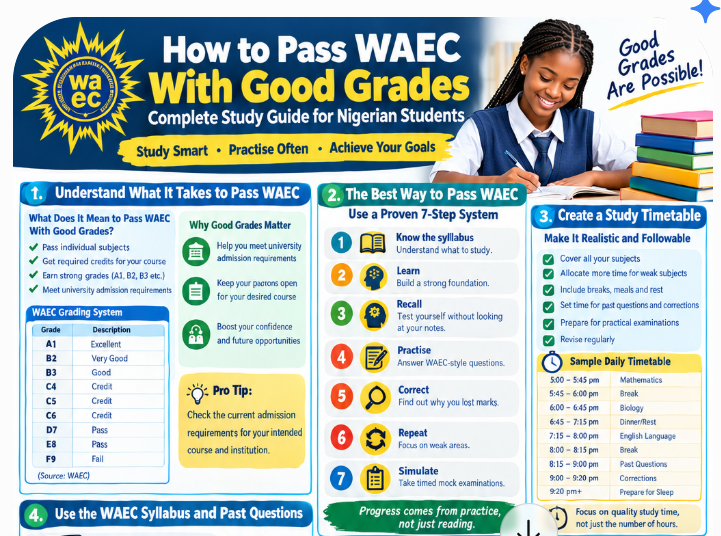
Welcome to Jambsmartprep.com, your no. 1 guide for Jamb, WAEC, NECO and admissions. In today’s post, we will be covering virtually everything you need to know about How to Pass WAEC With Good Grades: Complete Study Guide for Nigerian Students.
Yes, during the course of this online guide, you will learn how to pass WAEC with good grades using the syllabus, past questions, active recall, study timetables, mock exams and effective exam strategies. All you need to do to get what you want is to keenly follow all the instructions outlined in this post.
If you are searching for how to pass WAEC with good grades, you probably want more than a simple list telling you to “read hard.”
You want to know what to read, how to read it, how often to practise past questions, how to prepare weak subjects, how to create a timetable and what to do when the examination is getting close.
You may also be wondering whether you can still improve your result if you started preparing late.
The good news is that WAEC preparation does not have to be complicated. What matters is having a system that takes you from learning the syllabus to practising questions, correcting your mistakes and eventually answering questions under examination conditions.
This guide explains that system step by step.
Whether you are preparing for WAEC Mathematics, English Language, Biology, Chemistry, Physics, Government, Economics, Literature-in-English or another subject, you will learn how to organise your preparation and give yourself a better chance of earning strong grades.
You will also learn how to prepare for WAEC in three months, two months or 30 days, how to study past questions correctly, how to improve after a poor mock score, how to deal with difficult subjects and how to prepare for the final week and examination day.
Most importantly, this guide is about legitimate preparation.
There is no need to depend on leaked questions, “expo,” impersonation or other forms of examination malpractice.
Your goal should be to walk into the examination hall knowing that your result came from your own preparation.
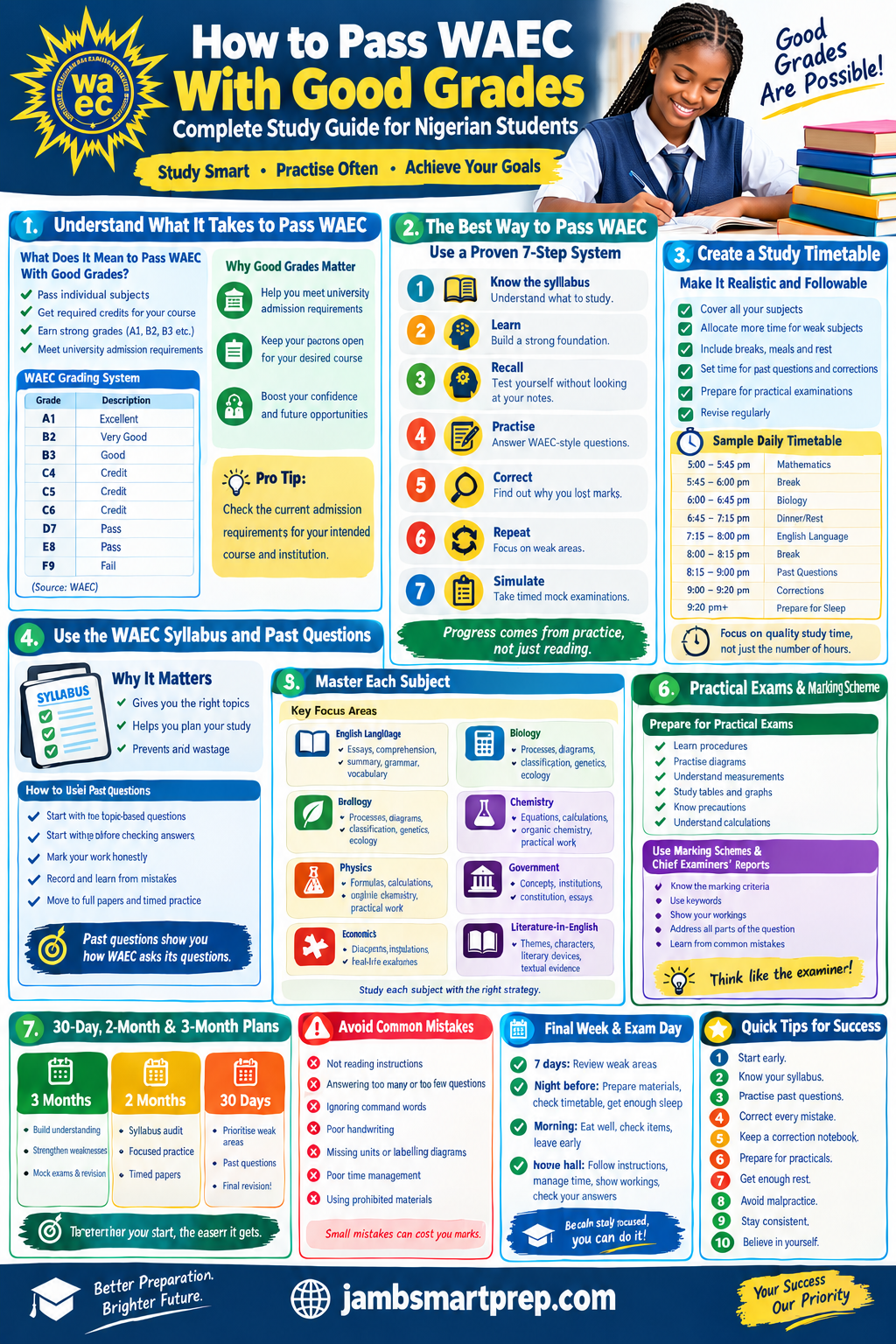
What Does It Mean to Pass WAEC With Good Grades?
Passing WAEC and getting good grades are related, but they are not exactly the same thing.
A candidate may technically pass several subjects but still have grades that do not meet the requirements of a particular course or institution.
For example, a student interested in Medicine, Nursing, Engineering, Law, Accounting or Computer Science may need specific subjects and credit grades for admission.
That means your target should not simply be:
“I don’t want to fail.”
A better target is:
“I want to understand my subjects well enough to earn the grades required for my next step.”
WAEC grades commonly range from A1 through F9, with A1 representing excellent performance and C grades representing credit-level performance.
However, the grade requirements for university admission depend on the course and institution.
Always check the current admission requirements of the university or other institution you intend to apply to.
Why Good WAEC Grades Matter for Nigerian Students
For many Nigerian students, WAEC is more than an examination at the end of secondary school.
It can become part of the documentation needed for admission into tertiary institutions.
JAMB UTME performance is important, but a strong UTME score does not remove the importance of meeting the O’level requirements for your chosen course.
For example, a student hoping to study Medicine may need strong results in subjects such as English Language, Mathematics, Biology, Chemistry and Physics, depending on the current requirements of the institution.
A prospective Engineering student will also need to pay close attention to Mathematics, English Language, Physics and Chemistry.
This is why your WAEC preparation should begin with understanding where your result needs to take you.
How WAEC Grades Can Affect Your Admission Plans
Before creating your study timetable, answer these questions:
- What course do I want to study?
- Which university or institution am I considering?
- What O’level subjects does the course require?
- What grades are required?
- Does the institution have any special requirements?
- Am I planning to use one sitting or combine results if necessary?
Do not rely on what a friend says about admission requirements.
Universities can have different requirements, and admission policies can change.
If your goal is Medicine, for example, it would be unwise to spend most of your study time improving an unrelated subject while neglecting a subject that is central to your intended course.
Your WAEC preparation should support your long-term admission plan.
Why Do Some Students Fail WAEC or Get Lower Grades Than Expected?
Poor WAEC performance is not always caused by a lack of intelligence.
Sometimes the problem is the preparation method.
A student can spend six hours with a textbook and still learn less than another student who spends two focused hours studying, testing themselves and correcting mistakes.
Here are some common problems.
1. Starting too late
Waiting until a few weeks before the examination can create unnecessary pressure.
You may have too many subjects and too little time to properly understand them.
2. Reading without testing yourself
Reading a chapter repeatedly can create the feeling that you know it.
But when the book is closed, you may discover that you cannot explain the concept.
That is why active recall and practice questions matter.
3. Ignoring the syllabus
Some students read randomly.
They move from one chapter to another without knowing whether they have covered the major areas of the examination.
The syllabus gives your preparation structure.
4. Memorising past answers
Past questions are extremely useful, but memorising an answer without understanding the topic can leave you unprepared when the question is presented differently.
5. Avoiding difficult subjects
If Mathematics scares you, avoiding Mathematics will not make the problem disappear.
The same applies to Chemistry, Physics, English Language or any other difficult subject.
6. Ignoring practical examinations
Science students sometimes focus almost entirely on theory.
That can be a mistake.
Practical work requires its own preparation.
7. Never practising under time pressure
Knowing an answer is different from producing it correctly within the available examination time.
8. Not reviewing mistakes
This is one of the biggest missed opportunities.
If you repeatedly make the same mistake but never analyse why, you are likely to repeat it.
The Best Way to Pass WAEC With Good Grades
Instead of thinking of WAEC preparation as simply “reading,” use this seven-stage system:
1. Know the syllabus
Understand what you need to cover.
2. Learn
Study the concepts properly.
3. Recall
Close your notes and explain what you remember.
4. Practise
Answer WAEC-style questions.
5. Correct
Identify exactly why you lost marks.
6. Repeat
Return to the weak area after some time.
7. Simulate
Take complete mock examinations under timed conditions.
This approach gives you a feedback loop.
You are not simply asking:
“How long did I study today?”
You are asking:
“What can I now answer that I could not answer before?”
That is a much more useful measure of progress.
Step 1: Get the WAEC Syllabus for Every Subject
One of the first things you should do is obtain the syllabus for each subject you are writing.
Do not treat the syllabus as a document you download once and never open again.
Turn it into a checklist.
For every topic, create columns such as:
| Topic | Studied | Practised | Current Score | Revision Needed |
|---|---|---|---|---|
| Topic A | Yes | Yes | 78% | No |
| Topic B | Yes | Yes | 45% | Yes |
| Topic C | No | No | — | High Priority |
This changes the syllabus from a passive document into a preparation tool.
You can see exactly where you stand.
The Federal Ministry of Education also provides access to curriculum-aligned digital learning resources, while its WAEC e-learning information points students toward resources covering WAEC-approved subjects and previous examination performance.
Step 2: Find Your Strong and Weak Subjects
Before creating a timetable, perform a simple diagnostic test.
Choose a past question paper or topic-based questions for each subject.
Do not look at the answers while working.
Mark yourself honestly.
Then divide your subjects into three groups.
Red: Weak
You frequently struggle with questions.
Yellow: Average
You understand some topics but make regular mistakes.
Green: Strong
You generally perform well but still need revision.
Your timetable should not necessarily give every subject exactly the same amount of time.
A weak subject may need more frequent attention.
Step 3: Create a WAEC Study Timetable
A study timetable should fit your real life.
If you attend school from Monday to Friday, do not create a timetable that assumes you have eight free hours every weekday.
You will probably abandon it.
A realistic timetable could look like this:
| Time | Activity |
|---|---|
| 5:00–5:45 pm | Mathematics |
| 5:45–6:00 pm | Break |
| 6:00–6:45 pm | Biology |
| 6:45–7:15 pm | Dinner/rest |
| 7:15–8:00 pm | English Language |
| 8:00–8:15 pm | Break |
| 8:15–9:00 pm | Past questions |
| 9:00–9:20 pm | Corrections |
| 9:20 pm onward | Prepare for sleep |
The times are examples, not rules.
The important thing is consistency.
How Many Hours Should You Study for WAEC?
There is no universal number of hours that guarantees an A1.
Five distracted hours may produce less learning than two focused hours.
Instead of chasing a huge number of hours, focus on:
- Concentration
- Active recall
- Practice
- Correction
- Revision
- Consistency
A student with two reliable hours every day may make substantial progress.
Another student may need more time because they have more subjects or significant gaps.
Your study time should match your situation.
How to Avoid Burnout While Preparing for WAEC
Do not build a timetable that leaves no room for sleep, meals, schoolwork or rest.
Your brain needs recovery.
Include:
- Short breaks
- Proper meals
- Sleep
- Some physical movement
- Time away from your phone
- Time to review mistakes
If you spend every night exhausted, your timetable is not helping you.
How to Prepare for WAEC in 3 Months
Three months gives you enough time to build a structured preparation plan.
Month 1: Build Understanding
Focus on:
- Getting your syllabus
- Identifying weak areas
- Learning major concepts
- Creating notes
- Beginning topic-based questions
Do not rush through the syllabus simply to say you have “finished.”
Understanding matters.
Month 2: Strengthen Weaknesses
Now increase your question practice.
For every major topic:
- Review the concept.
- Attempt questions.
- Mark your answers.
- Record mistakes.
- Study the correction.
- Attempt similar questions again.
Month 3: Examination Simulation
The final month should increasingly resemble the real examination.
Practise:
- Full papers
- Timed questions
- Essay writing
- Calculations
- Practical questions
- Objective questions
Analyse your results after every mock.
How to Prepare for WAEC in 2 Months
If you have two months, you need to be more selective.
Weeks 1–2
Complete a syllabus audit and identify weak topics.
Weeks 3–5
Focus heavily on learning and topic-based practice.
Weeks 6–7
Increase timed past-paper practice.
Week 8
Concentrate on corrections, weak areas, examination technique and final revision.
Do not spend the first six weeks simply reading textbooks.
Practice must begin early.
How to Prepare for WAEC in 30 Days
A 30-day preparation plan requires prioritisation.
You cannot approach the syllabus as though you have six months.
Days 1–5: Diagnose
Identify:
- Strong topics
- Weak topics
- Frequently tested concepts
- Subjects requiring urgent attention
Days 6–15: Learn and Practise
Work through important weak areas.
After studying each topic, answer questions.
Days 16–24: Past Papers
Begin more complete papers.
Work under time limits.
Days 25–27: Correct Your Mistakes
Return to the areas responsible for lost marks.
Days 28–30: Final Consolidation
Review:
- Formulas
- Definitions
- Diagrams
- Essay structures
- Practical procedures
- Mistake notebook
Avoid turning the final night into an all-night study session.
How to Study WAEC Past Questions the Right Way
Past questions are one of the most useful preparation tools available to a WAEC candidate.
But there is a right and wrong way to use them.
Wrong approach
Open a past question book and memorise the answers.
Better approach
Attempt the question yourself first.
Then check the answer.
Then ask:
Why did I get this wrong?
That question is more important than simply knowing the correct answer.
Use the Topic-by-Topic Method First
If you are weak in Mathematics algebra, for example, gather questions around algebra and practise them together.
If you are struggling with Biology genetics, focus on genetics questions.
This allows you to identify patterns.
Later, move to full papers.
The progression should be:
Topic practice → mixed practice → full timed paper
Create a WAEC Correction Notebook
This can become one of your most valuable study tools.
For every mistake, record:
| Question | My Answer | Correct Answer | Why I Was Wrong | What I Must Remember |
|---|---|---|---|---|
| Q5 | B | D | Misread question | Check wording |
| Q12 | 24 | 18 | Calculation error | Recheck operation |
Do not simply copy the correct answer.
Write the reason for the mistake.
Common reasons include:
- I did not understand the topic.
- I forgot the formula.
- I misread the question.
- I rushed.
- I made an arithmetic error.
- I used the wrong unit.
- I did not know the required definition.
- I ran out of time.
Once you know the cause, you can fix it.
Use Active Recall to Remember What You Read
Active recall means trying to retrieve information from memory rather than simply looking at it.
For example, after studying Biology, close the textbook.
Ask yourself:
What are the functions of the parts of this system?
Then answer without looking.
For Government:
What are the functions of this institution?
For Chemistry:
What is the process involved in this reaction?
For Economics:
What factors affect this economic concept?
For Mathematics:
Which formula applies here and why?
If you cannot answer, reopen your notes, review the material and try again.
Use a Brain Dump
Take a blank sheet.
Write the topic.
Then write everything you remember.
For example:
Topic: Photosynthesis
Write:
- Definition
- Site
- Raw materials
- Products
- Conditions
- Factors affecting the process
- Importance
Then compare your brain dump with your notes.
The missing information becomes your revision list.
Use Spaced Revision
Do not study a topic once and abandon it.
A simple revision pattern could be:
Day 1 → Day 3 → Day 7 → Day 14 → Day 30
You can adjust the intervals.
The point is to revisit important information before you completely forget it.
Practise Under Time Limits
Many students discover during WAEC that they know the material but cannot finish the paper.
Timed practice helps identify this problem before the real examination.
When practising:
- Set the timer.
- Put your phone away.
- Use the appropriate paper format.
- Do not check answers during the test.
- Mark yourself afterward.
- Record your score.
- Analyse your mistakes.
How to Improve Your WAEC Score After a Mock Test
Suppose you score 48%.
Do not simply say:
“I am not good at this subject.”
Instead, analyse the 52% you lost.
Perhaps:
- 20% came from topics you never studied.
- 15% came from careless mistakes.
- 10% came from time pressure.
- 7% came from misunderstanding instructions.
Now you have a plan.
You can revise the missing topics, practise accuracy and improve time management.
The process is:
Test → Mark → Diagnose → Revise → Reattempt
That is much more useful than taking one mock examination after another without reviewing your performance.
How to Study When You Have a Weak WAEC Subject
If you are weak in a subject, do not begin by saying:
“I am not a science student.”
or:
“I can never understand Mathematics.”
Start smaller.
Choose one topic.
Learn the basic concept.
Attempt a simple question.
Correct it.
Then attempt another.
Your confidence should come from evidence of improvement, not motivational statements alone.
How to Pass WAEC Mathematics With a Good Grade
Mathematics requires regular practice.
Reading a Mathematics textbook for three hours without solving problems is not enough.
Focus on:
- Understanding formulas
- Knowing when to use them
- Algebra
- Geometry
- Statistics
- Probability
- Graphs
- Mensuration
- Trigonometry where applicable
- Word problems
- Calculation accuracy
Your mistake notebook is particularly valuable for Mathematics.
If you repeatedly make the same type of error, practise that type of question until the error becomes less common.
Always show your workings where required
Even when you know the answer, make sure your method is clear where the question requires working.
Also pay attention to units.
A correct calculation with an incorrect unit can affect your answer.
How to Pass WAEC English Language With a Good Grade
Do not assume English Language requires little preparation simply because you use English every day.
The examination tests specific skills.
Prepare for:
- Essay writing
- Comprehension
- Summary
- Grammar
- Vocabulary
- Sentence construction
- Oral English where applicable
Practise essay writing
Learn how to:
- Understand the question
- Identify the required format
- Plan your points
- Organise paragraphs
- Develop ideas
- Use appropriate vocabulary
- Check grammar
- Write a suitable conclusion
Do not memorise a complete essay and hope the exact topic appears.
Learn how to construct an answer.
How to Pass WAEC Biology
Biology becomes easier when you understand relationships between concepts.
Review:
- Definitions
- Biological processes
- Classification
- Genetics
- Ecology
- Reproduction
- Human systems
- Adaptation
- Diagrams
- Practical Biology
Practise drawing and labelling important diagrams where appropriate.
Do not merely look at a diagram.
Close your book and try to reproduce it.
How to Pass WAEC Chemistry
Chemistry requires both understanding and practice.
Focus on:
- Chemical equations
- Mole calculations
- Atomic structure
- Periodic concepts
- Acids, bases and salts
- Organic chemistry
- Separation techniques
- Qualitative analysis
- Practical procedures
For calculations, write the steps.
Do not rely on trying to remember the final answer to a previous question.
Understand the process.
How to Pass WAEC Physics
Physics requires you to connect formulas with physical concepts.
Review:
- Formulae
- Units
- Definitions
- Graphs
- Calculations
- Practical principles
- Problem-solving methods
Whenever you learn a formula, ask:
- What does each symbol mean?
- What unit is associated with it?
- When should I use it?
- What information does the question provide?
Then practise.
How to Pass WAEC Government
For Government, focus on understanding concepts rather than memorising disconnected paragraphs.
Review:
- Political concepts
- Institutions
- Functions
- Constitutional development
- Political systems
- Citizenship
- Political participation
- International organisations
- Essay structure
Practise explaining concepts in your own words.
If you cannot explain a topic without looking at your notes, you probably need more revision.
How to Pass WAEC Economics
Focus on:
- Definitions
- Economic concepts
- Diagrams
- Calculations
- Market structures
- National income
- Inflation
- Unemployment
- Public finance
- International trade
- Development
Practise drawing relevant diagrams correctly.
Do not simply memorise what the diagram looks like.
Understand what changes in the diagram mean.
How to Pass WAEC Literature-in-English
For Literature, understand the texts rather than memorising isolated quotations.
Review:
- Themes
- Characters
- Character relationships
- Plot
- Conflicts
- Literary devices
- Poetry
- Drama
- Prose
- Significant events
Practise answering questions in a structured way.
When making an argument about a character or theme, support it with relevant knowledge from the text.
Do Not Ignore WAEC Practical Examinations
Students sometimes spend most of their preparation time on theory.
That can leave them unprepared for practical work.
For practical subjects, review:
- Apparatus
- Specimens
- Procedures
- Measurements
- Calculations
- Tables
- Graphs
- Diagrams
- Observations
- Precautions
- Sources of error
Do not depend on predictions about the exact specimen or practical question that will appear.
Prepare from legitimate learning materials and the relevant syllabus.
How to Use WAEC Marking Schemes and Chief Examiners’ Reports
A useful way to improve is to think about how marks are actually awarded.
WAEC explains that its marking process involves a marking guide, examiner coordination, supervision by team leaders and oversight by chief examiners. This means your preparation should not focus only on “getting the topic.”
You should also learn how to produce answers that meet the requirements of the question.
Ask:
- What is the question actually asking?
- What points are required?
- Do I need an explanation?
- Do I need examples?
- Do I need a diagram?
- Do I need calculations?
- Do I need units?
- Have I answered every part?
This is particularly important for theory papers.
How to Study for WAEC at Home
You do not necessarily need an expensive tutorial centre to begin serious preparation.
A student studying at home can use:
- School notes
- WAEC syllabus
- Past questions
- Approved textbooks
- Teacher explanations
- Legitimate online learning resources
- WAEC e-learning materials
- Federal Ministry of Education learning resources
The Federal Ministry of Education’s e-learning ecosystem includes curriculum-aligned resources, while its WAEC resource information specifically points learners toward WAEC materials and practice resources.
If you have internet access, use it strategically.
Do not spend your study time scrolling through unrelated videos.
Should You Join a WAEC Tutorial Centre?
A tutorial centre can be useful for some students, especially when they need additional explanation or accountability.
But joining one does not automatically guarantee a good grade.
Before paying for a tutorial centre, ask:
- Who teaches the subjects?
- Do they use a structured syllabus?
- Do students practise questions?
- Do teachers correct mistakes?
- Are mock examinations conducted?
- Is there practical preparation?
- Are they making unrealistic promises?
Be particularly cautious about anyone promising guaranteed grades or claiming to have secret access to WAEC questions.
WAEC itself states that it does not establish or affiliate with tutorial centres for candidate preparation.
How to Pass WAEC Without Expo or Cheating
You do not need examination malpractice to build a strong preparation strategy.
WAEC identifies activities such as bringing books or “cribs” into the examination hall, impersonation, script swapping and organised cheating as examination malpractice.
Results can be cancelled when candidates are found guilty of malpractice.
That means relying on “expo” is not a legitimate preparation strategy.
If you are behind, use the remaining time to:
- Identify important weak topics.
- Study the basics.
- Practise questions.
- Correct mistakes.
- Complete timed papers.
- Ask teachers for help.
- Revise repeatedly.
A difficult preparation period is still safer than risking your examination result through malpractice.
How to Prepare During the Final 7 Days Before WAEC
The final week should be about consolidation.
Day 7
Identify your remaining weak areas.
Day 6
Complete a timed paper.
Day 5
Analyse and correct the paper.
Day 4
Revise weak topics.
Day 3
Complete another timed practice.
Day 2
Review mistakes, formulas, definitions and important concepts.
Day 1
Check your timetable, prepare examination materials, plan your journey, review lightly and get enough rest.
Do not attempt to learn an entire syllabus on the final night.
What to Do the Night Before WAEC
The night before should be organised rather than chaotic.
Check the timetable
Confirm:
- Subject
- Paper
- Date
- Time
- Examination centre
Review lightly
Focus on:
- Formulas
- Definitions
- Mistakes
- Important concepts
- Practical procedures where relevant
Prepare your materials
Get everything ready before bedtime.
Plan transportation
Do not discover your route in the morning.
Avoid unnecessary social media
WhatsApp groups can become full of rumours before examinations.
Do not allow them to consume your night.
Sleep
An all-night reading session is not a requirement for passing WAEC.
For a detailed final-night routine, use this “What to Do the Night Before a WAEC Examination” guide.
What to Do on WAEC Examination Morning
Your morning should be simple.
- Wake up early.
- Prepare without rushing.
- Eat normally if you usually eat breakfast.
- Check your examination materials.
- Avoid frantic last-minute reading.
- Leave home early.
- Arrive at the centre with enough time.
- Follow instructions.
You do not need to spend the morning comparing your preparation with everyone else.
What to Do When You Arrive at the Examination Centre
Confirm that you are at the correct centre.
Pay attention to instructions from authorised examination officials.
Do not assume that something is permitted because another student is doing it.
If you are unsure about a procedure, ask the appropriate official.
Your responsibility is to follow the examination rules and protect your script.
How to Manage Your Time During WAEC
Time management should be practised before examination day.
During your mock examinations, learn how quickly you normally answer questions.
In the real examination:
- Read instructions carefully.
- Understand the number of questions required.
- Avoid spending too long on one difficult question.
- Keep track of time.
- Leave time for checking where possible.
- Review calculations.
- Check that you answered the required questions.
The exact structure and duration vary by paper, so always follow the instructions on your current examination paper and the official timetable.
What to Do When You See a Difficult WAEC Question
Do not immediately conclude:
“I am finished.”
A difficult question may simply be a question you should temporarily leave.
If the paper structure permits it:
- Read the question carefully.
- Identify what you know.
- Attempt it if you can make useful progress.
- Move to another question when appropriate.
- Return later.
Do not allow one question to consume the time needed for several questions you can answer.
Common WAEC Examination Mistakes That Can Cost Marks
Some mistakes have nothing to do with whether you studied.
They happen because students rush.
Watch out for:
- Not reading instructions
- Answering too many or too few questions
- Misreading the question
- Forgetting units
- Failing to label diagrams
- Poor time management
- Leaving sections unfinished
- Making avoidable calculation errors
- Incorrectly entering required candidate information
- Using the wrong writing material where instructions specify otherwise
WAEC’s official FAQ specifically notes that some cases of partial result release can arise from administrative mistakes such as wrong transfer of examination numbers, failure to shade examination numbers and shading objective sheets with biro instead of pencil.
The lesson is simple:
Examination technique matters alongside academic knowledge.
How to Pass WAEC If You Have Failed Before
Failing a previous examination does not automatically tell you that you cannot improve.
Instead, analyse the previous attempt.
Ask:
- Which subjects did I struggle with?
- Which topics caused problems?
- Did I practise enough questions?
- Did I understand the syllabus?
- Did I run out of time?
- Did I make careless mistakes?
- Did I prepare for practicals?
- Did I study consistently?
- Did I rely too heavily on memorisation?
Then change the preparation method.
If your previous strategy did not work, repeating the exact same strategy is unlikely to solve the problem.
Can You Pass WAEC If You Start Studying Late?
Starting late makes preparation more difficult, but it does not mean you should give up.
The amount of time available determines your strategy.
Six months available
Build deep understanding and practise extensively.
Three months available
Follow a structured syllabus and question-practice plan.
Two months available
Prioritise weak areas and increase timed practice.
Thirty days available
Use a focused emergency plan.
Seven days available
Consolidate, practise and correct.
One day available
Do not attempt to learn everything.
Focus on organisation, light revision and rest.
How to Remember What You Read for WAEC
If you frequently say:
“I read this yesterday but I cannot remember it today,”
change your study method.
Instead of reading the same page repeatedly:
Read
Understand the material.
Close the book
Try to remember it.
Write
Record what you know.
Check
Compare your answer with the notes.
Correct
Fill the gaps.
Repeat
Return to the topic later.
This is far more active than simply highlighting paragraphs.
How Parents Can Help Students Prepare for WAEC
Parents can support preparation without turning the home into a pressure centre.
Helpful support includes:
- Providing a quiet study environment
- Helping with necessary materials
- Encouraging consistent preparation
- Supporting transport arrangements
- Monitoring excessive late-night studying
- Avoiding comparisons with other children
- Encouraging students when they struggle
A student who is constantly frightened of disappointing everyone may find it harder to focus.
The goal is accountability without unnecessary pressure.
A Complete WAEC Preparation Checklist
Before You Begin
- List all registered subjects.
- Get the relevant syllabus.
- Gather textbooks and learning materials.
- Get reliable past questions.
- Identify strong and weak subjects.
- Create a realistic timetable.
During Preparation
- Study the syllabus systematically.
- Use active recall.
- Practise questions.
- Mark your work.
- Record mistakes.
- Revisit weak topics.
- Practise under time limits.
- Prepare for practical examinations.
- Complete mock examinations.
Before the Examination
- Check the official timetable.
- Confirm examination centre.
- Prepare permitted materials.
- Review important weaknesses.
- Reduce unnecessary distractions.
- Plan transportation.
- Get adequate rest.
On Examination Day
- Arrive early.
- Follow instructions.
- Read questions carefully.
- Manage your time.
- Show workings where required.
- Check answers before submitting where possible.
- Avoid prohibited materials and conduct.
The 15 Rules to Remember If You Want Good WAEC Grades
- Start preparing early whenever possible.
- Know your syllabus.
- Find your weak subjects.
- Create a realistic timetable.
- Study actively.
- Use past questions regularly.
- Correct every mistake.
- Keep a correction notebook.
- Practise under examination conditions.
- Prepare for practical examinations.
- Treat English Language and Mathematics seriously.
- Do not neglect subjects relevant to your intended course.
- Protect your sleep and concentration.
- Ignore unreliable “sure question” and expo claims.
- Follow WAEC’s examination rules.
Frequently Asked Questions About Passing WAEC With Good Grades
How can I pass WAEC with good grades?
Study systematically from the syllabus, practise WAEC-style questions, use active recall, correct your mistakes, take timed mock examinations and revise weak areas repeatedly.
How can I get A1 in WAEC?
There is no legitimate method that guarantees an A1. Your best preparation is to understand the syllabus thoroughly, practise extensively, correct mistakes, master examination technique and follow the rules.
Can I pass WAEC in one sitting?
Yes, candidates can prepare to complete their required subjects successfully in one sitting, but the outcome depends on their preparation and examination performance.
How many hours should I study for WAEC?
There is no universal number of hours that guarantees a particular grade. Focus on consistent, distraction-free study, practice and correction rather than simply counting hours.
Is reading WAEC past questions enough?
No. Past questions are valuable practice, but you should combine them with syllabus-based learning and genuine understanding of the topics.
How many years of WAEC past questions should I practise?
There is no universal number that guarantees success. Use enough relevant papers to expose yourself to different question styles, then focus on understanding and correcting your mistakes.
How can I pass WAEC in 30 days?
Use a focused plan: diagnose your weaknesses, prioritise important topics, practise questions daily, analyse your mistakes and complete timed papers before the final days.
Can I pass WAEC if I start studying late?
You can still make meaningful progress. The less time you have, the more selective and structured your preparation needs to become.
How do I pass WAEC Mathematics?
Study the underlying concepts, practise regularly, review formulas, solve problems under time limits and keep a record of repeated mistakes.
How do I pass WAEC English Language?
Practise essay writing, comprehension, summary, grammar and vocabulary. Learn how to organise answers rather than memorising complete essays.
How do I pass WAEC Biology?
Understand biological processes, practise diagrams, review definitions and concepts, and prepare properly for practical components.
How do I pass WAEC Chemistry?
Combine conceptual learning with calculations, equations, reactions and practical preparation. Practise solving problems rather than memorising final answers.
How do I pass WAEC Physics?
Understand formulas, units and concepts, then practise calculations, graphs and practical questions under time limits.
How do I pass WAEC without expo?
Use the syllabus, textbooks, past questions, mock examinations, active recall, teacher support and legitimate online learning resources. Do not rely on leaked questions or prohibited materials.
What should I do if I keep failing WAEC mock examinations?
Do not simply take more mocks without analysis. Identify why you are losing marks, revise those areas, practise similar questions and retest yourself.
Should I join a tutorial centre to pass WAEC?
A good tutorial centre can provide structure and additional teaching, but it is not a guarantee of success. Evaluate the quality of teaching, practice, feedback and materials before paying.
Is Mathematics compulsory for WAEC?
Current WAEC entry regulations for candidates registering for the 2026 and 2027 WASSCE identify English Language and General Mathematics as the two currently available core subjects, with candidates selecting additional subjects to reach the required total.
Always verify the current regulations for your examination year.
What should I do the night before WAEC?
Review important material lightly, prepare your examination materials, check the timetable, plan your journey, avoid unnecessary distractions and get enough rest.
How important are practical examinations?
They can be important components of relevant subjects. Candidates should prepare for practical procedures, observations, measurements, calculations, diagrams and precautions rather than relying on predictions.
Your WAEC Result Starts With How You Prepare
Getting good WAEC grades is not about finding one secret trick.
It is about building a preparation system and following it consistently.
Know what you need to study.
Use the syllabus.
Learn the concepts.
Test yourself.
Practise past questions.
Correct your mistakes.
Return to weak areas.
Take timed mock examinations.
Prepare for practicals.
Then learn how to manage the actual examination.
Most importantly, do not measure your preparation only by how many hours you spend reading.
Measure it by what you can now remember, explain and answer correctly.
If you are preparing for WAEC now, start with one simple action today.
Get your subject list and syllabus.
Create your study timetable.
Choose one weak topic.
Study it.
Close your book and test yourself.
Then answer a few relevant questions and record your mistakes.
Repeat that process tomorrow.
That is how preparation becomes progress.
For more support, continue with your WAEC preparation resources covering the WAEC syllabus, past questions, subject-specific study guides, study timetables, practical examinations and examination-day tips. Students preparing for university should also check the current JAMB and institution-specific admission requirements for their intended course so that their WAEC targets match their future plans.
