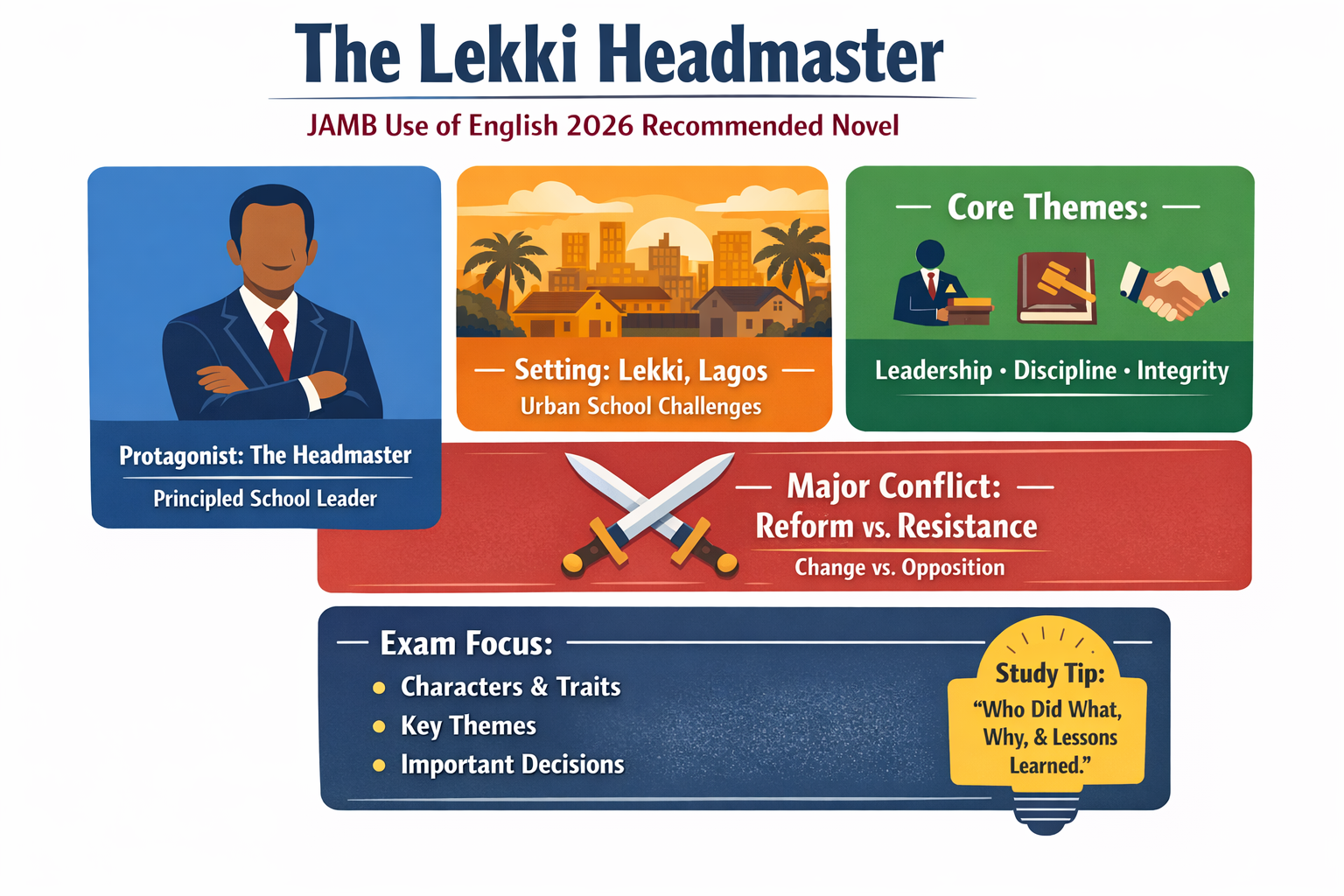
The Lekki Headmaster by Kabir Alabi Garba is the novel JAMB approved as the recommended reading text for the Use of English paper in the 2025 UTME, and it was used again for 2026. It tells the story of Mr Bepo Adewale, the long-serving principal of Stardom Schools in Lekki, Lagos, who is pressured by his wife, Seri, a nurse in the United Kingdom, to resign and join the family abroad. The novel follows his struggle between “japa” (emigration) and his commitment to his students, his school and his country, while exposing problems in Nigerian education, from corruption and greed to parental pressure. JAMB sets questions on the text, so candidates who read it fully gain some of the most reliable marks in the UTME.
This guide gives you everything you need to prepare: the key facts about the book, a chapter-by-chapter overview, the main characters and their roles, settings, themes, language points that link the novel to the English paper, sample questions in the JAMB style, a reading plan, and what 2027 candidates should know about the text.
- Author: Kabir Alabi Garba
- JAMB use: recommended Use of English text for the 2025 and 2026 UTME (it replaced Life Changer by Khadijat Jalli, used in 2024)
- Protagonist: Mr Bepo (Adebepo) Adewale, principal of Stardom Schools, Lekki
- Central conflict: whether Bepo will leave Nigeria to join his wife Seri and their daughters in the UK
- Chapters: 12, from “Dusk” to “…Dawn”
- Major themes: emigration (japa), integrity, corruption in education, wealth and privilege, duty to country
- 2027: confirm whether JAMB retains it when the 2027 text is announced
In this guide:
- About the novel
- Is The Lekki Headmaster the JAMB text for 2027?
- Chapter-by-chapter overview
- Main characters
- Settings
- Themes
- Style, symbols and language points
- How JAMB asks about the text
- Sample questions with answers
- How to study the novel: a 3-week plan
- Mistakes candidates make with the text
- Frequently asked questions
About the novel
JAMB announced The Lekki Headmaster as the approved Use of English text in January 2025, ahead of that year’s UTME registration. The novel was written by Kabir Alabi Garba. It’s a contemporary story set mainly in a private secondary school in Lekki, one of Lagos’s wealthiest areas, and it deals with issues many Nigerian families talk about every day: the pull of emigration, the cost of living, standards in schools, and what it means to do the right thing when the system rewards shortcuts.
The book is popular with teachers because it’s readable, short enough to finish in a few weeks, and full of realistic school situations: assemblies, staff meetings, prefect elections, parents’ complaints, sports days and board meetings. For JAMB candidates, that familiarity is helpful. Many of the scenes will remind you of your own school, which makes events and characters easier to remember.
The title echoes the classic Nigerian television drama The Village Headmaster. In the novel, the nickname “The Lekki Headmaster” is given to Bepo by a colleague, Mr Audu, the Fine Art teacher.
Is The Lekki Headmaster the JAMB text for 2027?
JAMB used The Lekki Headmaster for the 2025 and 2026 UTME. JAMB announces the recommended text for each examination year, and texts have historically been changed after a period of use (Life Changer was the text before it). As of November 2026, 2027 candidates should watch JAMB’s official channels at jamb.gov.ng for confirmation of the 2027 text.
What should you do in the meantime? If you’re preparing for the 2027 UTME, reading The Lekki Headmaster now is a reasonable step, because it’s the current text and the reading itself helps your English. But stay alert: if JAMB announces a new text, switch to it immediately. A harmonised timetable proposed by the Federal Government and shared by JAMB places the 2027 UTME around 15 to 25 March 2027 (JAMB described the dates as provisional), so there may be less time than usual to read a new book. Don’t rely on social media rumours; confirm on JAMB’s official channels.
Chapter-by-chapter overview
The novel has 12 chapters. The first is titled “Dusk” and the last “…Dawn”, a contrast that mirrors Bepo’s journey from despair to renewed purpose. This overview gives the main events to help your revision. It isn’t a substitute for reading the book, because JAMB questions often test details that summaries leave out.
| Chapter | Title |
|---|---|
| 1 | Dusk |
| 2 | The Enticement |
| 3 | Migration Tales |
| 4 | A Case of Visa Denied |
| 5 | Snake in the Roof |
| 6 | Ade as Well as Jide COMES vs. COME |
| 7 | Ritualists |
| 8 | Missions Unaccomplished |
| 9 | Laughing Waterfalls |
| 10 | Passport Pains |
| 11 | Point of No Return |
| 12 | …Dawn |
Chapter 1: Dusk
The novel opens dramatically at a morning assembly at Stardom Schools. Shortly after a student, Ikenna Egbu, delivers a well-received speech, the principal, Mr Bepo Adewale, a man known for discipline and composure, breaks down in tears on the podium. Staff dismiss the students, and colleagues take Bepo to his office. The Vice Principal, Mrs Apeh, contacts the Managing Director, and Mr Ope Wande, a Physics teacher who is also a pastor, tries to counsel him. The chapter leaves the reader asking why such a strong man is weeping, and sets up the mystery that drives the opening of the book.
Chapter 2: The Enticement
The reason for Bepo’s distress emerges: his wife, Seri, who lives in the United Kingdom with their daughters, wants him to resign and join them. The “enticement” is the promise of a better-paid life abroad, which Bepo weighs against his long service at Stardom, his plans for his later years, and his sense of duty.
Chapter 3: Migration Tales
Bepo hears stories from people who have emigrated or know those who have, including his former colleague Sola, now in the UK. The tales show both sides of japa: opportunities and higher earnings, but also professionals doing work far below their training, strained marriages and loneliness. These stories feed Bepo’s uncertainty.
Chapter 4: A Case of Visa Denied
A parent, Mrs Ignatius, calls Bepo late at night in distress. During her family’s visa process, a DNA test has revealed that her husband is not the biological father of their child, Favour, causing a crisis at home. The chapter also recalls the case of Mr Ayesoro, the Government teacher, who was moved out of the classroom after a wealthy parent, Mrs Ladele, complained that her daughter Bibi had nightmares about his tribal marks. The episodes show how the wishes of rich and powerful parents can override fairness.
Chapter 5: Snake in the Roof
The Managing Director, Mrs Ibidun Gloss, notices expensive cars parked on a school-owned plot of land and suspects wrongdoing. It turns out staff bought the cars with loans from the staff cooperative society, which holds a large sum. The MD worries about what the staff could do with such money, describing the situation with the image of “hanging a snake in the roof and going to bed”, a proverb about ignoring a danger close at hand.
Chapter 6: Ade as Well as Jide COMES vs. COME
This chapter centres on a dispute over English usage. The senior English teacher, Mr Fafore, faces a complaint about subject–verb agreement with “as well as”, and his job is put at risk. Bepo defends him. For JAMB candidates, the chapter is doubly useful: it’s part of the story and it illustrates a concord rule tested in the structure section of the English paper. (With “as well as”, the verb normally agrees with the first subject: “Ade, as well as Jide, comes.”)
Chapter 7: Ritualists
The novel looks back at Bepo’s time at his former workplace, Beesway Group of Schools, under its director, Mr Egi Meko, where Bepo encountered corruption and practices he considered ungodly, and which shaped his commitment to integrity. Superstition and ritual beliefs around success and admission also appear in the school setting.
Chapters 8–10: Missions Unaccomplished, Laughing Waterfalls, Passport Pains
The middle and later chapters follow Bepo as he works through unfinished business at the school and the practical steps of leaving. “Passport Pains” deals with the frustrations of getting travel documents, including Bepo’s dealings with Tai, a passport agent, and shows the bureaucracy and racketeering many Nigerians face. Other school life continues around him, including student rivalries, such as the prefect election contest between Banky and Tosh, the son of Chief Didi Ogba.
Chapter 11: Point of No Return
As his departure approaches, Bepo is filled with nostalgia and uncertainty. A farewell is organised for him by the school community. He reflects on his relationships with students and staff and on matters left unresolved, while preparing to move forward.
Chapter 12: …Dawn
The title signals a new beginning, answering the “Dusk” of the opening chapter. Study guides describe Bepo abandoning his trip at the airport after a nightmare and returning joyfully to his students, choosing to stay in Nigeria. Read the final chapter carefully, because questions about the resolution, and about what finally changes Bepo’s mind, are natural targets for examiners.
Main characters
| Character | Role |
|---|---|
| Mr Bepo (Adebepo) Adewale | Protagonist; principal of Stardom Schools; disciplined, principled; nicknamed “The Lekki Headmaster” |
| Seri | Bepo’s wife; a nurse in the UK; pressures him to join the family |
| Nike and Kike | Bepo’s daughters, living in the UK with Seri |
| Mrs Ibidun Gloss | Managing Director of Stardom Schools; daughter of its founder |
| Chief David Aje | Late founder of Stardom Schools, who hired Bepo |
| Chief Mrs Solape Bayo | Chairman of the board; the MD’s mother |
| Mrs Grace Apeh | Vice Principal |
| Mr Audu | Fine Art teacher; comic relief; coined the nickname “The Lekki Headmaster” |
| Mr Ope Wande | Physics teacher and pastor; tries to counsel Bepo |
| Mr Fafore | Senior English teacher; faces a grammar complaint; defended by Bepo |
| Mr Ayesoro | Government teacher moved out of the classroom after a parent’s complaint about his tribal marks |
| Mr Jeremi Amos | School accountant |
| Mr Ibe | Games master |
| Ikenna Egbu | Student and poet whose speech precedes Bepo’s breakdown |
| Banky and Tosh | Rival students in the prefect election; Tosh is the son of Chief Didi Ogba |
| Chief Didi Ogba | Wealthy parent and politician |
| Mrs Ignatius | Parent whose family’s visa process leads to a paternity crisis |
| Mrs Mary Ladele and Bibi | Wealthy parent and her daughter, whose nightmare leads to Mr Ayesoro’s removal |
| Mr Egi Meko | Director of Beesway Group of Schools, Bepo’s former employer |
| Sola | Former colleague who emigrated to the UK |
| Tai | Passport agent |
| Mr Ogunwale and Jide | Bepo’s landlord in Ikeja and the landlord’s grandson, whom Bepo tutors |
Character names and minor roles vary slightly between study guides, so check spellings and details against the novel itself.
Bepo Adewale in depth
Bepo is the moral centre of the book. He is strict and disciplined, devoted to his students, honest with parents even when it’s uncomfortable, and willing to defend colleagues treated unfairly, as with Mr Fafore. He is also human: torn, tired, emotional, and under real financial and family pressure. Examiners may ask about his qualities, his motives and the events that test him. When you revise, note specific actions that show each trait.
Seri
Seri represents the pull of japa. She isn’t a villain: her desire for the family to be together in a place she believes offers a better life is understandable. Her pressure on Bepo creates the central conflict.
Mrs Ibidun Gloss
The MD represents ownership and business interests in private education. Her concerns about money, control and the school’s reputation sometimes clash with Bepo’s educational priorities.
Settings
- Stardom Schools, Lekki, Lagos: the main setting, a private school serving wealthy families.
- Bepo’s home in Ikeja, Lagos: where he lives as a tenant of the Ogunwale family.
- Beesway Group of Schools: Bepo’s former workplace, seen in flashbacks.
- The United Kingdom: where Seri and the children live; present through phone calls, stories and Bepo’s plans.
- The airport: the setting of the novel’s turning point.
Themes
Emigration (japa) and brain drain
The novel’s central theme is the wave of Nigerian professionals leaving for countries like the UK, Canada and the US. Through Bepo and the migration tales he hears, it shows the attractions of leaving and its costs, and asks what happens to institutions when their best people go.
Integrity and duty
Bepo’s refusal to compromise, at Beesway and at Stardom, makes him a symbol of principle. The novel suggests that people of integrity are needed most where integrity is hardest.
Corruption and greed in education
From the questionable practices at Beesway to money matters at Stardom and ritual beliefs, the book exposes ways in which education can be corrupted by greed and shortcuts.
Wealth, privilege and power
Wealthy parents and influential figures repeatedly try to bend the school to their will, as in Mr Ayesoro’s removal and the prefect election. The novel questions whether money should buy influence in a school.
Family and sacrifice
Bepo’s marriage and his relationship with his daughters show how emigration can separate families and force painful choices.
Language and standards
The grammar dispute in Chapter 6, and Bepo’s attention to correct usage, reflect a concern for standards in education, and connect neatly to the English paper itself.
Hope and renewal
The movement from “Dusk” to “…Dawn” frames the novel as a story of renewal. Despite the problems it exposes, it ends on a hopeful note about commitment and service.
Bepo’s dilemma: the case for leaving and the case for staying
The heart of the novel is a decision, and understanding both sides helps you answer questions about Bepo’s motives and the book’s message. It also helps if you’re asked about themes or the significance of events.
Reasons pulling Bepo to leave
- Family: his wife and daughters are already in the UK, and the separation strains the marriage.
- Money: work abroad promises higher pay than he earns in Lagos, at a time when living costs are rising.
- Security for later life: he worries about his retirement and earlier plans that didn’t work out.
- Frustration with the system: corruption, interference from wealthy parents and owners, and poor working conditions for teachers.
- Social pressure: many colleagues and acquaintances are leaving, and staying can look like failure.
Reasons holding Bepo back
- His students: his bond with them and his belief in what education can do.
- His colleagues: he protects staff treated unfairly, as with Mr Fafore.
- Duty to country: the sense that people of integrity are needed to fix institutions, not abandon them.
- The migration tales: stories of professionals doing menial work, strained marriages and isolation abroad.
- Identity: being a principal is not just his job but a large part of who he is.
The novel doesn’t pretend the choice is easy, and it treats Seri’s position with sympathy. Its resolution, with Bepo returning to his students, suggests the author’s view that commitment and service at home have value that money can’t measure. In an exam, if a question asks what the ending suggests, think in terms of hope, renewal and duty.
Lessons and messages for readers
Beyond the plot, the novel carries messages that make it a fitting choice for school leavers:
- Integrity matters even when shortcuts seem to pay.
- Wealth and influence shouldn’t decide what’s fair in a school.
- Emigration is a personal decision with real gains and real losses.
- Teachers deserve respect and fair treatment.
- Good standards, including in language, are part of good education.
These messages also link to other parts of your preparation. The novel’s critique of shortcuts in education echoes the reasons to avoid exam malpractice. See how to pass JAMB without malpractice.
Style, symbols and language points
- Chapter titles as symbols: “Dusk” and “…Dawn” frame the story as a passage from darkness to light.
- Proverbs and images: “hanging a snake in the roof and going to bed” in Chapter 5 is a vivid warning about ignored danger.
- Humour: Mr Audu provides comic relief, which balances serious themes.
- Flashback: the Beesway episodes reveal Bepo’s past and explain his values.
- Realism: everyday Lagos life, school routines and familiar social issues ground the story.
- Grammar in the plot: the “as well as” concord dispute is a live example of a structure rule you need for the exam.
How JAMB asks about the text
Text questions in the Use of English paper are multiple choice and usually test specific knowledge of the book. Common question types include:
- Who: which character did or said something?
- Where: where did an event take place?
- Relationships: how are two characters related?
- Roles: what subject did a teacher teach, or what position did someone hold?
- Events and causes: why did something happen?
- Themes and meaning: what does an event or title suggest?
Because these questions test details, candidates who have read only a summary often find two options that both look plausible. Reading the full text, with notes, is the best preparation. See Use of English areas of concentration.
Sample questions with answers
These practice questions are written in the JAMB style, based on the novel’s main facts. They aren’t actual JAMB questions. For a larger set, see Lekki Headmaster questions and answers.
- Bepo Adewale is the principal of A. Beesway Group of Schools B. Stardom Schools C. Lekki Grammar School D. Stardom Hub.
Answer: B. - Who gave Bepo the nickname “The Lekki Headmaster”? A. Mr Fafore B. Mr Wande C. Mr Audu D. Mrs Apeh.
Answer: C. - Bepo’s wife, Seri, lives in A. Canada B. the United States C. the United Kingdom D. Ghana.
Answer: C. - The Managing Director of Stardom Schools is A. Mrs Ladele B. Mrs Ibidun Gloss C. Mrs Ignatius D. Chief Mrs Solape Bayo.
Answer: B. - Mr Ayesoro was removed from his teaching role because A. he was caught in malpractice B. a parent complained her daughter feared his tribal marks C. he emigrated D. he failed a grammar test.
Answer: B. - The expression “hanging a snake in the roof and going to bed” suggests A. careful planning B. ignoring a danger close at hand C. superstitious belief D. a celebration.
Answer: B. - Mr Ope Wande teaches A. Chemistry B. Physics C. Government D. Fine Art.
Answer: B. - The first and last chapters are titled A. “Dawn” and “Dusk” B. “Dusk” and “…Dawn” C. “The Enticement” and “Point of No Return” D. “Migration Tales” and “Passport Pains”.
Answer: B. - Bepo’s former workplace was A. Stardom Hub B. Beesway Group of Schools C. Ikeja Grammar School D. a London school.
Answer: B. - Choose the correct sentence: A. Ade as well as Jide come early. B. Ade, as well as Jide, comes early. C. Ade, as well as Jide, are coming early. D. Ade as well as Jide have come early.
Answer: B. With “as well as”, the verb agrees with the first subject.
How to study the novel: a 3-week plan
| Week | Task |
|---|---|
| 1 | Read chapters 1–6 for the story. After each chapter, write five key events and the characters involved. |
| 2 | Read chapters 7–12. Build a character page for each major character and a timeline of key events. |
| 3 | Re-read key passages (opening, Chapter 6, ending). Do practice questions; check answers against the book. Revise notes. |
After that, revise your notes for 15 minutes once a week until the exam, and include text questions in your timed English practice. In the final week, read your character and timeline notes once more.
Note-making tips
- Use one page per major character: role, relationships, key actions, quotes.
- Keep a chapter timeline with one line per major event.
- List settings and which events happen in each.
- Note proverbs, unusual expressions and grammar points.
- Write down any detail that surprised you; surprising details are often examined.
Study questions to test your understanding
After reading, try answering these in your own words without looking at the book. If you can’t, go back to the relevant chapter. They’re designed to build the kind of detailed understanding that makes multiple-choice questions easy.
- What happens at the assembly in Chapter 1, and how do different staff members respond?
- What is “the enticement” in Chapter 2, and who offers it?
- Name two migration stories Bepo hears and what each suggests about life abroad.
- What crisis does Mrs Ignatius face, and how is it connected to the visa process?
- Why was Mr Ayesoro removed from his class, and what does the episode show about power in the school?
- What did the MD discover on the school’s land, and what does the “snake in the roof” image mean?
- What grammar point is at the centre of Chapter 6, and how does Bepo respond?
- What did Bepo experience at Beesway, and how did it shape him?
- Who are Banky and Tosh, and what contest are they part of?
- How do the chapter titles “Dusk” and “…Dawn” reflect the story?
Mistakes candidates make with the text
- Reading only summaries, which miss the details JAMB tests.
- Leaving the text until the last week. It needs several weeks to read and revise.
- Confusing minor characters, such as different teachers and parents. Make a character list.
- Relying on unverified “likely questions” without reading.
- Using a pirated or incomplete PDF that may have missing pages or errors. Get a proper copy of the book.
- Assuming the text for next year without checking JAMB’s announcement.
Why the text is worth your time
Many candidates treat the recommended text as optional, something to look at if there’s time after “real” studying. That’s a costly mistake. Text questions don’t require calculation, long reasoning or mastery of a whole syllabus; they require that you’ve read one short novel carefully. For a few weeks of reading and note-making, you can secure marks that many other candidates leave on the table. The reading also improves your comprehension speed, vocabulary and feel for grammar, which helps across the whole English paper. See how to pass JAMB for how the text fits into your overall plan.
Free: JambSmartPrep UTME Readiness Hub
Test yourself with today’s free 10-question UTME quiz. Every answer comes with an explanation, and the hub tracks your streak and your weakest topics.
Frequently asked questions
Who wrote The Lekki Headmaster?
Kabir Alabi Garba. JAMB announced the book as the approved Use of English text in January 2025, replacing Khadijat Jalli’s Life Changer, and it remained the text for the 2026 UTME.
Is The Lekki Headmaster still the JAMB novel?
It was used for the 2025 and 2026 UTME. Confirm the 2027 text on JAMB’s official channels when it’s announced.
What is The Lekki Headmaster about?
It’s about Bepo Adewale, principal of Stardom Schools in Lekki, who is torn between joining his wife and children in the UK and staying with his school in Nigeria. It explores emigration, integrity and problems in Nigerian education.
How many chapters are in The Lekki Headmaster?
12, beginning with “Dusk” and ending with “…Dawn”.
Who is the main character?
Mr Bepo (Adebepo) Adewale, the principal of Stardom Schools. The whole story is built around his choice between joining his family abroad and staying with his school, so most questions connect to him in some way.
Does Bepo travel to the UK at the end?
Study guides describe Bepo turning back at the airport and returning to his students, choosing to stay. Read the final chapter to understand exactly how and why.
What was the JAMB novel before The Lekki Headmaster?
Life Changer by Khadijat Jalli, used for the 2024 UTME.
Can I pass the text questions with a summary?
A summary helps revision, but questions often test details summaries omit. Read the full book.
Where can I get The Lekki Headmaster?
Buy a proper printed or licensed copy from bookshops or the publisher’s official channels. Pirated PDFs circulating online may have missing pages or errors, and a complete, accurate copy matters when questions test details.
Who is Mrs Ibidun Gloss?
The Managing Director of Stardom Schools and the daughter of the school’s late founder, Chief David Aje. She is Bepo’s employer.
How many questions does JAMB set on the novel?
JAMB doesn’t publish a fixed number, but text questions appear in the Use of English paper every year the text is prescribed.
Related guides: Lekki Headmaster questions and answers · Use of English areas of concentration · How to pass JAMB · Using the JAMB syllabus
