Graduating from university in Nigeria is often a bittersweet moment. While students feel excited about completing their degrees, many are also anxious about what comes next. According to the National Bureau of Statistics (NBS), Nigeria’s youth unemployment rate hovered around 2.99% in 2024, with many graduates either unemployed or underemployed.
The challenge is clear: having a degree does not always guarantee a job. This is why choosing the right career path early is so important. The course you study and the career you pursue afterward can make all the difference between struggling and thriving.
In this article, we will explore the top 10 career paths in Nigeria after university, their job outlook, earning potential, and growth opportunities. By the end, you’ll have a clearer understanding of where to focus your energy and how to prepare for success.
Why Choosing the Right Career Path Matters in Nigeria
It is no surprise that many graduates enter the labor market without a clear plan. Unfortunately, this often leads to frustration, wasted years, and financial struggles.
Here’s why making smart career choices is important:
-
Nigeria’s high unemployment rate: As of 2024, more than one-third of Nigerian youths were unemployed. This makes the job market highly competitive.
-
Employers value skills, not just degrees: A B.Sc. or HND alone is not enough. Graduates who align their skills with industries in demand stand a better chance.
-
Salary and stability: Certain careers, such as medicine or IT, not only pay well but also offer opportunities abroad.
-
Career growth: Some industries, like renewable energy or digital marketing, are expanding rapidly and will continue to grow over the next decade.
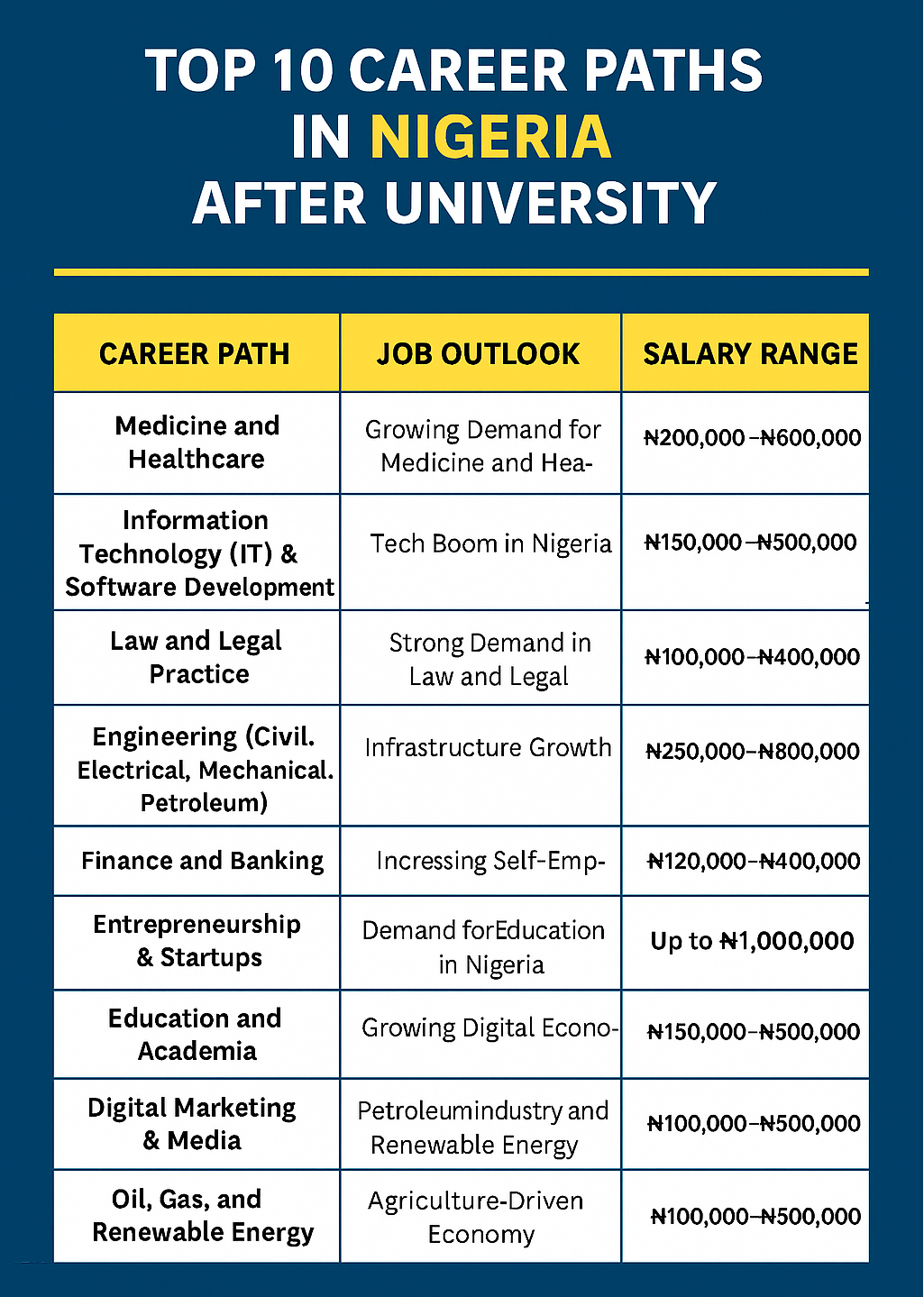
Top 10 Career Paths in Nigeria After University
1. Medicine and Healthcare
Healthcare remains one of the most competitive and rewarding career paths. Nigeria, like many other countries, faces a shortage of doctors, nurses, pharmacists, and medical laboratory scientists.
-
Global demand: The World Health Organization (WHO) estimates a shortage of 11 million health workers worldwide by 2030. This makes Nigerian-trained professionals highly sought after abroad.
-
Job outlook: Nigerian hospitals and private clinics need specialists in areas such as pediatrics, surgery, and public health.
-
Salary: Doctors in Nigeria can earn between ₦250,000 and ₦700,000 monthly, while opportunities abroad offer far higher pay.
2. Information Technology (IT) & Software Development
The Nigerian tech sector is booming. Companies like Andela, Paystack, Flutterwave, and Interswitch have put Nigeria on the global map.
-
In-demand roles: Software developers, cybersecurity experts, data analysts, and AI specialists.
-
Remote work opportunities: Many Nigerian developers now work for international companies while living in Lagos or Abuja.
-
Salary range: Junior developers earn ₦150,000–₦300,000 monthly, while experienced programmers can make ₦500,000 or more.
3. Law and Legal Practice
Law continues to be one of the most respected professions in Nigeria. Beyond courtroom practice, lawyers find opportunities in corporate law, human rights advocacy, and consultancy.
-
Why it matters: Nigeria’s growing business environment means companies need legal experts for contracts, compliance, and dispute resolution.
-
Salary: Entry-level lawyers may start with ₦100,000 monthly, while corporate lawyers in big firms can earn ₦400,000 or more.
-
Career outlook: Opportunities expand further when pursuing international law certifications.
4. Engineering (Civil, Electrical, Mechanical, Petroleum)
Engineering has long been a prestigious career choice in Nigeria. From building infrastructure to powering the oil and gas sector, engineers play a vital role in development.
-
Civil & Electrical Engineering: Needed for construction, roads, bridges, and renewable energy projects.
-
Petroleum Engineering: Still one of the highest-paying fields due to Nigeria’s oil reserves.
-
Salary: Petroleum engineers can earn ₦500,000–₦1,000,000 monthly in the oil sector.
5. Finance and Banking
Despite the rise of technology, finance remains a strong career path. The growth of fintech companies like Opay and Flutterwave has also expanded opportunities beyond traditional banking.
-
Career paths: Accountants, auditors, investment bankers, and financial analysts.
-
Professional certifications: ACCA, ICAN, and CFA can significantly boost earning potential.
-
Salary: Entry-level banking staff earn around ₦120,000–₦200,000 monthly, while senior managers make several millions annually.
6. Entrepreneurship & Startups
With limited formal jobs, many graduates now create their own paths. Entrepreneurship is becoming one of the most practical career choices.
-
Examples: Digital marketing agencies, agribusiness ventures, and e-commerce startups.
-
Support programs: Initiatives like the Tony Elumelu Foundation and government schemes (YouWin, N-Power) encourage self-employment.
-
Potential: Though risky, entrepreneurship offers unlimited earning opportunities and independence.
7. Education and Academia
Nigeria’s education system still struggles with a shortage of qualified lecturers and teachers. At the same time, some Nigerian online educational platforms are making education digital.
-
Career paths: Lecturers, private tutors, curriculum developers, and online instructors.
-
Salary: A university lecturer earns ₦150,000–₦500,000 depending on rank.
-
Global reach: Online tutoring offers opportunities beyond Nigeria.
8. Digital Marketing & Media
With millions of Nigerians active on social media, digital marketing has become an essential business tool.
-
In-demand roles: SEO specialists, content creators, social media managers, and brand consultants.
-
Salary: Freelancers and full-time marketers can earn ₦100,000–₦500,000 monthly.
-
Growth: Companies now allocate bigger budgets to digital campaigns, making this a fast-rising career.
9. Oil, Gas, and Renewable Energy
While the oil industry remains profitable, renewable energy is the future. Companies are investing in solar power to meet Nigeria’s energy needs.
-
Career paths: Petroleum engineers, geoscientists, and renewable energy specialists.
-
Salary: Oil and gas professionals earn some of the highest wages in Nigeria.
-
Future demand: Solar engineers and renewable specialists are increasingly needed.
10. Agriculture & Agribusiness
Nigeria’s economy remains heavily reliant on agriculture. According to the National Bureau of Statistics, the Agriculture sector grew by 10.04% year-on-year in nominal terms in Q1 2025. This increased shows an increase of 7.87% points from the same quarter of 2024.
Interestingly, with modern techniques and startups like Thrive Agric, the industry is seeing renewed interest.
-
Opportunities: Crop farming, food processing, animal husbandry, and export businesses.
-
Salary potential: Agripreneurs can scale from small profits to millions depending on the market.
-
Future growth: Nigeria’s food demand ensures long-term sustainability.
How to Choose the Right Career Path After University
Selecting the right career requires careful planning. Here are practical steps:
-
Assess your strengths and interests – Choose a path you can sustain long-term.
-
Research market demand – Focus on industries with growing job opportunities.
-
Consider postgraduate studies – Specialization increases competitiveness.
-
Build networks – Use LinkedIn, professional bodies, and alumni groups.
-
Gain experience – Internships, volunteering, and side projects build credibility.
Future Careers to Watch in Nigeria (2025 and Beyond)
As technology and globalization evolve, some careers will dominate the next decade:
-
Artificial Intelligence & Robotics – Automation is transforming industries.
-
Renewable Energy Specialists – Clean energy solutions are gaining ground.
-
Health Tech Professionals – Digital health services are expanding.
-
Blockchain & Fintech Experts – Cryptocurrency and mobile finance are here to stay.
-
Creative Industry – Film, gaming, and design are global money-makers.
Conclusion
Nigeria’s job market is tough, but opportunities exist for graduates who prepare wisely. From medicine to IT, agriculture to entrepreneurship, there are multiple career paths with strong potential.
The key is to stay adaptable, gain relevant skills, and pursue opportunities that align with your strengths.
If you found this guide helpful, consider subscribing to our newsletter for updates on career guides, WAEC/JAMB tips, and scholarship opportunities.
FAQs
Q1: What is the best career in Nigeria for graduates in 2026?
A: IT, Medicine, and Engineering remain top choices due to demand and salaries.
Q2: Which career pays the highest salary in Nigeria?
A: Medicine, Oil & Gas, and Finance often rank highest.
Q3: Can I succeed with entrepreneurship in Nigeria?
A: Yes, especially in agribusiness, e-commerce, and tech startups.
Q4: What skills do Nigerian employers value most?
A: Problem-solving, digital literacy, communication, and leadership.
Q5: How can I know the right career path for me?
A: Assess your strengths, research industries, and seek mentorship.
