Every year, millions of Nigerian students sit for examinations organized by the West African Examinations Council and the National Examinations Council.
After checking their results, many students begin comparing grades and asking questions like:
- “Is WAEC grading harder than NECO?”
- “Which exam is easier to pass?”
- “Do universities prefer WAEC over NECO?”
- “Can I combine WAEC and NECO results?”
These questions are common because both examinations play a major role in university admission, scholarships, and career opportunities in Nigeria.
The good news is that both WAEC and NECO use similar grading systems, and universities generally accept both examinations. However, there are still important differences students should understand.
In this guide, you will learn everything about WAEC grading vs NECO grading, including grading scales, admission acceptance, differences in marking systems, and practical advice for improving your grades.
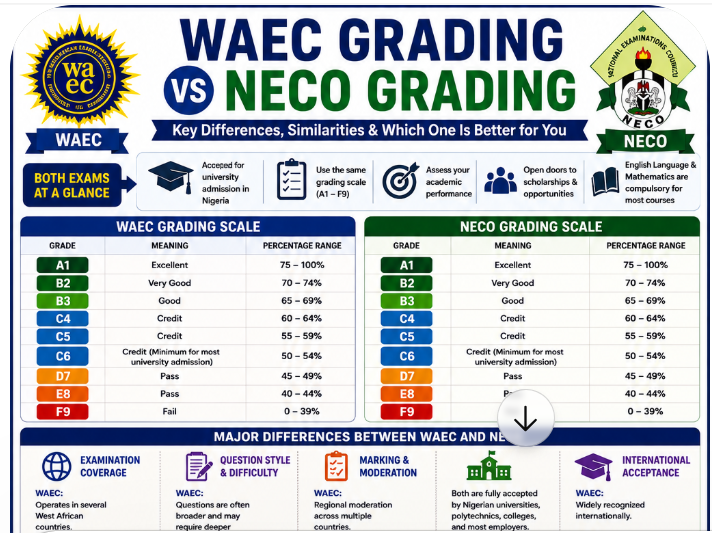
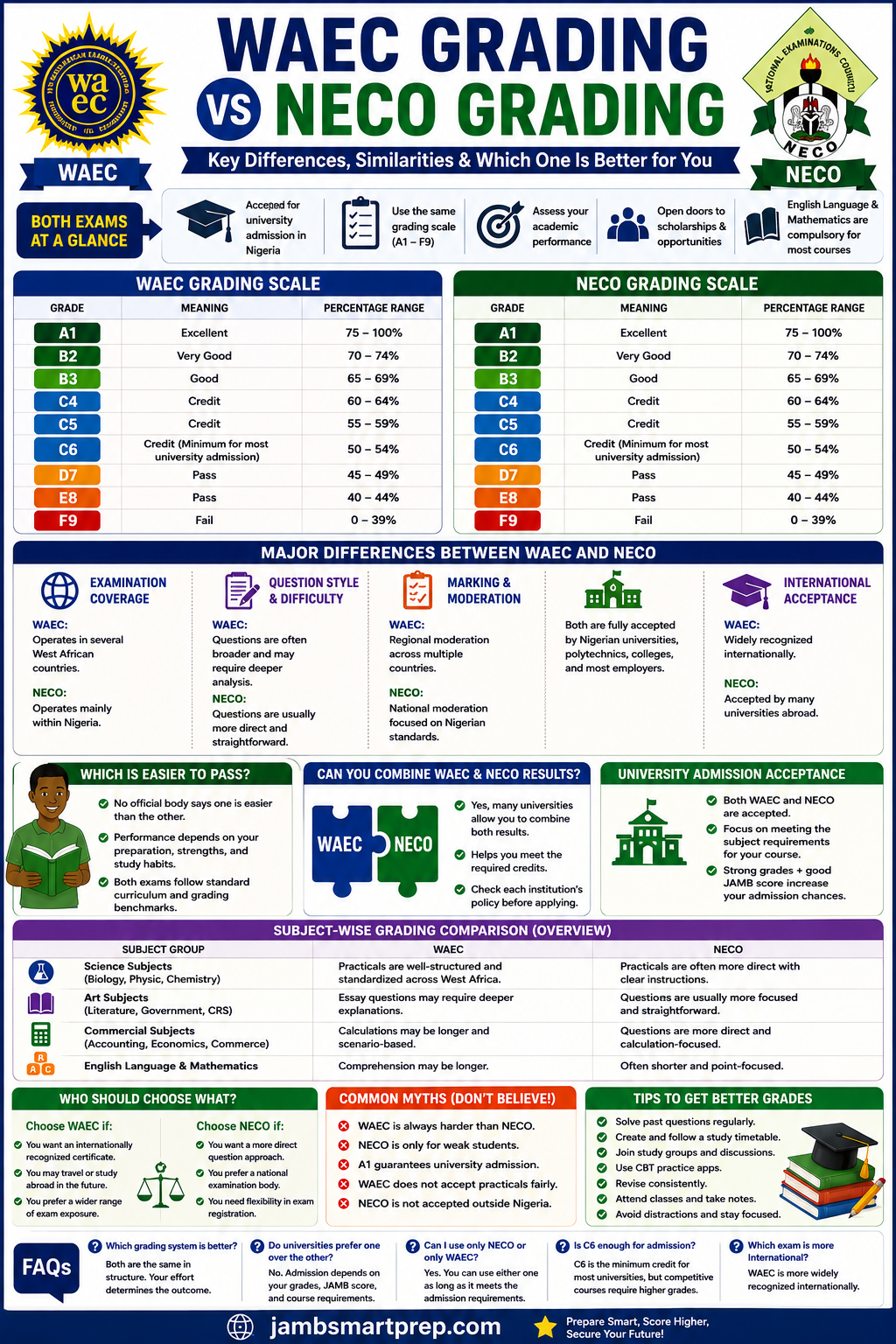
WAEC vs NECO Grading at a Glance
Side-by-Side Grading Comparison
| Grade | Meaning | Percentage Range |
|---|---|---|
| A1 | Excellent | 75–100% |
| B2 | Very Good | 70–74% |
| B3 | Good | 65–69% |
| C4 | Credit | 60–64% |
| C5 | Credit | 55–59% |
| C6 | Credit | 50–54% |
| D7 | Pass | 45–49% |
| E8 | Pass | 40–44% |
| F9 | Fail | 0–39% |
Quick Facts Students Should Know
- Both WAEC and NECO use A1 to F9 grading systems
- Most universities accept both examinations
- English Language and Mathematics are compulsory for admission
- C6 is usually the minimum acceptable credit
- Strong grades improve admission opportunities
What Are WAEC and NECO?
Before comparing grading systems, it is important to understand what both examination bodies represent.
What Is WAEC?
WAEC stands for the West African Examinations Council.
It conducts examinations for English-speaking West African countries including:
- Nigeria
- Ghana
- Sierra Leone
- Liberia
- The Gambia
WAEC has existed for decades and is widely recognized across West Africa.
What Is NECO?
NECO stands for the National Examinations Council.
It was established mainly for Nigerian students and operates within Nigeria.
Also read: NECO Grading System Explained for Nigerian Students
NECO also conducts:
- Senior Secondary Certificate Examinations
- Basic Education Certificate Examinations
Both WAEC and NECO are accepted for university admission in Nigeria.
WAEC Grading System Explained
Students searching for “WAEC grading system” usually want to understand what grades like A1 or C6 actually mean.
WAEC Grading Scale
| Grade | Meaning | Percentage Range |
|---|---|---|
| A1 | Excellent | 75–100% |
| B2 | Very Good | 70–74% |
| B3 | Good | 65–69% |
| C4 | Credit | 60–64% |
| C5 | Credit | 55–59% |
| C6 | Credit | 50–54% |
| D7 | Pass | 45–49% |
| E8 | Pass | 40–44% |
| F9 | Fail | 0–39% |
Meaning of WAEC Grades
A1 — Excellent
This is the highest grade possible.
Students with several A1 grades are usually competitive for courses like:
- Medicine
- Law
- Pharmacy
- Engineering
B2 and B3 — Very Good and Good
These are strong grades accepted for most university programs.
C4 to C6 — Credit
C6 is usually the minimum acceptable grade for university admission.
D7 and E8 — Pass
These are weak grades and may not qualify students for competitive courses.
F9 — Fail
F9 means failure in a subject.
NECO Grading System Explained
The NECO grading system is very similar to WAEC grading.
NECO Grading Scale
| Grade | Meaning | Percentage Range |
|---|---|---|
| A1 | Excellent | 75–100% |
| B2 | Very Good | 70–74% |
| B3 | Good | 65–69% |
| C4 | Credit | 60–64% |
| C5 | Credit | 55–59% |
| C6 | Credit | 50–54% |
| D7 | Pass | 45–49% |
| E8 | Pass | 40–44% |
| F9 | Fail | 0–39% |
Interpretation of NECO Grades
The meanings are almost identical to WAEC:
- A1 represents excellent performance
- C6 remains the minimum credit accepted by most universities
- F9 indicates failure
Most Nigerian universities accept NECO results the same way they accept WAEC.
Major Differences Between WAEC and NECO Grading
Although the grading scales are similar, some important differences still exist.
Examination Coverage
WAEC
WAEC operates across several West African countries.
NECO
NECO mainly serves Nigerian students.
Because WAEC covers multiple countries, some students believe its examination structure feels broader.
Question Style and Difficulty
Many students say NECO questions are more direct and straightforward.
WAEC questions sometimes require deeper interpretation and broader understanding.
However, this opinion varies among students.
A well-prepared student can succeed in either examination.
Marking and Moderation
Both examination bodies use moderation processes to maintain fairness.
However, marking approaches may differ slightly.
WAEC often uses wider regional moderation standards because it covers several countries.
NECO moderation focuses mainly on Nigerian academic standards.
Is WAEC Grading Harder Than NECO?
This is one of the most searched questions among Nigerian students.
The truth is that no official educational body has declared WAEC harder than NECO.
Students’ opinions differ because of:
- Individual strengths
- Subject preferences
- Preparation quality
- School background
Some students find WAEC tougher because of question structure.
Others believe NECO requires stronger precision in answering.
In reality, preparation matters more than the examination body.
WAEC vs NECO Grading for University Admission
Which Result Do Universities Prefer?
Most Nigerian universities accept both WAEC and NECO results equally.
Admission decisions usually depend on:
- JAMB score
- Post-UTME performance
- Course competitiveness
- Subject combinations
Examples of Competitive Courses
Medicine
Usually requires strong grades in:
- English
- Mathematics
- Biology
- Chemistry
- Physics
Law
Important subjects include:
- English
- Literature
- Government
Engineering
Students usually need strong grades in:
- Mathematics
- Physics
- Chemistry
Whether you use WAEC or NECO, strong grades remain very important.
Can Students Combine WAEC and NECO Results?
Yes. Many Nigerian universities allow candidates to combine WAEC and NECO results.
This is called “O’Level result combination.”
Advantages of Combining Results
- Covers weak subjects
- Improves admission chances
- Helps students meet credit requirements
Possible Disadvantages
Some competitive institutions may prefer one sitting results.
Students should always check school admission policies carefully.
WAEC vs NECO Grading for Science Students
Science students often face stronger admission competition.
Important science subjects include:
- Biology
- Physics
- Chemistry
- Further Mathematics
Practical Examination Differences
Some students believe NECO practical questions feel more direct.
Others believe WAEC practical examinations are more standardized internationally.
Regardless of opinion, practical preparation is essential.
WAEC vs NECO Grading for Art and Commercial Students
Art and commercial students also compare both examinations regularly.
Important Art Subjects
- Literature in English
- Government
- CRS
- History
Important Commercial Subjects
- Accounting
- Commerce
- Economics
Students applying for competitive courses like Accounting or Mass Communication should target strong credit grades.
Common Misunderstandings About WAEC and NECO Grading
Several myths continue to confuse students.
“NECO Is Not Accepted Internationally”
This is incorrect.
Many foreign institutions recognize NECO results alongside other requirements.
“WAEC Always Gives Lower Grades”
Performance depends largely on preparation.
No official evidence proves this claim.
“A1 Guarantees Admission”
Excellent grades help, but admission also depends on:
- JAMB score
- Post-UTME results
- Catchment policies
- Competition level
“NECO Is Only for Weak Students”
This misconception is false.
Many outstanding students write and pass NECO successfully every year.
How to Improve Your Grades in WAEC and NECO
Students aiming for distinctions should focus on smart preparation strategies.
Best Study Tips for Both Exams
Practice Past Questions
Past questions reveal repeated patterns and common topics.
Create a Reading Timetable
A timetable improves consistency and discipline.
Join Group Discussions
Studying with focused classmates can improve understanding.
Practice CBT Questions
CBT preparation improves speed and confidence.
Use Educational Apps
Popular apps Nigerian students use include:
- JambSmartPrep CBT App
Revise Regularly
Revision strengthens long-term memory retention.
Frequently Asked Questions About WAEC vs NECO Grading
Which is easier to pass between WAEC and NECO?
Difficulty depends more on preparation than the examination body itself.
Do universities prefer WAEC over NECO?
Most Nigerian universities accept both equally.
Is NECO accepted outside Nigeria?
Yes. Many institutions outside Nigeria recognize NECO results.
Can I combine WAEC and NECO results?
Yes. Many universities allow result combination.
Is the grading system the same?
Yes. Both use A1 to F9 grading scales.
Which exam is better for Medicine?
Both are accepted for Medicine if students meet admission requirements.
What is the minimum accepted grade for admission?
Most universities require at least C6 in core subjects.
Does WAEC grading change every year?
The grading structure remains similar, although moderation may vary slightly.
Which exam gives better grades?
Results vary based on preparation, school quality, and student performance.
Can I use only NECO for university admission?
Yes. Many universities accept only NECO results if requirements are met.
Conclusion
Understanding WAEC grading vs NECO grading can help students make better academic decisions and reduce unnecessary confusion.
Although both examinations have small differences in structure and moderation, they use very similar grading systems and are both widely accepted for admission in Nigeria.
Rather than worrying excessively about which examination is easier, students should focus on proper preparation, regular revision, and strong study habits.
In the end, discipline and consistency matter more than the examination body itself.
Which exam do you prefer between WAEC and NECO? Share this guide with another student preparing for exams and bookmark this page for future admission guidance.
