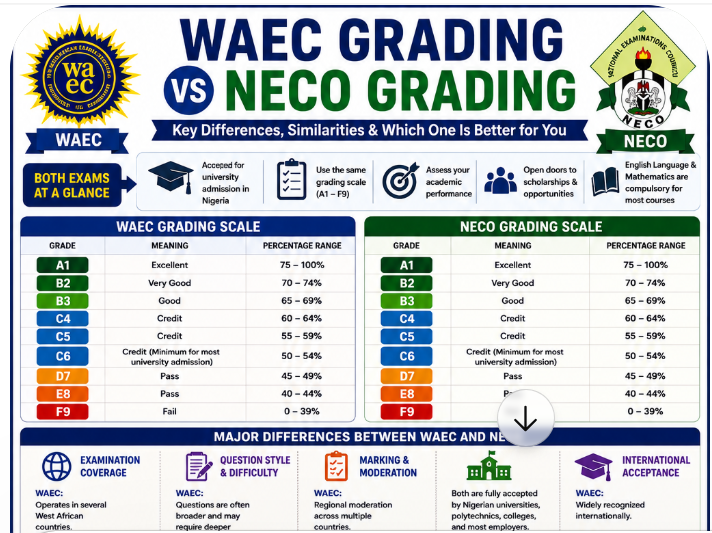
WAEC and NECO use the same grading system for their senior school certificate exams: nine grades from A1 (Excellent) to F9 (Fail), with A1 to C6 counting as credits, D7 and E8 as passes, and F9 as a fail. The commonly published score bands are also the same: A1 75–100, B2 70–74, B3 65–69, C4 60–64, C5 55–59, C6 50–54, D7 45–49, E8 40–44, F9 0–39. For admission, JAMB and Nigerian tertiary institutions treat a credit from either body the same way, and many institutions let you combine WAEC and NECO results from two sittings. Where the two exams differ is in timing, administration, result checking, verification and certificates, not in what each grade means.
This guide compares WAEC and NECO grading side by side, explains what each grade is worth for admission, shows how to combine results, compares 2026 pass rates, sets out the practical differences between the two exams, and answers common questions such as whether NECO is “easier” and whether every university accepts NECO.
| Grade | Score band | WAEC remark | NECO remark | Credit? |
|---|---|---|---|---|
| A1 | 75–100 | Excellent | Excellent | Yes |
| B2 | 70–74 | Very Good | Very Good | Yes |
| B3 | 65–69 | Good | Good | Yes |
| C4 | 60–64 | Credit | Credit | Yes |
| C5 | 55–59 | Credit | Credit | Yes |
| C6 | 50–54 | Credit | Credit | Yes |
| D7 | 45–49 | Pass | Pass | No |
| E8 | 40–44 | Pass | Pass | No |
| F9 | 0–39 | Fail | Fail | No |
Score bands are the commonly published guide; results show grades, not exact marks.
In this guide:
- Why the grading is the same
- Credits, passes and admission
- Is a NECO credit equal to a WAEC credit?
- Combining WAEC and NECO results
- 2026 results compared
- Where WAEC and NECO actually differ
- Is NECO easier than WAEC?
- Grade points in screening
- Should you write WAEC, NECO or both?
- Frequently asked questions
Why the grading is the same
WAEC (the West African Examinations Council) conducts the West African Senior School Certificate Examination (WASSCE) across several West African countries. NECO (the National Examinations Council) conducts the Senior School Certificate Examination (SSCE) in Nigeria. Both examine the same senior secondary curriculum and serve the same purpose: certifying secondary school completion and providing the O’level results used for admission and employment. Using the same nine-grade scale makes results comparable for institutions, employers and candidates.
The number in each grade shows its position on the scale: 1 is best and 9 is worst. So C4 is better than C6, and B2 is better than B3. The letter groups the grades into bands: A for excellent, B for very good and good, C for credit, D and E for pass, F for fail.
For a deeper look at each body’s system, see the WAEC grading system and the NECO grading system.
What each grade means in practice
The grade descriptions are short, but each one has a practical meaning for your next step. This table applies equally to WAEC and NECO results.
| Grade | Remark | What it means for you |
|---|---|---|
| A1 | Excellent | Top grade. Earns the most points where universities convert O’level grades for screening. |
| B2, B3 | Very Good, Good | Strong credits. Competitive for any course that needs that subject. |
| C4, C5 | Credit | Solid credits that meet requirements; fewer screening points than A or B grades. |
| C6 | Credit | The minimum credit. It meets the requirement but earns the fewest credit points. |
| D7, E8 | Pass | Not a credit. Doesn’t count towards the five-credit requirement for most tertiary admissions. |
| F9 | Fail | No credit or pass. If the subject is required, you’ll need to resit it. |
The most common surprise for candidates is D7. It reads as a “pass”, but for university and polytechnic admission it doesn’t help with the credit requirement. If you have D7 in English Language or Mathematics, treat it as a subject you still need to fix.
Is the grading the same for WAEC GCE and NECO external?
Yes. The private-candidate exams (WAEC’s WASSCE for private candidates, often still called “GCE”, and NECO’s SSCE external) use the same A1 to F9 scale as the school exams. A credit from a private-candidate exam counts the same way for admission, subject to each institution’s sitting rules.
What about junior (BECE) grading?
The Basic Education Certificate Examination at the end of JSS3 is a different exam with its own grading. NECO conducts BECE for federal unity colleges and some other schools, while state examination bodies run it in most states, so grading descriptions can vary. Check the grading key printed on the specific BECE result. The A1 to F9 scale on this page applies to the senior school certificate (SS3) exams.
Credits, passes and admission
For admission into universities, polytechnics and colleges of education, the line that matters most is between C6 and D7. A1 to C6 are credits; D7 and E8 are passes; F9 is a fail. Most courses require:
- Five credits, including English Language and Mathematics;
- Credits in course-specific subjects, often including your UTME subjects;
- Not more than two sittings at most institutions, though some courses or institutions require one sitting.
A pass (D7 or E8) doesn’t count towards the five-credit requirement. That’s true whether the D7 is from WAEC or NECO. See JAMB subject combinations and requirements.
Do some courses need more than a C6?
The official requirement for most courses is a credit, which means C6 or better. In practice, competitive courses such as medicine, law, pharmacy and engineering attract candidates with many A and B grades, and universities that score O’level results in their screening reward those grades with more points. So a C6 meets the rule, but it may leave you behind other applicants in the aggregate. Check your institution’s screening formula, which is usually published with its Post-UTME or screening notice.
Requirements by type of institution
- Universities: typically five credits, including English Language and Mathematics, in subjects relevant to the course, in not more than two sittings.
- Polytechnics (ND): typically five credits including English Language and Mathematics for most programmes; some departments specify particular subjects.
- Colleges of education (NCE): requirements vary by course and college; check the specific programme.
These are general patterns. JAMB’s brochure on e-Facility lists the exact O’level requirements for each course and institution, and it’s the source to rely on.
Is a NECO credit equal to a WAEC credit?
For admission purposes in Nigeria, yes. JAMB and Nigerian tertiary institutions accept NECO’s SSCE alongside WAEC’s WASSCE and NABTEB for O’level requirements. A C6 in Mathematics from NECO meets the Mathematics credit requirement just as a C6 from WAEC does. Some candidates ask “which university accepts NECO result?”; in Nigeria, NECO results are generally accepted for admission, but always check the specific requirements of your course and institution in JAMB’s brochure on JAMB e-Facility.
Outside Nigeria, acceptance depends on the country and institution. WAEC’s WASSCE is a regional exam taken in several West African countries, which can make it more familiar to some foreign institutions. NECO’s e-Verify platform, which NECO said was used by 64 institutions in 37 countries, helps institutions abroad verify NECO results. If you plan to study abroad, check the requirements of the institutions you’re considering.
Combining WAEC and NECO results
Many candidates use two sittings to meet requirements, for example WAEC in May/June and NECO internal or external. Where an institution accepts two sittings, credits from both can count together.
Example
| Subject | WAEC | NECO | Best credit |
|---|---|---|---|
| English Language | C6 | C5 | C5 (NECO) |
| Mathematics | D7 | C6 | C6 (NECO) |
| Biology | B3 | C4 | B3 (WAEC) |
| Chemistry | C5 | D7 | C5 (WAEC) |
| Physics | E8 | C6 | C6 (NECO) |
In this example, combining both sittings gives credits in English, Mathematics, Biology, Chemistry and Physics, enough for many science courses, provided the institution accepts two sittings.
What you need to do
- Check the sitting rules for your course and institution.
- Upload both results to JAMB. From 24 August 2026, WAEC results could be verified and uploaded online through e-Facility; NECO and NABTEB results still go through CBT centres. See what happens if you don’t upload your O’level.
- Make sure your details match on both results and your NIN. JAMB warned in August 2026 that uploads may be rejected if NIMC details don’t match certificate records.
- Bring both results to screening and clearance.
Combining results: common mistakes
- Assuming every course accepts two sittings. Some institutions or courses insist on one sitting. Check before you rely on a combination.
- Using more than two results. Most institutions that allow combination accept a maximum of two sittings. Three results won’t normally be accepted for one admission.
- Uploading only one result. If you’re combining, JAMB needs both results on your profile, and the institution sees what’s uploaded.
- Name mismatches. Different spellings or name orders on WAEC and NECO results can delay clearance. Fix errors with the examination body before screening.
- Relying on an awaiting result too long. Institutions may admit you with an awaiting result, but you must upload the actual result before the deadline. See using an awaiting result for admission.
How to upgrade a grade
If you have a pass or fail in a required subject, the only way to improve it is to sit the subject again. You can’t appeal a grade into a credit. Practical options:
- WAEC’s WASSCE for private candidates, which in 2026 ran its first series from 28 January to 14 February as a computer-based exam.
- NECO’s SSCE external, usually held towards the end of the year.
- Your school’s next WAEC or NECO internal exam, if you’re still a registered school candidate.
Pick the exam whose results will be out before your admission or screening deadline, and register for every subject you need to fix in one sitting if you can.
2026 results compared
| WAEC WASSCE (school candidates) | NECO SSCE (internal) | |
|---|---|---|
| Candidates who sat | 1,950,726 | 1,371,992 |
| Five credits including English and Mathematics | 61.54% | 58.67% |
| Five credits irrespective of English and Mathematics | Not compared here | 84.70% |
| Results withheld / malpractice | 167,486 results withheld (8.59%) | 1,406 malpractice cases |
| Results released | 5 August 2026 | 24 September 2026 |
The headline rates are close: about six in ten candidates in each exam obtained five credits including English and Mathematics. NECO’s 84.70% figure, irrespective of English and Mathematics, shows how often those two subjects are the deciding factor. Differences in rates between the two bodies reflect many factors, including candidate populations and exam conditions, so they don’t tell you that one exam is easier for you.
Reading the 2026 figures correctly
Three cautions help you avoid misreading these numbers. First, the WAEC figure is for school candidates in the May/June WASSCE and the NECO figure is for the internal SSCE, so the candidate groups aren’t identical. Second, withheld results and malpractice cases are reported differently by each body, so the numbers in that row aren’t directly comparable. Third, a national pass rate says nothing about your own chances: your grades depend on your preparation in each subject. Use the figures to understand the overall picture, not to choose an exam because it “looks easier”.
Where WAEC and NECO actually differ
| WAEC | NECO | |
|---|---|---|
| Coverage | Regional (several West African countries) | National (Nigeria), with some centres abroad |
| School candidates’ exam | WASSCE, usually April–June; 2026 described as the second computer-based WASSCE for school candidates | SSCE internal, usually mid-year |
| Private candidates’ exam | WASSCE for private candidates; first series in 2026 ran 28 January–14 February (computer-based) | SSCE external, usually towards the end of the year |
| Result checking | waecdirect.org; 2026 PINs via waec.org using exam number, NIN and OTP | results.neco.gov.ng with a token |
| JAMB upload | Online through e-Facility from August 2026 | At JAMB-accredited CBT centres |
| Verification | WAEC’s official verification; ₦4,000 one-off verification fee through JAMB for admission | NECO e-Verify (everify.neco.gov.ng) |
| Certificate reprint | Follow WAEC’s procedures | ₦50,000 reprint fee announced, within one year of issue |
For 2027, a harmonised timetable proposed by the Federal Government places NECO’s SSCE from 1 April to 14 May and WAEC’s WASSCE from 11 May to 18 June 2027, with results targeted by August 2027; the dates were described as provisional. See how to check WAEC results on WAECDirect and how to check NECO results.
Continuous assessment and the new guidelines
Both WAEC and NECO use schools’ continuous assessment (CA) records for school candidates. In 2026, the Federal Government announced new operational guidelines for how schools submit CA records to WAEC, NECO and NBAIS, starting from the 2026/2027 session. Reported changes include fixed submission windows (first-term records in January, second-term in April, third-term in August), a learner identity number linked to each candidate’s NIN, CA records that follow a student who changes schools, and sanctions for schools that submit false records. These changes are about record integrity; they don’t change the A1 to F9 grading scale.
How results are presented
Both bodies report each subject with a grade, not a raw score. That’s why the score bands in the table above are described as the commonly published guide: you won’t usually see your exact mark. When checking results online, note the subjects, grades and your examination number, and print or save a copy for JAMB and your institution.
- WAEC: check on WAECDirect. For 2026, serial numbers and PINs are generated or recovered on waec.org using your examination number, NIN and a one-time password.
- NECO: check on the NECO results portal with a result token.
Is NECO easier than WAEC?
This is one of the most common questions, and the honest answer is: not in any way you can rely on. Both exams follow the same curriculum and grading scale. Pass rates vary by year and between the two bodies for many reasons, and in 2026 they were close (61.54% for WAEC and 58.67% for NECO for five credits including English and Mathematics). Individual candidates sometimes feel one exam suited them better, but that’s usually about preparation, timing and the questions they happened to get, not a built-in difference in difficulty.
The better question is which exam fits your timing. If you need a missing credit before admission closes, the exam whose results arrive in time is the right one. See NECO vs WAEC: which is better for you?
If you’re deciding between the two for a resit, compare the next available dates, the expected release dates and your institution’s sitting rules side by side. For 2027, the proposed harmonised timetable puts NECO’s SSCE before WAEC’s WASSCE, which could matter if you need results early; confirm the final dates when the examination bodies publish them.
Grade points in screening
Many universities convert O’level grades into points for Post-UTME screening. Each institution sets its own table, and the same table applies whether the grade came from WAEC or NECO. A typical pattern gives the most points to A1 and fewer for each lower credit, with passes and fails earning nothing. This is why better grades matter even after you’ve met the minimum: two candidates with five credits each can have very different aggregate scores. See how to prepare for Post-UTME.
An illustration of how grades turn into points
Universities publish their own conversion tables, so the numbers below are only an illustration of how such tables usually work, not any institution’s actual formula. Suppose a university awards points like this for the five relevant subjects:
| Grade | Illustrative points |
|---|---|
| A1 | 6 |
| B2 | 5 |
| B3 | 4 |
| C4 | 3 |
| C5 | 2 |
| C6 | 1 |
| D7–F9 | 0 |
Candidate A has A1, B2, B3, C4 and C5: 6 + 5 + 4 + 3 + 2 = 20 points. Candidate B has five C6s: 5 points. Both meet the five-credit rule, but Candidate A is far ahead in screening. Whether those grades came from WAEC or NECO makes no difference to the points; what matters is the grade itself.
Common myths about WAEC and NECO grading
- “NECO grades are worth less.” For admission in Nigeria, a NECO credit meets the same requirement as a WAEC credit.
- “D7 is a credit.” It isn’t. D7 and E8 are passes; credits are A1 to C6.
- “You can combine three results.” Most institutions accept a maximum of two sittings, and some only one.
- “A higher score band is used for science subjects.” The same nine-grade scale applies to every subject.
- “GCE grades don’t count.” WAEC’s private-candidate exam and NECO’s external exam use the same grading and are accepted subject to sitting rules.
- “Your result shows your exact mark.” Results show grades. The score bands are a guide to what each grade represents.
Verifying WAEC and NECO results
Institutions and employers verify results directly with the examination bodies, and JAMB checks the O’level results you upload. WAEC results can be verified through WAEC’s official channels, and JAMB introduced a one-off verification fee for admission checks. NECO results can be verified on NECO e-Verify, which NECO says is used by institutions in Nigeria and abroad. Never pay unofficial agents to “upgrade” or “verify” results; changed results are detected during verification and can lead to cancellation of admission. See how to protect yourself from NECO result scams and how to verify a NECO result.
WAEC grading outside Nigeria
Because WAEC is a regional body, the WASSCE is also taken in Ghana, Sierra Leone, The Gambia and Liberia. The A1 to F9 grade descriptions are widely used across these countries, though admission requirements depend on each country’s institutions. NECO’s SSCE is a Nigerian exam, but NECO’s online verification makes it easier for foreign institutions to confirm results.
How to move up a grade
Because the grade bands are only five marks wide in the middle of the scale (for example, C6 is 50–54 and C5 is 55–59), a small improvement in exam technique can move you up a full grade. These habits make the most difference in both WAEC and NECO:
- Study the syllabus, not just the textbook. Both bodies set questions from their syllabuses, so make a checklist of topics and tick them off as you master them.
- Practise past questions under timed conditions. Many candidates know the content but lose marks by running out of time or leaving questions unanswered. See how to use WAEC past questions effectively.
- Learn how marks are awarded in theory papers. Show working in calculations, define terms precisely, label diagrams clearly and answer exactly what the question asks.
- Take practicals seriously. In science subjects, the practical paper contributes a large share of marks; careful observation and recording can lift your grade. See how to prepare for WAEC practicals.
- Prioritise English and Mathematics. They’re required for almost every course, and a credit in both is the most common deciding factor.
- Cut careless errors. Read every question twice and check your answers. See how to stop making careless mistakes.
Set a target grade for each subject
A simple planning tool: write each of your subjects in a table with three columns: the grade you need (usually C6 or better for required subjects), the grade you want (for screening points), and the grade you’re currently getting in mock exams. The gap between the last two shows where to spend your time. For example, if you’re getting C6 in Chemistry but need a B3 to be competitive for pharmacy, Chemistry deserves more of your revision hours than a subject where you’re already scoring B2.
Review the table after every mock exam. It turns a vague goal (“pass WAEC and NECO”) into specific targets, and it works the same way for both exams because they share one grading scale. For a full study system, see how to pass WAEC with good grades and how to create a NECO reading timetable.
Should you write WAEC, NECO or both?
- Both, if your school offers them: many Nigerian schools present candidates for both, which gives a second chance at key credits.
- WAEC private or NECO external if you need to fix one or two credits after school.
- Consider timing: which exam’s results will be available before your admission deadline?
- Consider sitting rules: if your course requires one sitting, aim to get every credit in one exam.
- Prioritise English and Mathematics in whichever exam you write.
See how to pass WAEC and how to read for NECO.
If you’re short of a credit in English or Mathematics
English Language and Mathematics are the two subjects most often required for every course, and the gap between NECO’s 84.70% (five credits irrespective of English and Mathematics) and 58.67% (including them) in 2026 shows how many candidates are held back by one of them. If that’s you:
- Confirm the requirement. A few courses or institutions may have different rules, especially for Mathematics in some arts programmes. Check the brochure for your course.
- Register for the next available sitting, WAEC private or NECO external, whichever fits your timeline.
- Study from the syllabus and past questions rather than from memory of the last exam. See how to use the WAEC syllabus and WAEC English past questions.
- Keep your UTME and admission timeline in view. An awaiting result can sometimes carry you through the UTME stage, but you must upload the credit before admission is confirmed.
Checklist before screening or clearance
- Both results (if combining) printed or saved, with scratch cards or tokens if the institution asks for them.
- Names, dates of birth and examination numbers matching across results, JAMB profile and NIN.
- All required subjects at C6 or better, within the allowed number of sittings.
- Results uploaded to your JAMB profile (WAEC online via e-Facility; NECO at an accredited CBT centre).
- Your institution’s screening formula checked, so you know how your grades will be scored.
Keep a copy of every result, token and receipt in one folder, because you’ll need them again at admission and during final-year clearance.
Frequently asked questions
Are WAEC and NECO grades the same?
Yes. Both use A1 to F9 with the same remarks and commonly published score bands.
Is a NECO credit accepted like a WAEC credit?
Yes, for admission in Nigeria. JAMB and Nigerian institutions accept both.
Can I combine WAEC and NECO for admission?
At institutions that accept two sittings, yes. Some courses require one sitting.
Which is harder, WAEC or NECO?
Neither is reliably harder. Both follow the same curriculum and grading; 2026 pass rates were close.
Is D7 a credit in WAEC or NECO?
No. D7 is a pass in both. Credits are A1 to C6.
Is C6 a good grade?
C6 is a credit, so it meets admission requirements. It’s the lowest credit, though, and earns the fewest points where universities score O’level grades.
Is E8 a pass or a fail?
E8 is a pass, not a fail and not a credit. It doesn’t count towards the five-credit requirement for most admissions.
What is the score range for A1 in WAEC and NECO?
The commonly published band is 75–100 for both. Results show the grade rather than the exact score.
Does the WAEC GCE use the same grading?
Yes. WAEC’s private-candidate WASSCE uses the same A1 to F9 scale, as does NECO’s SSCE external.
Do all Nigerian universities accept NECO?
Nigerian universities generally accept NECO’s SSCE for O’level requirements, alongside WAEC and NABTEB. Always confirm in JAMB’s brochure for your course.
Can I combine WAEC GCE with NECO internal?
Where your institution accepts two sittings, yes. The type of exam (school or private candidate) doesn’t usually matter, but check the institution’s rules.
Has the WAEC grading system changed for 2026?
The A1 to F9 grading scale is unchanged. Changes in 2026 were mainly about how exams are delivered (for example, computer-based WASSCE) and how continuous assessment records are submitted, not the grade scale.
Is NABTEB graded the same way?
NABTEB results are also accepted alongside WAEC and NECO for O’level requirements in Nigeria. Check NABTEB’s own grading key on your result, and confirm that your course accepts it in JAMB’s brochure.
Which is better for admission, WAEC or NECO?
Neither is better for admission in Nigeria; both are accepted. Choose based on timing, sitting rules and when results will be released.
How many sittings are allowed for admission?
Most institutions accept up to two sittings; some courses require one. JAMB’s brochure lists the requirement for each course.
Related guides: WAEC grading system · NECO grading system · NECO vs WAEC · Awaiting results for admission
