
Every year, thousands of Nigerian students prepare for WAEC with serious effort, yet many still fall short of their expected grades. The problem is not always laziness. In most cases, it is poor direction.
A common question students ask is simple but important:
Should I focus on the WAEC syllabus or past questions?
Some students read textbooks from cover to cover but still struggle in the exam hall. Others rely only on past questions and get stuck when questions are slightly changed.
This guide clears that confusion.
By the end of this article, you will understand the difference between the WAEC syllabus vs past questions, and more importantly, how to combine both in a practical way that improves your chances of scoring high.
What Is the WAEC Syllabus?
The WAEC 2026 syllabus is the official guide that outlines everything you are expected to study for each subject.
It is not just a list of topics. It is a structured roadmap designed by examiners to guide your preparation.
Key Features of the WAEC Syllabus
- Organized into subjects and clear topic areas
- Includes learning objectives for each topic
- Recommends textbooks and materials
- Covers both theory and practical components
Why the WAEC Syllabus Is Important
Many students ignore the syllabus and later regret it.
Here is why it matters:
- It prevents you from reading irrelevant topics
- It gives you a clear direction from the start
- It helps you build strong understanding, not just memory
- It aligns your preparation with what WAEC actually tests
Think of the syllabus as a map. Without it, you may be studying hard but moving in the wrong direction.
What Are WAEC Past Questions?
WAEC past questions and answers are previous exam papers used by students to prepare for upcoming exams.
They show you what WAEC has tested in the past and how questions are structured.
Benefits of Using Past Questions
- You understand the exam format
- You identify commonly repeated topics
- You improve your speed and accuracy
- You build confidence before the exam
Do WAEC Questions Repeat Every Year?
Yes, but not always in the same form.
WAEC often repeats concepts, not exact questions. For example:
- A Biology question on genetics may appear every year
- A Mathematics question on algebra may come in different formats
Students who rely only on memorizing past answers may struggle when questions are slightly changed.
WAEC Syllabus vs Past Questions – Key Differences
| Feature | WAEC Syllabus | WAEC Past Questions |
|---|---|---|
| Purpose | Guides what to study | Helps you practice |
| Coverage | Covers all topics | Focuses on repeated ones |
| Strength | Builds deep understanding | Improves exam technique |
| Limitation | Does not show exam patterns | Does not cover everything |
Understanding this difference is the first step to preparing effectively.
Which Is More Important for WAEC 2026?
This is where many students get it wrong.
The truth is simple:
You cannot choose one and ignore the other.
Both are essential parts of a complete WAEC study guide 2026.
When to Focus on the Syllabus
- At the beginning of your preparation
- When learning new topics
- When you want to understand concepts clearly
When to Focus on Past Questions
- During revision periods
- When preparing for mock tests
- Close to the exam
Students who balance both tend to perform better.
Best Strategy: Combine WAEC Syllabus and Past Questions
If your goal is to understand how to pass WAEC 2026, this is the method that works.
Step-by-Step Study Method
- Start with the WAEC syllabus
- Pick one topic at a time
- Study it carefully using your textbook
- Immediately practice past questions on that topic
- Identify patterns and repeated questions
- Revise regularly
Proven Study Formula
Learn → Practice → Review → Repeat
This method ensures that you are not just reading, but actually preparing for the exam.
WAEC Areas of Concentration Based on Past Questions
One of the smartest ways to study is to focus on WAEC areas of concentration 2026.
These are topics that appear frequently in exams.
Most Repeated Topics
Biology
- Genetics
- Ecology
- Human physiology
Chemistry
- Chemical bonding
- Stoichiometry
- Acids and bases
Physics
- Electricity
- Motion and forces
- Energy
Mathematics
- Algebra
- Trigonometry
- Graphs
Focusing on these topics increases your chances of meeting familiar questions in the exam.
Common Mistakes Students Make
Many WAEC candidates repeat the same errors every year.
- Reading only past questions without understanding
- Ignoring the WAEC syllabus completely
- Memorizing answers instead of learning concepts
- Skipping revision
- Studying without a clear plan
Avoiding these mistakes can already place you ahead of many students.
Real-Life Example (Nigerian Student Case Study)
Consider two students preparing for WAEC.
Student A:
Focused only on past questions. He memorized answers but struggled when questions were slightly changed.
Student B:
Used both the syllabus and past questions. She understood the topics and practiced regularly.
When results came out, Student B performed much better.
Lesson: Balanced preparation produces better results.
How to Use WAEC Past Questions Effectively
Many students have past questions but do not use them properly.
Smart Practice Tips
- Study questions topic by topic
- Time yourself during practice
- Review every mistake carefully
- Repeat difficult questions until you understand them
Past questions are not just for testing. They are powerful learning tools.
How to Use WAEC Syllabus Effectively
To get the best out of the syllabus:
- Break topics into smaller sections
- Study with understanding, not cramming
- Use recommended textbooks
- Tick off topics as you complete them
This approach helps you stay organized and motivated.
Best Study Plan Combining Syllabus and Past Questions
Weekly Plan
- Monday: Learn new topics
- Tuesday: Practice past questions
- Wednesday: Revise weak areas
- Thursday: Mixed practice
- Friday: Timed test
- Saturday: Full mock exam
- Sunday: Rest and light revision
This simple routine keeps your preparation balanced and consistent.
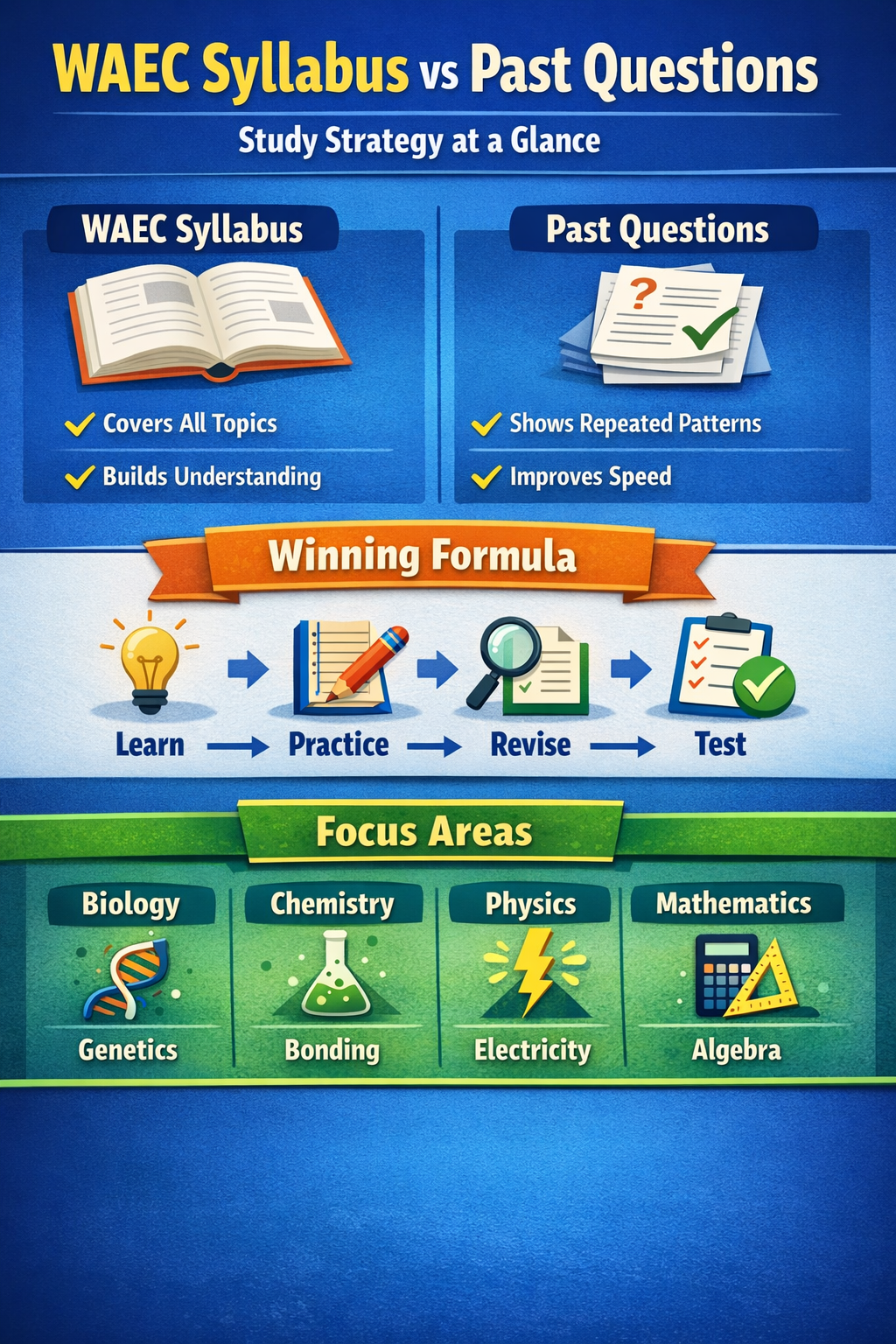
WAEC Syllabus vs Past Questions – Study Strategy at a Glance
WAEC Syllabus
- Covers all topics
- Builds understanding
Past Questions
- Shows repeated patterns
- Improves speed
Winning Formula
Learn → Practice → Revise → Test
Focus Areas
- Biology → Genetics
- Chemistry → Bonding
- Physics → Electricity
- Mathematics → Algebra
Frequently Asked Questions (FAQs)
Should I read WAEC syllabus or past questions?
Use both. The syllabus gives you knowledge, while past questions help you apply it.
Do WAEC questions repeat every year?
Yes. Topics repeat frequently, though questions may be reworded.
Can I pass WAEC using past questions only?
It is possible but risky. Without understanding the syllabus, you may struggle with new questions.
What is the best way to study for WAEC 2026?
Combine syllabus study with consistent past question practice.
How many years of past questions should I study?
At least 10 years for proper coverage.
WAEC syllabus vs past questions which is better?
Neither is better alone. The best results come from combining both.
How do I know important topics in WAEC?
By using the syllabus and checking repeated topics in past questions.
Can I finish WAEC syllabus on time?
Yes, with a proper timetable and focused study.
Is WAEC difficult to pass?
It becomes easier when you study the right topics and practice regularly.
What is the fastest way to prepare for WAEC?
Focus on key topics, use past questions, and revise consistently.
Pro Tips to Score High in WAEC 2026
- Start early with the syllabus
- Practice past questions daily
- Focus on repeated topics
- Revise regularly
- Avoid last-minute cramming
- Stay consistent with your study plan
Conclusion
Success in WAEC does not come from choosing between the syllabus and past questions. It comes from using both wisely.
The syllabus gives you direction. Past questions give you experience.
When you combine the two, your preparation becomes stronger and more focused.
Take action today.
Pick one subject, study the syllabus, practice past questions, and track your progress.
Have you been using past questions or the syllabus more? Share your study method in the comments.
And one more thing:
Which course are you planning to study in university? Let us know below.

How to Use WAEC Past Questions Effectively: A Complete Study Guide – JambSmartPrep
Sep 30, 2026 -
[…] Also read article: WAEC Syllabus vs Past Questions: What to Focus On to Score High […]
WAEC Preparation Tips for First-Time Candidates: Complete Study Guide – JambSmartPrep
Oct 4, 2026 -
[…] Also read: WAEC Syllabus vs Past Questions: What to Focus On to Score High […]