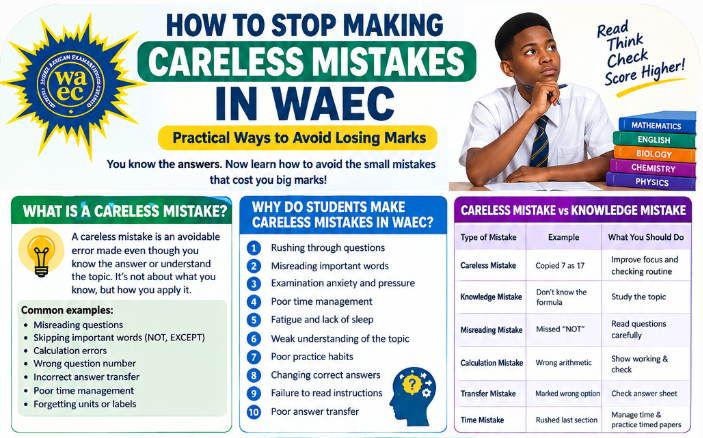
Welcome to Jambsmartprep.com, your no. 1 guide for Jamb, WAEC, NECO and admissions. In today’s post, we will be covering virtually everything you need to know about How to Stop Making Careless Mistakes in WAEC: Practical Ways to Avoid Losing Marks.
Yes, during the course of this online guide, you will Learn how to stop making careless mistakes in WAEC, avoid losing easy marks, manage exam time, check answers, and improve accuracy in every subject. All you need to do to get what you want is to keenly follow all the instructions outlined in this post.
Yes, if you often finish a WAEC practice paper and say, “I actually knew the answer, I just made a careless mistake,” you are not alone.
You may understand the topic, remember the formula, know the correct definition, and still lose marks because you rushed through the question, copied a figure incorrectly, forgot a unit, misunderstood one word, or selected the wrong option on the answer sheet.
These mistakes can be frustrating because they are different from not knowing the answer.
The good news is that careless mistakes are not something you simply have to accept.
You can identify the mistakes you repeatedly make and build simple habits that reduce them.
This is particularly important in an examination such as the West African Senior School Certificate Examination, where a candidate may spend months preparing but lose valuable marks because of avoidable errors during the actual paper.
The goal of this guide is not to tell you to “be careful” and leave you with nothing practical to do.
Instead, you will learn why careless mistakes happen, how to identify your personal mistake patterns, how to check answers without wasting time, and how to build an accuracy routine before WAEC.
Also read: How to Practice WAEC Past Questions Under Time Pressure
You will also learn how to reduce careless mistakes in Mathematics, English Language, Biology, Chemistry, Physics, practical examinations, objective questions, and theory papers.
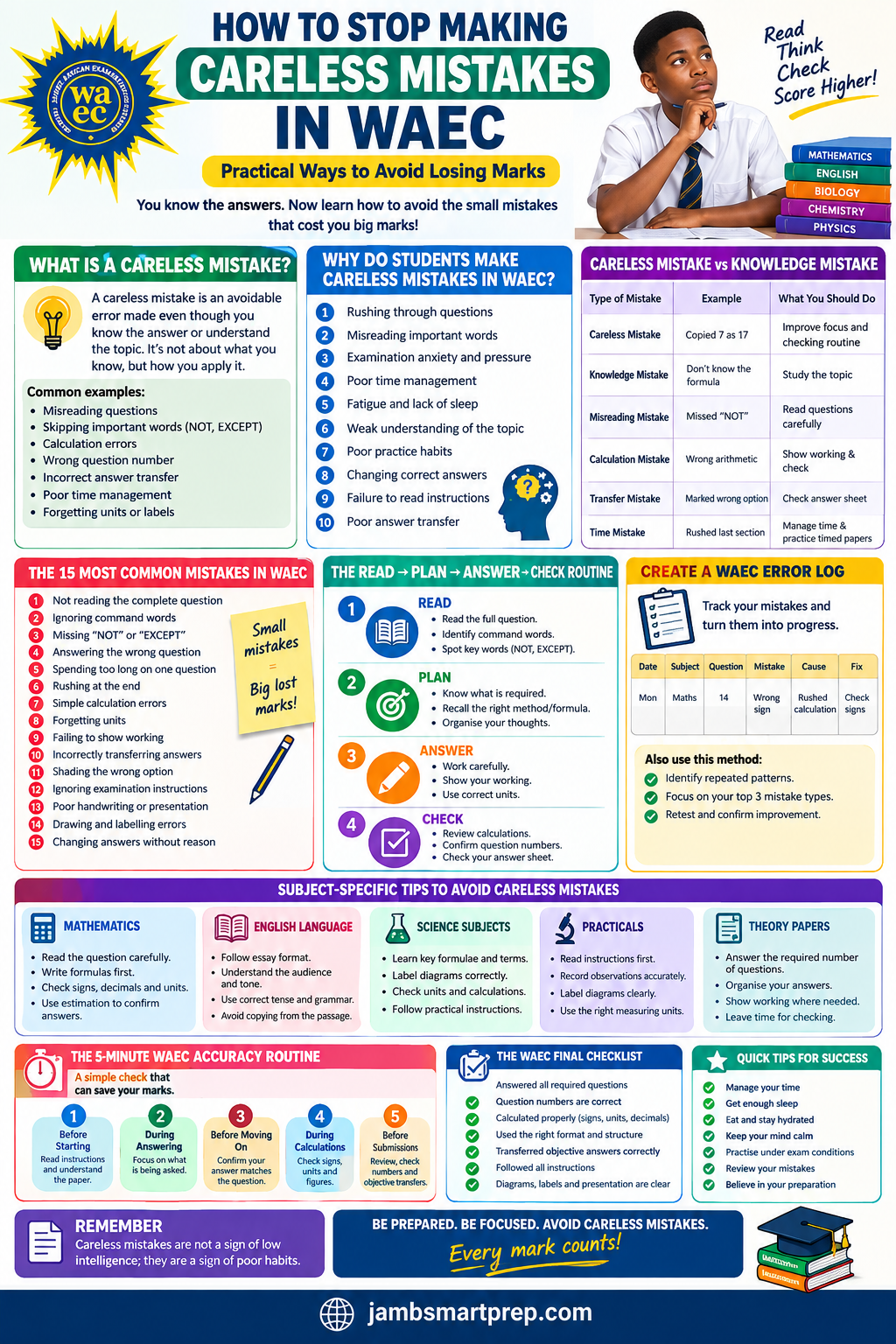
What Counts as a Careless Mistake in WAEC?
A careless mistake is generally an avoidable error made even though you have enough knowledge or skill to answer the question correctly.
For example, imagine a Mathematics question asks you to calculate the value of:
2x + 5 = 15
You correctly understand the method and obtain:
x = 5
But you accidentally write x = 10 as your final answer.
That is not necessarily a lack of knowledge.
You may have understood the entire question but made an execution error.
Other examples include:
- Reading “NOT” as if it were not there.
- Solving for
xwhen the question asks for2x. - Copying 3.5 as 35.
- Forgetting to convert centimetres to metres.
- Using the wrong sign in a calculation.
- Choosing option B when your working clearly supports option C.
- Leaving one sub-question unanswered.
- Giving three answers when the instruction asks for two.
- Forgetting to label a Biology diagram.
- Writing the wrong question number beside an answer.
- Changing a correct answer because you became nervous.
- Spending too much time on one difficult question and rushing the final section.
The important thing is to understand that “careless mistake” describes the result, not necessarily the cause.
You need to discover what actually caused the error.
Why Do Students Make Careless Mistakes in WAEC?
There is rarely one single reason.
Several factors can combine during preparation and during the examination itself.
1. Rushing Through Questions
One of the biggest causes of avoidable mistakes is rushing.
A student sees a familiar question and immediately starts solving it without properly reading what is required.
For example:
“Calculate the value of x.”
You solve the problem and obtain x.
But the final sentence actually says:
“Hence, calculate the value of 2x + 3.”
You may know the mathematics but still lose the mark because you answered a different question.
The solution is not necessarily to work slowly throughout the examination.
Instead, slow down at the most important moments.
Read carefully before starting.
Then work efficiently.
Before moving to the next question, confirm that your final answer responds to what was actually asked.
2. Misreading Important Words
Words such as these can completely change a question:
- NOT
- EXCEPT
- INCORRECT
- CORRECT
- MOST
- LEAST
- BEST
- FIRST
- MAIN
- ONLY
- DIFFERENCE
- SIMILARITY
- CALCULATE
- EXPLAIN
- STATE
- LIST
- COMPARE
Consider:
Which of the following is NOT a function of the liver?
If you overlook the word NOT, you may select an answer that is actually correct but does not answer the question.
Make it a habit to identify the command word before answering.
3. Poor Time Management
Some students make very few mistakes at the beginning of an examination and many mistakes toward the end.
Why?
They have spent too much time on earlier questions.
Eventually, they begin rushing.
They skip words.
They make calculation errors.
They forget to answer sub-sections.
They fail to check their work.
Good time management is therefore not just about finishing the examination.
It is also about protecting your accuracy.
4. Examination Anxiety
A student may know a topic perfectly well at home but become confused when sitting in the examination hall.
This can cause:
- rushing,
- second-guessing,
- difficulty concentrating,
- unnecessary answer changes,
- forgetting simple procedures,
- poor time decisions.
One way to reduce this problem is to practise under realistic conditions.
Do not always solve past questions while lying on your bed with your phone beside you and the answers available.
Occasionally sit at a desk.
Set a timer.
Put your phone away.
Attempt the questions without assistance.
This helps you practise not only knowledge but also exam execution.
5. Fatigue
Studying until very late every night may feel productive, but exhaustion can make concentration more difficult.
A student who has spent the previous night trying to memorise an entire Chemistry textbook may enter the examination tired and make errors in topics they actually understand.
Your preparation should therefore include adequate rest, especially before important examination days.
6. Weak Understanding
Not every mistake is careless.
Sometimes the student genuinely does not understand the topic.
This distinction matters.
If you keep getting questions on quadratic equations wrong because you do not understand how to solve them, repeatedly checking your answers will not solve the problem.
You need to learn the topic.
That is why every wrong answer should be diagnosed before you label it “carelessness.”
Careless Mistake vs Knowledge Mistake
After every practice test, classify your mistakes.
| Mistake type | Example | What you should do |
|---|---|---|
| Knowledge mistake | You do not know the definition | Study the topic |
| Misreading mistake | You missed “NOT” | Improve question-reading routine |
| Calculation mistake | You copied 7 as 17 | Improve working and checking |
| Method mistake | You used the wrong formula | Review the method |
| Transfer mistake | You knew the answer but selected the wrong option | Improve answer-sheet checking |
| Time mistake | You rushed five questions at the end | Improve time allocation |
| Presentation mistake | Your answer is difficult to follow | Improve organization |
| Memory mistake | You forgot a fact or formula | Use active revision |
| Instruction mistake | You answered more or fewer questions than required | Read instructions before starting |
This classification is one of the most important habits you can develop.
If you simply write:
“I got Question 14 wrong.”
you have learned very little.
Instead write:
“Question 14 was wrong because I missed the word ‘NOT’.”
That gives you something specific to fix.
The Most Important Rule: Stop Saying “I Am Careless”
Calling yourself careless does not solve the problem.
Instead ask:
What exactly did I do wrong?
Was it:
- misreading?
- rushing?
- poor calculation?
- wrong formula?
- wrong question number?
- forgotten unit?
- poor handwriting?
- answer transfer?
- lack of knowledge?
- changing an answer unnecessarily?
Once you know the pattern, you can create a specific solution.
For example:
Problem: I repeatedly forget units.
Solution: Every numerical answer must finish with a unit check.
Problem: I frequently miss “NOT.”
Solution: Circle or underline negative command words before answering.
Problem: I rush the last 20 minutes.
Solution: Use timed practice and reserve a review period.
This is much more effective than simply telling yourself:
“Next time I will be more careful.”
15 Common Careless Mistakes WAEC Candidates Make
1. Not Reading the Complete Question
Never assume you know what a question is asking because the first sentence looks familiar.
Read the complete question.
2. Ignoring Command Words
Pay attention to words such as state, explain, calculate, compare, list, describe, identify, discuss, and give reasons.
They tell you what type of response is required.
3. Missing “NOT” or “EXCEPT”
These small words can reverse the meaning of an objective question.
4. Answering the Question You Expected
You may recognise a familiar topic and begin answering from memory.
But the actual question may require something different.
Always answer the question on the page, not the one you expected to see.
5. Spending Too Long on One Question
If one question is consuming too much time, move on when appropriate and return later.
6. Rushing at the End
Do not allow poor time management at the beginning of the paper to destroy accuracy at the end.
7. Making Simple Calculation Errors
Write important steps rather than performing complicated calculations entirely in your head.
8. Forgetting Units
A numerical answer without the required unit may be incomplete where the unit is part of the expected response.
9. Failing to Show Working
For calculation-based questions, working can make your solution easier to follow and helps you identify where an error occurred.
10. Transferring an Answer Incorrectly
A student may solve a question correctly but mark the wrong option.
This is especially dangerous because the mistake happens after the actual problem has already been solved.
11. Ignoring Examination Instructions
Read the instructions before answering.
Do not assume that every section follows the same format.
12. Poor Handwriting
Your answer should be sufficiently clear for the examiner to understand what you have written.
13. Poor Diagrams and Labels
Science questions often require accurate diagrams, labels, tables, or other forms of presentation.
14. Changing Answers Without a Good Reason
Fear is not evidence that an answer is wrong.
If you change an answer, have a specific reason.
15. Failing to Review Your Paper
Even a few minutes of targeted checking can help you find mistakes that you would otherwise submit.
The Read, Plan, Answer, Check Method
A simple routine can help you approach questions more deliberately.
Step 1: Read
Read the entire question.
Step 2: Plan
Identify what the question wants.
For Mathematics, this may mean identifying the formula or method.
For English, it may mean identifying the required writing task.
For Biology, it may mean identifying whether the question asks you to state, describe, explain, or draw.
Step 3: Answer
Give the required response.
Avoid unnecessary information that does not answer the question.
Step 4: Check
Before moving on, ask:
Did I answer exactly what was asked?
This four-step process is simple enough to practise repeatedly during revision.
Your Goal Is Accuracy, Not Slowness
There is an important difference between being careful and being unnecessarily slow.
If you spend five minutes checking a question worth one mark, you may create another problem.
You could lose several marks elsewhere because you ran out of time.
The objective is therefore not:
“Work as slowly as possible.”
It is:
“Work efficiently while protecting accuracy at high-risk moments.”
That distinction can make a major difference in a timed examination.
How to Train Yourself to Make Fewer WAEC Mistakes
Create a WAEC Careless Mistake Error Log
One of the most effective ways to improve your accuracy is to keep an error log.
An error log is simply a record of the mistakes you make during practice.
You can use a notebook, spreadsheet, or a section of your revision notebook.
Create columns for:
| Date | Subject | Question | What went wrong? | Cause | How will I prevent it? |
|---|---|---|---|---|---|
| Monday | Mathematics | 14 | Wrong sign | Rushed calculation | Check signs |
| Tuesday | Biology | 21 | Wrong option | Misread question | Read full stem |
| Wednesday | Chemistry | 8 | Forgot unit | Final check skipped | Check units |
| Thursday | English | 5 | Missed instruction | Started too quickly | Read task first |
The important part is “What went wrong?”
Do not write:
“I was careless.”
Write:
“I read ‘least’ as ‘most’.”
Or:
“I copied 0.25 as 2.5.”
Or:
“I knew the answer but marked option C instead of B.”
That information is useful.
Why an Error Log Works
Suppose you complete five WAEC Mathematics practice papers.
Your scores are:
- 64%
- 68%
- 70%
- 73%
- 75%
You might think your preparation is improving.
That is good.
But your error log might reveal something more useful.
You may discover that across those five papers:
- 7 mistakes came from signs
- 5 came from copying numbers
- 4 came from misreading questions
- 3 came from forgetting units
- 2 came from genuinely not knowing the topic
Now you know where to concentrate.
Instead of spending another week randomly solving questions, you can deliberately practise the areas producing repeated errors.
Use the Mistake → Cause → Fix → Retest System
Every important mistake should pass through four stages.
1. Mistake
What did you get wrong?
2. Cause
Why did you get it wrong?
3. Fix
What will you do differently next time?
4. Retest
Can you answer a similar question correctly later?
For example:
Mistake: Wrong answer in a Chemistry calculation.
Cause: Correct formula but wrong substitution.
Fix: Write the values separately before substitution.
Retest: Complete five similar questions the next day.
This is how mistakes become learning opportunities.
Do Not Use WAEC Past Questions Only to Memorise Answers
Past questions are extremely useful, but there is a wrong way to use them.
Some students solve a past question, check the answer immediately, memorise the option, and move on.
That does not necessarily improve examination accuracy.
Instead, use this process:
- Attempt the question without checking the answer.
- Mark your work.
- Identify every wrong answer.
- Classify each mistake.
- Correct the mistake.
- Understand why your original answer was wrong.
- Write the prevention rule in your error log.
- Attempt another similar question.
- Revisit the mistake several days later.
This method helps you train both knowledge and execution.
How to Stop Careless Mistakes in WAEC Mathematics
Mathematics is one of the subjects where a student can understand the method and still lose marks because of one small error.
Common problems include:
- copying numbers incorrectly,
- dropping a negative sign,
- using the wrong formula,
- incorrect substitution,
- arithmetic errors,
- decimal errors,
- incorrect brackets,
- forgetting units,
- stopping at an intermediate answer,
- answering for the wrong variable.
Read the Question Before Touching Your Calculator
Do not immediately start calculating.
First ask:
What exactly am I being asked to find?
For example:
A trader buys an item for ₦8,000 and sells it for ₦10,000. Calculate the percentage profit.
Do not simply calculate the difference.
The question asks for percentage profit.
The relevant calculation is:
Profit = ₦10,000 − ₦8,000 = ₦2,000
Then:
Percentage profit = (Profit ÷ Cost Price) × 100
The calculation is straightforward, but a student rushing through the question may stop after finding ₦2,000.
That is an execution error.
Write Important Steps
Do not try to keep every calculation in your head.
Writing steps gives you something to inspect.
For example:
2x + 6 = 18
Subtract 6:
2x = 12
Divide by 2:
x = 6
If you immediately write the final answer without working, you make it harder to identify where an error occurred.
Check Whether Your Answer Makes Sense
A final answer should be reasonable.
If you calculate that a person’s age is 250 years, stop.
Something has gone wrong.
If a percentage is supposed to represent a proportion and you obtain an impossible result, check your calculation.
This is called a reasonableness check.
How to Avoid Careless Mistakes in WAEC English Language
English Language requires a different type of accuracy.
You need to pay attention not only to grammar but also to the exact task.
Essay Writing
Before writing, identify:
- the type of essay,
- the topic,
- the intended audience,
- the purpose,
- the required format,
- the major points you want to discuss.
For example, if the question requires a formal letter, do not write an informal message simply because the topic feels familiar.
Your introduction, tone, organisation, and closing should match the required format.
Comprehension
Read the passage carefully before rushing into the questions.
Avoid answering from your general knowledge when the answer should come from the passage.
If the question asks you to explain an expression as used in the passage, look at the context.
Summary
Summary questions require precision.
Avoid copying long sections of the passage unnecessarily.
Identify the required points and express them clearly.
Objective Questions
Do not allow familiarity to replace careful reading.
Read the full question and all relevant options before selecting your answer.
How to Avoid Careless Mistakes in WAEC Biology
Biology requires both knowledge and precision.
Common avoidable errors include:
- incorrect spelling of biological terms,
- poor diagrams,
- missing labels,
- confusing similar structures,
- giving vague definitions,
- failing to follow the wording of the question,
- poor practical observations.
Label Diagrams Carefully
If you are asked to draw and label a structure, make the labels clear.
Do not draw a complicated diagram and then rush through the labels at the end.
Practise diagrams during revision.
For example, depending on your syllabus and the question, you may need to practise diagrams involving:
- plant cells,
- animal cells,
- flowers,
- reproductive structures,
- digestive systems,
- respiratory structures,
- ecological diagrams.
The specific diagram you should prepare depends on the syllabus and topics covered in your examination.
How to Avoid Careless Mistakes in WAEC Chemistry
Chemistry has many opportunities for small errors.
Pay attention to:
- chemical symbols,
- formulae,
- balancing equations,
- valencies,
- calculations,
- significant figures where required,
- units,
- observations,
- laboratory procedures.
Check Chemical Formulae
A small change in a formula can completely change the meaning.
Do not rely on memory alone when writing complex formulae.
Practise them repeatedly and check your work during revision.
Be Careful With Calculations
Write the formula first.
Substitute the values carefully.
Then calculate.
Finally, check the unit.
This gives you several opportunities to catch an error before submitting the answer.
How to Avoid Careless Mistakes in WAEC Physics
Physics combines concepts, formulae, calculations, units, diagrams, and explanations.
A good routine is:
Identify → Formula → Substitute → Calculate → Unit → Check
For example, if you are calculating speed:
Speed = Distance ÷ Time
Do not immediately insert numbers.
First confirm:
- What is the distance?
- What is the time?
- Are the units compatible?
- What unit should the final answer have?
A correct formula with incorrect units can still produce an incorrect final response.
How to Avoid Mistakes in WAEC Practical Examinations
Practical examinations require a different mindset.
Do not treat them like ordinary theory questions.
Depending on the subject, you may need to work with:
- specimens,
- apparatus,
- measurements,
- observations,
- tables,
- diagrams,
- calculations,
- experimental procedures.
Read the Practical Instructions First
Do not begin touching equipment or writing observations before understanding the task.
Record Observations Carefully
Do not write what you expect to see simply because you remember the textbook result.
Record the actual observation required by the question and follow the examination instructions.
Check Labels and Tables
If you construct a table, ensure that:
- headings are clear,
- units are included where appropriate,
- values are recorded correctly,
- observations are placed in the correct rows or columns.
Leave Time for Review
If you spend the entire practical period rushing through procedures, you may have no time to inspect your work.
Include a final check whenever the examination format permits it.
How Your Revision Style Can Create Careless Mistakes
Your revision method matters.
If you spend most of your preparation passively reading notes, you may feel familiar with the material without developing enough ability to retrieve and apply it.
A stronger approach combines:
- active recall,
- past questions,
- timed practice,
- topic revision,
- correction of mistakes,
- repeated testing.
For example, instead of reading a Mathematics topic for two hours, you could spend part of the session solving questions and analysing every mistake.
The same principle applies to JAMB preparation.
A JAMB candidate who repeatedly makes the same calculation or reading error will benefit more from identifying that pattern than from simply solving hundreds of additional questions without reviewing the errors.
Build an Accuracy Session Into Your Study Timetable
You do not need to dedicate every study session to careless mistakes.
Even 20 to 30 minutes can help.
For example:
Monday: Mathematics error correction
Tuesday: English question-reading practice
Wednesday: Chemistry calculations
Thursday: Biology diagrams and terminology
Friday: Mixed timed questions
Saturday: Full past paper
Sunday: Review your error log
The exact schedule can be adjusted to your subjects.
The important point is to make accuracy a deliberate part of preparation.
How to Avoid Careless Mistakes Inside the WAEC Examination Hall
How to Manage Your WAEC Exam Time Without Rushing
Time management is one of the most important parts of examination accuracy.
A candidate can know the material and still lose marks because too much time was spent on a small number of questions.
Your goal is to balance speed and accuracy.
Start With a Calm First Question
When the examination begins, do not panic because the first question looks difficult.
Read the instructions carefully.
Understand the structure of the paper.
Then begin according to the examination instructions and your prepared strategy.
Starting calmly can help you establish a better rhythm.
Do Not Fight One Question for Too Long
If a question is consuming too much time, mark it mentally and move on when appropriate.
You can return later.
A difficult two-mark question should not consume the time needed to answer several easier questions.
Use Timed Practice Before WAEC
You should practise under realistic time limits.
For example, if you normally take an entire afternoon to solve a past paper because you frequently check textbooks and use your phone, that practice does not accurately prepare you for the examination environment.
Try this instead:
- Get your past question.
- Set the appropriate time.
- Keep your phone away.
- Use only permitted materials.
- Start the timer.
- Complete the paper.
- Stop when the time finishes.
- Mark your work.
- Analyse your mistakes.
This gives you useful information about both knowledge and speed.
How to Use the Final Minutes of a WAEC Paper
Do not wait until the last few seconds before checking your work.
If possible, reserve some time for review.
But do not simply read every answer from the beginning again.
Use a targeted check.
First Check: Completion
Ask:
- Did I answer every required question?
- Did I skip any sub-question?
- Did I accidentally leave a page?
- Did I answer the required number of questions?
Second Check: High-Risk Errors
Look specifically for:
- calculation errors,
- negative signs,
- wrong units,
- wrong question numbers,
- missing labels,
- copied figures,
- incomplete answers,
- obvious spelling errors,
- objective answer-transfer errors.
Third Check: Instructions
Ask:
Did I follow the instructions for this section?
This matters because an answer can be well written and still fail to satisfy the actual task.
WAEC Objective Examination Mistakes You Must Avoid
Objective questions may look simple, but small errors can cost marks.
Read the Whole Question
Do not select an answer after reading only the first line.
Read All Options
Sometimes the first option that appears reasonable is not the best answer.
Read the available options before making your final choice.
Watch the Question Number
If you are transferring answers to an objective answer sheet, pay attention to alignment.
A shift of one question can create multiple incorrect entries.
For example:
If Question 15 is marked on the row for Question 16, subsequent answers can also become misaligned.
Check Your Answer Transfer
If the examination format requires an objective answer sheet, make sure the answer you intend to submit corresponds to the correct question.
This is an important distinction:
Knowing the answer and recording the answer are two different tasks.
You need to be accurate at both stages.
Important WAEC Nigeria Guidance on Answer-Sheet Errors
This is not merely a theoretical concern.
The West African Examinations Council specifically addresses candidate mistakes that can lead to queries and partial release of results.
According to WAEC Nigeria’s official FAQ, partial release of results can arise from mistakes including wrong transfer of examination numbers in one or more papers, failure to shade examination numbers, shading objective sheets with biro instead of pencil, and mistakes in entries that result in duplication of subjects.
This is why examination administration should be treated as seriously as answering the academic questions.
You are not only preparing your brain to remember information.
You are also preparing yourself to enter, record, and submit information correctly.
Do Not Ignore Examination Instructions
Before the examination begins, pay attention to the instructions provided.
Do not assume that the same approach applies to every paper.
For example, instructions may tell you:
- how many questions to answer,
- which sections are compulsory,
- how answers should be presented,
- what materials are permitted,
- how much time is available.
If you ignore these instructions, you can create an avoidable problem even when you know the subject.
Be Careful With Examination Materials
Candidates should follow the official instructions concerning writing materials and answer sheets.
Do not rely on what a friend used in another examination.
Do not assume that because something was permitted in school tests it is automatically permitted in WAEC.
Check the current instructions for your examination.
This is particularly important for objective answer sheets because WAEC Nigeria’s official FAQ specifically identifies incorrect shading practices as one of the mistakes associated with partial result release.
Theory Examination Mistakes to Avoid
Theory questions require more than knowing facts.
You must answer the question in a form that addresses the examiner’s demand.
Follow the Number of Questions Required
If the instruction says to answer a specified number of questions, follow it.
Do not assume that writing everything you know will automatically increase your marks.
Answer What Was Asked
Suppose the question says:
State three advantages of crop rotation.
A long essay about agriculture is not necessarily better.
Give the requested information clearly.
Show Your Working Where Appropriate
For calculations, working helps demonstrate your method and allows you to inspect your reasoning.
Do not hide your entire calculation process because you want to finish quickly.
Keep Your Answers Organised
Use clear numbering.
If the question has parts such as:
a, b, c, and d
make it obvious which answer belongs to which part.
This reduces confusion for you and makes your script easier to follow.
Should You Change an Answer After Choosing It?
This is a common problem.
A student selects an answer.
Then five minutes later, anxiety starts.
“Maybe B is actually correct.”
The student changes B to C.
Later, they discover B was correct.
The solution is not to adopt a rule that you must never change answers.
Sometimes an answer should be changed.
The important question is:
Why are you changing it?
A good reason could be:
- You reread the question and found a word you missed.
- You noticed a calculation error.
- You remembered a relevant fact.
- You discovered that your first answer contradicted the question.
A weak reason is:
“I suddenly felt that it was probably wrong.”
If you change an answer, do so because you have evidence.
The Three-Pass Checking Method
Instead of repeatedly reading your entire paper, divide checking into three passes.
Pass 1: Completion
Check for unanswered questions and missing sections.
Pass 2: Mechanical Errors
Check:
- calculations,
- signs,
- units,
- copied numbers,
- labels,
- answer transfers,
- question numbers.
Pass 3: Meaning
Ask:
Does my answer actually answer the question?
This final question is extremely important.
A candidate can perform a perfectly correct calculation and still answer the wrong thing.
WAEC Marking Is Structured
Students sometimes worry that marking is random or that only a particular style of answer will receive marks.
WAEC Nigeria explains that marking guides are developed and examiners are trained through a coordination process. Team Leaders and Chief Examiners supervise marking, while checkers verify that marks are correctly recorded and transferred.
This reinforces an important lesson.
Your job is to make your response clear, relevant, complete, and consistent with the question and instructions.
Learn From WAEC Chief Examiners’ Reports
WAEC Nigeria says its Chief Examiners’ Reports provide feedback on candidates’ performance and can help schools and private candidates prepare for subsequent examinations.
If a relevant report is available for your subject, use it as part of your preparation.
It can help you understand areas where candidates commonly struggle.
Instead of only asking:
“What topics are in this subject?”
also ask:
“What mistakes do candidates commonly make when answering questions from these topics?”
That is a more advanced approach to preparation.
Careless Mistakes vs Examination Malpractice
It is important not to confuse an ordinary academic mistake with an examination offence.
For example:
- calculating a value incorrectly is a normal academic error;
- forgetting a unit may be an academic error;
- misreading a question is an academic error.
These are different from deliberate acts such as cheating or impersonation.
WAEC Nigeria states that results are cancelled when candidates are found guilty of examination malpractice and lists offences such as bringing prohibited materials into the examination hall, impersonation, swapping scripts, and organised cheating.
The safest approach is simple:
Follow the examination rules exactly.
Do not allow pressure for a high WAEC result to push you into behaviour that violates the rules.
Protect Your Accuracy Before Examination Day
Careless mistakes are not only created inside the examination hall.
Your habits during preparation can influence how you perform.
Before WAEC:
- practise timed papers;
- keep an error log;
- review recurring mistakes;
- practise reading questions carefully;
- sleep properly;
- prepare permitted materials;
- avoid last-minute panic;
- revise weak topics;
- practise writing complete answers;
- become familiar with your examination routine.
If you prepare only for knowledge but not for execution, you may discover on examination day that your preparation did not cover the entire challenge.
7-Day WAEC Careless Mistake Reduction Plan
If your examination is approaching and you want a practical way to start reducing careless mistakes, use this seven-day system.
You can repeat the cycle as many times as necessary.
Day 1: Discover Your Most Common Mistakes
Take one past question paper.
Complete it under timed conditions.
When marking it, do not focus only on your score.
Create a list of every mistake.
Classify each one:
- knowledge,
- misreading,
- calculation,
- transfer,
- time management,
- instruction,
- presentation,
- memory,
- careless execution.
At the end of the day, identify your top three mistake types.
For example:
1. Misreading questions
2. Calculation errors
3. Forgetting units
Those become your targets.
Day 2: Build Your Error Log
Create your error log.
For each repeated mistake, write a prevention rule.
Example:
Mistake: I forget units.
Rule: Check the unit immediately after writing every numerical answer.
Another:
Mistake: I miss “NOT.”
Rule: Circle or underline NOT, EXCEPT, and INCORRECT before answering.
Another:
Mistake: I rush the final questions.
Rule: Monitor time during the examination rather than waiting until the end.
The rule should be short enough to remember.
Day 3: Practise Question Reading
Take 20 to 30 objective questions.
Do not rush to answer them.
Your goal is to practise reading.
Identify:
- command words,
- negative words,
- numbers,
- units,
- conditions,
- key phrases.
For every question, ask:
What exactly is this question asking me to find, choose, explain, or identify?
This trains the first stage of accuracy.
Day 4: Practise Calculations
Focus on numerical subjects.
Complete questions from:
- Mathematics,
- Physics,
- Chemistry,
- Economics,
- Accounting,
- Further Mathematics,
depending on the subjects you are taking.
Do not focus only on obtaining the correct answer.
Pay attention to your process.
Check:
- copied figures,
- formula,
- substitution,
- signs,
- arithmetic,
- decimal points,
- units,
- final answer.
Day 5: Complete a Timed Paper
Take another past paper.
This time, apply your new checking routine.
Do not wait until the end to practise accuracy.
Use:
Read → Plan → Answer → Check
After the paper, compare your new mistakes with your Day 1 error log.
Are the same mistakes still appearing?
If yes, identify why.
Day 6: Attack Your Biggest Weakness
Choose the mistake that keeps repeating.
For example:
If you repeatedly forget units, complete numerical questions and deliberately check every unit.
If you repeatedly misread questions, practise reading.
If you repeatedly run out of time, complete timed sections.
If you repeatedly change correct answers, examine why you are doing it.
The goal is targeted practice.
Day 7: Complete a Full Mock Examination
Create realistic conditions.
Put your phone away.
Prepare your permitted materials.
Use the appropriate time limit.
Sit at a desk.
Complete the paper.
Then perform a detailed review.
Compare the result with your previous attempts.
Do not measure success only by your score.
Also measure:
How many careless mistakes did I make?
That number may tell you more about your progress.
The 5-Minute WAEC Accuracy Routine
If you do not have much time, use this short routine.
Before Starting
Read the instructions carefully.
Understand what the paper requires.
During Each Question
Ask:
What is being asked?
Then answer it.
Before Moving On
Ask:
Does my answer match the question?
During Calculations
Check:
- formula,
- numbers,
- signs,
- units.
Before Submission
Check:
- unanswered questions,
- question numbers,
- objective answers,
- calculations,
- units,
- diagrams,
- instructions.
The routine is simple.
Its strength comes from repetition.
WAEC Careless Mistakes Checklist
Before submitting your paper, run through this checklist where the examination format and available time permit.
Question Reading
- Did I read each question completely?
- Did I notice words such as NOT, EXCEPT, BEST, and INCORRECT?
- Did I identify exactly what was required?
Calculations
- Did I copy the figures correctly?
- Did I use the correct formula?
- Did I check signs?
- Did I check decimals?
- Did I include the correct units?
- Does the answer make sense?
Theory
- Did I answer the required number of questions?
- Did I answer every sub-question?
- Did I follow the command word?
- Are my answers clearly numbered?
- Did I provide enough explanation?
Diagrams and Practical Work
- Are diagrams clear?
- Are labels correct?
- Are tables properly arranged?
- Are observations recorded correctly?
- Are units included where required?
Objective Questions
- Did I mark the correct question number?
- Did I transfer answers correctly?
- Did I accidentally leave an answer blank?
- Did I follow the instructions for the answer sheet?
Final Review
- Did I check the questions I flagged?
- Did I avoid unnecessary answer changes?
- Did I follow all instructions?
How Sleep and Stress Can Affect Your Accuracy
Preparation is not only about books.
Your physical and mental condition can influence how well you apply what you have learned.
If you are extremely tired, you may find it harder to maintain concentration.
If you are panicking, you may rush.
If you are hungry or distracted, you may find it harder to focus.
That is why your final days before WAEC should not consist entirely of frantic all-night reading.
A sensible final-week routine should include:
- focused revision,
- timed practice,
- mistake review,
- adequate sleep,
- preparation of permitted materials,
- reasonable breaks.
You do not need to eliminate every feeling of nervousness.
You need to prevent nervousness from controlling your actions.
What to Do If You Suddenly Panic During WAEC
Imagine you reach a question and your mind goes blank.
Do not immediately assume you have forgotten everything.
Try this:
- Put your pen down briefly.
- Take a slow breath.
- Read the question again.
- Identify the exact requirement.
- Recall the relevant topic or formula.
- Start with the part you understand.
- Move on if necessary and return later.
One difficult question does not determine the entire examination.
Do not spend the next 30 minutes mentally replaying one question.
Your attention belongs to the paper in front of you.
What If You Keep Making the Same Mistakes?
This is where many students become frustrated.
They say:
“I have tried everything, but I still make mistakes.”
If this happens, make the problem more specific.
Do not say:
“I make careless mistakes.”
Say:
“I lose marks because I copy numbers incorrectly during calculations.”
That is a solvable problem.
Then create a countermeasure.
For example:
Before calculation: Copy the values carefully.
During calculation: Write each important step.
After calculation: Compare the original figures with the values used.
Before moving on: Check the final answer and unit.
Now you have a system.
How Parents and Teachers Can Help Students Reduce Careless Mistakes
Parents and teachers should also avoid reducing every mistake to:
“You are not serious.”
That statement does not identify the problem.
A better question is:
“What type of mistake did you make?”
If the student repeatedly misreads questions, help them practise question interpretation.
If they repeatedly make calculation errors, examine the calculation process.
If they know the answer but record it incorrectly, practise answer transfer.
If they do not understand the topic, provide additional teaching.
This distinction helps students improve without developing unnecessary fear around examinations.
Can Careless Mistakes Affect Your WAEC Result?
Yes, ordinary mistakes can reduce the marks you receive because examination marks depend on the accuracy and completeness of your answers.
There is also an important administrative side to the examination.
WAEC Nigeria states that certain candidate-entry and answer-sheet mistakes can result in queries associated with partial release of results. These include wrong transfer of examination numbers, failure to shade examination numbers, incorrect shading of objective sheets, and duplicate-subject entry mistakes.
This is why accuracy should cover both:
Academic answers
and
Examination administration.
You should therefore take your examination details, question numbers, answer sheets, and other required entries seriously.
How to Stop Losing Easy Marks in WAEC
If your goal is to improve your WAEC result, do not think only about learning more difficult topics.
Also protect the marks you already have the ability to earn.
Ask yourself:
- Am I reading questions properly?
- Do I understand what each command word requires?
- Do I make repeated calculation errors?
- Do I forget units?
- Do I run out of time?
- Do I change correct answers unnecessarily?
- Do I transfer objective answers correctly?
- Do I leave questions incomplete?
- Do I practise under timed conditions?
- Do I analyse my mistakes?
Improvement is not always about learning something completely new.
Sometimes it is about stopping the same avoidable mistake from happening repeatedly.
Frequently Asked Questions About Careless Mistakes in WAEC
Why do I keep making careless mistakes in WAEC?
You may have a repeated error pattern involving reading, calculation, time management, answer transfer, memory, or examination pressure.
Instead of calling yourself careless, record your mistakes and identify the exact cause.
How can I stop making careless mistakes in WAEC?
Use a repeatable system:
Read → Plan → Answer → Check.
Keep an error log, practise past questions under timed conditions, identify recurring mistakes, and create a specific prevention rule for each one.
How can I avoid losing easy marks in WAEC?
Read questions carefully, follow instructions, show appropriate working, check calculations, use correct units, answer the required number of questions, and reserve time for targeted review.
How do I stop rushing during WAEC?
Practise with a timer before the examination.
Learn to move past questions that are consuming too much time and return to them later when appropriate.
The more often you practise under realistic conditions, the easier it becomes to manage your time.
Should I check every answer twice?
Not necessarily.
Checking everything repeatedly can consume valuable time.
A targeted check is usually more practical.
Focus on your known high-risk areas such as calculations, signs, units, question numbers, instructions, and answer transfers.
Should I change my answer if I suddenly feel it is wrong?
Do not change an answer simply because you become nervous.
Change it when you have a specific reason, such as finding a calculation error or noticing that you misread the question.
How can I stop making careless mistakes in WAEC Mathematics?
Write important steps, check signs, copy numbers carefully, use the correct formula, verify units, and perform a reasonableness check before moving on.
How can I avoid mistakes in WAEC English Language?
Understand the exact task before writing.
Pay attention to essay format, audience, tone, comprehension wording, summary requirements, grammar, spelling, paragraphing, and the instructions for each section.
How can I avoid careless mistakes in WAEC practicals?
Read the instructions carefully, understand the procedure, record observations accurately, label diagrams clearly, check tables and calculations, and use your time carefully.
Does practising past questions reduce careless mistakes?
It can, especially when you analyse your mistakes instead of simply checking your score.
The important process is:
Attempt → Mark → Diagnose → Correct → Retest.
Should I study all night before WAEC?
Studying late into the night is not automatically better preparation.
Your revision should balance study, practice, correction, and adequate rest.
What is the best way to review my mistakes?
Use an error log.
Record:
Mistake → Cause → Correction → Retest
This turns mistakes into specific revision targets.
Can careless mistakes affect my WAEC result processing?
Certain administrative and answer-sheet mistakes can create problems.
WAEC Nigeria specifically lists wrong transfer of examination numbers, failure to shade examination numbers, incorrect objective-sheet shading, and duplicate-subject entries among mistakes associated with partial release of results.
What should I check before submitting my WAEC paper?
Check:
- unanswered questions,
- question numbers,
- calculations,
- signs,
- units,
- diagrams,
- labels,
- instructions,
- objective answer transfers,
- and the required number of answers.
Related WAEC Guides to Read
If you are building a complete WAEC preparation plan, consider connecting this article with other useful guides on your website, such as:
- WAEC Preparation Tips for First-Time Candidates
- How to Use WAEC Past Questions Effectively
- WAEC Syllabus for All Subjects
- How to Study for WAEC at Home
- How to Pass WAEC With Good Grades
- Common WAEC Examination Mistakes
- WAEC Mathematics Examination Tips
- WAEC English Language Examination Tips
- WAEC Biology Examination Tips
- WAEC Chemistry Examination Tips
- WAEC Physics Examination Tips
- WAEC Practical Examination Tips
- WAEC Timetable and Examination Guide
- WAEC Marking Scheme Explained
- How to Check WAEC Result Online
- WAEC Result Checker Guide
- What to Do If Your WAEC Result Is Withheld
These articles can form a strong topical cluster around WAEC preparation and help readers move naturally from one stage of their examination journey to another.
Final Thoughts: Stop Trying to Be “Careful” and Start Training Accuracy
The biggest lesson from careless mistakes is simple:
You do not fix a repeated mistake by merely promising to be more careful.
You fix it by identifying exactly what went wrong and building a better process.
If you repeatedly miss words such as NOT and EXCEPT, train yourself to identify them.
If you repeatedly lose marks through calculations, write your working and check the critical steps.
If you forget units, make unit checking part of your routine.
If you rush the final section, practise timed papers.
If you change correct answers because of anxiety, require yourself to have a specific reason before changing one.
If you transfer objective answers incorrectly, build answer-sheet checking into your practice.
If you do not understand the subject, stop calling the problem carelessness and go back to the topic.
Your WAEC preparation should therefore have two goals:
Learn the material.
Learn how to deliver what you know accurately under examination conditions.
That second skill is often overlooked.
A student who knows the material but repeatedly loses marks through avoidable errors needs more than additional notes. They need an accuracy system.
Start with your next past question paper.
Complete it under timed conditions.
Create your error log.
Identify your three most common mistakes.
Then work on those mistakes deliberately.
Over time, the goal is not to become a student who never makes a mistake.
Nobody can guarantee that.
The goal is to become a student who recognises common error patterns, catches avoidable mistakes earlier, manages examination time intelligently, and submits answers with greater confidence and accuracy.
That is a much more practical way to prepare for WAEC.
If this guide helped you, bookmark it and return to the seven-day careless-mistake reduction plan while preparing for your next WAEC paper.
