Welcome to Jambsmartprep.com, your no. 1 guide for Jamb, WAEC, NECO and admissions. In today’s post, we will be covering virtually everything you need to know about How To Correct Wrong NECO Registration Number.
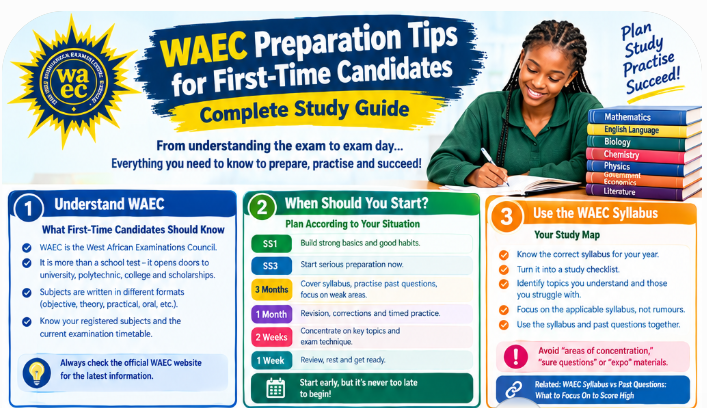
Yes, during the course of this online guide, you will learn how to prepare for WAEC as a first-time candidate with practical study tips, syllabus planning, past questions, revision strategies, practicals and exam-day advice. All you need to do to get what you want is to keenly follow all the instructions outlined in this post.
As we are all aware, if you are preparing for WAEC for the first time, it is normal to feel confused about where to begin.
You may be wondering which subjects deserve the most attention, how to use the WAEC syllabus, how many past questions you should practise, how to create a reading timetable, or what you should expect on examination day.
The good news is that you do not need to study randomly or wait until the examination is close before taking preparation seriously.
A good WAEC preparation strategy is a process.
You start by understanding your subjects and syllabus. Then you build a realistic study timetable, learn the topics, practise questions, identify your mistakes, revise weak areas and gradually move from ordinary study to timed examination practice.
This guide explains how to prepare for WAEC as a first-time candidate, including what to study, how to use past questions, how to prepare for practical examinations, how to deal with weak subjects and what to do during the final weeks before WAEC.
Whether you are in SS3, preparing alongside your normal schoolwork, or trying to recover after starting late, the goal is to help you replace panic with a practical preparation system.
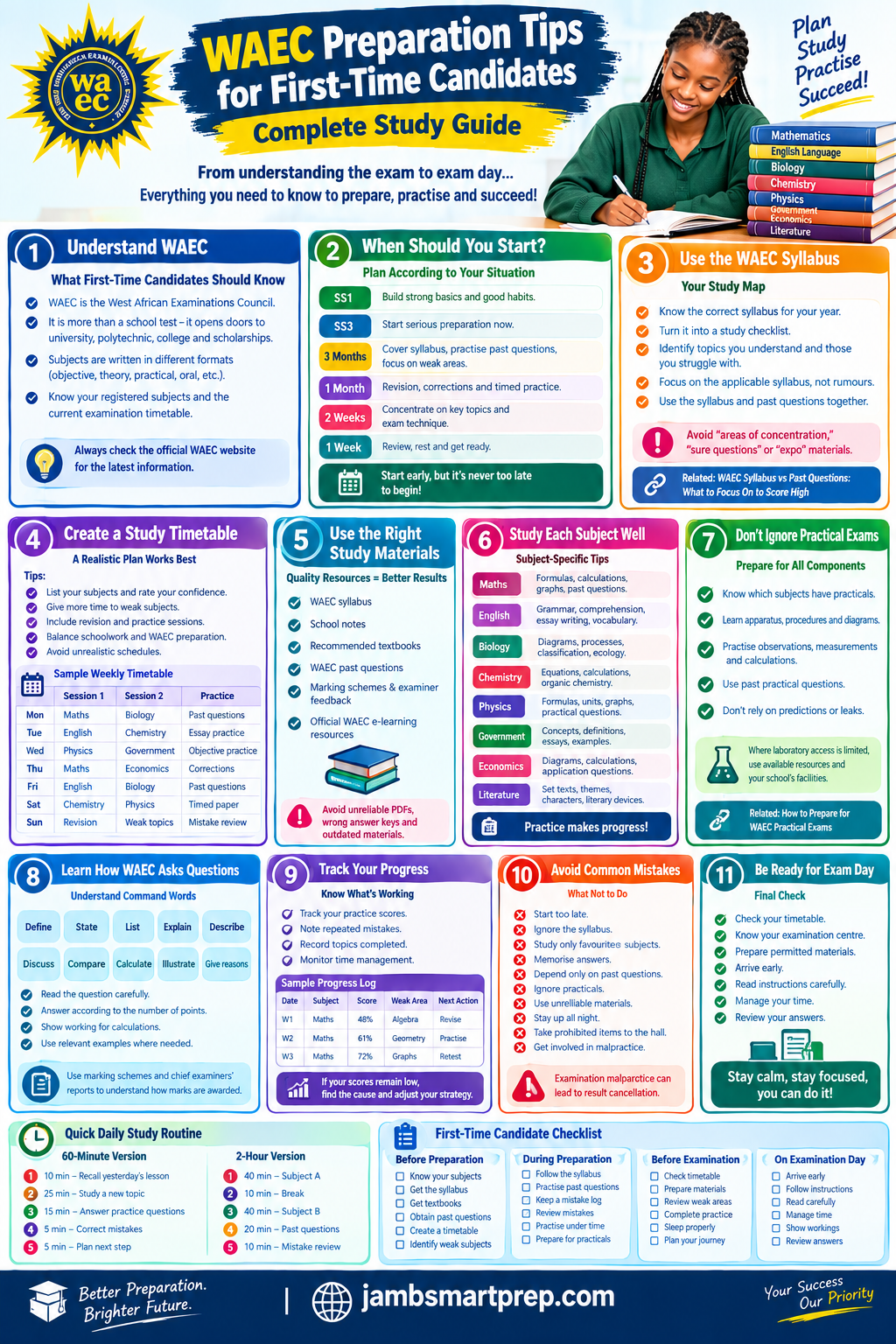
What First-Time WAEC Candidates Should Know Before They Start Preparing
Before creating a timetable or downloading past questions, understand the examination you are preparing for.
WAEC, formally the West African Examinations Council, conducts the West African Senior School Certificate Examination for candidates in participating West African countries.
For a Nigerian student, WAEC is more than another classroom test.
Your result can become important when applying for universities, polytechnics, colleges of education, scholarships and other opportunities.
That is why your preparation should focus on understanding the subjects and developing examination skills, rather than simply trying to memorise large amounts of information.
WAEC is not one single type of paper
One mistake first-time candidates make is assuming that every subject is written in exactly the same way.
Depending on the subject, candidates may encounter objective questions, essay or theory questions, practical work, oral components, performance tests or alternative-to-practical components.
The exact arrangement depends on the subject and examination year.
For example, the official WAEC timetable has included different components for subjects such as Mathematics, Physics, Government, languages and practical or performance-based subjects. This means your preparation should follow the current syllabus and official timetable for your own examination, rather than an old timetable found online.
Know the subjects you are actually writing
Start by creating a simple list of your registered subjects.
For example:
| Subject | Current Level | Priority |
|---|---|---|
| English Language | Average | High |
| Mathematics | Weak | Very High |
| Biology | Strong | Medium |
| Chemistry | Weak | Very High |
| Physics | Average | High |
| Government | Strong | Medium |
| Economics | Average | High |
| Literature | Weak | High |
Do not simply assume that every WAEC candidate has the same subject combination.
WAEC’s current entry information says candidates are required to sit a minimum of eight and maximum of nine subjects, with the applicable core-subject arrangements depending on the examination year. For 2026 and 2027, WAEC states that English Language and General Mathematics are the two core subjects, while some newly introduced subjects are not scheduled for examination until 2028. Always verify the requirements applicable to your own examination year.
Understand your examination timetable
Do not wait until the week of an examination before looking at your timetable.
Once the official timetable becomes available, study it carefully.
Record:
- Subject
- Paper
- Date
- Time
- Duration
- Practical date where applicable
- Oral or performance component where applicable
A student preparing for Chemistry, for example, should know whether the examination involves separate objective, essay and practical components.
The same principle applies to English Language and other subjects with multiple papers.
Your preparation should match the actual examination structure.
When Should a First-Time Candidate Start Preparing for WAEC?
The earlier you build good study habits, the easier serious WAEC preparation becomes.
However, there is no single number of months that works for every student.
A student who already understands most of the syllabus may need a different preparation schedule from someone who has major gaps in Mathematics, English or the sciences.
Is SS1 too early to start preparing for WAEC?
No.
You do not need to spend every evening solving WAEC papers in SS1.
Instead, use the early years to build a strong academic foundation.
Focus on:
- Understanding basic concepts
- Improving English reading and writing
- Building Mathematics skills
- Developing regular study habits
- Keeping organised notes
- Asking teachers questions when confused
- Learning how to revise
These habits become valuable when you reach SS3.
What if you are already in SS3?
Start now.
Do not waste time calculating how much preparation you should have completed six months ago.
Create a realistic plan based on your current position.
Ask yourself:
- What subjects am I writing?
- Which topics have I covered?
- Which topics do I understand?
- Which topics do I struggle with?
- How much time do I have?
- What practical work do I need to prepare for?
- How much past-question practice have I completed?
Your answers will determine your next steps.
How many months do you need to prepare for WAEC?
Instead of looking for one magic number, think in stages.
Six months or more: Build strong understanding and steadily practise.
Three months: Cover remaining syllabus areas, strengthen weak topics and increase past-question practice.
One month: Concentrate heavily on revision, weak areas, past questions and timed practice.
Two weeks: Prioritise important weaknesses, corrections, practical preparation and examination technique.
One week: Consolidate rather than trying to learn an entire subject from scratch.
Starting late does not mean you should panic.
It means you need to become more selective and organised.
Start With the WAEC Syllabus
One of the most important WAEC preparation tips for first-time candidates is simple:
Do not start your preparation by randomly solving questions from the internet.
Start with the syllabus.
The syllabus gives you a framework for what you are expected to study.
It prevents a common problem among students: spending hours reading topics that are either outside the applicable syllabus or not the best use of their available preparation time.
How to use the WAEC syllabus
Suppose you are studying Biology.
Instead of writing:
“Study Biology today.”
Break the subject into smaller tasks based on the applicable syllabus.
For example:
Topic → Subtopic → Learn → Practise → Review
This changes your preparation from vague reading to measurable progress.
You can create a checklist such as:
- ☐ Topic understood
- ☐ Notes reviewed
- ☐ Examples studied
- ☐ Past questions attempted
- ☐ Mistakes corrected
- ☐ Topic retested
Why the syllabus should control your preparation
The internet contains thousands of WAEC-related pages, videos, PDFs and social-media posts.
Some may be useful.
Others may be incomplete, outdated or based on speculation.
You may also encounter phrases such as:
- “WAEC areas of concentration”
- “100% sure questions”
- “Questions that must repeat”
- “WAEC expo”
- “Secret topics”
Do not build your entire preparation around these claims.
Your foundation should remain the applicable syllabus, your school instruction, reliable textbooks and legitimate examination resources.
Syllabus and past questions work together
The syllabus tells you what to study.
Past questions help you practise how the knowledge is tested.
That is why the two should not be treated as competing resources.
Your study cycle can look like this:
Syllabus → Learn topic → Attempt past questions → Mark → Find mistakes → Revise → Reattempt
Also read: WAEC Syllabus vs Past Questions: What to Focus On to Score High
Also read: How to Use the WAEC Syllabus to Prepare Smarter
Choose the Right WAEC Study Materials
You do not need ten different textbooks and twenty WhatsApp groups to prepare effectively.
Too many resources can actually make preparation confusing.
Start with a small collection of reliable materials.
1. The applicable WAEC syllabus
This is your study map.
2. Your school notes
Your classroom notes can help you understand how your teachers explain topics.
3. Appropriate textbooks
Use textbooks that properly explain the subject rather than books that only provide short answers.
4. WAEC past questions
Use past questions to practise concepts, question formats, timing and answer presentation.
5. Marking schemes and examiner feedback
These can help you understand where marks are earned or lost.
6. Reliable online resources
Use reputable education platforms and official WAEC resources where appropriate.
WAEC states that candidates can access up-to-date practice questions through its e-learning platform. WAEC also says its Chief Examiners’ Reports provide feedback on candidate performance and help schools and private candidates prepare for subsequent examinations.
How to Create a WAEC Study Timetable You Can Actually Follow
A timetable is useful only when you can follow it.
Many students create beautiful timetables with six or eight hours of daily study, then abandon them after a few days.
Do not create a timetable to impress yourself.
Create one that fits your actual life.
Step 1: List your subjects
Write every subject you are preparing for.
Step 2: Rate your confidence
Use:
- Strong
- Average
- Weak
Step 3: Identify high-priority subjects
Your weakest subjects should receive more attention, but do not completely abandon subjects you already understand.
Step 4: Consider your school schedule
If you return from school at 5 p.m., a timetable beginning at 4 p.m. is useless.
Work with reality.
Step 5: Include practice sessions
Do not make every timetable entry say “read.”
Include:
- Revision
- Past questions
- Essay writing
- Calculations
- Practical preparation
- Timed practice
- Corrections
Example weekly WAEC timetable
| Day | Session 1 | Session 2 | Practice |
|---|---|---|---|
| Monday | Mathematics | Biology | Mathematics questions |
| Tuesday | English | Chemistry | Essay practice |
| Wednesday | Physics | Government | Objective questions |
| Thursday | Mathematics | Economics | Corrections |
| Friday | English | Biology | Past questions |
| Saturday | Chemistry | Physics | Timed paper |
| Sunday | Revision | Weak topics | Mistake review |
This is only an example.
Your timetable should reflect your subjects, school schedule and weaknesses.
How many hours should you study for WAEC?
There is no universal number that guarantees success.
Two focused hours can be more useful than five hours of distracted reading.
During each study session:
- Put your phone away.
- Set a clear objective.
- Study one manageable topic.
- Test yourself.
- Record what you did not understand.
- Take an appropriate break.
- Return later for revision.
Do Not Study Every Subject the Same Way
Different subjects require different methods.
A student preparing for Mathematics cannot use exactly the same approach used for Literature-in-English.
For calculation-heavy subjects
Spend more time solving problems.
For essay-based subjects
Practise organising and expressing answers.
For science subjects
Combine concepts, diagrams, calculations, experiments and past questions.
For English Language
Practise comprehension, summary, grammar, vocabulary and writing.
For Literature
Read the prescribed texts and practise interpreting themes, characters, literary techniques and relevant textual evidence.
The objective is not simply to “read more.”
The objective is to be able to answer the type of questions your subject requires.
How to Use WAEC Past Questions Effectively
Past questions are one of the most useful preparation tools available to a candidate, but only when used properly.
Do not treat a past-question booklet as something you simply memorise.
Use it as a diagnostic tool.
Step 1: Learn the topic first
If you are studying quadratic equations, understand the concept before jumping into twenty questions.
Step 2: Attempt questions without looking at answers
Give yourself a genuine opportunity to solve them.
Step 3: Mark honestly
Do not give yourself marks because your answer “looks close.”
Step 4: Diagnose your mistakes
Ask:
- Did I not know the topic?
- Did I misunderstand the question?
- Did I forget a formula?
- Did I calculate incorrectly?
- Did I rush?
- Did I run out of time?
- Did I fail to follow the instruction?
Step 5: Return to the topic
If you got six questions wrong because you do not understand a concept, solving another twenty questions without revising the concept will not solve the problem.
Step 6: Reattempt
Try similar questions again.
Step 7: Retest later
This helps you determine whether the correction actually worked.
The full process becomes:
Learn → Attempt → Mark → Diagnose → Repair → Reattempt → Retest
That is much more effective than simply counting how many questions you have solved.
How Many Years of WAEC Past Questions Should You Study?
There is no official universal number of years that every candidate must study.
The more useful question is:
Have you practised enough relevant questions to understand the syllabus, common concepts, question formats and your weaknesses?
Instead of obsessing over “five years” or “ten years,” use past questions progressively.
Start with topic-based practice.
Then move to year-based practice.
Finally, complete full papers under timed conditions.
Topic-based practice
Best when you are still learning.
Example:
Biology → Genetics → practise genetics questions
Year-based practice
Useful when you have covered substantial portions of the syllabus.
Example:
Complete a past Biology paper from one examination year.
Full timed practice
Best for building examination stamina and time management.
The important point is not the number of papers you collect.
It is what you learn from them.
Should You Memorise WAEC Past-Question Answers?
No.
Memorising an answer key can create false confidence.
Imagine a student memorises:
“Question 14 = C.”
That information is almost useless if the next question tests the same concept differently.
Instead, learn why C is correct.
If you understand the underlying concept, you can apply it to a new question.
That is especially important in Mathematics, Physics, Chemistry, Biology and essay-based subjects.
How to Use a WAEC Mistake Log
A mistake log is one of the simplest tools you can create.
You can use an exercise book, spreadsheet or notebook.
| Question | Topic | Mistake | Correction |
|---|---|---|---|
| 12 | Algebra | Formula error | Revise formula |
| 18 | Geometry | Misread question | Slow down |
| 24 | Probability | Concept gap | Study topic again |
| 31 | Graph | Calculation error | Practise graphs |
Over time, your mistake log becomes a personalised revision guide.
Instead of revising everything equally, you can focus on the areas where you repeatedly lose marks.
Use WAEC Marking Schemes Properly
Do not wait until the end of your preparation to look at marking guidance.
After attempting a theory paper, compare your answer with the applicable marking guidance or reliable model answer.
Ask:
- Did I answer the actual question?
- Did I provide enough points?
- Did I explain rather than simply list?
- Did I show my calculations?
- Did I include relevant examples?
- Did I use correct terminology?
WAEC explains that its marking process uses marking guides and coordination to help examiners apply the marking requirements consistently.
This is why learning how marks are awarded can be almost as important as learning the subject content.
Learn From WAEC Chief Examiners’ Reports
Chief Examiners’ Reports can provide another useful layer of preparation.
They can help reveal common weaknesses observed among candidates.
For example, examiner feedback across different subjects has highlighted issues such as poor interpretation of questions, weak technical terminology, inadequate preparation, calculation errors, poor diagrams and failure to follow rubrics.
Instead of reading examiner feedback passively, turn it into action.
If a report highlights poor graph work, practise graphs.
If it highlights weak explanation, practise explaining answers.
If it highlights poor use of technical terms, revise the correct terminology.
This turns examiner feedback into a practical study checklist.
How to Practise Under Examination Conditions
At the beginning of your preparation, it is fine to pause and consult your notes.
Later, you need to remove that support. Also read: How to Practice WAEC Past Questions Under Time Pressure
Choose a past paper.
Check the official duration applicable to the paper you are practising.
Then:
- Put away your textbook.
- Put away your phone.
- Set the timer.
- Start the paper.
- Do not search for answers.
- Follow the instructions.
- Stop when the time ends.
- Mark the paper.
- Analyse your mistakes.
This reveals problems that ordinary studying can hide.
You may discover that you know the material but work too slowly.
Or perhaps you spend too much time on one difficult question.
Or you understand objective questions but struggle with theory.
Those discoveries are valuable because they tell you what to fix before the actual examination.
How to Prepare for Each Major WAEC Subject
There is no single study method that works perfectly for every WAEC subject.
Your strategy should change depending on whether you are dealing with calculations, essays, comprehension, practical work or text interpretation.
Below are practical approaches for some of the subjects commonly taken by Nigerian candidates.
How to Prepare for WAEC Mathematics
Mathematics improves through understanding and repeated problem-solving.
Reading a Mathematics textbook for two hours without solving problems is not enough.
Focus on:
- Understanding formulas
- Knowing when to use each formula
- Solving worked examples
- Practising calculations
- Showing your working
- Checking units
- Practising graphs
- Reviewing mistakes
- Completing timed questions
When you make a mistake, do not immediately look at the answer and move on.
Ask why you made the mistake.
Was it a formula problem?
A calculation problem?
A misunderstanding?
Or did you simply rush?
Then practise another question based on the same concept.
Mathematics example
Suppose you repeatedly lose marks on probability.
Do not simply solve another full Mathematics paper.
Return to probability.
Review the concept.
Solve easy examples.
Move to moderate questions.
Then solve past questions.
Finally, retest yourself later.
That is targeted preparation.
How to Prepare for WAEC English Language
English Language requires regular practice because several skills are involved.
Your preparation can include:
- Comprehension
- Summary
- Grammar
- Vocabulary
- Essay writing
- Sentence construction
- Reading
- Oral English where applicable
Practise writing
Do not assume that reading model essays automatically makes you a good writer.
Write.
Ask a teacher or qualified person to review your work when possible.
Pay attention to:
- Introduction
- Organisation
- Paragraphing
- Relevance
- Grammar
- Vocabulary
- Spelling
- Punctuation
- Conclusion
Build a vocabulary notebook
When you encounter unfamiliar words, record:
Word → Meaning → Example sentence
This is more useful than trying to memorise a huge dictionary.
How to Prepare for WAEC Biology
Biology contains many areas where diagrams, terminology, processes and explanations matter.
Do not rely entirely on memorising definitions.
Understand processes.
For example, when studying photosynthesis, ask:
- What is photosynthesis?
- Where does it occur?
- What materials are required?
- What products are formed?
- What conditions affect it?
- How can the process be demonstrated?
- How might a question test it?
Practise diagrams
Learn how to draw and label relevant biological structures neatly.
Also practise explaining processes in your own words.
How to Prepare for WAEC Chemistry
Chemistry preparation should combine understanding, calculations and application.
Focus on:
- Chemical equations
- Mole concepts
- Periodic trends
- Organic chemistry
- Acids and bases
- Qualitative analysis
- Calculations
- Laboratory concepts
- Practical questions
Do not memorise equations without understanding what they represent.
When practising calculations, always pay attention to units and the information provided in the question.
How to Prepare for WAEC Physics
Physics requires both conceptual understanding and mathematical application.
Practise:
- Formula selection
- Substitution
- Unit conversion
- Graphs
- Definitions
- Principles
- Calculations
- Practical interpretation
A common problem is knowing a formula but not knowing when to use it.
Past questions can help you learn how concepts are applied.
How to Prepare for WAEC Government
Government is not simply about memorising long notes.
Learn the concepts.
For example, if studying democracy, understand:
- Its meaning
- Features
- Advantages
- Limitations
- Institutions
- Examples
- Related concepts
Then practise answering questions in a structured way.
For essay questions, make your points clear and explain them.
How to Prepare for WAEC Economics
Economics preparation should combine definitions, diagrams, calculations and application.
When studying a concept, ask:
What does it mean?
What causes it?
What are its effects?
Can I draw the relevant diagram?
Can I apply it to an example?
This makes revision more active.
How to Prepare for WAEC Literature-in-English
Literature requires genuine engagement with the prescribed texts.
Do not rely entirely on summaries.
Read the texts where possible.
Pay attention to:
- Characters
- Themes
- Setting
- Plot
- Literary devices
- Relationships
- Conflicts
- Significant events
- Relevant textual evidence
Then practise essay questions.
A student who has memorised a summary but cannot explain why a character acted in a particular way may struggle with an unfamiliar question.
Do Not Ignore WAEC Practical Examinations
One of the biggest mistakes first-time candidates can make is preparing only for theory papers.
Some subjects have practical, oral, performance or alternative-to-practical components.
The exact requirements depend on the subject and examination year.
The official WAEC timetable illustrates that examination components can include practical sessions, oral papers and performance tests in addition to written papers.
How to prepare for WAEC practicals
Start early.
Where your school provides laboratory or workshop access, participate actively.
Do not just watch someone else perform an experiment.
Learn:
- Apparatus
- Specimens
- Procedures
- Measurements
- Safety precautions
- Observations
- Tables
- Graphs
- Calculations
- Diagrams
- Conclusions
What if you have limited laboratory access?
Use every legitimate opportunity available through your school or qualified teacher.
Supplement this with reliable educational resources that explain the experiments, equipment and principles.
But remember that reading about a practical procedure is not exactly the same as performing it.
Do not depend on practical predictions
You may see online claims about “sure specimens” or guaranteed practical questions.
Treat such claims cautiously.
Prepare the relevant practical concepts instead of gambling your preparation on predictions.
Learn How WAEC Questions Are Asked
Knowing your subject is important.
Knowing what a question is asking is equally important.
Pay attention to command words.
“Define”
Give the meaning.
“State”
Give the required fact or points directly.
“List”
Provide the requested items.
“Explain”
Give the point and make its meaning clear.
“Describe”
Explain what happens or what something looks like in the required context.
“Compare”
Show relevant similarities and differences.
“Calculate”
Show the appropriate working and give the answer with the correct unit where applicable.
“Discuss”
Provide a developed response rather than a one-line answer.
These words tell you something about the type of response expected.
Answer According to the Question
Imagine a question asks you to:
“State three effects of unemployment.”
Writing a page of unrelated information does not necessarily make the answer better.
Give the requested points clearly.
If the question asks you to explain, provide explanations.
If it asks for calculations, show your work.
If it requires a diagram, draw an appropriate diagram.
This sounds simple, but it can make a significant difference to how effectively you communicate what you know.
How to Know Whether Your WAEC Preparation Is Working
Do not measure your preparation only by the number of hours you spend studying.
Measure results.
For example:
| Week | Subject | Practice Score | Weak Area | Next Action |
|---|---|---|---|---|
| 1 | Mathematics | 48% | Algebra | Revise |
| 2 | Mathematics | 57% | Geometry | Practise |
| 3 | Mathematics | 66% | Graphs | Retest |
| 4 | Mathematics | 73% | Probability | Review |
The exact percentages are only examples.
The principle is what matters.
Track four things
1. Topics completed
Which syllabus areas have you covered?
2. Practice scores
Are your results improving?
3. Repeated mistakes
Which mistakes keep appearing?
4. Time
Can you complete questions within the appropriate duration?
A student who moves from 48% to 66% after identifying and fixing specific weaknesses is gaining useful information even before the final examination.
What to Do If Your WAEC Past-Question Scores Are Low
Do not immediately conclude that you cannot pass.
First, diagnose the problem.
If you do not understand the topics
Return to your textbook, class notes or teacher.
If you understand the topic but cannot answer questions
Do more guided practice.
You may need to learn how the concept is applied.
If you make careless mistakes
Slow down and identify the specific pattern.
If you run out of time
Practise under timed conditions.
If you forget what you studied
Use active recall and spaced revision rather than simply rereading.
If one topic keeps causing problems
Give that topic targeted attention.
Do not hide from difficult topics because they make you uncomfortable.
What If You Keep Making the Same WAEC Mistakes?
This is where a mistake log becomes valuable.
Suppose you repeatedly lose marks because you:
- Forget units
- Misread instructions
- Leave calculations unfinished
- Give incomplete explanations
- Confuse similar terms
- Draw poor diagrams
Write these down.
Then create a correction rule.
For example:
Problem: Forgetting units.
New rule: Check units before moving to the next calculation.
Problem: Incomplete explanations.
New rule: After writing each point, ask, “Have I explained it?”
The goal is to turn mistakes into habits of improvement.
How to Prepare for WAEC When You Are Weak in a Subject
Do not spend your entire timetable avoiding your weakest subject.
That only makes the problem larger.
Instead, break it into manageable sections.
Example
Suppose Chemistry is your weakest subject.
Do not write:
“Study Chemistry for three hours.”
Write:
“Study mole calculations for 45 minutes and solve 10 related questions.”
This is much easier to execute.
Use the difficulty ladder
Start with:
Understand → Easy questions → Moderate questions → Past questions → Timed questions
Do not jump straight into the hardest questions and become discouraged.
How to Prepare for WAEC Without Cramming
Cramming often feels productive because you can spend hours reading.
But reading something repeatedly is not the same as being able to recall and apply it.
Try active methods.
Use active recall
Close the book and explain what you just learned.
Use practice questions
Answer questions without looking at the solution first.
Teach someone
Explain the concept to a friend or younger student.
Make short revision notes
Keep them focused on important concepts and your own weaknesses.
Space your revision
Return to topics after some time instead of studying them once and forgetting them.
Mix learning and testing
A strong study session can look like:
Learn → Close book → Recall → Practise → Mark → Correct
Three-Month WAEC Preparation Plan
If you have about three months, divide your preparation into phases.
Month 1: Build the foundation
Focus on:
- Syllabus coverage
- Difficult topics
- School notes
- Textbooks
- Basic past-question practice
Do not wait until Month 3 before discovering that you do not understand a major topic.
Month 2: Increase practice
Focus on:
- Past questions
- Weak areas
- Theory questions
- Calculations
- Practical preparation
- Mistake correction
Month 3: Examination mode
Increase:
- Timed papers
- Full-paper practice
- Revision
- Mistake-log review
- Weak-topic correction
Reduce unnecessary switching between resources.
One-Month WAEC Preparation Plan
If you have only one month, you need to become highly organised.
Week 1
Identify:
- Weak subjects
- Weak topics
- Missing syllabus areas
- Practical gaps
Week 2
Concentrate on weak areas and past questions.
Week 3
Increase timed practice.
Complete full papers where appropriate.
Week 4
Focus on:
- Corrections
- Weak topics
- Important concepts
- Practical revision
- Timed practice
- Examination readiness
Do not spend the final week trying to learn every subject from zero.
One-Week WAEC Revision Plan
The final week should be about consolidation.
Day 1
Review major weaknesses.
Day 2
Practise difficult questions.
Day 3
Review formulas, definitions and important concepts.
Day 4
Complete selected timed practice.
Day 5
Review mistakes.
Day 6
Light revision and preparation.
Day 7
Rest, organise materials and prepare mentally for the next paper.
Adjust this based on your actual timetable.
If you have an examination the next morning, the subject scheduled next should receive priority.
What to Do the Night Before a WAEC Examination
Do not attempt to read the entire textbook overnight.
Instead:
- Review your short notes.
- Review mistakes.
- Revise important concepts.
- Check your examination details.
- Prepare permitted materials.
- Confirm your transportation plan.
- Set an alarm.
- Get reasonable sleep.
An exhausted student may struggle to concentrate, interpret questions and manage time.
WAEC Exam-Day Preparation for First-Time Candidates
Your preparation does not end when you leave home.
Check your timetable
Make sure you know the correct paper, date and time.
Arrive early
Give yourself enough time to reach the centre without unnecessary rushing.
Follow examination instructions
Do not assume that something is permitted simply because another student used it previously.
Read the questions carefully
Do not start answering before understanding what the question requires.
Manage your time
If a question is taking too long, move forward when appropriate and return later.
Review your work
If time remains, check:
- Question numbers
- Calculations
- Units
- Unanswered questions
- Spelling where relevant
- Required labels
- Instructions
What First-Time WAEC Candidates Should Not Do
Some mistakes have nothing to do with academic ability.
Avoid these common preparation problems.
1. Waiting until the last minute
Last-minute studying creates unnecessary pressure.
2. Ignoring the syllabus
Random preparation can leave important areas uncovered.
3. Studying only your favourite subjects
You may enjoy Biology but dislike Mathematics.
That does not mean Mathematics should disappear from your timetable.
4. Memorising answer keys
Understand the concept behind the answer.
5. Depending entirely on past questions
Past questions are practice material, not a replacement for learning the syllabus.
6. Ignoring practical work
If your subject includes a practical component, prepare for it.
7. Trusting “sure questions”
Nobody should encourage you to abandon the syllabus because someone online claims to know exactly what WAEC will ask.
8. Using unreliable PDFs
A badly prepared or incorrectly labelled answer key can teach you the wrong information.
9. Never reviewing mistakes
Solving hundreds of questions without analysing errors can become repetitive rather than productive.
10. Studying only by reading
Testing yourself is essential.
11. Sacrificing sleep repeatedly
Your preparation needs consistency, not endless exhaustion.
12. Getting involved in examination malpractice
Do not carry prohibited materials into the examination hall, impersonate another candidate, swap scripts, participate in organised cheating or engage in other prohibited conduct.
WAEC’s official guidance identifies such acts as examination malpractice and states that results can be cancelled when candidates are found guilty.
A Simple Daily WAEC Study Routine
If you have only one hour available, you can still create a productive session.
60-minute routine
10 minutes: Recall yesterday’s lesson
25 minutes: Study one topic
15 minutes: Answer practice questions
5 minutes: Correct mistakes
5 minutes: Record what to revise next
The objective is to leave every study session knowing exactly what you accomplished.
Complete WAEC First-Time Candidate Checklist
Before serious preparation
- ☐ Confirm your registered subjects
- ☐ Get the applicable syllabus
- ☐ Organise your textbooks
- ☐ Get reliable past questions
- ☐ Create a realistic timetable
- ☐ Identify weak subjects
- ☐ Identify practical components
During preparation
- ☐ Follow the syllabus
- ☐ Study difficult subjects regularly
- ☐ Practise past questions
- ☐ Keep a mistake log
- ☐ Review mistakes
- ☐ Practise theory questions
- ☐ Practise calculations
- ☐ Prepare for practicals
- ☐ Practise under time
- ☐ Track your progress
Before each examination
- ☐ Check the timetable
- ☐ Know the correct paper
- ☐ Prepare permitted materials
- ☐ Review weak areas
- ☐ Complete appropriate practice
- ☐ Sleep properly
- ☐ Plan your journey
On examination day
- ☐ Arrive early
- ☐ Follow instructions
- ☐ Read questions carefully
- ☐ Manage your time
- ☐ Show required workings
- ☐ Review your answers
- ☐ Avoid prohibited materials and conduct
Frequently Asked Questions About WAEC Preparation for First-Time Candidates
How should I start preparing for WAEC for the first time?
Start by listing your registered subjects, getting the applicable syllabus, identifying your strengths and weaknesses, gathering reliable study materials and creating a realistic timetable. Then study the topics systematically and introduce past-question practice.
How many hours should I study for WAEC every day?
There is no universal number of hours that guarantees a particular result. Focus on consistent, distraction-free study sessions and make sure you are actually learning and practising rather than simply sitting with a textbook.
When should I start preparing for WAEC?
Start as early as practical. Early preparation gives you more time to understand difficult topics, practise questions and correct weaknesses. If you are already close to the examination, start from your current position instead of wasting time worrying about when you should have started.
Can I prepare for WAEC in three months?
Yes, three months can be used productively if you have a clear plan. Prioritise syllabus coverage, weak areas, past questions, practical preparation and timed practice.
Can I prepare for WAEC in one month?
You can still make meaningful progress in one month, but you need to be organised. Focus on the applicable syllabus, important weaknesses, past-question practice, corrections and examination technique.
How many years of WAEC past questions should I study?
There is no universal number that every candidate must complete. Use enough relevant past questions to understand the subject, practise different concepts, identify weaknesses and become comfortable with the examination format.
Can I pass WAEC with past questions alone?
Past questions are extremely useful practice material, but they should not replace learning the syllabus, studying your subjects, preparing for practical components and understanding concepts.
Do WAEC questions repeat?
Topics, concepts and question formats can appear in similar ways across different examinations, but students should not assume that an exact question will appear. Prepare for the syllabus rather than trying to predict a paper.
Should I study WAEC past questions by topic or by year?
Use both.
Topic-based practice is useful while learning specific concepts. Year-based full papers are useful later when testing your overall readiness and time management.
How can I remember what I read for WAEC?
Use active recall, practice questions, spaced revision, teaching or explaining concepts and regular self-testing. Do not depend entirely on rereading.
What should I do if my WAEC practice scores are low?
Find out why the scores are low. Separate knowledge gaps from careless errors, calculation problems, question-interpretation problems and time-management issues. Then target the specific weakness and retest yourself.
How can I prepare for WAEC practical exams?
Study the practical requirements for your subject, participate in laboratory or workshop sessions where available, learn apparatus and procedures, practise observations and calculations, and use appropriate past practical questions.
What should I do one week before WAEC?
Review weak areas, practise appropriately timed questions, revise important concepts, review your mistake log, check your timetable and prepare your examination materials. Avoid trying to learn everything from scratch.
What should I do the night before WAEC?
Review key material lightly, organise what you need, confirm your examination details and get enough rest. Avoid an all-night study session.
What should I take to the WAEC examination hall?
Follow the official instructions for your examination and subject. Prepare only materials that are permitted. Do not assume that an item is allowed because another candidate brought it previously.
How can I avoid examination malpractice?
Prepare early, rely on legitimate study materials, avoid “expo” or leaked-question claims, follow examination instructions and never bring prohibited materials into the examination hall. WAEC publishes its rules and identifies various forms of malpractice in its official guidance.
Final Thoughts: Your First WAEC Does Not Have to Be a Mystery
Your first WAEC examination may feel intimidating because everything is unfamiliar.
You may not know exactly how the papers will feel, how quickly you should work, how much revision is enough or how to organise several subjects at once.
That uncertainty becomes much smaller when you have a system.
Start with the applicable syllabus.
Know your subjects.
Create a realistic timetable.
Study the concepts rather than memorising isolated answers.
Practise past questions.
Keep a mistake log.
Review difficult topics.
Prepare for practical components.
Practise under appropriate time limits.
Track your progress.
Then use the final weeks to consolidate what you have learned instead of trying to panic-read everything.
Most importantly, do not build your preparation around shortcuts, leaked questions or claims that someone knows exactly what WAEC will set.
Your strongest preparation is the preparation you can explain, practise and reproduce for yourself.
If you are also preparing for JAMB after WAEC, organise your study schedule carefully so that both examinations receive appropriate attention. Your WAEC preparation can also strengthen your foundation for subjects you may encounter in JAMB UTME.
For more preparation help, continue with related guides on WAEC syllabus planning, WAEC past questions, WAEC study timetables, WAEC practical preparation and WAEC exam-day tips on JAMB Smart Prep.
Start with the syllabus. Study consistently. Practise honestly. Learn from your mistakes. Then walk into the examination prepared rather than afraid.
