Welcome to Jambsmartprep.com, your no. 1 guide for Jamb, WAEC, NECO and admissions. In today’s post, we will be covering virtually everything you need to know about What to Do the Night Before a WAEC Examination: Complete Guide.
Yes, during the course of this online guide, you will Find out what to do the night before a WAEC examination, including what to study, what to pack, sleep, food, revision, anxiety and exam-morning tips. All you need to do to get what you want is to keenly follow all the instructions outlined in this post.
As we are all aware, the night before a WAEC examination can feel strangely difficult.
You may have spent weeks or months preparing, yet as the examination gets closer, you suddenly remember topics you have not revised, formulas you cannot remember, past questions you have not attempted and chapters you wish you had studied earlier.
For some Nigerian students, this is also the night when WhatsApp groups become extremely active.
Someone claims to have seen the questions. Another person posts a list of “sure questions.” A friend says you should read until 3 a.m. Someone else insists that you must finish the entire textbook before sleeping.
This can turn an ordinary revision night into a stressful one.
But the night before a WAEC examination should not be about trying to learn an entire syllabus from scratch. It should be about recalling what you already know, correcting important mistakes, organising everything you need and giving yourself enough rest for the examination.
That distinction matters.
Whether you are preparing for WAEC Mathematics, English Language, Biology, Chemistry, Physics, Government, Economics, Literature-in-English, Accounting or another subject, your final evening should have a clear purpose.
This guide explains exactly what to do, what to study, what to avoid, how to prepare your examination materials, how to handle anxiety, what to do if you have not finished studying and how to prepare for the morning of the examination.
What Should You Do the Night Before a WAEC Examination?
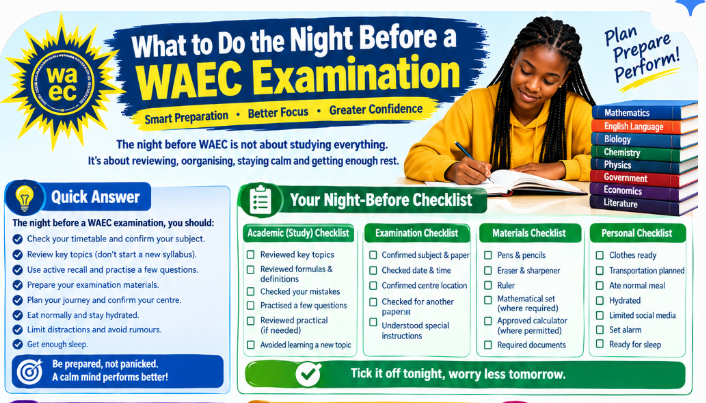
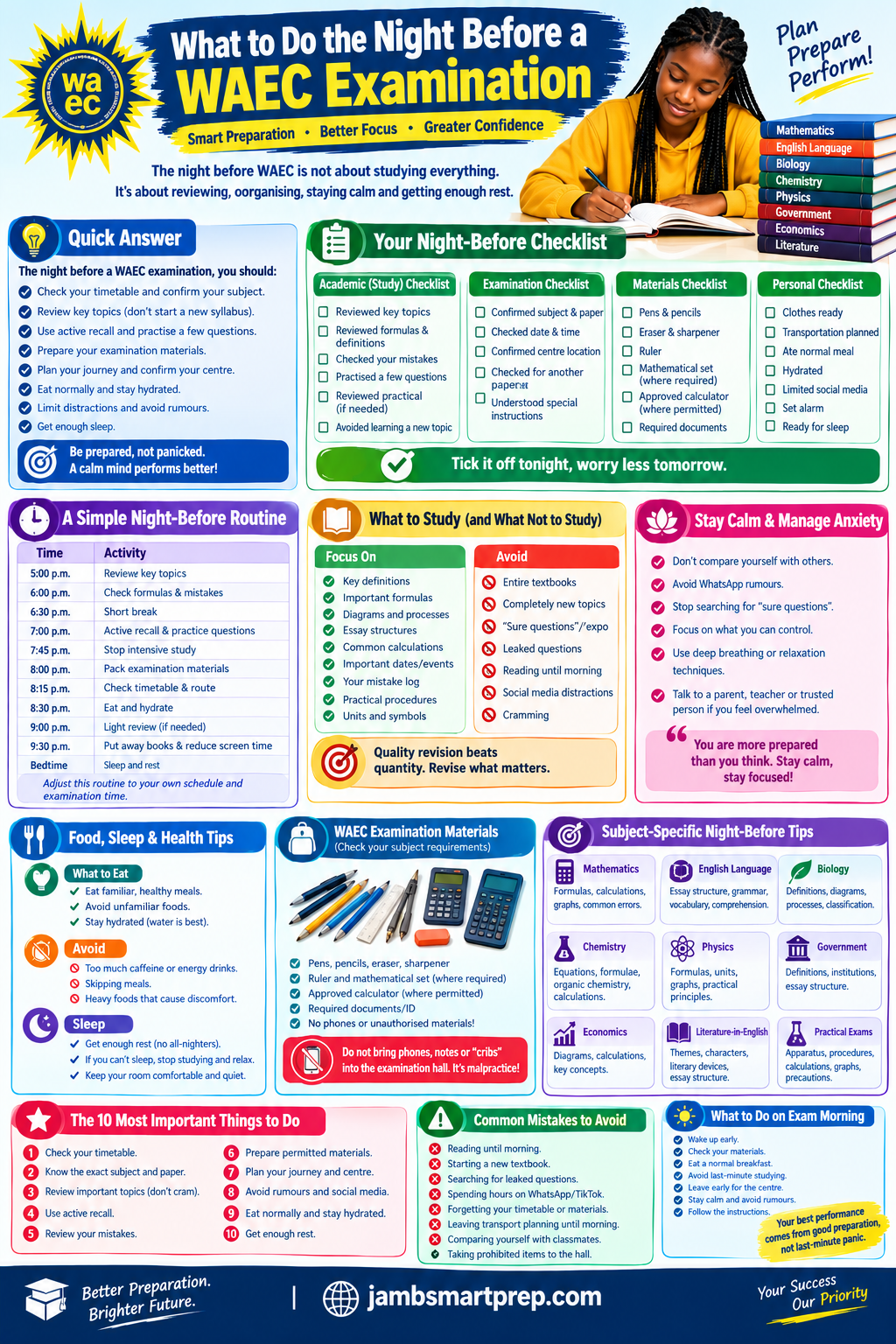
If you want the short answer, concentrate on these ten things:
- Check your WAEC timetable carefully.
- Confirm the exact subject and paper you are writing.
- Review important topics rather than starting an entirely new syllabus.
- Use active recall instead of simply reading your notes repeatedly.
- Review mistakes you made in previous tests and past questions.
- Prepare your permitted examination materials.
- Confirm your examination centre and plan how you will get there.
- Eat a familiar meal and stay properly hydrated.
- Reduce social media, rumours and distracting conversations.
- Go to bed early enough to get adequate rest.
The goal is not to prove how many hours you can stay awake.
The goal is to arrive at the examination centre prepared, organised, alert and calm enough to use what you have learned.
Why the Night Before WAEC Is Different From a Normal Study Night
During normal preparation, you can spend several hours learning a new topic, attempting questions, checking your answers and studying your mistakes.
The night before the examination is different because the examination is very close.
You have limited time and your priority should shift from broad learning to final consolidation.
A useful way to think about your preparation is:
Normal preparation:
Learn → Practise → Check → Correct → Repeat
Night before the examination:
Recall → Correct → Organise → Rest
This does not mean you should stop studying completely.
It means you should become selective.
For example, if you have already studied quadratic equations several times but frequently make mistakes when solving them, the night before Mathematics is a good time to review those mistakes.
It is less useful to suddenly open a completely unfamiliar chapter at 11:30 p.m. and attempt to master everything before sleeping.
Should You Study All Night Before WAEC?
For most students, studying throughout the night is not a sensible final strategy.
The temptation is understandable.
You may think:
“If I read until morning, I will cover more topics.”
But the number of hours spent with an open textbook is not the same as the amount of useful information you will remember during the examination.
An exhausted candidate can spend several hours reading while retaining very little.
An all-night session can also make the following morning more difficult. You may arrive at the examination centre feeling sleepy, mentally slow or unusually anxious.
What if I have not studied enough?
This is where many students make the biggest mistake.
They panic and attempt to read everything.
Instead, use triage.
Separate your remaining material into three groups:
Group 1: Topics you already understand
Do not spend most of your final night rereading these chapters.
Quickly test yourself and move on.
Group 2: Topics you have studied but frequently forget
These deserve attention.
Review formulas, definitions, processes, examples and mistakes.
Group 3: Topics you have never properly studied
Be realistic.
You can learn a few important concepts, but do not assume you can master an entire difficult topic in one sitting.
Focus on the most understandable and useful parts, then stop.
Your objective is to make your preparation stronger, not to create an even bigger source of panic.
What Should You Study the Night Before WAEC?
Your final revision should be short, targeted and familiar.
Good things to review include:
- Key definitions
- Important formulas
- Important dates and events where relevant
- Diagrams
- Processes and stages
- Rules and principles
- Common calculations
- Essay structures
- Important literary themes
- Frequently confused concepts
- Questions you previously got wrong
- Practical procedures
- Units and symbols
- Important examples from your notes
One of the most valuable resources you can use is your own mistake list.
If you repeatedly make the same mistake in Mathematics, Chemistry or Physics, review it.
If you often confuse biological terms, review the differences.
If you struggle with essay introductions or conclusions, practise one or two.
If you repeatedly lose marks because you forget units, make units part of your final review.
The night before WAEC is an excellent time to fix known weaknesses.
Use Active Recall Instead of Reading Everything Again
There is an important difference between looking at information and retrieving information.
Suppose you are studying Biology.
Instead of reading a page about photosynthesis three times, close the book and ask yourself:
- What is photosynthesis?
- Where does it occur?
- What raw materials are required?
- What is the role of chlorophyll?
- What products are formed?
- What factors affect the process?
Now answer without looking.
If you cannot remember something, check your notes and try again.
You can use the same technique for almost every WAEC subject.
Try a quick brain dump
Take a blank sheet of paper.
Write the name of the topic at the top.
Without looking at your textbook, write everything you remember.
Then compare your answer with your notes.
The gaps you discover are the areas that deserve your final attention.
This is much more targeted than turning pages for hours.
Should You Solve WAEC Past Questions the Night Before?
Yes, but use them intelligently.
The night before an examination is not the best time to attempt hundreds of past questions.
Instead, select a small number of representative questions.
For example, you might choose:
- A few questions from topics you frequently miss
- One or two calculation problems
- A short objective-question set
- One essay question
- A practical-style question where applicable
The purpose is to refresh your thinking and identify weaknesses.
It is not to memorise answer patterns.
Past questions are useful because they help you become familiar with the style of questions you may encounter, but they should not become a substitute for understanding the subject.
Most importantly, be careful with claims about “WAEC expo,” “leaked questions,” “sure questions” or secret answer materials.
Do not base your preparation on them. Also read: What Are the Best Ways to Prepare for WAEC Without Relying on Expo?
Official WAEC information identifies bringing books or cribs into the examination hall, impersonation, script swapping and organised cheating among examination malpractice offences.
Check Your WAEC Timetable Before Going to Bed
Never assume that you remember the examination time correctly.
Check the timetable.
Confirm:
- Subject
- Paper
- Date
- Starting time
- Centre
- Whether there is another paper later that day
- Whether a practical, oral or alternative paper is involved
This is especially important because WAEC examinations can contain different papers for the same subject.
For example, the official 2026 WASSCE school-candidate timetable contains separate papers and sessions for subjects such as Mathematics, English Language, Chemistry and Physics.
The timetable also demonstrates why candidates should not rely on memory or information circulating in class WhatsApp groups.
Check the official timetable relevant to your examination diet.
For private candidates, WAEC also provides examination timetable and candidate information through its registration system and official channels.
Prepare Everything You Need Before Sleeping
One of the worst ways to begin an examination morning is by searching for a missing pen, pencil, ruler or other required item.
Prepare your materials at night.
Depending on the examination and current WAEC instructions, this may include appropriate writing and drawing materials such as:
- Pens
- Pencils
- Eraser
- Sharpener
- Ruler
- Mathematical set
- Approved calculator where permitted
- Other subject-specific materials that are officially allowed
Do not assume that something is permitted simply because another student carried it into an examination in the past.
Check the instructions for your examination.
Also remember that your phone is not a substitute for permitted examination materials.
Do not enter the examination hall with prohibited materials simply because you think you will not use them.
Check Your Examination Information
If you are a private candidate, pay particular attention to the identification information associated with your registration.
WAEC states that the identification photo card contains important candidate information including the examination centre name, location, number and subjects entered.
School candidates should also confirm their examination details through their school.
Before sleeping, ask yourself:
Do I know exactly where I am going tomorrow?
Do I know the subject and paper?
Do I know what time I need to leave home?
Do I know what I need to take with me?
If the answer to any of these questions is no, solve the problem before going to bed.
Plan Your Journey to the Examination Centre
Do not wait until the morning to decide how you will get to your WAEC centre.
This is particularly important for candidates travelling through busy Nigerian cities.
Traffic can change your journey significantly.
Consider:
- How you will get to the centre
- How long the journey normally takes
- Possible traffic
- Public transport availability
- A backup transport option
- The location of the examination centre
- Where you will wait if you arrive early
If your parent, guardian or driver is taking you, confirm the arrangement before sleeping.
You want your morning to be predictable.
How Much Sleep Should You Get Before WAEC?
Do not treat sleep as wasted study time.
Your final hours should include enough rest for you to function properly the following day.
There is no magic number of hours that guarantees a particular WAEC grade.
However, deliberately staying awake all night is usually a poor trade-off.
If you normally sleep around a particular time, try to maintain a sensible routine instead of suddenly forcing yourself to study until dawn.
What if you cannot sleep because of anxiety?
This happens to many students.
Do not make the situation worse by repeatedly checking the time and thinking:
“If I sleep now, I will only have five hours.”
Instead:
- Put your books aside.
- Put your phone away.
- Make sure your materials are ready.
- Confirm your alarm.
- Take slow breaths.
- Remind yourself that the examination will test what you know, not how frightened you feel.
- Allow yourself to rest.
You do not need to feel perfectly calm before you can sleep.
You simply need to stop feeding the anxiety.
What Should You Eat the Night Before WAEC?
You do not need a special “WAEC food.”
Eat a familiar meal that normally agrees with you.
The night before an important examination is not the best time to experiment with unfamiliar foods.
You can choose a normal balanced meal and drink enough water.
Avoid making energy drinks, excessive caffeine or very sugary drinks the centre of your preparation.
If you normally drink tea or coffee, do not suddenly consume an unusually large amount because you are trying to stay awake.
The same principle applies to breakfast.
Eat something familiar on examination morning if that is part of your normal routine.
How to Handle WAEC Examination Anxiety
Examination anxiety often becomes worse when students focus on things they cannot control.
You cannot control:
- What questions WAEC chooses
- What your classmates claim to know
- Whether someone says a topic will “surely” appear
- Rumours circulating online
- What another candidate studied
You can control:
- Your final revision
- Your materials
- Your journey
- Your sleep
- Your attitude
- Your examination technique
- Your response to difficult questions
That is where your attention should go.
Stop comparing yourself with other candidates
Someone saying:
“I have finished the whole syllabus.”
does not tell you how well that person understands the material.
Likewise, someone saying:
“I have not read anything.”
does not mean they actually know nothing.
Do not allow other people’s statements to determine your confidence.
What to Do If You Have Not Finished Studying for WAEC
This is one of the most common last-minute problems.
The solution is not panic.
Use a last-minute priority system.
Step 1: List the major topics
Write down the topics you know are relevant to the examination.
Step 2: Mark your strongest areas
Do not spend unnecessary time there.
Step 3: Identify your weakest familiar areas
Focus on topics you have already encountered but need to strengthen.
Step 4: Review high-value basics
Focus on:
- Definitions
- Formulas
- Principles
- Common calculations
- Diagrams
- Processes
- Essay structures
- Common errors
Step 5: Attempt a few questions
Use them to test yourself.
Step 6: Stop at a sensible time
At some point, further reading becomes counterproductive.
Your goal is not to become a completely different student overnight.
Your goal is to make the best use of the preparation you already have.
Should You Learn a Completely New Topic the Night Before WAEC?
Usually, do not make a completely unfamiliar topic the centre of your night.
There is a difference between:
“I studied this topic but forgot some parts.”
and
“I have never studied this topic before.”
The first situation is ideal for night-before revision.
The second requires more caution.
If a new topic is relatively simple, you may be able to learn some basic concepts.
But if it is a large and difficult chapter, attempting to master it at midnight may create more stress than value.
Prioritise understanding over volume.
What Not to Do the Night Before WAEC
There are several mistakes you should deliberately avoid.
1. Do not read until morning simply because you are afraid
Long hours do not automatically equal effective preparation.
2. Do not start a completely new textbook
Use the materials you already understand.
3. Do not spend hours searching for “sure questions”
No social media group can replace legitimate preparation.
4. Do not depend on leaked questions
Apart from the reliability problem, attempting to use prohibited material can put your examination at risk.
5. Do not spend the night on WhatsApp
A few minutes can become several hours when messages keep arriving.
6. Do not compare your preparation with everybody else
Your examination paper will not be answered by your classmates.
You will answer it.
7. Do not forget the timetable
Always verify the official information.
8. Do not leave your materials until morning
Prepare them before sleeping.
9. Do not experiment with unfamiliar food
Keep things normal.
10. Do not sacrifice all your rest
You need to function during the examination.
A Simple WAEC Night-Before Study Routine
Here is an example of a practical evening routine.
This is not an official WAEC schedule. Adjust it according to your examination time, school instructions and personal routine.
| Time | Activity |
|---|---|
| 5:00 p.m. | Review major topics |
| 6:00 p.m. | Review formulas, definitions and mistakes |
| 6:30 p.m. | Take a short break |
| 7:00 p.m. | Active recall and selected practice questions |
| 7:45 p.m. | Stop intensive study |
| 8:00 p.m. | Pack examination materials |
| 8:15 p.m. | Check timetable and examination details |
| 8:30 p.m. | Eat and hydrate |
| 9:00 p.m. | Light review only if necessary |
| 9:30 p.m. | Put away books and reduce screen use |
| Bedtime | Sleep and prepare for the morning |
The exact clock time does not matter as much as the sequence.
Study → organise → check → relax → sleep.
What to Do the Night Before WAEC Mathematics
Mathematics requires a different final revision approach from subjects that depend more heavily on essay writing.
Do not try to solve every Mathematics question in your textbook.
Instead, review:
- Important formulas
- Common calculation methods
- Algebraic manipulation
- Geometry rules
- Trigonometric relationships where applicable
- Graphs
- Statistics
- Probability
- Mensuration
- Common mistakes
- Units
Most importantly, revisit questions you previously got wrong.
For example, if you regularly lose marks because you forget to change centimetres to metres, make that a final reminder.
If you make mistakes when interpreting graphs, practise one or two.
If you understand a topic but often make arithmetic errors, slow down and check your working.
Mathematics night-before rule
Review methods, not hundreds of questions.
What to Do the Night Before WAEC English Language
For English Language, focus on the skills required in the examination rather than memorising entire essays.
Review:
- Essay structure
- Introduction and conclusion
- Formal and informal writing requirements where applicable
- Comprehension techniques
- Summary writing
- Grammar
- Vocabulary
- Common spelling mistakes
- Sentence construction
- Your previous writing mistakes
If you struggle with essay writing, write a quick outline for one or two likely types of essays.
Do not memorise an entire essay and hope that the exact topic appears.
Instead, understand how to construct an answer.
A strong final review should help you adapt to the actual question.
What to Do the Night Before WAEC Biology
Biology candidates can use the final evening to review:
- Definitions
- Biological processes
- Diagrams
- Classification
- Genetics
- Ecology
- Reproduction
- Human systems
- Adaptations
- Important practical concepts
Pay particular attention to diagrams you are expected to understand or reproduce.
You should also review practical concepts if a practical paper is approaching.
Do not spend the night trying to memorise every sentence in your Biology textbook.
Focus on understanding relationships between concepts.
For example, instead of memorising isolated facts about an ecosystem, make sure you understand concepts such as food chains, food webs, energy flow and ecological relationships.
What to Do the Night Before WAEC Chemistry
Chemistry revision can become overwhelming because there are many formulas, reactions and calculations.
Prioritise:
- Chemical equations
- Formulae
- Mole calculations
- Atomic structure
- Periodic trends
- Acids, bases and salts
- Organic chemistry
- Separation techniques
- Qualitative analysis
- Practical procedures
- Common calculation errors
Do not simply read equations.
Close the book and try to reproduce them.
For calculations, solve a small number of representative problems.
If you repeatedly forget a particular step, write it on your final revision sheet.
What to Do the Night Before WAEC Physics
Physics candidates should review:
- Important formulas
- Units
- Definitions
- Graph interpretation
- Calculations
- Common relationships between quantities
- Practical principles
- Common mistakes
For every important formula, know what the symbols represent and the units involved.
For example, knowing a formula is less useful if you cannot identify the quantities being measured.
Practise a few questions rather than attempting an entire question bank.
What to Do the Night Before WAEC Government
For Government, concentrate on:
- Definitions
- Political concepts
- Constitutional principles
- Institutions
- Functions
- Political systems
- Important historical developments
- Essay structure
- Differences between related concepts
Do not turn the final night into a memorisation contest.
Practise explaining concepts in your own words.
For essay questions, remember that knowing a concept is different from knowing how to organise it into a coherent answer.
What to Do the Night Before WAEC Economics
Review:
- Definitions
- Economic concepts
- Diagrams
- Formula-based calculations
- Market concepts
- National income
- Inflation
- Unemployment
- Public finance
- International trade
- Development concepts
Pay attention to diagrams and calculations.
If you have previously confused two related concepts, review the difference.
For example, if you often confuse movements along a demand curve with shifts in demand, use the final revision to correct that exact weakness.
What to Do the Night Before WAEC Literature-in-English
Literature candidates can review:
- Major themes
- Characters
- Relationships
- Literary devices
- Plot structure
- Important conflicts
- Important scenes
- Poetic techniques
- Dramatic techniques
- Prose elements
Do not try to memorise every line of a text.
Instead, make sure you understand the major ideas and can support your explanation with appropriate textual knowledge.
For poetry, revise devices and themes.
For prose and drama, revise character development, themes, conflicts and significant events.
What to Do the Night Before WAEC Practical Examination
Practical examinations deserve special attention.
Depending on the subject, review:
- Apparatus
- Specimens
- Procedures
- Measurements
- Calculations
- Tables
- Graphs
- Diagrams
- Precautions
- Sources of error
- Expected observations
- Safety procedures
However, do not depend on predictions about the exact specimens or practical questions that will appear.
Your preparation should be based on the syllabus and legitimate practice.
For a Chemistry practical, for example, review the principles behind the procedures you have practised.
For Physics, revise measurements, graphs and experimental relationships.
For Biology, revise specimens, identification features, drawings, observations and biological processes.
The objective is to understand the practical method rather than memorise a supposed leaked answer.
What If You Have Two WAEC Papers on the Same Day?
This situation requires planning.
If you have two papers scheduled for the same day, prepare for both before leaving home.
Do not make the mistake of preparing only for the first examination because it is the one you are thinking about.
The night before:
- Check both papers.
- Pack what you need for both.
- Review the first paper.
- Review the second paper briefly.
- Know the times of both papers.
- Plan what you will eat or drink between them.
- Avoid spending the break discussing every answer from the first paper.
Once the first paper is over, it is over.
If you immediately start comparing answers with friends, you may increase your anxiety before the second paper.
Focus on the examination that is still ahead.
What to Do on the Morning of Your WAEC Examination
Your morning should be simple.
You have already done most of the important preparation the night before.
1. Wake up early
Give yourself enough time to prepare without rushing.
2. Check your materials
Make sure you have what you prepared.
3. Eat normally
If you normally eat breakfast, have a familiar meal.
4. Avoid frantic studying
A quick glance at formulas or definitions can be useful.
Trying to learn five new chapters while getting dressed is not.
5. Leave early
Give yourself enough time for transport and unexpected delays.
6. Avoid rumours
Do not allow another candidate’s “I heard this question is coming” to disrupt your concentration.
7. Stay calm
You do not need to feel completely fearless.
You simply need to remain focused.
What to Do When You Arrive at the WAEC Examination Centre
When you arrive, confirm that you are at the correct centre.
Pay attention to instructions from authorised examination officials.
Do not assume that something is allowed because another candidate has done it.
If you are uncertain about an examination procedure, ask the appropriate official rather than relying on another candidate.
Remember that the examination centre is not the place to experiment with rules.
Your objective is simple:
Write your examination according to the instructions and protect your script.
What to Do During the First Few Minutes of the WAEC Examination
When the paper begins, resist the urge to panic.
Read the instructions carefully.
Pay attention to:
- Number of questions
- Required number of questions
- Sections
- Time available
- Special instructions
- Whether calculations or workings are required
Do not spend the first several minutes staring at one difficult question.
If the examination structure allows you to choose which questions to answer, identify questions you understand and plan your time accordingly.
If a question appears difficult, move on when appropriate and return to it later.
The official timetable is useful for planning, but always pay attention to the actual instructions on the question paper and from examination officials.
Be Careful With Your Examination Number and Answer Sheet
Small administrative mistakes can create serious problems.
WAEC’s official FAQ notes that some results can be partially released because of issues such as incorrect transfer of examination numbers, failure to shade examination numbers and using biro instead of pencil on objective sheets where pencil is required.
This is one reason you should not treat the administrative part of the examination casually.
Before submitting your work, check the information you are required to provide.
Make sure you follow the instructions exactly.
WAEC Night-Before Checklist
Use this checklist before you go to bed.
Academic Checklist
- I reviewed the main topics.
- I reviewed important formulas.
- I reviewed important definitions.
- I checked my common mistakes.
- I tested myself using active recall.
- I solved a few relevant practice questions.
- I reviewed practical procedures if necessary.
- I avoided trying to learn the entire syllabus overnight.
Examination Checklist
- I checked the subject.
- I checked the paper.
- I checked the date.
- I checked the examination time.
- I confirmed the centre.
- I know whether I have another paper that day.
- I understand any special instructions relevant to my examination.
Materials Checklist
- Pens
- Pencils
- Eraser
- Sharpener
- Ruler
- Mathematical set where required
- Approved calculator where permitted
- Other officially permitted materials
- Required candidate information or documents
Personal Checklist
- My clothes are ready.
- My transport is arranged.
- I know how to reach the centre.
- I have an alarm.
- I have reduced unnecessary phone use.
- I have eaten normally.
- I have had enough water.
- I am ready to sleep.
The 10 Most Important Things to Do the Night Before WAEC
If you remember nothing else from this article, remember these ten points:
- Check your official timetable.
- Know exactly which paper you are writing.
- Review important material instead of cramming everything.
- Use active recall.
- Review your mistakes.
- Prepare your permitted examination materials.
- Plan your journey.
- Avoid rumours, “expo” claims and unnecessary social media.
- Eat normally and stay hydrated.
- Get enough rest.
The night before WAEC should make tomorrow easier, not make tomorrow harder.
Frequently Asked Questions About the Night Before WAEC
What should I do the night before WAEC?
Check your timetable, review important topics, practise active recall, review mistakes, prepare your examination materials, plan your journey, eat normally and get adequate rest.
Should I read all night before WAEC?
An all-night study session is generally not a good strategy. A focused final review followed by adequate rest is more practical than sacrificing the entire night to reading.
What should I study the night before WAEC?
Study important formulas, definitions, diagrams, processes, concepts, common mistakes and topics you have already studied but still find difficult.
Should I solve WAEC past questions the night before?
Yes, but selectively. Use a small number of relevant questions to test your understanding rather than trying to complete a huge collection of past papers.
Should I learn a new topic the night before WAEC?
If it is a small and manageable topic, you can review it. Avoid spending the entire night attempting to master a large unfamiliar chapter.
How many hours should I sleep before WAEC?
There is no special WAEC-approved number of hours that guarantees a grade. The important point is to avoid deliberately staying awake all night and to give yourself enough rest to function properly during the examination.
What should I eat before WAEC?
Eat familiar food that normally agrees with you. Avoid experimenting with unfamiliar meals or relying heavily on stimulants to stay awake.
Can I take my phone into the WAEC examination hall?
Do not assume that your phone is permitted. Follow the current WAEC examination rules and instructions from examination officials. Do not take prohibited materials into the examination hall.
What if I have not finished studying for WAEC?
Do not panic. Prioritise familiar weak areas, formulas, definitions, important concepts, common mistakes and selected practice questions. Make the best use of your remaining time instead of attempting to read every topic.
What should I do the night before WAEC Mathematics?
Review formulas, common calculation methods, units, graphs and the types of questions you frequently get wrong. Solve a few representative problems rather than hundreds of questions.
What should I do the night before WAEC English?
Review essay structure, comprehension, summary, grammar, vocabulary and your common writing mistakes. Practise planning answers rather than memorising complete essays.
What should I do before a WAEC practical?
Review procedures, apparatus, measurements, calculations, diagrams, graphs, observations and precautions. Do not depend on supposed practical-question predictions.
What should I do if I am very nervous about WAEC?
Reduce social media and rumours, prepare your materials, check your timetable, take slow breaths and focus on things you can control. You do not need to eliminate every feeling of nervousness before you can perform well.
Should I search WhatsApp for WAEC sure questions?
No. Treat claims about “sure questions,” leaked papers or guaranteed answers with caution. Legitimate preparation should be based on your syllabus, lessons, practice and reliable examination information.
What should I do if I cannot sleep before WAEC?
Stop studying, put your phone away, make sure your materials are ready, set your alarm and give yourself permission to rest. Constantly checking the time can increase anxiety.
Should I revise in the morning before WAEC?
A short review can be useful, especially for formulas, definitions or key reminders. Avoid turning the morning into another major study session.
What should I do after my first WAEC paper if I have another one later?
Do not spend the break obsessing over answers from the first paper. Eat or drink something appropriate, review the next subject briefly and focus on the examination that is still ahead.
Can I bring notes into the WAEC examination hall?
Do not bring books, notes or other prohibited materials into the examination hall. WAEC identifies bringing books or cribs into the hall as examination malpractice.
What if another student tells me they know the questions?
Do not allow the claim to change your preparation. Continue with legitimate revision and rely on official examination information.
What should I do immediately before entering the examination hall?
Check that you have your permitted materials, confirm the correct examination location and follow the instructions of authorised examination officials.
Final Thoughts: Make Your Last Night Work for You
The night before a WAEC examination is not the time to measure how much of the syllabus you failed to study.
It is the time to make the preparation you have already done as useful as possible.
Review the important material.
Test yourself.
Correct your common mistakes.
Prepare your materials.
Check the timetable.
Plan your journey.
Stay away from distracting rumours.
Eat normally.
Then rest.
If you are a Nigerian student preparing for WAEC, remember that your preparation should not end with this article.
Use the official WAEC timetable and examination information for your particular examination diet. Use legitimate practice resources, including the WAEC e-learning platform where appropriate. Review your syllabus and past questions as study tools, not as substitutes for understanding.
You can also continue with related preparation guides covering WAEC study timetables, WAEC past questions, WAEC syllabus preparation, WAEC practical examinations and examination-day strategies.
Most importantly, do not allow the pressure of the final night to convince you that you must sacrifice everything else.
A successful examination morning begins the night before with three simple things:
Good preparation. Good organisation. Good rest.

How to Pass WAEC With Good Grades: Complete Study Guide for Nigerian Students – JambSmartPrep
Sep 30, 2026 -
[…] a detailed final-night routine, use this “What to Do the Night Before a WAEC Examination” […]